Blog

  • Designing Cabinets with Cord Access for Seamless Charging Stations

    The promise of a hidden charging cabinet—clear countertops, no more chargers scattered in the open—unravels fast under daily pressure. What starts off looking crisp behind a cabinet door usually turns into another slow spot in your routine: cords jumbled behind baskets, plugs fighting for space, and someone in a rush yanking a half-charged phone free while the door hangs open. Instead of clean-up, you get a new kind of clutter—this time locked inside a box that’s meant to simplify life, not complicate it. If your cabinet doesn’t match how your household actually plugs in and grabs gear on repeat, you’re not escaping mess—you’re just stashing it out of sight, only to find new frustrations behind the door.

    From Clear Counters to Hidden Complications

    The first days with a closed charging cabinet feel like an upgrade: no more cords trailing off the hallway table, no flashing LEDs at night. But as soon as you live with it—especially in a high-traffic spot—tiny flaws multiply. Every retrieval tests the design: is there enough space to reach in without dragging out everything at once? Is unhooking headphones a one-motion move, or does it mean untangling them from a sideways tablet and two charging cubes? Most cabinets allow at most a single cord port tucked at the back—fine for solo living, quickly overloaded in family use. Cables pile up, adaptors wedge each other into corners, and the process of plugging or grabbing turns into a slow shuffle. Suddenly, that “organized” shelf is jammed by baskets that don’t fit chargers, with cables forced through one crowded slot, so nothing returns smoothly to its zone.

    The original sense of order starts cracking almost as soon as you begin swapping out devices, juggling multiple chargers, or trying to reset the lineup for different users. Without a structure that matches how things are actually used, the cabinet just becomes the place where clutter hides until the next round of frustration.

    The Repeated Routines That Break a “Hidden” Station

    Daily access exposes every design shortcut in a charging cabinet that hides clutter but doesn’t organize it for real life. Picture after-school rush—phones, tablets, earbuds landing at once, but only enough plug-in spots for half of them. Now cords dangle at the edge, chargers double up at the outlet, and someone frustrated leaves a device half out, stretching a cable that prevents the door from closing. Soon, that cabinet door is propped open just to keep things charging—meant to be “just for now,” but quickly becoming the default, with devices left teetering on the ledge or sticking out into the walkway.

    This cycle repeats: doors won’t shut, plug-ins get interrupted, and instead of clutter disappearing, it resurfaces in a more chaotic, harder-to-fix form. The cabinet absorbs mess until a real reset is needed—usually involving emptying the shelf to untangle cables twisted behind baskets or crammed through a single adapter slot—proving that “out of sight” doesn’t equal “organized.”

    Why Most Cabinets Become Clutter Magnets

    Closing a cabinet door hides the chaos—for a day. By week’s end, the limits show: too few cord pathways, not enough shelf room, charging blocks stacked two deep, and mixed-up cables that require a miniature excavation just to unplug the right device. If you have to repack or rearrange after every retrieval, the hidden storage setup isn’t making life easier; it’s just delaying the effort. Two or more regular users means faster shelf crowding, slower returns, and constant low-grade tension as devices overlap and chargers cross wires.

    Even well-intentioned fixes, like trays or baskets, misfire if they block outlets or force cords into tangles around rigid dividers. One oversized cord hole does little but encourage every cord to fight for limited space, making unplugging a repeat struggle and increasing reset burden instead of preventing it. Instead of a system that absorbs household pressure, the cabinet quietly generates new work: extra time untangling cables or repeatedly shuffling devices just to close the door at night.

    Making a Cabinet Charging Station Actually Work

    The only way a charging cabinet works long-term is if it stands up to repeated, fast-paced use—retrieving in a rush, plugging in multiple types of devices, and resetting without effort after every cycle. A layout that solves this keeps access routines friction-free. Start with multiple cord routes—ideally, one for each device or shelf. It’s not about micromanaging storage, but matching cord travel to charging demands and the reality of regular movement.

    Trays or slim dividers built along the inside shelf give each cord a lane, stopping chargers from sprawling across and over each other. Labeling, color-coding, or even just loosely assigning shelf zones tells everyone where things go back, so return flow stays stable instead of descending into category drift. These adjustments turn a cabinet from a box of cables into a system that survives the real cycle of family evenings and morning departures. Nothing snags; the door shuts with everything inside; resets shift from chore to afterthought.

    Subtle Fixes That Ease Everyday Reset

    A few targeted changes—like drilling extra, well-sized cord holes (not one cramped slot)—give every device a direct path to the power strip and its own space to rest. Forcing thick charging cables through a single small opening isn’t just awkward—it can pinch cords, overheat power bricks, and block airflow, making resets messier and even less safe. Leave space for plugs and air; clear lines from shelf to outlet; and avoid layouts that double up device weight or trap cords behind immovable bins. Each device should move in and out without shoving everything else aside.

    The real test: before moving in for good, try plugging and unplugging every device, one at a time, to see where hangups and catches happen. Shift dividers, adjust zones, and keep tweaking until the reset feels effortless and nothing blocks a quick grab on the way out the door. The payoff isn’t just a neater look, but a setup that stops draining attention every day.

    When Hidden Storage Slows You Down

    A setup meant to streamline device charging shouldn’t force new workarounds—like popping the door open all evening just to accommodate a mess of dangling cords, or stacking phones on the nearest shelf because it’s faster than fighting for a plug in a crowded box. Warning signals: blocked hall traffic, partially closed doors, a hunt for the right adapter each morning, or a side shelf that starts collecting overflow as family members silently avoid the cabinet altogether.

    Hidden storage justifies itself by making routines invisible, not harder. If you keep nudging the door ajar, or workflows stall because you’re untangling the same set of cables on repeat, the setup is demanding more from you rather than fading into the background. In a system that works, return and retrieval happen with one action—devices drop in their lane, plug in, and disappear until needed, no recurring struggle or category confusion. If it keeps fighting you, it needs a rework—not more patience.

    The Lasting Calm of a Well-Planned Cabinet

    When hidden charging storage delivers, the difference is obvious on a busy night: no bottle-neck in the hallway, no pileup developing on the flop shelf, and no one freezing up in the doorway searching for the right plug. The right cabinet layout keeps the floor path open, clears visual clutter, and fits not just the footprint of your entryway or utility corner, but the real pulse of device use in your home. Each cord has its channel, every device returns to the same spot, and resets happen with barely a pause.

    Hiding devices is only half the work. The real goal is a cabinet system that absorbs all those surges and returns—the tug-of-war of family schedules, drop-offs, handoffs, and rushed plug-ins—without unraveling. Hallway, multi-use corner, or closet shelf, the inside plan makes the outside calm hold steady. The right storage habit isn’t just hidden—it stays quiet, obvious to no one because it simply works under pressure.

    Find more ways to make inside storage easy to use and simple to reset at Gridry.

  • How Clipping Your Pet’s Leash Transforms Travel Efficiency and Access

    Every pet owner knows this moment: you start a trip with a bag or carrier that seems impressively organized—every item in its place, everything zipped, clipped, or nested just so. It looks ready. But by the second or third stop, the supposed “order” collapses: the leash that looked secure slithers into a seat crack, tangles with the bowl, or covers the wipes you suddenly need. Neatness slips into hassle. Instead of a smooth handoff—car door open, leash on, pet out—you’re stuck untangling gear, digging past comfort supplies, or reaching for cleanup items trapped under a loop of leash. What was supposed to make each stop easier now drags the routine, slows the return to movement, and leaves you rethinking your setup before you’re even halfway there. PawGoTravel’s world is built around these kinds of friction points—practical, repeated-use pet-travel setups that don’t just look ready but actually stay workable stop after stop.

    When “Neat” Turns Into New Hassles

    Letting the leash sit loose or unfastened between stops feels harmless on a single quick trip. But the real cost is in repetition. Every time the car moves, so does your gear—leash sliding into gaps, blocking fast access, hovering over wipes you need in a rush. By the time the trip has a few stops behind it, the initial neatness is gone, replaced by a low-level scramble: shifting, fishing, and reshuffling to get ready each time your pet needs out.

    The snag isn’t just visual: you open the door, pet alert and pulling, and the leash is blocked behind wipes—or wound halfway around your bowl. You lunge for supplies, but everything interrupts everything else. That extra pause isn’t dramatic, but it repeats—and any setup that makes you pause is quietly working against you all trip long.

    The “Slack Leash” Habit: Hidden Cost in Repeat Use

    If dropping the leash loose seems easy, it’s only because the problem hides until it’s too late. Every time the leash isn’t properly clipped, it migrates. It coils under bags, loops over cleanup gear, or covers the same pocket you need for waste bags. By the fourth stop, one loose leash blocks the entire flow—interrupting speed, sapping focus, breaking the “in and out” rhythm you thought you had built.

    This hassle spreads. One tangled leash makes the wipes harder to grab, delays waste-bag reach, and even pushes your own items—bottle, keys, sanitizer—out of order. Every missed grab shifts your focus away from the pet and toward managing clutter. Your setup isn’t just slow; it keeps turning simple actions into repeated, unnecessary little chores.

    Repeated Stops, Friction Stacks Up

    Pet travel only exposes weak spots through repetition: out, leash on, supplies grabbed, pet walked, back in. A leash lost under the carrier or an item slid over the wipes isn’t an isolated nuisance—it’s a flaw you relive every time. One second here, three seconds there, and when your pet grows restless or the weather turns, each friction point becomes a small test of your setup.

    The interruption isn’t just mess. It’s loss of control when it matters most—dog on high alert, your hands full with the carrier, wipes just out of reach because the leash slipped into their pocket. The kit stays clean but the function breaks rhythm: what looked “travel-ready” can’t keep up with real use.

    Rest Stop Reality: Where Setup Shows Weakness

    You pull into a rest area. Pet looks up, tension rising. You open the door expecting to move fast—but you’re stalled, digging for a leash that’s wrapped around a water bowl, pressing the wipes just out of reach. Pet whines. Your organization buys you nothing because key pieces overlap, block, or bury each other as soon as you use the bag in motion. Not a disaster, but the strain grows obvious over a handful of stops: each slow restart is the sign of a bag failing repeated-use, not just looking less tidy.

    Looks Ready, Works Slowly: The Setup Illusion

    It’s easy to trust a setup that “looks finished”—leash buried, wipes zipped, all pockets flat. But stillness isn’t the test. In practice, the first hurried moment buries the leash under supplies or marries it to the wrong pouch, and the whole idea of “being prepared” falls apart. A bag that photographs as organized sometimes sabotages every routine with slow, repeat touchpoints you can’t ignore on the road.

    Organization only pays off if you can reach what you need, when you need it, without rearranging the whole setup each time. After a few stops, any kit that resists quick access drains the very focus and calmness it was meant to deliver.

    Practical Fix: Elevate and Anchor Your Leash

    The least glamorous tweak is often the most decisive: clip the leash short and high—looped onto a top handle or dedicated ring—every time you re-enter the car. This isn’t about keeping things pretty. It prevents the leash from slipping into seat cracks, keeps it clear of wipes and bowls, and turns it into a one-handed grab instead of a treasure hunt. With leash anchored, gear overlap and last-second reshuffling drop off sharply.

    This one change flips the routine: out, leash on, grab what you need, pet walks, supplies stay accessible, bag resets smoothly. Stops feel like movement, not maintenance. Bad weather, urgent stops, or anxious pets no longer multiply the hassle—repeated friction quietly melts away, making the whole trip easier without a total bag redesign.

    No Setup Is Effortless—But This Kills the Worst Delay

    No travel kit is perfect. Even with a clipped leash, comfort items might shift, a treat pouch can slip, or you’ll run into a pocket that’s not quite where you want it. But the main recurring hang-up—the leash blocking essentials, vanishing in seat cracks, or snagging cleanup gear—disappears as a routine headache. Over a day of travel, that means fewer interruptions, less forced patience, and a pet setup that doesn’t just look well-ordered, but delivers stop after stop.

    Less Frustration, More Flow—What You’ll Notice:

    • No more blocked pockets: The leash clears the way for wipes, waste bags, or other essentials—no more reaching around it.
    • Minimal gear overlap: Bowls, comfort supplies, and quick-access items stay untangled and within reach, not trapped beneath a wandering leash.
    • Restart friction fades: Getting out and back in stops being slow work—each step flows instead of repeating the same hunt for loose items.
    • One-hand control returns: If your pet is antsy or conditions are rough, you can manage leash and gear without giving up control or dropping focus.

    The Shift That Actually Matters

    The change isn’t dramatic at first—just less struggling past overlaps, fewer seconds lost at each pause. But after a few rounds—coffee stops, a quick park break, messing with the tank at the gas station—the advantage is obvious. Travel setups that ignore this leash routine mistake the meaning of “organized.” It’s not about seat display, but about reliable, repeatable, fast routine—so your time stays on the move, not in salvage mode.

    Find practical pet-travel solutions that keep your routine moving at PawGoTravel.

  • Optimizing Toy Storage Placement to Simplify Indoor Cat Play Cleanup

    Cleanup always sounds simple until you run it on repeat. A toy storage bin fixes scattered “cat stuff” for the first day: the room looks clear, and chasing a wand toy doesn’t have to mean crumbs in every corner. But reality sets in the third or fourth time your knee clips the bin edge as you refill the water bowl—or the moment a stray plush squeezes underfoot right where groceries come through or the next meal is prepped. Suddenly, it’s not about less mess. It’s about constant, minor reshuffles that stack up across the day and quietly reverse your win.

    When Convenience Becomes Collision

    At first, the logic is obvious: keep the toy bin by the play mat, clear the clutter in one scoop, and get space back immediately. It works—if you reset every session and never rush. But in actual use, routines overlap: you’re tidying toys at breakfast when the cat dashes for kibble, or you sweep up after play while juggling an armful of laundry. That’s when a once-perfect setup starts crowding everything else. The bin drifts into pathways, a crinkle ball rolls under the water station, and the one bin meant to fix chaos becomes the obstacle you keep bumping on every short trip. Each skipped reset, even one in a busy week, spreads toys and storage just enough to get in your way.

    It’s rarely a meltdown—but it’s never “done,” either. A space can look presentable and still snag snacks, snag feet, even slow down the next refill loop. Overlapping routines—feeding, playing, sweeping up—turn neatness into a daily maze.

    How Toy Drift Breaks the Daily Reset

    Routine is relentless: you feed, clean up, play, reset, and repeat. The failure point isn’t dramatic; it’s one skipped or distracted reset when something else needs attention—like scooping litter or dealing with a water spill. That’s when system cracks show:

    • Toys find the wrong areas. Stuffed mice wedge under feeding mats, or catnip fleece ends up soggy on the edge of the water tray. Mealtime means taking one extra minute to fish toys out of spill zones—or worse, missing them until the next accidental step.
    • The bin turns obstacle. Drift just a couple inches, and suddenly it blocks the path to refilling the fountain or sweeping up shed fur. What felt “tucked away” in the morning juts into your route by afternoon.
    • Micro-adjustments drain time. Instead of a single pass, pickups turn into two or three sweeps: move the bin again, nab that runaway spring, clear the mat line. The upgrades you hoped would save cycles only create new friction.

    The space doesn’t collapse into chaos, but the routine is slower, and the reset never feels complete. Every shortcut today adds a complication tomorrow.

    Why the “Perfect” Spot Decays Over Time

    Every setup looks organized when freshly reset: toys neat, mats aligned, bins in position. What you don’t see is how quickly convenience sours as tasks pile up. By midday, the “tidy” zone feels crammed, and the energy needed for one more adjustment outpaces any initial time saved. True weak points show up only as the day layers: the bin blocking the hallway for a second time, a plush mouse dusted with shed fur after a sweep, a toy spring sitting damp by the water dish. One rushed moment, and the order blurs fast.

    • You sidestep the storage every feeding refill and nudge toys aside, again.
    • Playtime leftovers show up where cleaning can’t reach—like in front of a drippy water fountain or pinned behind furniture legs.
    • Quick sweeps miss what’s beneath the visible layer, so tomorrow’s mess drifts out where it interrupts something else.

    What once took seconds now takes minutes, and each reset only half fixes the overlap. Chores start to repeat themselves—but slightly more awkward each time.

    Seeing the Difference Between Tidy and Truly Usable

    An indoor setup can look under control and still jam up your basic movements when things get busy. Toy bins rarely block you outright at first. But the pace of daily life forces small compromises: you step over a lid, dig for a wanted toy while two others tip out, or find reset routines dragging as you avoid knocking the whole thing sideways again. Over time, tidiness without boundaries only creates extra layers to undo.

    • The shortest walking line gets blocked by a bin corner you barely notice until your shin brushes it, again.
    • You spot a favorite cat toy but have to empty half the bin to reach it—meaning more mess after you’re done.
    • Each pass-through gives you an extra reminder that even “put away” can still mean “in the way.”

    Real convenience isn’t about proximity—it’s about staying out of the crossover. The most common mistake? Using visible tidiness to hide daily friction. The wrong fix always trades one small problem for another that you notice the next time you move.

    One Adjustment That Loosens the Chore Cycle

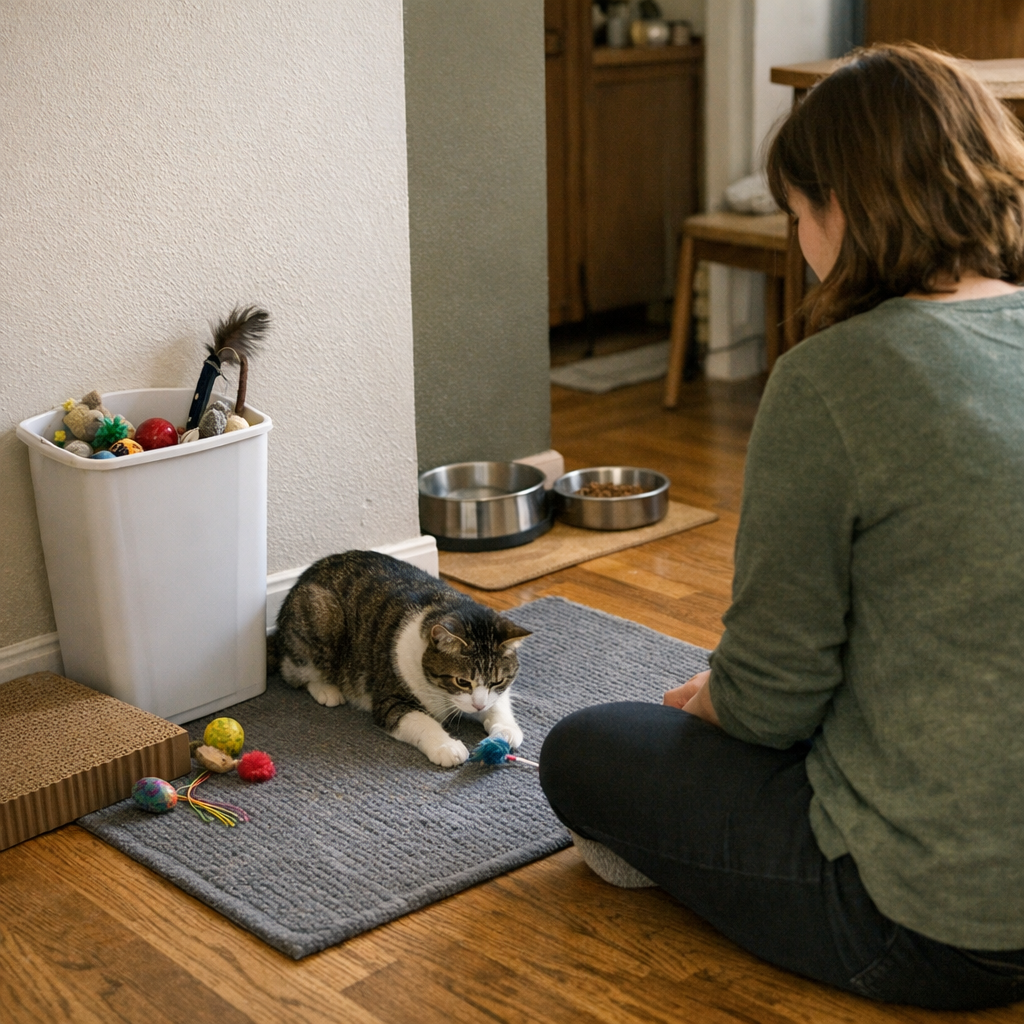
    The single most effective shift isn’t a new organizer, but moving your current setup just outside daily collision zones. That means the toy bin lives a mat’s width away from food and water—far enough not to snag a refill pass, close enough for cleanup to stay quick. Out of the main path, and just past the “cat chaos” spill line. In reality, that’s a couple feet, or the edge of a bench, or one square of floor your cat doesn’t race past at top speed.

    • Toys collected after play don’t bleed into meal prep or get stuck by the water.
    • Resetting happens once; hunted-for objects don’t require second sweeps under or behind stands.
    • You avoid working around your own cleanup. Access stays easy, but nothing blocks the next run-through of basic chores.
    • Now, when routines overlap—scooping bowls, toy pickup, mat wipe-down—they don’t force you into makeshift fixes that only last until the next rush hour in your home.

    The smallest move changes the feel: instead of “fixing things again,” those chores stop interrupting one another. The shift is easy to miss at first, but after three days you’ll notice what you haven’t had to redo.

    Practical Boundaries: Small Changes, Real Results

    Create a hard boundary between play and feeding. Just one mat’s width—about 18–24 inches—acts as a neutral zone, stopping toys from drifting into food and water territory. The result: less cross-contamination, no more feathery debris appearing mid-meal, and a lot fewer plush toys getting caught up in dried kibbles or water splashes. The bin itself is easier to access but never blocks the hand-off between one cat routine and the next.

    Choose bins that reinforce the boundary, not just hold clutter:

    • Open bins let you scoop and drop without pausing. Reset cycles stay quick, even on busy mornings.
    • Lidded or fully enclosed bins trade off a few seconds of visual calm for longer stalling—most people skip the extra step, leaving toys out to “get later.”
    • Slim, corner-hugging options fit behind low benches or next to shelf lines, keeping the boundary visible and blocking drift without taking over the whole room.

    If there’s no defined border, use a mat as much for your own cue as for the cat’s. Everything inside the edge gets put back, everything outside is out of play. In time, your cat’s habits help—less toy spread, less guessing games with what you’ll find underfoot when the lights go out.

    How Repeated Routines Reveal Weakness—and the Solution

    Repetition is what exposes every setup’s flaw, and repetition is daily life with indoor cats. Maybe the same plush mouse turns up four times a week behind the trash can, or the bin gets kicked out of position each time you pass with groceries. These aren’t failures, just bright signals for precisely where your structure needs its nudge—or a new boundary to divert mess before it interrupts another routine.

    Moving toy storage out of the overlap zone won’t make your home magazine-clean, but it does break the loop of endless re-dos. Over the course of a normal week, you’ll spend less effort battling sideways sprawl, and more time actually enjoying what works—letting cleanup and comfort reinforce each other instead of fighting for space and attention.

    For more ideas on practical indoor-cat arrangements that reset easily and work under real conditions, visit StillWhisker.

  • How Fixed Drawer Dividers Transform Daily Home Organization and Calm

    The Calm Drawer Illusion: When Setup-Day Order Disappears

    The first day you set up new drawer dividers, everything looks like a photo shoot. Socks perfectly folded, utensils lined up, hair ties in their own spot. But the real truth comes later—when you’re scrambling on a Wednesday morning or tossing things into drawers after a late night. That’s when you hit the same old friction: stacks losing shape, categories bleeding together, and those organizers that felt so crisp at first now quietly failing the test of real life. The illusion isn’t what you see right after setup. It’s believing that look will stick without changing how things move and shift when you actually live with them.

    The Friction That Sneaks Up—And Spreads Fast

    Drawers don’t shout when your system slips—they quietly let things unravel. That’s how you wind up moving three things to get what you need. A sock slithers over a flimsy divider. Hair ties end up tangled around a comb. Utensils bunch together until the slim spatula goes missing under a pile. You don’t always notice it the first time, but after a few rushed days, those clean lines are history. Suddenly, grabbing one thing means sifting through clutter that barely even looks like a system anymore.

    When Organized Stops Saving You Time

    It’s usually not the messiest drawers that slow you down. It’s the “pretty organized” ones where categories keep slipping. An open tray looks fine at first, but by Thursday makeup brushes are mixed with floss and earrings, and getting one thing means shuffling four. The more a drawer gets used—bathrooms, kitchen tools, a catchall drop-zone—the more obvious the weak points become. If you catch yourself dreading a reset or spending those extra seconds fixing the dividers “just so,” your system is mostly for show, not for speed.

    The Daily Test: Where Your Setup Really Breaks Down

    Picture your bathroom during the real morning scramble. You reach for toothpaste and instead dig through lip balm, moisturizer, travel shampoo, and a rogue bracelet. By bedtime, the situation repeats—brushes and bottles have drifted into each other’s lanes, and anything small is lost under something bulky. Those little misplacements add up, making every grab slower and every reset less satisfying.

    By the end of the week, it’s not outright chaos, but the promise of easy access is gone. Suddenly you’re pausing to readjust stacks, rescue items buried at the back, or just shove things aside. It’s not that you don’t have organizers—it’s that your organizers don’t hold the line when real life pushes back.

    Entryways and Utility Drawers: Where Order Collapses Fast

    Take the entryway. Keys, sunglasses, mail, earbuds—they have designated spots, but only in theory. The first few days with a new tray feel structured until mail covers the keys, sunglasses bury under a scarf, and soon it’s a catch-all. Busy areas demand boundaries that hold, or you end up searching for essentials every single time you leave the house.

    The Silent Workload of Weak Storage

    Every time you hunt for something lost, or restack piles just to find a basic item, your storage is working against you. If one quick hand, or one child’s grab, is all it takes for categories to collapse, the daily friction multiplies. Kitchen drawers are classic here: a place for ladles and tongs on paper, but by the weekend you’re wading through loose chip clips and random corkscrews. You might reset it all Sunday afternoon, but after three rushed meals, it’s the same old shuffle.

    Closets and dressers have their own version: tall stacks that crumble after two days, deep bins where socks, shirts, and underwear blur together, and sections meant for “just pants” that quietly collect extra odds and ends. If you’re moving piles just to get to the item you wear most, you know your organization is all surface and no backbone.

    Strong Boundaries, Fewer Resets: Storage That Stays Useful

    The solution isn’t buying more containers—it’s picking the right ones for the job. Choose shallow, dedicated bins or trays that match what you actually use and how you reach for it. In the bathroom, a tray for hair ties that’s too narrow for brushes will keep them separate by default. Assign each daily-use bottle or tube its own defined space—no piles, no ambiguity.

    Utility drawers shape up with bins sized for the task: a snug container for batteries, a divided tray for rubber bands, a box for screwdrivers (not tools and tape and loose lightbulbs all in one). In the closet, pick bins just tall enough for T-shirts, not so deep you lose the bottom row. The goal: you return things without thinking about it, and the system quietly resets itself through everyday use, not just a big once-a-week effort.

    Practical Rule: Don’t Let Bins Become Black Holes

    Deep bins tempt you to toss in anything extra. Resist. When bins have a real physical boundary for each category—and they aren’t overloaded—the inevitable mess can’t sneak in and take over. Leave a little space between bins, so things can’t hop boundaries with one clumsy reach. With smaller, clearer zones, it takes only a five-second sweep to keep things in check instead of an exhausting overhaul every weekend.

    Does Your System Hold Up—Or Just Look Good?

    A real storage system stands up to your busiest days, not just your motivation to tidy. Ask yourself with every drawer or shelf:

    • After several days of use, can you still find and grab each item instantly?
    • Are quick returns truly quick—or do you have to rearrange, re-stack, or push things aside?
    • Is “resetting” getting faster over time, or do you keep fighting the same small mess?
    • When you’re in a rush, do boundaries hold—or does chaos always creep back in?

    If your answer is “sometimes, but not really,” you don’t have a failing system—you just have the wrong boundaries in place.

    The Subtle Payoff: Calm That Spreads Room by Room

    Real calm isn’t about a flawless showpiece drawer—it’s about a setup that shrugs off the blur of normal life. Choosing bins and organizers that hold clear, realistic category lines shrinks the invisible work of organization. It means less time spent reshuffling, and more time just using your stuff. When your drawer resets itself almost by accident, you notice other things get easier, too—the entryway doesn’t bottleneck, the kitchen drawer stays friendly, and last-minute searches simply vanish.

    Browse storage and drawer solutions at ClosetWorks

  • How Temporary Pet Care Spots Quietly Disrupt Your Daily Routine

    Every dog or cat routine comes with a weak point that creeps in faster than you expect: a water bowl wedged behind shoes, a half-empty kibble bag sitting just inside the kitchen, a towel slung on the first doorknob you can reach. These “temporary” fixes don’t just clutter up the corners—they quietly decide how every feeding, cleanup, and after-walk moment unfolds. Before long, one missed refill or slow grab for a tool becomes a daily annoyance, and the friction adds up whether the space looks tidy or not. CalmPetSupply exists to challenge the idea that the way things are today is “good enough”—because the wrong setup never stays invisible for long.

    How Temporary Spots Become the Routine

    Leave a backup bowl under the table for one rushed morning, and it silently becomes a fixture. The shuffle starts small—a towel tossed on a hook because you only had one hand free, the scoop drifting away from the bin. These half-solutions stack up in plain sight. Each one asks you to bend, reroute, or pause a little longer. It’s rarely just visual clutter: you notice it when the secondary bowl’s bone-dry and you’re already running late, or the towel never fully dries and greets you with a damp shock when you need it. The setup promises less work, but the burden quietly grows.

    Everyday Scenes: Where Slowdowns Sneak In

    Picture a real morning: You bend down to refill the dog’s bowl, but yesterday’s laundry blocks your arm. After a soggy walk, the towel you meant to have ready is crumpled and cold by the door—just when muddy paws are already stepping across the floor. The grooming brush that was “always close” now hides between couch cushions or lands in a closet after a quick sweep. On their own, none of these are disasters. But together, they force repeated detours, shuffling, and half-pauses that stack on every routine. Feeding and cleaning, which should be five-minute habits, drag out as you search, move, or settle for an awkward alternative.

    The cost isn’t just in minutes lost. It’s in second-guessing: was the water bowl actually topped off—or will you hear restless paws later? Was the brush put away anywhere useful, or only wherever fit at the time? Attention keeps breaking for “little things” that don’t stay little when they come up daily.

    When Setup Helps—and When It Hinders

    Sometimes you really do need a towel by the door—when the weather and your pet both insist on it. A second water bowl near the bedroom means a thirsty pet doesn’t wake you up. But any helpful extra has a flip side. A towel hung wrong keeps staying damp, turning your quick wipe down into a reluctant pat. A bowl never refilled becomes pure clutter, doubling your walk to refill both and tripling cleanup later after a spill. What helped one piece of the routine exposes just how awkward the next step can get if setup and use don’t match.

    Pet Care Items Spreading—and Interrupting Home Flow

    Spread supplies too widely, and simple routines start tripping up the rest of your day. A stray bag of kibble blocks the path during dinner prep. Bowls just out of sight turn into ankle hazards where foot traffic is heaviest. You reorganize, but some trouble spot keeps coming back—maybe the brush disappears right after you need it most, or the litter scoop lands on the wrong shelf again after every use. Every “temporary” workaround becomes a regular interruption: sidestepping for a bowl, picking up supplies so you can actually reach the counter, repeating steps you thought you’d already finished.

    One weak spot—never quite fixed, always slightly misplaced—sets the stage for tomorrow’s shuffle. Repeated enough times, it’s not a fluke, but the new baseline of how pet care drains your energy.

    The Real Difference: Tidy vs. Truly Smooth Routines

    A pet care nook can look beautifully calm while still slowing you down. All wipes hidden away? It keeps surfaces bare, but if the cabinet is a room away or locked, supplies creep back to countertops “just for tonight”—and then never leave. It’s the difference between visual order and physical ease: if you still reroute mid-routine, the system isn’t helping. The real challenge is not making your pet setup look organized, but building it so that everything falls into place, right where your hands already go.

    Concrete Steps: Resetting for Ease, Not Just Tidiness

    The real fix is nearly always subtraction, not addition. Strip back to a single, reliable spot for each tool—anchored to where you actually use it. Make the feeding scoop return to the bin after every meal, instead of drifting toward the counter. Hang one towel close by the exit, where air can reach both sides and it dries before the next turn. If you keep two bowls, each should be where you’ll notice and refill as part of your real walking path—not just where they “fit.”

    Build reset habits into the routine: shut the bin, rehang the towel, snap the lid. If an item keeps slowing you down—always out of reach, always in the way—it’s a warning, not something to endure. Redesign where it lands, or simplify until each care step flows without a second thought.

    The Payoff: More Predictable, Less Demanding Care

    Assign every essential item a spot that matches real use—food scoop in the bin, bowl on the mat, towel on an open hook—while trimming away extra gear. Instantly, your routines stop dragging. Feeding, watering, wiping paws, clearing up after dinner: these tasks shrink back down to what they should be—quick, straightforward, low fuss. You’re not doubling back or working around clutter. Most days, you only realize something’s changed when you finally stop thinking about it.

    The result isn’t just neater surfaces—it’s a care system that quietly reduces missed steps and hidden hassles. When your setup fits your daily pattern, both you and your pet get an unbroken routine that’s easier to keep up with, no matter how busy the day.

    See everyday setups that keep routines simple at CalmPetSupply.

  • How Small Evening Changes Can Transform Your Dog’s Morning Routine

    The last quiet hour before bed: it’s supposed to wind down, but for most dog owners, it’s where the day keeps snagging. You organize the bowls, gather up toys, wipe muddy paws—then notice your dog pacing the hallway, hesitating by the water bowl, or giving you that expectant look near the bedroom door. These aren’t random quirks. They are friction points that keep popping up, forcing you to shuffle cleaning rags, step over spilled chews, or make a second trip for that bowl you thought was already in place. When the routine feels “done” but your dog keeps hovering, you know tomorrow’s morning will start on shaky ground—featuring an amped-up dog, awkward leash grabs, or a feeding scramble before you’ve even had coffee. Surface calm hides a restless cycle that builds up, not down, making every reset just a little heavier.

    Unrest That Doesn’t Shout—But Still Wears at the Routine

    Pre-bed tension isn’t explosive, but it lingers. Maybe it’s a dog restlessly circling the hallway, or stalling between water checks and the bedroom. One night it’s an extra lap, the next it’s standing in the way as you try to drop your keys. Over and over, the same friction: you step around a bed placed just a stride too close to the door, or fumble for a towel that’s tucked behind a bag. By the third morning, you’re coaxing your dog out—a pull at the leash or a scramble for the bowl means the “routine” isn’t smooth at all. This dull friction adds up. It isn’t dramatic, but it drags every part of the reset sequence.

    Not All Calm Means Restful

    Even when your home looks dialed in—water fresh, toys gathered, bed fluffed—fragmented signals show through: your dog gets up to double-check the bowl, repositions close to your movements, or pauses just outside the light. It reads as calm, but underneath is a fidgety tension carried into morning. The result: you’re running interference from the jump, already managing a dog who never switched off—and the whole day starts slower, requiring more adjustments from you at every step.

    Where Most Setups Quietly Miss the Mark

    Putting every item “in place” looks like the finish line. But most setups fail at flow, not organization. A water bowl shoved against a high-traffic wall seems neat but blocks the quick pass to bed. A soft, out-of-the-way bed requires an awkward detour for the dog. Toys clustered by the entryway only to spill into the walkway after lights go out. Over time, it adds up to a routine that looks good but keeps pulling you—literally—back for another adjustment, and keeps your dog guessing about what comes next. A setup that’s photo-ready isn’t always routine-ready.

    Repeating Friction Hides in the Edges

    You rarely spot the real issue until it’s routine: you’re double-backing for leashes, nudging aside bowls, or picking up a towel mid-hallway while your dog waits, half-settled, for the next move. Each small loop—extra water checks, edge pacing, toys in your path—signals the system isn’t working for the actual nightly flow. It’s less “my dog won’t settle” and more “my setup keeps asking for fixes.” Over days, the result is the same: unsettled sleep, unsettled start.

    Small Nighttime Signals with Next-Day Consequences

    Spot these signals—they’re easy to ignore, but they build:

    • Dog returns to the water bowl after lights-out—despite just drinking
    • Pausing in hallways, especially in doorways or at bedroom thresholds
    • Repeating circles before settling, instead of flopping down and staying
    • Shadowing you during end-of-day tasks, tail thumping lightly or eyes fixed for a cue

    No single moment is dramatic. But put together, they create leftover energy—restlessness that spills over into morning. This is how you end up juggling an early leash tug, racing through breakfast, or tripping over toys you’d “put away” the night before. The wrong setup doesn’t cause chaos, but it reliably steals smoothness from your next day.

    When the “Quiet Hour” Isn’t Actually Quiet

    It becomes clear after a string of choppy mornings: you’re grabbing at a leash wedged under a stray towel, dodging a dog waiting in the hallway as if still expecting to go outside, or finding a water bowl blocking the doorway while you try to slip back to bed. Even when everything looks organized, the routine still resists. Your dog’s “wait” is really a stall, their rest is interrupted, and your supposedly end-of-day calm keeps requiring another fix. Underneath the order, the setup is working against you.

    The Missing Reset: Why Access and Placement Matter

    It’s not about having the right items—it’s about where and when they’re put to use. If the bed is in a dead corner but unreachable without crossing your own path five times, or the water bowl is in the main walkway, your dog must choose between comfort and access. Each awkward pause, stall, or redirected path is a missed reset. Dogs react to these spatial blocks in real time—with hesitations that ripple into your next routine. Routine friction isn’t about the number of supplies; it’s about the flow they allow or block when the same steps are repeated nightly.

    One Setup Change—A Real Routine Shift

    Think about a hallway water bowl, always accessible—but only by running interference with the rest of the house. Move that bowl a few feet to a quiet, open corner thirty minutes before lights-out and suddenly: your dog checks water once, pads calmly to the bed, and doesn’t double back or pace. For the owner: there’s no sidestepping bowls, no leash tangles, no blocked exit during bedtime cleanups. The shift isn’t about adding more—it’s about stopping the need for repeated shuffles. Over the week, this small fix removes the root of morning rust: fewer pre-dawn interruptions, less scramble, and a dog that resets without leftover friction.

    Not About More Steps—About Fewer Sticky Transitions

    Most owners try to patch tension with more: extra treats, longer wind-down, added cues. But what works is removing the drag points: that bowl in the main crossing, the pile of toys in walkway spillover, the crate with the tricky latch facing the wrong way. Dropping friction means fewer sticky transitions—your dog stops looping the hall, you stop rerouting routines. The evidence is in the shift: one clear movement from water to rest, fewer circles, no last-minute pacing. The setup supports default calm, not ongoing adjustment.

    Recognizing and Responding to Routine Clues

    Problem setups show up as clusters, not one-offs. Watch for:

    • Increasing evening pacing after what should have been a calm day
    • Your dog blocking, waiting, or lying across doorways before bed
    • Leash moments getting clumsy—snags, double backs, tangled hands
    • Feeding times inching earlier because your dog is already pushing for reset

    These clues mean your setup isn’t matching real routine flow—it looks neat, but works against lived experience. Friction repeats until the arrangement allows the night to move forward without extra signals or repeated interruptions.

    Everyday Example: When Organization Isn’t Enough

    Picture your routine: post-walk, keys and leash into bins, towel by the door. But the water bowl sits in a high-traffic zone—your dog hovers right where you’re putting shoes away. By the time the house goes quiet, your dog isn’t settled, just tracking your moves, ready to get up when you do. The space looks managed, but every step feels delayed. These mismatches aren’t obvious at first—they show up after nights of repeating the same awkward dance.

    What Actually Shows Progress? Small Pattern Changes

    Don’t look for dramatic scenes. The proof is:

    • Your dog checks water once, then chooses a spot and stays put
    • Less hallway crossing, fewer late laps, more direct movement to bed
    • Morning transitions feel smoother—no rushing, fewer leash standoffs, feeding without a scramble
    • The sequence becomes repeatable: bed, water, settle, done—without negotiation

    You won’t notice a magical drop in mess. You’ll notice tension slipping out of your routines, fewer backtracks, and a system that finally supports how you and your dog actually move through the day—not just how the area looks at night.

    Better Setup, Smoother Days

    There’s no need to chase a perfect evening. The win is in finding and breaking the repeating friction—the bowl in the wrong place, the rest area always in the cross-traffic zone, the toy pile spilling into the walkway. Every time mornings

  • Streamline Your Carry-On Setup to Avoid Travel Delays and Frustrations

    Looks can deceive in carry-on travel. A bag that seems perfectly organized at home—color-sorted cables, passport front and center, neat little pouches—rarely survives the first wave of airport reality. Under pressure, your “quick-access” pocket turns into a choke point. The passport you set on top slips under a charger pouch; your boarding pass slides behind tangled headphones; even the zipper fights you, catching on a misplaced pouch. You feel the slowdown as soon as your gate is called. Access that felt effortless on your living room floor now burns precious seconds at security and in the aisle, making what should be a streamlined routine a repeated frustration. If you’ve ever jabbed through an outer pocket, pawing at overlapping layers for a single document, you know how fast a tidy layout collapses inside a crowded terminal. This is the difference between bags that only look ready and bags that actually work—a difference CarryOnSupply is built to expose and solve.

    Order That Doesn’t Hold Up Under Speed

    Packing order never guarantees smooth airport movement. Real friction shows up in every transition: security checks, boarding lines, overhead-bin lifts, and seat scrambles. The tell isn’t mess, but slowing access. You reach for your passport, and instead of a quick pull, you unzip, shift pouches, fish beneath a charger, and repack everything with the line breathing down your neck. The more you move, the more your careful layout resists. Instead of reliable quick grabs, you get sudden stutters—fumbling during boarding, delays at checkpoints, items slipping further out of sync each time you open your bag. The cost: seconds lost at the worst moments, and a bag that interrupts your movement when you most need it to help.

    Real Moments Where Organization Breaks Down

    Security tray delays: In the scanning line, you unzip a “security” pouch expecting one thing, but find headphones tangled with power packs, and a toiletry kit blocking the reach. The layout that felt logical yesterday now jams at the exact moment the tray needs to move forward.

    Boarding stress: As the line inches ahead, your passport hides behind two slim cases, forcing you to haul out every pouch, spread your tray of travel bits onto the boarding lane, and try to repack with a dozen eyes on you.

    Seat entry interruptions: Squeezing into a window seat, you try to extract earbuds from the outer pocket but hit a wall of cable bundles and hard-to-grab gadgets. You pause, dig, and catch the aisle traffic, repacking items on your knees before you can sit down.

    When Setups That Look Good Fail in Real Movement

    Flat, color-coded layouts fail the second you start opening the bag for actual travel needs. Each new access moment—passport, charger, boarding pass—pushes pouches out of position, bunches zippers, and nudges essentials deeper. The thing you need twice in an hour slips behind gear you only touch once per trip. “Neat” turns into “nested,” and retrieval cost grows—a few seconds per interruption, magnified across gate changes, connections, or last-minute security requests.

    Repeated Access, Repeated Interruption

    The friction isn’t in what you pack—it’s the buried access path. First pack always feels controlled. True pressure comes after a few real transitions. Your urgent item, easy in theory, ends up trapped behind layers of less-used gear. Soon, pulling a passport means unzipping three sections or balancing your bag on a knee just to fish out a cable that’s migrated to the bottom. Every slight reshuffle multiplies, turning a one-motion retrieve into a multi-step scramble as your day stacks up transfers and checks.

    Building a Carry-On Structure for Actual Use, Not Just Appearance

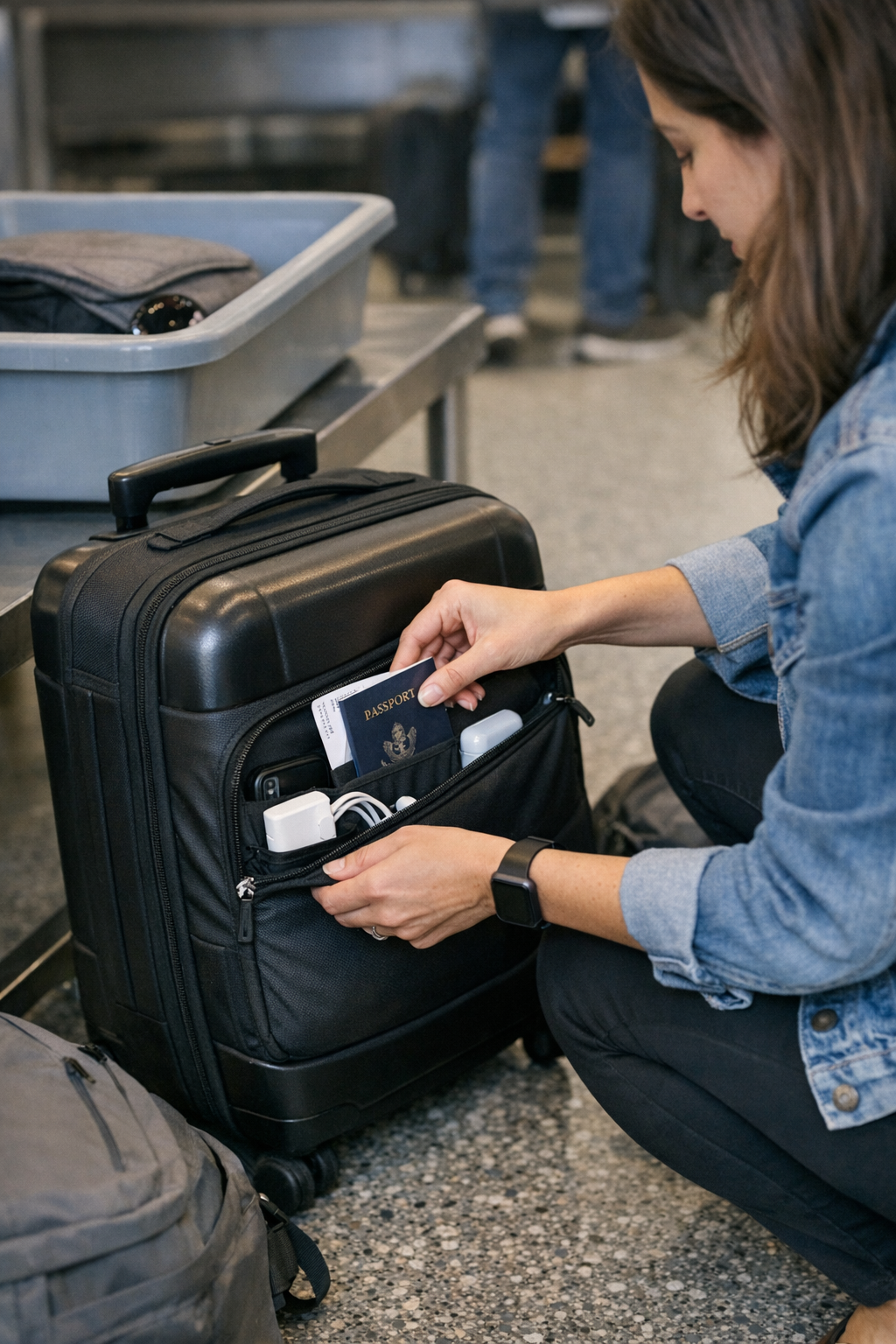
    Function under travel strain comes down to one rule: High-frequency items must be within one honest, unstacked reach. The difference isn’t the number of pouches—it’s which pocket you trust for what you actually need in motion. Shifting essential documents and devices to a dedicated, shallow-access pocket makes the entire process direct. No more unzipping the main compartment at the gate, no more stacking organizers to get to your phone at security. A single, well-laid outer pocket turns scramble into flow: unzip, retrieve, done. When real travel disrupts order, only setups that protect immediate access keep working hour after hour.

    Minimizing the Mid-Journey Repacking Cycle

    This small structure shift—reserving the fastest access slot for only passport, boarding pass, and phone—drops the cycle of public repacking. Retrieval shrinks from minutes to seconds. At the gate, in boarding aisles, or at the security scanner, you open one zip, grab what you need, and move. Old routines of laying out every small pouch or re-layering tech organizers in the aisle disappear. The essentials remain forward, the friction recedes, and your setup no longer tutors you in airport repacking while other travelers rush past.

    Practical Tweaks That Reduce Travel Slowdown

    Keep outer-access lean. Every item labelled “essential” but used once per day slows the pocket you actually need fast. Cramming too many things into shallow pockets piles up overlap and snag risk; soon, the “quick” pocket is just another layer to dig through. Watch for signals: if you’re pausing at security or fumbling documents at the gate, it’s time to rotate items further back. The difference is immediate—true high-frequency tools stay in reach, low-frequency gear slides deep, and travel flow regains momentum.

    The Shift from “Looks Packed Well” to “Works on the Move”

    This isn’t about spotless visuals. A setup’s proof is in movement by your second or third flight—not the Instagram shot on a hotel bed. The real test is how retrieval speed holds up when the boarding lane clogs, or how your pocket works when you’re bending to slide a bag under the seat. Glitches still show up—pockets sometimes crowd or shift in turbulence—but the difference is measurable: you reach for most-used items and get them in a motion or two, not a messy repack. Consistency, not perfection, is what lowers travel friction in real time.

    Consistent Access Means a Smoother Trip—Even When Things Speed Up

    Truly efficient carry-on setups aren’t just mess-free—they cut out repeated, avoidable interruption. Move quick-grabs to a single, honest outer-access pocket, and your bag becomes an extension of your travel rhythm. Security checks, overhead lifts, boarding—suddenly, interruptions fade and your setup keeps pace. The cost of sticking with “tidy but buried” is clear: more digging, more slowdowns, and time lost fixing a bag instead of moving forward. It’s not about hitting perfection, but about making visible order deliver in the real, moving world of travel—especially when seconds count.

    CarryOnSupply—see smarter carry-on tools for repeated real travel use.

  • How Early Glare Control Transforms Your Work Area Lighting Experience

    A desk setup can look streamlined—a neat lamp, clean lines, no visible clutter—and still wear you down, day after day. Glare streaks across your monitor, your eyes dart to a cable looped across the edge, and your “solved” setup quietly demands small, constant fixes: adjusting the lamp’s angle, scooting your seat, stacking papers just to block a reflection. What seemed carefully arranged at first becomes a source of interruption, not focus. When lighting and support don’t match real working habits, friction accumulates in every session, no matter how established the routine.

    Why Glare Keeps Sneaking Back, Even in “Solved” Setups

    Glare isn’t just an occasional inconvenience—it’s a regular intruder that returns as soon as you begin using the space. A desk lit by an overhead panel or a sleekly mounted lamp may look like a productivity win, but the moment screens light up or hands move through paperwork, the cracks show: a bright patch tracks across your documents, or your monitor turns into a mirror for the ceiling light. Initial satisfaction fades when the setup ignores the surfaces you actually interact with.

    The real issue isn’t which lamp looks best or how well you’ve hidden cords—it’s whether the light falls where you actually work. If your lighting stays fixed on looks instead of alignment, stray glare or murky shadows creep in. Each day brings the same fight with distraction: surfaces washed out, reflections that pull your eyes away from what matters, and the kind of lingering discomfort that isn’t obvious until the workday stretches on.

    Workspaces That Look Right, But Act Wrong

    Plenty of setups appear “finished” but reveal their weak spots once you start working. Ceiling panels flood the space and erase dark corners, but that blanket light often bounces straight off smooth desk surfaces or screens, etching a bright stripe across your primary view. This isn’t a rare failure—it’s the new normal by afternoon: sunlight shifts, ambient panels stay fixed, and you start reaching for folders or tilting your laptop just to regain usable real estate on your desk.

    Task lamps promise targeted clarity, but that’s only true if their brackets and shades are tuned perfectly. Slide one just a little off, or route a cable without thinking through sightlines, and you’ve traded general glare for sharp, creeping shadows—or a cable that distracts before the work even starts. The setup may look clean, but you’re still dodging problems every hour.

    Scenes From a Real Worktable: Two Approaches, Two Problems

    Picture a shared worktable: Overhead, a ceiling fixture casts wide light; below, an under-shelf strip clicks into place with minimal brackets. Both setups seem intentional. But the ceiling-lit side collects hot spots as the afternoon fades—laptop screens reflect glare from angles that never showed up in the morning, and paperwork picks up harsh lines that shift as you swap seats. Meanwhile, under the shelf, the light stays controlled and single-directional, but its reach is short—the far side of the table loses definition, so anyone sharing materials ends up squinting at patches of shadow or stretching to pull things into the lit zone.

    “Filming” the setup for photos might hide the drift, but in real use the weaknesses resurface. Each improvement solves one problem but quietly creates another, and you’re left with a space that functions worse the longer it’s used without small, targeted adjustments.

    What Actually Moves the Needle on Glare

    After weeks of nudging angles and dodging glare stripes, the first real breakthrough isn’t a brighter bulb. It’s an adjustment you feel in workflow: a glare shield clipped onto the lamp, knocking out harsh streaks across key documents; the bracket tweaked just enough to push light away from the screen, not onto it; a cable redirected to trace the desk’s back edge instead of the hand path. Not a design overhaul—just enough friction removed in the right spot.

    The effect isn’t dramatic in photos, but at your desk it’s obvious. No more reaching for folders as makeshift shields, no more flickering annoyance from cable shadows, no more ritual adjustments before every session. The workspace finally works with you, not against you—the real goal for any lighting or support setup.

    Common Signals: When Glare and Cables Haven’t Been Tamed

    • Eyestrain begins not with intensity, but with steady, slow build-up during routine tasks.
    • Bright streaks or shifting patches show up on screens or documents, just as you’re trying to focus on details.
    • You catch yourself stacking objects or moving equipment simply to dodge a persistent glare spot.
    • Visible cables or oddly placed brackets claim your attention, breaking focus more than actual clutter.

    If you’re constantly searching for “the right spot” to work, it’s rarely due to mood or habit—it’s almost always a mismatch in lamp angle, light support, or cable placement.

    Why Fixing the Support System Is as Important as the Light Itself

    The weakest link in any desk setup isn’t always the bulb. A cable draped across open desk, a bracket that shines more metal than sense, or a lamp arm set at just the wrong height can undo hours of planning. Every visible cable or misplaced support throws new lines and shadows into your routine. Support structure isn’t cosmetic—it shapes the entire field of view, redirecting attention (and frustration) with every misplaced element.

    Test this: After you set up “tidy” cable runs or new support hardware, sit at the level you’ll actually work—not standing, not looking down from above. A cable that’s invisible in profile view often turns into a visible annoyance right at eye level, introducing distraction where you most want focus.

    Putting the Space to the Test: What Holds Up Across a Week?

    A good lighting or support setup isn’t measured by how crisp it looks the first day—it’s defined by what stays invisible after a week. If you’re still sliding your monitor every afternoon or ignoring half a shared table, something isn’t supporting real use. Satisfying setups are the ones that “disappear”—no need for daily cable shuffles, no fighting a moving glare stripe, no adjusting lamp heads just to make a piece of paper legible.

    Small interventions last longest: a shield that cuts hot spots, a simple bracket realignment, a cable held flush against support bars. None radically alter how the workspace looks, but each one shrinks the list of things that slow you down, hour after hour. Most setups don’t fail all at once—they slip, quietly, where support or alignment hasn’t matched routine reality.

    From “Looks Good” to “Lives Better”: A More Reliable Approach

    The difference between a setup that “looks good” and one that’s truly workable is invisible in most catalog photos but obvious in daily use: no glare arcs sneaking onto your screen, no cables drawing your eye, no surfaces left just a little too dark or too bright. Address lamp angles, cable lines, and support details before friction becomes routine—adjust them during real tasks, not just at setup.

    A week later, what stands out isn’t the clean look, but the silence: no more fiddling, no more small, predictable annoyances, just a space that holds steady as the day changes. That’s when you notice your lighting and support are finally doing their job—by staying out of your way.

    Find practical indoor lighting, cable management, and support solutions at LightSupport.

  • How Dehumidifiers Transform Humid Laundry Rooms and Entryways Efficiently

    Humidity is the hidden sabotage in every entryway and laundry drop zone, quietly wrecking routines long before you notice a mess. Shoes that never quite dry, bags going musty overnight, towels clinging to dampness—these small failures pile up until every return trip across your threshold means pausing, rearranging, and settling for gear that feels halfway reset. Order on the surface hides a slow, sticky traffic jam underneath. One rainy week, and you realize: even when everything looks lined up—bins in place, bags stacked, floors swept—the zone still works against you. The difference between an entryway that helps and one that hinders usually begins here, in the buildup you can’t see but can feel every morning with a pair of clammy shoes or a bench that never quite loses its burden.

    Where Humidity Hides in Transition Spaces

    Most transition spaces—especially narrow entryways or those bordering laundry—become moisture traps, no matter how tidy they appear. Air stagnates just at bag-drop level, keeping shoes damp and slow-cooking the reset process. The real friction points? Open shoe racks hugging the floor soak up run-off from shoes and boots. Deep bins promise containment but gather every drop that drips off jackets and umbrellas. Under-bench stashes, though out of sight, trade clutter for a slow-cycling damp cycle, leaving shoes on the threshold between “almost dry” and “not quite ready.”

    Each night’s reset ends up half-finished. Morning means toeing into last week’s moisture and shuffling bags that seem to collect a humid undercurrent no matter how often you rotate them. The signals show up quietly—the swampy edge that never clears, or shoes that seem to trade places in search of real airflow. The things you set down keep a record, and the price is paid in daily inconvenience.

    Why Neat Isn’t Always Functional: The Clutter Lag

    Your entryway may look under control at first glance. But once humidity stakes its claim, small problems multiply:

    • Bags “dropped for a second” on the bench end up parked there for days, blocking both seat and reset path.
    • Shoes aligned neatly at night have migrated by morning, each pair chasing a drier corner along the floor or crowding the one spot that almost dries out.
    • Temporary drying racks inch outward, tightening the main walkway and demanding extra navigation for every trip in or out.

    Hidden friction always outlasts visible clutter. What looks organized in a photo feels stalled in use: each “grab and go” becomes a slow search for something not too wet to wear, with overflow starting to pulse out from under the bench or crowd the sides. True function is measured not by appearance, but by how little you have to think about resets or sidestep yesterday’s mistakes.

    Small Shifts, Noticeable Change: Elevation and Airflow

    Anyone who’s slogged through a stormy stretch knows how fast a neat entry slips into recovery mode—coats and shoes multiply, every reset takes longer, and what worked on a dry day starts falling apart. The fix isn’t aspirational—it’s practical: work with airflow, not against it.

    What shifts the daily tide: Lift your storage. Raising shoe racks or bag cubbies at least 6-8 inches above the floor lets air reach the problem zones. Wall-mounted open-back units installed just above bench height multiply airflow, letting thick-soled shoes dry by morning instead of next week. Leave a two-inch gap between items, and suddenly, the dehumidifier can circulate air around everything—no more wet pockets building up behind the last row of boots.

    The results show up in small, repeatable wins:

    • Overnight resets actually complete—the morning check stops revealing “almost dry” excuses
    • Odors and mildew get cut off before they spread
    • Return routes clear up, and the threshold stops accumulating semi-permanent overflow

    This isn’t about an “organized” look, but a real shift: your entry stops being a workaround and starts supporting a routine that moves, dries, and resets on time—even when the forecast refuses to cooperate.

    Facing Real-World Constraints: When Space or Layout Won’t Cooperate

    But plenty of transition areas simply can’t fit deep shelving or a wide bench. In narrow halls or shared utility passageways, every inch counts, and compromise is constant. Clutter moves from visible piles into the tightest corners, and the real battle is against crowding your walking path, not just your storage plan.

    For these compressed scenarios, work with the space:

    • Slim, vertical racks—mobile or wall-mounted—lift gear off the ground without stealing floor space and can be shifted at night to chase dry air
    • Shelves set back from direct entry splashes or out of the cross-breeze prevent gear from languishing in a drip zone or permanent draft
    • A little extra space between pairs—even just a hand-width—beats stuffing every inch and guarantees dry outs actually happen between uses

    In these setups, blocked paths and collision points multiply fast. The more your storage lets gear breathe, the less time you’ll spend untangling a slow-motion jam at the doorway. Every step you don’t have to repeat is one that gives your entryway back some breathing room—literally.

    What About Storage Cabinets and Hidden Moisture?

    Cabinets can trick you: they hide visual clutter but trap every bit of humidity unless they vent or remain propped open. Even a dehumidifier can’t reach inside a sealed cabinet, turning those perfect-looking shelves into low-level swamps for shoes and gear. That’s why semi-open wall units, vented cubbies, or modular shelves always outperform closed boxes when the real test is daily drying, not just keeping up appearances.

    Quick Q&A: Entryway Dryness Essentials

    How do I keep shoe storage dry in a humid entryway?

    Lift racks or cubbies at least 6-8 inches above the floor, leave a small space between each item, and run a dehumidifier right where gear lands. Placement and spacing matter just as much—sometimes more—than the machine itself.

    Does a dehumidifier help closed cabinets?

    Not unless those cabinets can vent or stay partially open; otherwise, moisture just settles in, hidden until the next reset fails.

    What’s the best move if space is extra tight?

    Go vertical: use a skinny wall-mounted shelf or a small rolling rack you can pull out of the way at night. Even a little elevation buys hours of drying you otherwise lose to ground-level gloom.

    The Real Test: Reset Speed and Daily Movement

    Transition spaces fail quietly—not because they’re messy, but because the setup can’t keep up with real flow. If you’re moving yesterday’s bag to reach the bench, nudging wet shoes sideways, or starting every morning with a check for leftover damp, the zone is stalling. Raise, space, and ventilate your storage, and resets get easier, not just less cluttered or “prettier.”

    The entryway that works isn’t one frozen in order; it’s the one where your routine moves freely—shoes and bags dry overnight, paths stay clear, and each return doesn’t spark another rearrangement. That’s the threshold worth trusting, no matter the weather outside.

    http://www.betweenry.myshopify.com

  • Anchored Cable Management Enhances Focus and Streamlines Desk Workflow

    A desk that “looks” organized can still wear you down if every reset drags a cable into your reach zone or forces a clumsy workaround. You’ve seen it: the desktop is spotless, monitors lined up, but power cords migrate across the workspace every time you slide your chair back in, or a headphone cable reappears under your forearm just as you get going. That silent cable drift isn’t just messiness in disguise—it’s a micro-interruption that stacks up, breaks your focus, and exposes gaps between visual order and functional flow. The desk may photograph as “clean,” but if you find yourself chasing charger wires or correcting cable paths multiple times a day, your setup isn’t actually working for you.

    The hidden cost of drifting cables

    Cable drift doesn’t just ruin the look—it chips away at your routine, one interruption at a time. If power cords hang loose, or you catch a USB cable while reaching for a notebook, that tiny catch disrupts your pace and stalls the work you started. Swap devices, pivot your chair, or tilt a monitor and the cables reset themselves in your hand space again. The cost isn’t just appearance—it’s the loss of a clear, ready work area. Over time, what’s supposed to be simple access—plugging in, grabbing the right connector, keeping the edge clear—turns into an endless loop of fixes that slow every transition.

    How “organized enough” can still fail in daily use

    Trays, clips, and sleeves can make a surface look sorted for a few days, but repeated use exposes the limits. Twist your screen mid-call or slide a work notebook closer, and unanchored cables rebound into cleared zones, brushing your hand or hovering exactly where you meant to write. Add too many clips, and you flip the problem—removing or swapping a device becomes a slow un-snapping sequence, not a fast plug-and-go. Order for its own sake can work against the real goal: a desk that adapts and stays predictable even as you move and multitask.

    The trouble is, most cable “management” aims at appearance, not cable behavior. Adhesive clips lose grip after a week of use or heat; desk-top sleeves soon gather crumbs and dust, and start to block charging ports. True predictability comes from under-desk trays placed right in the active zone—not locking cables so tightly you’re stuck, but anchoring them where drift stops being a problem. When cable movement is actually intercepted—not just hidden—routine plugging, grabbing, and switching finally stops feeling like a chore.

    Where workstation setups start to break down

    If you cycle between dual screens, a laptop, and stacks of paperwork, cable slippage usually shows up before lunch. You leave for a call, return to a cord now sprawled under your mouse, or nudge a monitor only to have an HDMI line swing into your notes. None of these disruptions ruin your setup—but each one pulls you out of the zone just enough to derail smooth work. The more times you clear the same spot, the less organized your routine actually feels.

    By late afternoon, the side effects are obvious: you’re shifting cables instead of working, untangling power just to reset, and steering your mug around wires that crept back while you were away. “Organized” doesn’t deliver if cables can’t be trusted to behave the same way, every time you start your next session. True flow depends less on a tidy surface and more on cable paths that don’t change unless you want them to.

    An anchored cable tray: the smallest change, the biggest difference

    Switching from scattered surface clips to a single anchored cable tray under the desk broke the reset cycle at my own workstation. Adhesive clips always gave out just when things got busy; sleeves at desk level became another spot for dust and cord creep. Installing a tray exactly two inches from the back edge of the desk kept charging lines accessible but kept slack hidden. Now, only cable ends poked out, the monitor base stayed uncluttered, and notebook space no longer vanished under coiled wires. Desk depth felt bigger. Snack plates stopped balancing on top of tangled chargers.

    The change wasn’t about making things “look” neater—but making the 30-second reset after each project disappear. Instead of untangling and clearing clutter, it’s now: pull the cable, plug in, done—no extra step, no drift, no overnight surprises. After two weeks, I stopped even noticing where my cables lived. That missing friction is the mark of a setup that finally works: real attention returned to the work, not the fix.

    Practical checkpoints for your own setup

    How can you tell your current cable control is slowing you down?

    If you’re pushing wires out of the way whenever you type, tracking power cords in your side vision, or stopping to reroute the same cable after every break, you’re working around a hidden distraction—no matter how smooth the setup looks on camera.

    Can too much cable management make things worse?

    Definitely. Over-tight trays or wrapped-up sleeves turn a flexible desk into a rigid grid—good luck swapping devices or reaching a USB mid-task. The target isn’t freeze-dried order, but steady predictability and fast access. The best-anchored trays keep cables from breaking into your routine but flex when your devices (and your workflow) require it.

    What’s the most common desk mistake?

    Mounting trays out of reach, or letting loose sleeves spin across the top surface. Either makes access worse—or does nothing once cables return to their old habits. Smart placement puts trays inside your actual reach, intercepting cable swing but not burying the ends. That’s how the edge stays clear and device swaps stay effortless.

    What matters most: does your desk “feel” easier after each use?

    The real marker for cable control isn’t the day it’s installed—it’s after your routine puts it to the test, over and over. If setup tweaks mean less time spent clearing space, less untangling, more sitting down and starting work, you know the structure is earning its place. Every small failure—like a charger that takes too long to grab or a line that creeps back into your writing zone—is a sign that function still lags looks.

    Perfect cable setup isn’t invisible—it’s unnoticeable because it no longer interrupts. When your cables finally stay anchored, and reach space goes unbroken the whole day, you have a desk that delivers real flow behind the appearance. That’s where workstation friction actually vanishes—and where “organized” finally means easy.

    Explore the full WorkBasic collection