Blog

  • Why Weekly Litter Box Edge Cleaning Prevents Hidden Cat Messes

    Most indoor cat homes look clean after a quick sweep, but under the surface, the real mess keeps returning—and keeps interrupting your day. You wipe the visible rim, vacuum a few scattered grains, call it handled. But by the time you’re resetting a feeding area, topping up water, or moving a mat to reach the edge, the friction comes back: persistent litter in the same thin strip where box, mat, and floor meet. Each “clean” reset buys hours, not days. The routine repeats—a little slower, a little less comfortable, one more unseen patch spreading into the paths you actually use.

    The Problem Line: Where the Litter Box Looks Clean but Feels Wrong

    Setups often start with a covered box on a mat, bowls nearby, a towel or cushion for comfort. On day one, this all feels in control. But a silent weak point emerges fast: the narrow margin at the rim where plastic meets floor and mat. Tracked litter sneaks out every time a cat jumps in, digs, or you do a late-evening scoop. It builds invisibly in those thin bands, just past the mat’s edge or under its curled lip.

    No matter how expensive the box or how plush the mat, grains cluster in the border that escapes daily cleaning. You notice it when kitchen socks crunch, or dinner prep means rescuing crumbs from under a baseboard. Each refill, scoop, and bowl reset pushes more grit where it’s least expected. Even a swept surface doesn’t hold up: comfort for the cat becomes inconvenience for you, as mess spreads on repeat through your regular paths—right where you prepare a meal or walk barefoot in the morning.

    Why Most Quick Cleans Don’t Stop the Mess

    Broom or vacuum runs clear the obvious, but ignore the thin, resistant band along the box’s rim and mat border. If your litter setup sits near a main walk-through, every daily overlap—from topping up cat food, to reaching for the vacuum, to stepping out of the bedroom—nudges more grains into circulation. Freshly swept looks mislead: new hard crumbs show up in the bathroom, or you stop mid-task to wipe the kitchen before breakfast.

    You end up spot-clearing more than planned. A brush for baseboards. A hand-wipe under the water station. Crumbs that evade every pick-up tool. The main problem isn’t neglect—it’s that surface-level cleaning can’t block mess that tucks itself just out of reach, only to emerge hours later in a smoother, once-clean room.

    The Weekly Edge Clean: Small Adjustment, Big Difference

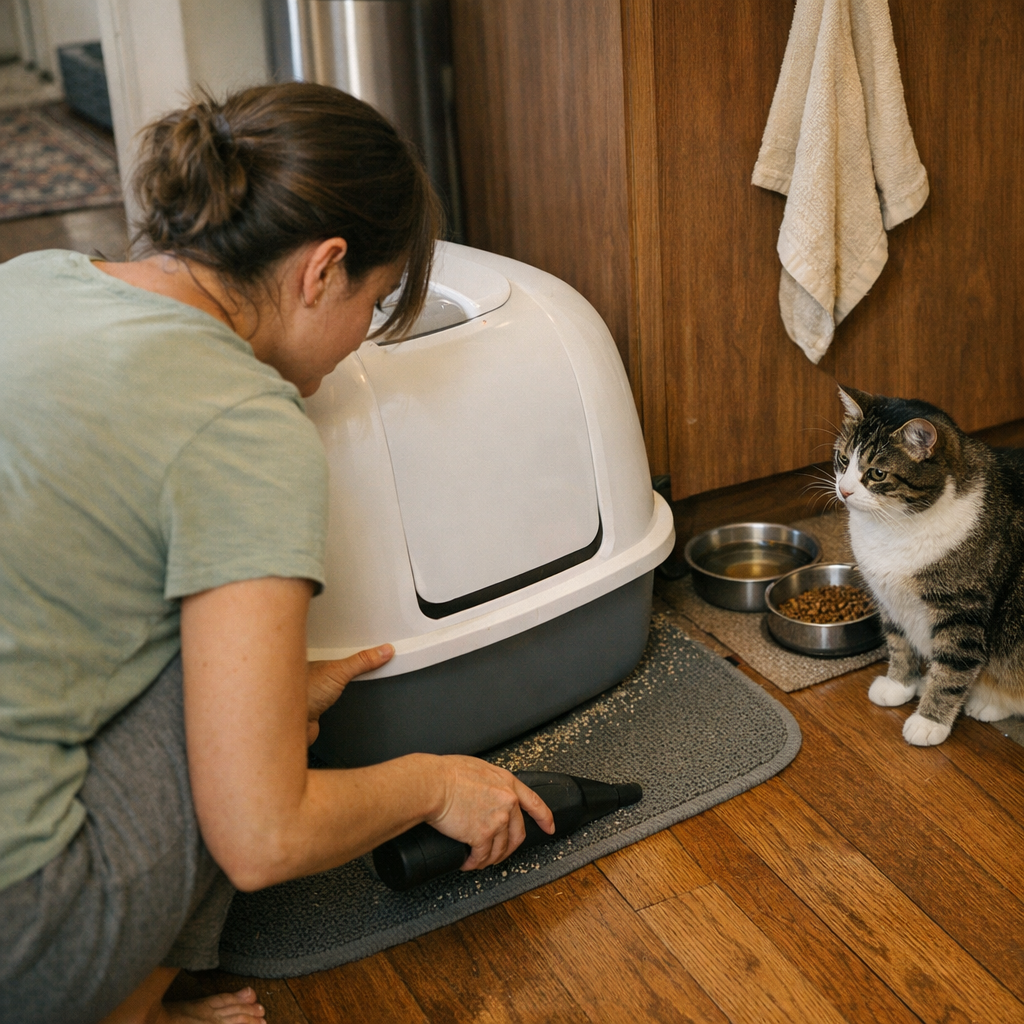
    There’s one shift that cuts the cycle: moving the litter box every week—just enough to reach behind and under the rim. This isn’t a full reset or deep overhaul; it’s about breaking the chain at its quietest link. Pick up or nudge the box a few inches. Run a handheld vacuum, brush, or damp cloth right along the edge. Peel back the mat, shake out the grains, and collect the litter that never appears on a daily walkthrough.

    This little reset prevents the “invisible spillway” from seeding your home with new grit. You don’t need to revamp your routine—just intercept the edge before it turns into a bigger problem. Within days, you see the pressure points fade:

    • Less litter stuck in mat corners or pressed into floor seams
    • Cleaner zones around food and water stations, so you don’t have to reach for a wipe between breakfast and litter scooping
    • Fewer surprise crunches underfoot on main walkways and kitchen entries
    • A cutoff in the chain-transfer of mess from the “litter zone” to every shared corner of your living space

    More than anything, your reset routine shrinks—and the cycle of endless touch-ups starts to taper off.

    What Real Use Looks Like: The Slow Spread vs. The Quick Reset

    Picture the test: a litter box pressed against a wall, mat underneath, food and water bowls a foot away. It looks tidy after a sweep, but by day two, there’s a tactile reminder—a grainy edge under your hand when you reach for a bowl, or stray litter showing up when you drag over a chair. Topping up water? You’re pausing to swipe a finger between mat and floor. Shifting toys? There’s a pocket of grit pooling in the crease. In the hallway or by shared space, edge buildup multiplies faster—cat routines and human routines keep dragging more litter further afield.

    The real-world sign: When your hand reaches for the refill scoop and you feel edge grit you missed. When supplies are in place but shielded by persistent crumbs. When a mat that looked settled turns out to be hiding a full new cleanup job underneath. That’s the signal: the setup is working against you, spreading out slow inconveniences until resets and walkways both start to drag and routines that initially felt “good enough” now require triple the attention just to stay under control.

    Making the Edge Part of the Routine: How and When It Matters

    The true test isn’t surface appearance, but how a full-use cycle exposes the edge buildup. Weekly edge cleaning isn’t glamorous or complicated, but it flips the long-term upkeep equation. How to work it in, so you stop trailing the problem:

    • Time it with your routine. Reset the edge during refill or scoop days—when the box already moves and the surface is open for a quick pass.
    • Shift, don’t just wipe. Even nudging the box a few inches reveals pockets of hidden grains along the rim.
    • Pull and check the mat. Fold or lift one side, and run a hand or vacuum along the border, especially if the mat sits up against a wall or cabinet base.
    • Target the margin—not just what you see. Where mat, box, and floor overlap, debris collects at double the usual rate and hides from typical sweeps.
    • Use a vacuum for tight edges. Cordless or handheld vacuums pull up embedded litter without recirculating the scatter that a broom just redistributes.

    The next day, you’ll experience the difference—fewer grains migrating past food bowls, less unplanned spot cleaning around high-traffic zones, and quicker resets that don’t turn into mini-projects.

    Compact Homes, Bigger Impact—Why Small Spaces Can’t Ignore the Edge

    In smaller apartments or multi-use rooms, tiny missed piles become instant interruptions. A forgotten margin spills into the kitchen, across the hallway, or under the only clear workspace. If you’ve ever switched steps to avoid a gritty patch or paused in the middle of breakfast to pick up litter stuck to a mat, you’ve seen how fast a small overlooked area can hijack flow in a compact space.

    Edge cleaning becomes a high-value routine in these places. That two-minute weekly swipe means fewer loops across the entire room. Instead of always seeming one cycle behind, your litter corner, mat, and shared paths start working together—less sidetracking, less reshuffling, fewer last-minute pauses to rescue the rest of your day from scatter overload.

    Mats Slow Tracking—But Only If the Hidden Zones Get Their Turn

    No mat stops grain migration entirely—especially not at the box/mat/floor border. Textured surfaces help, but most litter follows the path with the easiest escape: under mat edges, against baseboards, and deep along rim lines. Choosing a better mat is only half the fix. The true pain point is what gets shielded by a box pressed tightly into place, where you rarely check except during a full reset.

    Solution: weekly, lift or fold the mat, shake out trapped grains, check the border strip, and use a quick vacuum pass. These few seconds matter more than adding new surfaces or deeper grooves—this is how you actually keep litter from drifting into high-traffic areas before it becomes a pattern.

    The Takeaway: Why Edge Cleanups Matter More than Cosmetic Fixes

    Edge care isn’t a finishing touch. It’s the lever that keeps resets short and your rooms truly walkable. If you ignore the spot where rim, mat, and floor merge, you’ll always be caught by surprise crumbs and repeat cleanups. Put friction where it belongs—pick up the edge mess before it cycles out into every living area. The result: less backtracking, more usable space, and a setup that doesn’t steal time on each pass. Suddenly, even chaotic days don’t push your home into another mess spiral.

    See more practical indoor-cat-life ideas at StillWhisker.
  • Why Rigid Underbed Storage Bins Outperform Flexible Options Every Time

    The first morning with a new underbed storage bin always looks promising: every shoe, extra blanket, and batch of cables has a home. But two days into real use—reaching for gym clothes without waking anyone, or tossing shoes back after a late night—the cracks start to show. Flexible bins sag and skew; a neat pile at sunrise turns into a jumble by dinner. Instead of providing an easy out-of-sight stash, a flimsy underbed bin adds one more cycle of sorting, digging, and shoving—until the supposed organization is just hidden mess with a sliding lid.

    When Storage Structure Fails: Small Issues, Fast Friction

    Routine exposes what doesn’t work. Reach under the bed and feel a bin catch on a stray carpet edge; pull too hard and one corner collapses, sending a finished load shifting into a new confusion. Shoes wedge against the side, socks slip under books, and a tech charger presses into cardigan sleeves. Even if it looks fine once, the contents wander with every push and pull. One silent snag leads to a messier, less trustworthy zone. The cost isn’t all-at-once chaos—it’s the daily background friction: a return pile that starts blending categories, a mental note to “fix the bin” that never fits the week.

    Day after day, the setup slows you down. Each retrieval means resettling what shifted last time. Return flow breaks: you stop tossing things back in, or just shove them by habit, because keeping order isn’t practical. Underbed storage that can’t handle repeat movement becomes more avoided than used.

    Why Most Underbed Bins Collapse Under Real Pressure

    At first glance, a set of matching storage bins looks like an instant upgrade from piles creeping into floor space. But most soft-sided bins and flexy plastic boxes only win on Day One. Stack something heavier—a set of board games, winter boots, last year’s yearbooks—and the design falls short. Walls bow out, lids won’t sit straight, and every hurried return grinds the situation down. Bins catch on the frame, corners warp, and the floor under the bed starts collecting what should’ve stayed sorted inside.

    A flexible bin seems contained, but gives way just enough to scramble the inside. With every move, the categories blur. Cables tangle with shoes. Seasonal clothing seeps into last week’s tech. Retrieving one thing by feel means knocking other items loose. Bits that stuck to the edge yesterday have slid out of arm’s reach by tonight. You start fishing around—less organization, more low-key scavenger hunt.

    Rigid Bins: Holding Up When Everything Else Sags

    Rigid underbed bins shift the equation. Their structure absorbs the repeated pressure of real, unpredictable use: pull hard, push quick, or load them heavy—boxes keep their square shape and flat bottom. An early-morning grab or a one-handed toss doesn’t start the collapse. The lid always fits; the contents rarely migrate. Instead of dreading the shuffle, you learn to trust that what you put back will still be where you left it. Even when you’re moving fast, the setup keeps its form.

    Recurring Use Reveals the Difference Fast

    Picture a small bedroom with two people—shared space, rushed mornings, competing routines. Two bins need to open daily (clothes, chargers, shoes); other bins store off-season bedding or overflow. Soft bins mean corners sag, little things slide or get pinned underneath, and by Thursday, last week’s system is gone. One person’s hasty return undoes another’s precision—category order dissolves. Fast swaps and resets just speed up the drift from organized to chaotic.

    With rigid options, especially those built with interior dividers, there’s no daily reset tax. Shoes tossed in late stay in their section. Cables don’t entangle with clothing after three cycles of pull and return. Routine use—multiple times per week—leaves the setup basically unchanged. That’s the real metric: if your storage works when you’re hurrying, distracted, or sharing access, it’s actually fitting your life, not just your layout dreams.

    The Quiet Advantage of Internal Dividers

    Stiff walls alone aren’t enough if your bin is still just a big undefined box. Rigid bins with internal dividers segment the chaos. Each zone blocks drift: sneakers stay in their lane, chargers aren’t buried, out-of-season sweaters don’t obscure the daily rotation. Suddenly there’s no avalanche of cables when reaching for socks. On a rushed morning, you actually see what you need—no digging, no hesitation, no windfall of loose odds and ends.

    Years of small failures make it clear: if you’re loading up, invest in bins with solid panels and clearly partitioned interior sections. Anything that flexes, folds, or lacks defined compartments quickly turns return flow into more sorting—even for the tidiest person. Mixing heavy boots with delicate tech, or tools alongside linens, will always show stress at the seams when the structure isn’t firm. The cost? More time spent unsnarling instead of using your space.

    Movement Should Be Quick—Not One More Annoyance

    Most people underestimate how awkward it is when bins don’t move cleanly. At 6 a.m., a flexible bin’s sagging side is all it takes to wake up someone else—or yourself. Snagging on the frame, dragging on a rug, or warping as it’s pulled can sour a whole morning. Rigid bins, on the other hand, stay anchored and quiet, sliding in and out without drama. That’s not just aesthetics; it’s whether your storage adds minutes and frustration to a routine, or works so frictionlessly you forget the last time you sorted anything inside.

    Looks Sorted—But Will It Survive a Real Week?

    There’s a difference between bins that look organized when fresh and those that stay functional after repeat jolts, rushes, and returns. Storage can hide clutter as easily as it contains it. If it takes five minutes to rescue your system after three days of ordinary use, the solution is already eroding. True order isn’t just a clean lid—it’s finding what you need without redoing yesterday’s work. Systems that keep zones defined and returns simple hold up in real conditions: after guests, after a busy workweek, after storage needs scramble again.

    Rigid, pre-divided solutions catch small shifts before they escalate into invisible disorder. Less micro-managing, less tip-toeing around bins that erupt every time, less background annoyance—just functional space ready for whatever the week throws at it.

    Which Bin When Storage Pressure Builds?

    If your underbed area sees mixed traffic—shared bedrooms, kids swapping bins, crowded overflow—flimsy bins fall short. Flexible storage might keep lightweight blankets controlled for a month but buckles the first time you add manual weights, sports kits, or dense winter layers. Most households eventually test the limits. When bins open daily, serve more than one person, or have to absorb mixed loads, there’s no substitute for structural resilience.

    Shared zones and unpredictable routines break anything not built for repeat, rough, or uneven use. A strong underbed bin preserves category order with less hands-on rescue, absorbs chaos instead of multiplying it, and keeps the daily flow moving—no organizing streak required. Over time, that’s what keeps frustration low and living space easy, even as the demands on your storage system keep shifting.

    Browse more inside-storage solutions at Gridry.

  • How Small Changes in Pet Travel Gear Improve Every Stop and Start

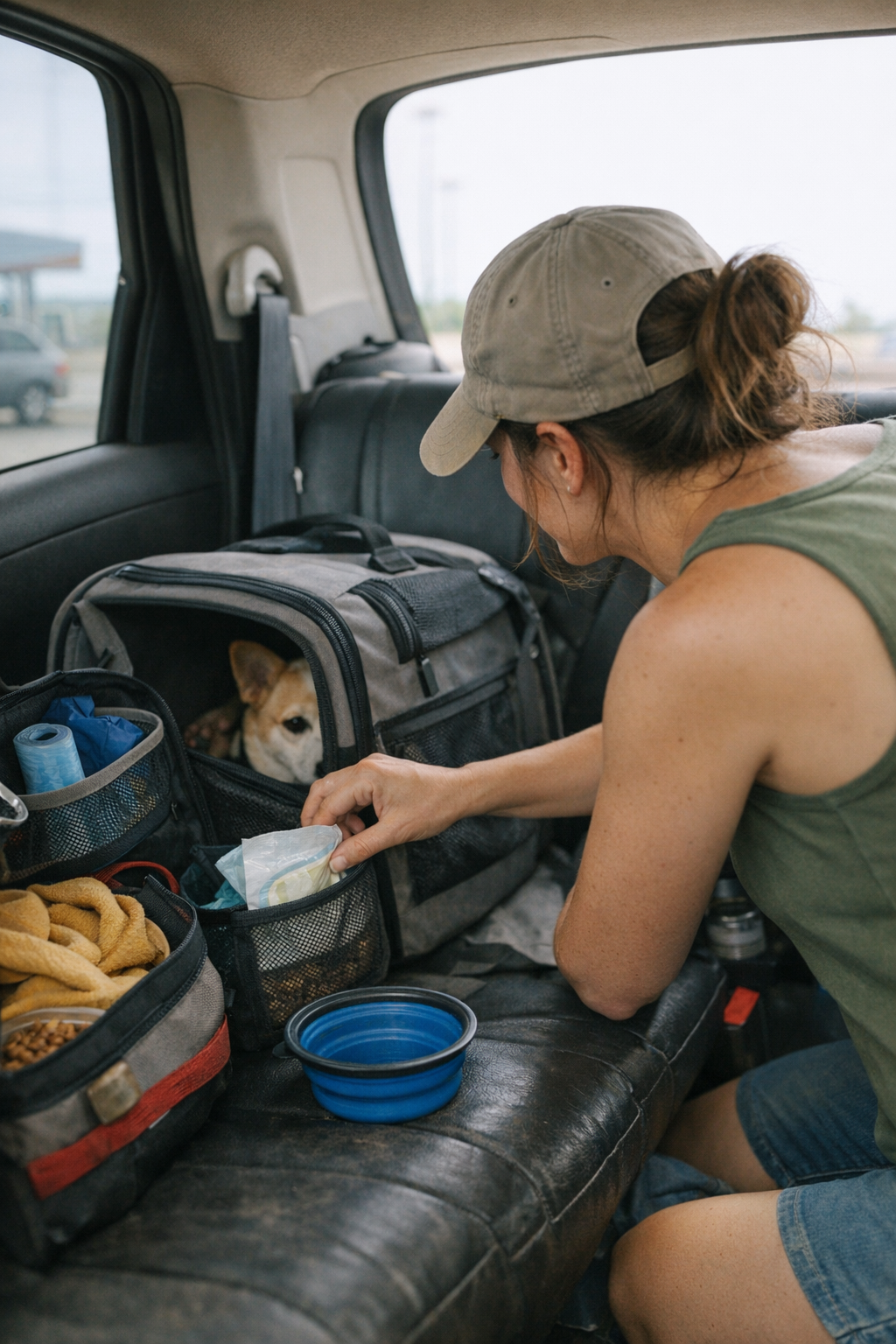
    Your pet hears the “ready to go?” signal and bounces up, but you reach for that travel bag—the one that looked perfect on the hook—and the friction starts faster than you’d admit. The zipper tugs, your keys snag on a side handle, or the wipes are packed just deep enough to slow you down when you stop. It’s the curse of a travel setup that looks ready and polished at home—but unravels the moment real movement interrupts the plan. By the first pit stop, what passed for “organized” keeps stealing seconds, blocking that quick leash grab, or turning a cleanup into a clumsy search. Pet calm fades while your hands sort, shuffle, and quietly lose the flow. This is where most so-called “organized” setups get exposed—and where the difference between neat looks and actual travel function really shows up.

    When “Packed and Ready” Turns Into a Slow-Down

    Most travel carriers and organizers look efficient when zipped and packed, every pocket filled for the road. But tidy exteriors don’t mean friction-free movement. You notice it at the first unscheduled stop: your hand goes to a side compartment only to find the leash stuck under bulkier gear. Or you open a pouch for treats and everything else threatens to spill. Each new stop adds another layer of reshuffling—digging for wipes under chew toys, hunting down a harness clip while your pet tugs in the other direction. On paper it’s all there, but in practice, the access you need is buried two pockets too deep.

    What held tight in your entryway gives way to reality on the road. Small slowdowns compound: a leashed tangle around a comfort blanket, food containers angled out of reach, a water bowl sliding into a dark corner of the bag. The “meticulously ordered” setup starts feeling like a puzzle that only resets harder with each pause. These aren’t showstopping failures—just an ongoing sequence of minor obstacles that grind away at the promise of easy travel.

    Moving Exposes the Friction Your Setup Hides

    Every time your trip gets broken up by stops, hidden design flaws multiply. Standing next to the car, cracking open the back seat, then awkwardly rooting through your bag for wipes or a leash—these are the moments that reveal what your gear really does (or doesn’t) solve.

    The more you repeat the routine, the clearer the weaknesses. You want a wipe after a quick walk, but it’s trapped below pet snacks you keep moving aside. The leash you reached for on autopilot is suddenly knotted around a toy or owner-side items. Every “grab-and-go” becomes a little search party in a bag that was supposed to keep things simple. Every pause means another mini-repack, another moment your pet is left waiting. What worked in your living room order falls short under backseat pressure.

    A Few Seconds Lost at Every Stop—And That Adds Up

    Every delay compounds: searching for your keys among pet supplies, steering bowls back to the edge, or wrangling an overstuffed closure while your pet pulls for the next adventure. What looked like a convenience turns, slowly, into an annoyance. These fragments of lost time collect—prolonging every break, sharpening your pet’s impatience, and stacking stress with every fetch for “just one more item.” If the setup slows your access just enough to break your stride, you’ll feel the drag after just a few ordinary stretches between stops.

    What Makes Pet Travel Actually Easier—Not Just Neater?

    The setups that make a difference aren’t the ones with the most sections—they’re the ones where the essentials actually fall into your hand in the middle of real movement. Spotting your own friction points matters more than features: where do you slow down? Why do you keep reaching for the same sleeve, muttering over the same pouch, or losing speed at the same type of stop?

    Cleanup tells the story: if wipes and sanitizers are tucked below layers you never use, every roadside reset becomes a two-handed, two-minute hassle. Shift those to a seat-side mesh slot or outer sleeve, and the whole cycle breaks: one reach, one wipe, done—no digging, no double-check, no repack. Leashes and treats, if positioned right, come out on the fly rather than after another dive past comfort items. Fewer hand-offs. Shorter pauses. Your attention back on the trip, not on sorting out your own gear halfway through.

    The Tipping Point: When Setup Structure Fails (And How You Know)

    Most pet-travel frustration isn’t dramatic—it’s the repeat infractions. If you keep searching for that one leash clip or get forced into awkward, two-handed unzipping just to find wipes, your structure is working against you. Watch for these pattern failures:

    • Pockets that routinely bury quick-grab items under gear you only use at home.
    • Compartments deep enough that everything shifts and stacks by stop two.
    • Clumsy closures that block you when one hand has to keep your pet safe.
    • Personal must-haves (keys, phone) mingled with pet emergencies, forcing you to dig for both and risk drops or tangles every trip.

    Small Adjustments—Big Payoff: How Structure Makes the Difference

    Sometimes a single move changes your whole travel rhythm. Swapping a hidden interior pocket for a mesh, seat-edge slot for wipes can turn a fumble into muscle memory—a quick grab that doesn’t interrupt either you or your pet. One small fix means fewer mid-trip resets, less cluttered time at every stop, and a pet who waits less and settles faster when you’re back on the move.

    No bag is ever perfect, and repeated travel exposes weak points that looked fine in your hallway. Real improvement comes from noticing those sticking points—the spots you keep grumbling about—and making structure changes so your kit flows at stop five just as smoothly as at stop one. If your organizer lets you find, grab, and stow without thinking, it’s doing its job. Anything less just slows down the whole journey, one small hassle at a time.

    Does Your Setup Really Help You Move—Or Just Look Organized?

    If grabbing wipes always means digging through toys, or you keep dragging comfort items just to reach the leash, your setup is quietly sabotaging your flow. “Looking neat” isn’t the same as moving smoothly: the real cost is every restart you slow down, every access you have to rethink, every time your pet’s patience thins as you hesitate beside the car. How your setup actually performs is lived out in those quick, repeat stops—not in a perfect snapshot when you leave your door.

    Notice what you keep reshuffling, which access points force you to pause, and which items always seem to block the hand-off back into travel. Setup structure isn’t about just being neat; it’s about giving you the right grab at the right second—no buried wipes, no blocked leash, no owner gear tangled with dog gear. That’s the difference between a trip that just looks calm and one that actually runs calm, right through the next stop.

    Visit PawGoTravel for truly practical pet-travel setups made for real movement.

  • Why Setting Boundaries Transforms Closet Stacking Into Lasting Order

    The illusion of a tamed closet shelf rarely survives the first few busy days. Stacks of folded shirts line up neatly and bins squeeze edge-to-edge, promising order. But fast-forward to Wednesday morning: you’re digging through piles, steadying a collapsing stack with your elbow, bracing a bin that’s wandered halfway across the shelf. The surface still looks “organized,” but the friction is building—and not just because you have too many clothes.

    Why “Stacked and Sorted” Fails by Midweek

    The first setup always feels promising: folded items arranged like a display, containers right to the border, everything giving off that ‘after’ photo energy. Reality arrives the moment you need your favorite sweater from three layers down—or when you try to return a t-shirt to a category that’s already started to blur. Each attempt to grab, return, or reshuffle sends corners drooping and stacks slumping. What started as order quickly dissolves into a juggling act: pull one thing, hold up another, watch the overflow spill into whatever space is open. Categories you swore you’d keep separate slide together, and a shelf intended for “sweaters” becomes part accessory graveyard.

    How Boundaries Break Down (and Clutter Creeps In)

    Deep shelves almost invite trouble. The more surface area you have, the more likely stacks and bins are to lose form after a few real-life uses. By day three, those once-crisp edges get fuzzy. A hurried morning leaves shirts nudged into the scarf zone. By the second laundry cycle, you’re barely able to tell where one type of clothing ends and the next begins. Maybe you wedge a basket between half-crushed piles just to keep things from sliding completely out of place.

    None of it feels catastrophic in the moment. Instead, it drags at you—a slow, steady loss of clarity, until grabbing a single item means rearranging everything around it. The problem isn’t just “stuff overflow.” It’s the absence of a real stopping point—something that holds the line when you’re not looking.

    Boundaries: The Real Secret to Closet Calm

    What keeps a closet feeling orderly isn’t perfection—it’s the presence of a real, unmoving limit. Shelf dividers, solid-sided bins, or even strict rules about stack size act as brakes against the natural spread of clutter. Their effect is easiest to see after you’ve gone without them. With a clear boundary, your “shirts” section stops at the divider—every time. Reach, retrieve, replace: the rest of the closet holds its form.

    In contrast, a bare shelf without boundaries mutates over days. The first shift is barely noticeable, but soon you’re double-handedly controlling piles, or re-folding shirts just to make space for one more. The shelf’s edge ceases to mean anything—the drift wins, and every section bleeds into the next until only the top layer looks intentional.

    One Closet, Two Outcomes

    Picture this: a closet with two shelves. Both start organized, but only one has fixed dividers every foot. By the end of a week, the divided shelf still lets you grab a hoodie or return a scarf without pushing two stacks together or holding up a toppling pile. The undivided shelf? Categories blur, and you catch yourself propping up one side just to slide something back—from visible order to visible frustration, in less than a workweek.

    Boundaries That Actually Hold Up

    So what works? Rigid boundaries—physical ones you can’t ignore or accidentally shift. Install vertical shelf dividers every 10–12 inches, or use bins with upright, sturdy sides. Even a tough shoebox can stand in as a makeshift border until a better solution comes along.

    The reliability comes down to this: when a stack has a set limit, every grab, return, or hurried reach is absorbed by the boundary, not by your hand or hope. You get one-handed access without needing to restack leftovers or worry about the pile slowly slithering sideways. After laundry day, items return right where they belong, instead of starting the next slow slide toward chaos. Resets are short; lines hold.

    Self-Check: Signs You’ve Outgrown Open Stacks

    If these feel familiar, your closet needs real boundaries:

    • You support one pile just to access another
    • You spend more time restacking than actually using the items
    • Sections that used to make sense (“shirts here, scarves there”) are now hopelessly blended

    Smarter Stacking for Everyday Closets

    Keep go-to items in a single-height stack wherever possible. Doubling up works for out-of-season or less-used things, but daily essentials topple plenty fast. Jeans and chunky sweaters can withstand taller piles; t-shirts and delicate linens cannot.

    Choose dividers that are firm but flexible. Clip-in shelf dividers or slotted organizers stay put through daily use, so your closet doesn’t drift out of order at the first grab. Temporary solutions are better than none—shoeboxes, shallow totes, even repurposed bookends—all create edges that buy you time and clarity.

    The True Difference: One Clear Edge

    A closet isn’t “good” because the shelves are deep or the containers pretty. The turning point is always a real physical edge— one that absorbs daily motion so you don’t. That edge means every shirt returns to its spot, resets don’t drag out, and you know at a glance what category belongs where, even at the end of a hectic week. Without boundaries, even the most beautiful setup backslides into hassle. With the right edge, the chaos is contained—and your morning routine (and mood) improves by more than a little.

    If your closet feels crowded, slow, or in need of constant policing, stop stacking for height and start creating boundaries that last. Order isn’t about how much you can fit—it’s about how easily everything finds (and keeps) its place.

    Shop practical closet solutions at ClosetWorks

  • Transform Your Car Interior with Smart, Easy-Access Organization

    Sit in a car that looks spotless, and you still might catch yourself fumbling for your phone, reaching around a loose cable blocking the cupholder, or digging past a seat organizer that interrupts every quick entry—over and over. Even “organized” setups can make daily car use clumsy and slow, especially for anyone running tight errand loops, school pickups, or regular commutes. The most common frustration isn’t visible mess—it’s the grind of items that are always one awkward move or delayed grab away, turning a neat interior into a repeated source of small aggravations. DriveWellSupply’s world starts here: not with showroom order, but with design that keeps daily driving friction from stacking up.

    Why “Organized” Isn’t Always “Easy” in Real Car Use

    It’s easy to believe order means efficiency: surfaces clear, organizers zipped shut, cords draped cleanly. Yet a setup that photographs well can fall flat within days of real use. The main problem: items are stored for looks, not for where your hands actually go during stop-and-go routines. What feels under control on Sunday becomes a slow-motion obstacle course by midweek.

    Picture a phone mount chosen to blend in—out of direct reach, fixed at an angle that seemed fine until you try to swipe or tap while stopped. Every small stretch costs attention. Or a sleek charging cord, perfectly “managed,” but crossing your cupholder so you bump it with every coffee or key grab. The setup didn’t break—but each day’s annoyance is repeatable and gets harder to ignore.

    How Repeated Use Reveals Hidden Weak Points

    No organizer or layout survives daily routines unchanged. The weak spots appear where habits clash with setup: busy commutes, family drop-offs, grocery runs, and continual slide-ins and outs flush out hidden flaws.

    The Return-to-Car Ritual

    You return to the car with bags, a phone, maybe a drink, and find the only open hand-space blocked by a packed seat-side pocket. The quick “I’ll grab it after” pile smothers essentials beneath less-used gear. Then, on cue, your charger ends up wedged below the seat edge—again—forcing a clumsy scramble just as you notice your battery is nearly dead. Every time, the pattern repeats: small, location-driven hassles that weren’t obvious during cleanup.

    Buried Essentials: Small Delays That Add Up

    Many drivers stash emergency kits, wipes, or spare cables for a tidy look, but real-world use exposes the downside. When flooring gets wet or coffee spills, the carefully hidden cleaning supplies mean rooting through trunk bins or seat trays—slowing things down just when you want fast fixes. The “smart” weekend arrangement transforms into a midweek annoyance, especially when weather, spilled snacks, or a drained battery create pressure and you can’t reach what you need quickly.

    When Neat Setups Interrupt the Flow

    Ultra-organized layouts often backfire with daily repetition. Floor trays corral loose change but fail to contain puddles after rain, leading to water escaping off the edge and into carpet traffic zones. Deep organizers can swallow keys, emergency tools, or dog leashes beneath layers of less-used clutter—leaving high-use items blocked exactly when you move quickly. The drag isn’t disorder; it’s the need to fix, re-fit, or dig past “organized” gear in the middle of a normal drive. The car looks better, but you spend your commute mentally managing small corrections: shifting the seat cover again, re-angling a sunshade, untangling the charger trailing across a grab area.

    Routine Pressure Makes Weak Points Return

    The friction goes from minor to memorable when you’re pressed for time: school runs in bad weather, tight parking, armloads of groceries. The moment you need dry footing, the seat-edge mat slides away, or the safety tool you meant to keep accessible is buried behind another bag stuffed into the trunk organizer. These layout faults only show up under repeated, real-world loading and fast, multi-bag entry—not after a single organizing push. The cycle continues: clean lines on the dashboard swap for ongoing fiddling with phone mounts, cables, and organizers. As the setup stiffens the car’s flow, errands take longer—and you realize that “order” hasn’t fixed your driving routine. Instead, it’s become its own slow leak of convenience.

    Redesigning for Real Access, Not Just Order

    The leap forward comes from rethinking for reach, not just storage.

    What actually works after a few weeks of real use? Small, intentional access shifts:

    • Mounting phones at arm’s natural line—centered, not obstructed by gearshift or cupholder reach zones
    • Laying a textured mat where wet boots or umbrellas go, so runoff never slides under carpeted patches or pedal zones
    • Routing charging cables along fixed anchor paths, away from high-traffic grab points and out of cupholder territory
    • Placing emergency and cleaning kits in door or seatback pockets—reachable with a single hand while seated, not buried in trunk storage

    After this realignment, the background friction drops: no more routine searching for cables, no more half-blocked grab for disinfectant wipes after errands, fewer fixes to shifting gear during daily parking. The car starts functioning as you move, not demanding regular reorganization to stay usable. What seemed like tiny inefficiencies stop accumulating, and the interior supports, instead of slowing, your driving flow.

    The Real Mark of a Car That’s Under Control

    The best setups don’t erase all signs of use, or make your interior look untouched. They shorten the path to what you reach for most, hold up to actual traffic, and reduce the steady low-level stress of repeated fixes. If gear stops drifting, hand-space stays clear, and the temptation to “just shift this again” vanishes, you’ll know your layout finally works. The visible difference isn’t just tidiness—it’s a car that keeps up with your day, drive after drive.

    For practical and reliably accessible car-use gear, visit DriveWellSupply.

  • Ensuring Long-Term Lighting Reliability by Proper Wire Tucking Techniques

    Lighting can look flawless in the walkthrough—yet still fall short when it matters most. Step into a hallway at night and your eyes adjust to a bright fixture, only to find one corner stubbornly in shadow or a flicker as you cross. Lean closer to a bathroom mirror and notice the best-lit spot is always just out of reach, washing your face in uneven halos. At the kitchen counter, overhead lights seem crisp until a dull edge creeps into the work zone, right where you need clarity. These aren’t just quirks of design; they’re the real cost of wires forced flat behind slim canopies, cables pinched by shallow boxes, and flush-mount fixtures that squeeze out proper slack in favor of a tidy finish. The surface glows, but the structure strains—and over days and repeated routines, that hidden stress becomes impossible to ignore.

    Hidden Trouble: Where Wire Stress Begins

    Most lighting wire problems don’t flag themselves the day you finish the install. The cover looks sealed, the sconce lines up, and nothing seems out of place. But the first bump, bulb swap, or deep clean starts an invisible tally: every slight tug compresses cables that were crammed to fit the plate or bent hard to clear a junction. Slowly, you start living with consequences—shadows sneaking around stair turns, the dead corner of a vanity mirror, a hallway light that fights to stay steady each time someone brushes by.

    What’s beneath the finish matters most where movement and visibility overlap—tight corridors, mirror walls, task counters, and any spot where people reach or adjust. Squeezing a flush mount fixture into a shallow ceiling box, or over-bending hardwired cables against a flat canopy, builds friction you’ll feel week after week.

    Lighting That Looks Fine—But Fails in Use

    Real-life lighting isn’t just about first impressions. Here’s where tension exposes itself:

    • Stairway Stall: Pausing on the landing with a laundry basket, the ceiling light flickers or casts just enough shadow to make your next step uncertain.
    • Mirror Gap: Over the bathroom sink, a tidy fixture throws an annoying shadow split across your face, making precision tasks feel clumsy every single day.
    • Hall Drift: Narrow hallway sconces glow at one end—but the opposite corner fades, flickering whenever a shoulder scrapes past or the door slams.
    • Counter Fade: Under-cabinet strips go dull along the far edge because every cabinet door opening tugs a tight cable, turning even illumination into a patchy half-light across meal prep zones.

    The common thread? Every movement, nudge, or cleaning exposes flaws in hidden wiring that looked “correct” on day one. When the structure underneath is stressed for the sake of appearance, the result is lighting that jerks between useable and unreliable with every real-world touch.

    Soft Loops Over Sharp Bends: The Unseen Difference

    Unstressed cables are everything. If wires aren’t allowed to rest in a natural curve—if they’re pressed hard behind a minimal fixture or flattened for a cleaner silhouette—persistent trouble follows. It shows up instantly the first time you change a bulb or adjust a tilt, but multiplies over seasons of use: insulation wears down, connections loosen, and that crisp install slips into constant troubleshooting territory, especially in bathrooms or multi-use rooms prone to movement and moisture.

    Real-World Fixes: “Calm Tucks” Instead of Forced Hides

    Durable setups happen when you resist stuffing all slack into the tightest cover. A stairway sconce will last longer when its wire draws a relaxed arc along the wall’s curve—absorbing bumps and micro-movements. Even in a cramped laundry corner, leaving half an inch of extra loop behind the fixture can mean the difference between quiet, steady light and another outage at the worst time.

    Practical cue: When a shallow or flush fixture feels essential, never flatten every cable tight for appearance. That slim loop—barely visible—protects the function far longer than a perfectly concealed tangle. It means less downtime, fewer surges, and no scramble to reseat a fixture after every routine jar or tap.

    Recognizing the Signs: When Wiring Trouble Surfaces

    Hidden stress only becomes obvious when it becomes disruptive. Watch for these repeat indicators:

    • Lights flicker after dusting, bulb change, or even slight movement
    • Shadows slice across key areas—mirror, wall, step—despite a high lumen reading
    • Edges of task areas (like counters or sinks) stay persistently dim, while the rest glows
    • Outages triggered by vibration, touch, or shifts in humidity—rarely a bulb’s fault

    If you’re looping back to the breaker or swapping bulbs only to have the problem return, odds are good the source is a cable under stress, not a failing lamp. Trace the issue to the wire path—not just what’s visible on the surface—and fix the structure that feeds the light.

    Repair Without Full Rework: What Actually Helps?

    You don’t always need a total teardown to regain reliable light. In the field, carefully lowering a ceiling plate or sconce, letting the cable fall into a gentle loop, and reseating the cover with minimal adjustment is often enough—as long as no insulation is breached. The fix is about movement, not force: prioritize a pathway for the wire that won’t strain with every reach or vibration, and let the cover follow the cable’s lead, not the other way around.

    Lighting Where People Move: The Difference Shows Up Over Time

    Long-lasting clarity isn’t an abstract goal—it lives in moments such as:

    • Landing safe on the right stair tread with no hesitation after dark
    • Turning on a sink task light and not squinting through glare or patchy dark bands
    • Checking a laundry tag without making the room flicker by shifting a load
    • Opening a cabinet or crossing a hallway and not watching the shadow jump from bright to dim each time

    Reliability starts behind the scenes. The right wire path lets flush mounts, wall sconces, and bathroom lights support actual human movement—not just look correct when untouched. Ignore the structure and every routine exposes the compromise; respect the cable path, and lighting adapts to life, not the other way around.

    Quick FAQ: Avoiding Invisible Lighting Flaws

    How much slack should wires have behind indoor fixtures?

    Let each cable bend gently behind the entry, without pressing it flat or forcing all slack behind the minimal cover. Especially with rigid or shielded wire, a natural arc makes the difference between a stable setup and a repeat call for flicker fixes.

    Why does lighting flicker or fade months after install?

    Strain from tightly packed wires, persistent compression from shallow mounting, or vibration across high-traffic zones gradually loosens or deforms connections. Flicker and shadow lines often trace back to this hidden pressure—not the bulb or the breaker.

    Is full rewiring required to fix minor outages or flicker?

    Usually not. If the insulation is sound, easing the fixture down and letting the wire find a soft loop often restores steady light. Avoid tugging or brute force—address the cable path first, not just the bulb or faceplate.

    The Lasting Impact: Lighting That Works With You, Not Against You

    A room can look finished while still tripping you with bad shadow lines, unreliable task visibility, or off-balance movement. The difference isn’t in the fixture’s outer shape, but in how its wiring was set up to last through actual routines. Don’t settle for a setup that only survives inspection—the results show up in every hallway pass, mirror glance, stair step, or prep surface you actually use. Letting the wire breathe quietly behind the scenes makes lighting easier to live with, week after week, routine after routine, instead of another silent frustration waiting for the next flicker.

    Find practical ceiling, wall, and utility lighting that’s built for real use and real routines at LightHelper.

  • Why Outdoor Storage Systems Fail When Real Use Begins

    Most outdoor storage feels solved until you actually start using it, week after week. At first, the side yard or patio-edge looks squared away—lidded bins snapped shut, lawn chairs stacked, rakes out of sight. But reach for a shovel after a rainstorm, or try to put away muddy boots when your hands are full, and the setup shows its cracks. That clean, organized surface quickly demands shuffling, stacking, and constant quick fixes. There’s a real difference between a backyard that looks tidy and one that actually lets you move, work, and reset without interruption.

    Clutter Moves Into Your Path, Not Just Your Pile

    The drive for a minimal fence-line or neat shed pushes everything into bins and boxes. Gloves wedged in totes, secateurs buried under hoses, soccer balls smothered by lawn bags: it’s organized until you need the third item down. One gardening session, and suddenly you’re peeling open heavy lids just for a misplaced trowel, or moving bins so you can grab the rake without knocking over the hose cart. That crisp, stacked look doesn’t last past the second or third use—friction creeps back in with every task.

    The mess rarely explodes all at once. Instead, you get walkways filling up with “just for now” piles—boots left near the shed door, garden bags dropped at the fence, tools that never quite make it home because their “home” is too buried. Every small detour signals it: the system isn’t out of space, it’s set up for surface calm and hidden hassle. The smooth footprint is an illusion; the more you use it, the more awkward the flow becomes.

    Where Tidy Setups Break Down—In Actual Motion

    Think about a typical setup: storage bins stacked along a garage wall or tucked into a side-yard cabinet. Leaving gear out of sight keeps the yard pretty, but only until you hit a wet stretch or a week of projects. That’s when the bottom container needs unloading, or the last-used tool ends up exiled somewhere in the stack. It takes just a couple of hurried drop-offs before the original “system” turns into a tangle—lidless containers, tools sprawled at the cabinet base, boots abandoned at the threshold, blocking the rest of the walkway.

    These are the choke points that shrink what should be open routes. Suddenly you’re shifting lawn chairs just to free the path for the mower, or nudging camping tables aside to clear access to the hose. Once piles gather along a wall, every quick return—“just leave it here for a minute”—invites more overflow. Days later, the area officially “organized” feels as clogged as before.

    The Modularity Shift: Open Use Beats Hidden Clutter

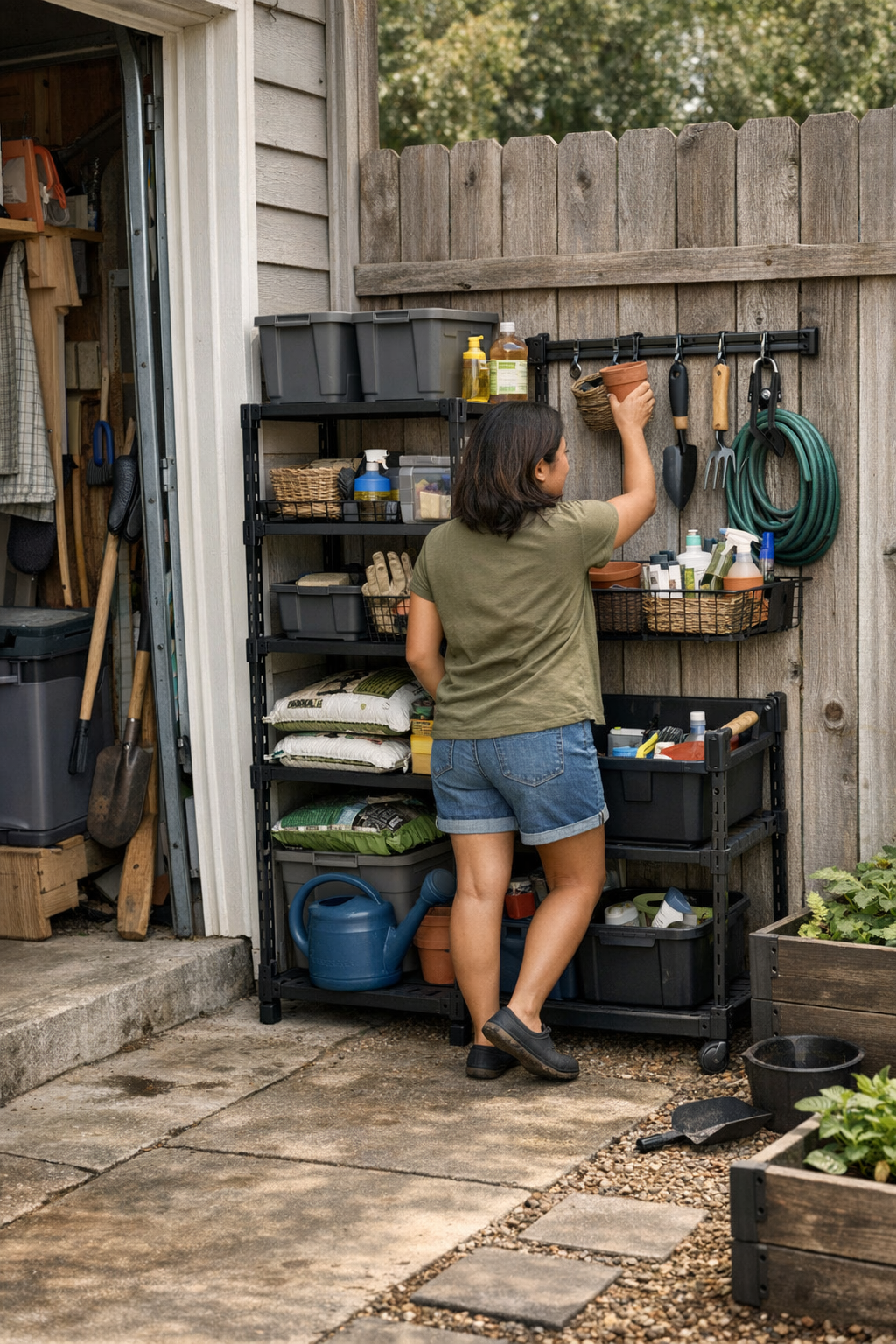
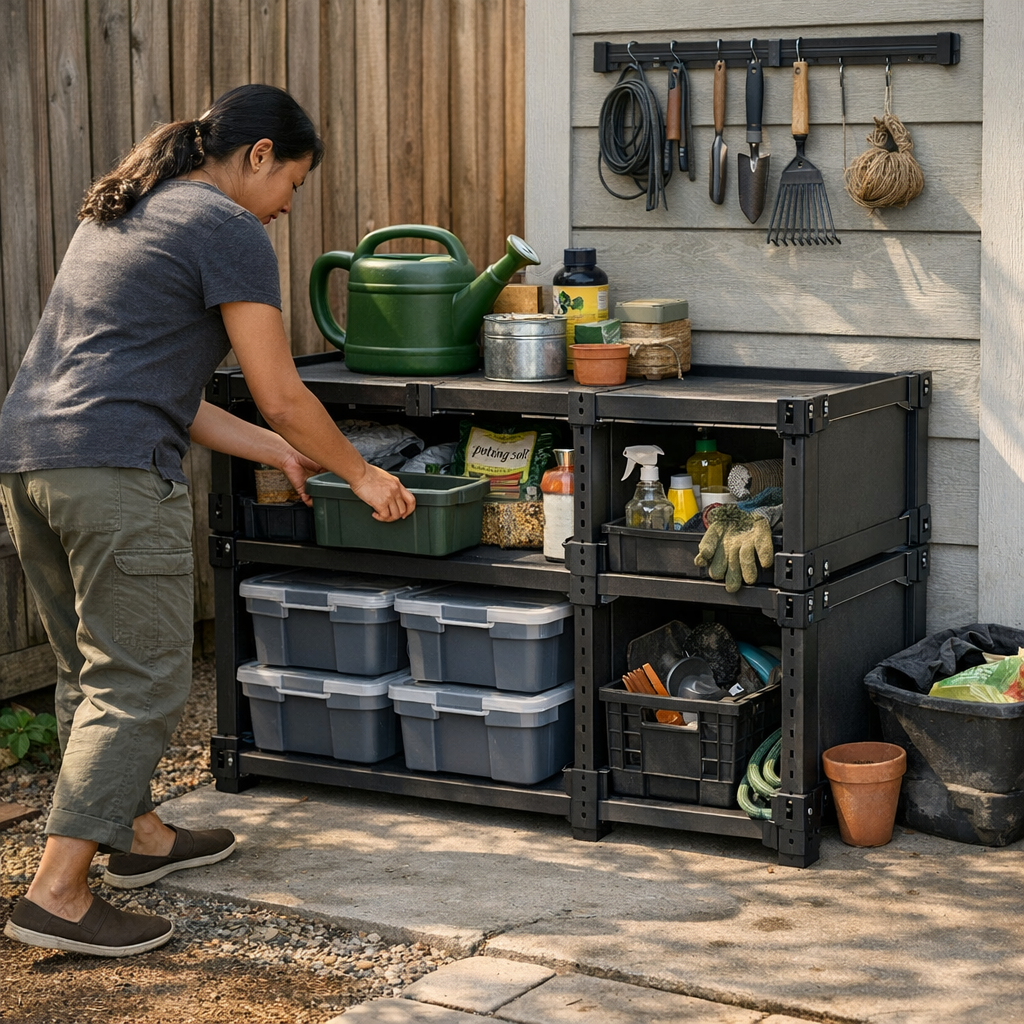
    Stacked bins try to keep order by hiding gear. Modular wall strips, open rails, or shelves shift order into motion: everything sits uncluttered, visible, ready to grab. At first, the wall rack full of shovels or pegs lined with gloves can seem busy—less visually tidy than matching tubs. But once outdoor tasks ramp up, the setup doesn’t unravel. You use one item, you return one item—no reshuffling, no leftover pileups.

    After a round of planting, you drop the trowel right onto its peg, hang up the gloves, and move on. Even with dirty hands or arms full, you can reset the area in seconds. The system doesn’t just look organized; it actually stays that way. Shared spaces suddenly work for everyone: no more decoding which bin holds what, no more “I’ll fix it later” dumps in the path, no more depending on whoever set the system up in the first place.

    Real-World Reset: Garage Edge Revisited

    This shift only feels real after you’ve lived the before-and-after. My patio cabinet, once packed with lidded tubs, lasted a few weeks before weather and routine opened the floodgates. Each trip meant digging through the bottom bin just to grab one bag of soil. Rain turned the ground around the cabinet into a catch-all: garden tools, boots, and empty planters crowding up the path. By May, my supposedly space-saving stack had doubled its footprint—but made moving through the zone a headache.

    Switching to an open rail and shelf, easy to reach and no stacking involved, changed the reset entirely. I could shove boots back onto an open rack and hang trowels straight from the door—no bins to open, nothing to move out of the way first. Even on wet days or with the pace of group cleanup, returns never clogged the entry. There wasn’t more storage; there was just less buildup, fewer obstacles, and an ease that stuck through the season. No more shifting two bins just to put one tool away—and no more micro-clutter dragging down every routine.

    Small Changes, Big Difference to Movement

    The worst blockages start right by the access points. Whenever you need to step around a bin, unstack a tub, or sidestep a jammed-in chair just to return one tool, clutter wins. Corners meant for easy passage quietly transform into overflow zones—the hidden graveyard of “temporarily” stranded boots and project leftovers. Even the least-used spot can become a dead space, a magnet for mess as soon as normal routines speed up.

    Modular wall systems or visible shelf zones flip that routine. Movement through the area stays clean; putting items back doesn’t trigger a domino effect of tidying. The next person in doesn’t face a mess from yesterday. Instead of warning kids, guests, or partners to “watch the pile by the door,” the area handles itself—a frictionless reset instead of a reluctant chore.

    From Dead Corners to Real Utility

    Some trouble zones never look “messy” until you see how they work. The side of the garage or a fence-line often collects stray gear: sports balls rolling into the open, tools set aside for “later,” garden supplies after a busy weekend. Closed bins claim to solve the problem, but the minute someone needs the lone basketball or hedge clipper, it resurfaces—forgets to get put away—and starts blocking the path. That one spot becomes a vortex for overflow, and the awkwardness spreads to every other border zone.

    The simplest fix is to make these corners accessible for real use: hang a low wall rail, mount a pegboard, or install a one-row shelf—just high enough for anyone to grab and to return what they need without ever stacking. Small layout tweaks—dropping a pegboard by six inches, adding a ledge by the backdoor—change how quickly gear comes and goes. Every step toward open movement is time gained for actual yard work, not just cleaning up last week’s clutter.

    Stop Hiding: Choose What Actually Works

    Shoving everything out of sight is the most tempting version of order, but relief comes from never having to move three things just to use the fourth. It’s not about perfect optics—it’s about not being interrupted by your own storage system. If you can return a rake, tuck a chair, or put back boots without a chain reaction of shifting, your space works. If you need to unbury bins or stack lids after every use, it’s time for a reset.

    See where your setup stalls, what triggers overflow, and which corners become the unofficial dumping ground. Lean into open, modular options that match how your yard gets used—not just what fits the space at rest. The right storage zones clear movement, cut down on daily reshuffling, and keep your outdoor area ready, no matter how many hands use it or how often the routines shift.

    See setups and outdoor storage solutions focused on real utility at TidyYard.

  • Minimizing Jig Saw Blade Drift for Cleaner Thick Panel Cuts

    You don’t spot jig saw blade drift while you’re cutting— You discover it when the panels hit the workbench and the edges won’t line up. That’s the moment you realize: cutting thick panels isn’t the satisfying “slice and stack” routine it looked like on the first couple sheets. Whether you’re running lengths of 32mm MDF or breaking down butcher block, those early success stories lull you into a rhythm. Then the friction creeps in. The saw starts to fight you just a bit more with every cut. Joints that should be seamless now need aggressive sanding. You spend longer clamping and re-trimming than actually assembling. Suddenly you’re second-guessing your grip, your setup—even the wood. But the real culprit, slowly compounding in the background, is blade drift worming its way down each cut, turning finishing work into a rescue effort.

    How Blade Drift Sneaks Into the Workflow

    On job one, it’s invisible. Two or three panels come out straight. You move with confidence—until your fifth thick cut, and the panels refuse to sit flush. Joints get rough, the grain tears, and it never feels like a single “bad move” caused it. You blame shaky hands, a glitchy saw, a deadline-induced caffeine jolt. The reality: a blade that’s been slowly flexing off its line, lost in the noise and vibration of repeat use.

    Fatigue starts small but snowballs fast. Each round, you press just a touch harder. The saw vibrates longer, the handle runs hot, and what felt like muscle memory turns into unconscious overcorrection. The blade starts to warm, bend, and walk. Slow enough that you can miss it on sheet two—glaringly obvious when you’re sanding out misaligned seams three hours later.

    Blade Drift: Small Lag that Compounds with Every Pass

    True blade drift doesn’t announce itself in a single bad cut. It’s a series of minor setbacks—the flex in a blade, a kerf that’s too wide, the urge to push faster when the saw stutters. What really goes wrong?

    • Stiffness rules the line. Soft blades feel fine early, then bow and veer on thicker material. A stiffer blade traces the layout you intended—panel after panel.
    • Kerf width isn’t just a number. Wide kerfs cause more friction, more vibration, more heat, and more wandering. Narrow kerfs glide truer and avoid the rough, scorched edge that only gets worse with each round of cutting.
    • Repetition is the silent thief. The longer you cut, the more lapses appear. Stiffness in your hand, wandering focus, and a dull blade invite mistakes that don’t show up until it’s assembly time.

    The result? What looked like a “good enough” blade on panel one gives you a ragged, misaligned gap by panel five—no matter how many minutes you lose at the sander trying to fix it.

    In the Shop: Where Drift Disrupts Build Flow

    The real hits show up mid-project: six slabs of butcher block, each topping 35mm, all queued for cabinet tops. With every panel, the early satisfaction wears thinner. On piece four, the jig saw starts to judder, the motor seems to strain, and the cut swerves—sometimes only half a millimeter, but enough to break the groove on a joint. You feel the blade catch and hesitate. Just one wrong choice—a generic, floppy blade midway through the stack—can sabotage your afternoon. In one case, chasing convenience cost the builder an extra hour: switching to a bargain blade meant recutting, resanding, and resigning himself to filler. Multiply this by every “just get it done” shortcut, and the backlog grows: wasted material, missed deadlines, cut corners you can’t hide after the last round of shellac.

    Choosing Blades: Why Similar Isn’t the Same

    Buying blades by the label is tempting. “Hardwood,” “precision,” “fine cut”—all sound right, but not every package tells the full story. Two blades of the same length and tooth count might behave worlds apart once you hit serious material. Softer steel flexes under pressure, wide kerfs bog the cut, and low-grade teeth dull out halfway through your run. Once vibration sets in and the saw turns jumpy, the best you can do is wrestle the workpiece and hope the sander covers your tracks.

    Test for real payoff: Check the specs—look for high-carbon or bi-metal designs, and aim for a narrower kerf every time. Run two blade types on scrap before you commit them to your workpiece. Sometimes, the winner is a surprise—the stiffer, “slower” blade outpaces the flashy label once you’re on the fifth thick cut.

    When Your Setup Works for You—Not Against You

    Get it right: stiff blade, narrow kerf, and a conscious drop in feed rate. Don’t force the saw. If your machine allows, set orbital action low—enough to eject sawdust, not enough to send the blade thrashing. Suddenly, even tough oak panels part clean, edges barely need more than a finishing pass with a sanding block. On a five-piece job, your drift is barely a hair’s width. Not flawless, but finally predictable—and predictable saves hours.

    You can’t fake a perfect seam, but you can stack the odds. Fewer repairs. Less time hunched over a sander. Enough consistency that the last cut is almost as sharp as the first—without gambling on luck or muscle memory.

    Warning Signs: The Subtle Feedback You Can’t Ignore

    Drift never announces itself with drama. It’s the small signals that matter:

    • Unexpected resistance halfway through a cut
    • Edges rougher on the underside than the top—gaps you didn’t see on pass one
    • The saw shudders more, demanding two hands when one used to be enough
    • The blade or motor housing surprisingly hot after long runs

    These signals build slowly, and they’re almost always the first sign you’re heading for misalignment. Ignore them, and you’ll spend the evening wishing you hadn’t.

    Shortcuts That Cost—and Tweaks That Deliver Every Time

    Slow the pace to stay in control. Pushing harder for the sake of speed forces the blade sideways, especially in thick stock. Reduce orbital setting when depth matters. If you’re burning through a stack, check the blade after every few panels—a small nick or warp at the tip can quietly ruin the next run of cuts.

    Stock extra blades—and use them. No blade handles repeated thick-panel jobs forever. Swapping to a new blade keeps cuts crisp and control intact. If the job list runs long, invest in bulk—not just for peace of mind, but to match blades to wood and panel thickness without hesitation.

    Precision Pays—Especially Under Deadline

    Preventing blade drift is a discipline, not a one-off fix. The reward isn’t gold-plate perfection—it’s a stack of panels that actually fit by shift’s end. The mistake with drift is letting minor slip-ups snowball: a nick here, a gap there, and suddenly the project runs late or finish quality suffers. Stay alert to the tool’s feedback—resistance, heat, vibration. Cut with a blade that actually matches the job, and stay ruthless about switching out tired hardware. That’s how you end the day closing panels clean, not fighting endless rounds of sanding to hide what drift slowly ruined.

    Explore practical jig saw blades and worksite accessories at Gumboll

  • How Quick Resets Transform Daily Pet Care Into a Smooth Routine

    The Hidden Gaps in Daily Pet-Care Setups

    That feeling of control—lined-up bowls, brushes at hand, fresh towel hooked by the door—rarely survives past the second feeding or first muddy walk. It looks set for easy care, but by lunchtime, the “organized” area is already fighting back: a wet bowl crowds the counter, the brush is gone, and you’re reaching past clutter to find even the basics. The illusion of order fades fast under repeat routines, and pet care slows as you reshuffle supplies or double back for missing items. What worked at the start of the week unravels by Wednesday, turning ordinary feeding and cleanup into a series of avoidable stalls.

    Where Pet-Care Routines Get Stuck

    That so-called organized corner breaks down the minute you try to use it under pressure. Reach for a water bowl and find a food bin shoved in the way—or yesterday’s rinsed bowl is still damp, awkwardly perched where a quick scoop should be. After a rushed grooming session, the brush is abandoned on the table, leaving you hunting for it with damp hands when you come back for the next round.

    Every small slip means another slow-down. The refill bottle’s empty and not where it should be; retrieving it means doubling back to the other room. That towel you rely on for after-walk paws is gone, so dirt travels farther into the house. Each “just a second” pause adds up, breaking the feeling of routine and pushing simple care into friction-heavy territory.

    Real Use Scenes: Interruptions That Sneak In

    Come in from an evening walk—leash in one hand, drippy toy in the other—expecting a towel at arm’s reach. Instead, it’s balled up on the sofa or vanished to the laundry pile. The jug you use to refill water dishes is empty, hiding behind unfolded laundry. You end up tracking messes through the space as you try to hunt down one missing supply after another, turning what should be a two-minute reset into a minor scavenger hunt.

    And during a busy week, the cat’s grooming brush never lands in the same spot twice—used by the kitchen sink, left on the coffee table, then migrated to the feeding zone. What saves a step in one moment adds to the search later, and you burn time chasing after items meant to be ready for quick routines. Even a feeding spot that started out “tidy” by evening is blocked off by scattered toys or abandoned breakfast bowls.

    Looks Tidy, Works Slower: The Practical Difference

    Visual order and daily function don’t always align. It’s easy to reset everything each night—align the supplies, wipe bald spots, hang that missing towel—but cracks show during high-traffic hours. The friction isn’t from visible mess; it’s from essentials going missing or getting harder to grab, so each basic care step slows or stalls. If you skip even one small reset, next time you’re left staring at a missing wipe or an empty water jug right when you need it.

    Focusing on appearances means you might beat back surface clutter, but routines pile up underneath. The towel isn’t ready for a muddy dog, the scoop’s gone missing, storage bins block the counter, and daily pauses multiply. The space designed for convenience keeps interrupting your real flow, and regular care starts to feel heavier, less automatic.

    Why Fast Resets Matter—And What Actually Helps

    A reliable pet-care area isn’t about perfect order, but about how quickly the basics land back in place after use. Immediate resets—refilling that bottle before it’s empty, hanging the towel as you finish, returning the brush right away—shorten the chain of slow-downs. Skip the reset and the next routine runs into a snag; build the habit and those missing-item interruptions mostly disappear.

    Fast resets work because every action counts: refilling a bowl right after feeding, stashing the brush as soon as you’re done grooming, and returning containers before stray items pile up. Supplies stop drifting out of reach, and routines start to run as intended—with care tasks handled before they turn into time-wasters.

    Troublesome Patterns & Easy Fixes

    Pay attention to the repeat offenders: the scoop always outside the litter area, the towel never on its hook, or a refill bottle that roams the house with no fixed base. These are the small leaks that drain your pet-care flow—even when the area tricks you into thinking it’s organized. Letting these patterns build up makes daily care feel like a string of micro-interruptions and forced resets.

    The solution isn’t a big once-a-day overhaul—it’s those simple, automatic resets baked into each routine. A quick return, a refill, a wipe-down in the moment keeps clutter from invading shared space and prevents pet-care basics from breaking down right when you need them.

    Function Over Appearance, Routine Over Reset

    A setup that works isn’t defined by how neat it looks, but by how smoothly it keeps you moving—feeding, cleaning, resetting, and repeating without slow-downs. Every small habit of putting things back saves time the next round, and your space quietly shifts from hidden obstacle to silent support. You don’t need a perfect corner—just a setup that keeps basic pet care from becoming a drain on your day.

    Browse practical pet-care setups at CalmPetSupply

  • Streamline Your Carry-On for Faster Travel and Less Stress

    If your carry-on feels organized at home but slows you down at every airport checkpoint, you’re not alone. The real test isn’t how sharp your bag looks on the hotel bed—it’s whether you can grab your passport or charger without stopping, unzipping, and digging through layers while the line behind you tightens. Every extra zipper, every layered pouch, every “system” that hides essentials adds real friction in transit: delays at boarding, shuffling at the security tray, irritation when your boarding pass is a step too deep, or that public fumble when your setup blocks the flow.

    Where “Order” Meets Real Travel: The Hidden Cost of Slow Access

    From the outside, a carry-on can look ready for anything: crisp lines, packed pouches, stacked organizers. The weakness only shows when pressure hits—right as you need to produce a document under watchful eyes, or reach your charger in a gate area packed with other travelers. The supposed order becomes a liability. A routine document check turns clumsy as you unzip, dig under a mesh pouch, and repack while the queue moves on. If every retrieval or return is “just a few extra steps,” those steps start to weigh on you in motion.

    Packing details that look finished at home often break down in use. Slowdowns build in seconds—choosing the wrong pouch, opening the main compartment for a cable you’ll need twice before landing, fishing for a boarding pass that’s trapped under your toiletries. Delays accumulate each time you loop through security or face another document check, making every movement with your bag feel heavier than it should.

    Repeated Friction: When Packing Choices Start to Backfire

    Take the boarding line: you join, bag slung confidently, only to freeze when asked for one last document. Your “organized” setup demands you unzip, sift through two pouches, then repack before you can move on. By the time you’re done, the gap ahead of you has closed and you’ve felt that slow, visible inconvenience. The more flights you catch, the more these tight spots stack up—making the initial feeling of control evaporate each time you repeat the same slow access under minor pressure.

    The Real Difference: How Quick-Access Packing Alters Your Trip

    A carry-on that actually works isn’t about symmetry or perfect layers—it’s about immediate reach for your high-frequency essentials. When a gate agent requests a document, or you need your charger with people crowding around, the difference is clear: can you retrieve and return that item without breaking your flow or repacking mid-stride?

    Looks can deceive: every quick-use item buried behind organizers or in an inner mesh section triggers a “pause and reshuffle” cycle. What seemed like tidy packing turns on you—two zippers here, a dig there, then restoring order for the next stop. Repeated exposures—security, boarding, in-seat—make hidden inefficiencies leap out. The payoff of control fades with each loop; the cost of inconvenience increases the more you travel.

    Scene in Motion: The Airport Security Tray Test

    Pressure spikes at the security trays. If your laptop or passport is even one zipper too far, you turn into the person halting the line, spreading pouches and chargers across the tray. Flawless-looking setups collapse here, turning your neat arrangement into a scramble as you repack under glances from agents and travelers alike. Even a “smart” organizer system can trip you up: time pressure, fiddly pockets, and the disruption of getting order back in seconds rather than at your own pace.

    Why “Looks Organized” Is Not the Same as “Works Fast”

    Visual order—neat stacks, symmetrical kits, perfectly zipped mesh—only solves for appearance. Once travel routines kick in, slow access becomes a repeating tax: longer pauses at every check, exposure as you search for one charger, control lost as a single retrieval disrupts your layered system. The evidence isn’t a catastrophic mess, but constant, minor interruptions that keep you from moving cleanly from point A to point B.

    A practical, movement-focused setup emphasizes separation for quick-use items. Visual neatness might take a hit—creases on your outer pocket, pouches that show wear—but deliberate priority puts your high-frequency tools within a snap of your hand. The result? Fewer hesitations, less awkwardness, and a daily travel flow that feels lighter both physically and mentally.

    Every Cycle Magnifies Weak Spots

    With each round—boarding, tray, hotel check-in, seat entry—the gap widens between a setup that “looks right” and one that “moves right.” Essentials that start one pouch too deep on day one seem to drift further as you repack in a rush. You feel it when your movement is stalled not by airport crowds but by the reach, search, and repair your own bag demands each time you need something fast.

    Practical Shifts: Packing for Movement, Not Just Appearance

    Anything you’ll need more than once or twice—passport, charger, frequent documents—should live in its own dedicated, easily reached outer area. Forget deep-stacked organizers for these. Store them where you can reach by muscle memory while moving, without the drama of a mid-queue unpack. This alone transforms the entire tempo of travel: single-motion retrieval instead of clumsy repacking, immediate access instead of one more bottleneck overtaking your careful appearance.

    Over repeated trips, the benefit is obvious: after a few airport cycles, that worn outer pocket becomes your functional command zone while everything else can stay locked down. Visual perfection fades, but flow improves with each use—no more restoring lost order after every checkpoint interruption.

    Resisting the “Catch-All” Trap

    The easy mistake is treating outer pockets like dumping grounds. That only piles on confusion. Instead, assign a purpose to every quick-access zone: passport and documents in one, charger and earphones in another, each item chosen for frequency, not category. The real measure: can you retrieve and return it by touch, even with your eyes on the gate, keeping the flow moving? That kind of functional separation pushes your bag to serve your route—not just your sense of order.

    Spotting the Signals: When Your Setup Isn’t Working

    Weak setups reveal themselves early. Red flags: needing to open multiple areas for one passport, having to stack kits onto the security tray just to reach a charger, pausing with your bag splayed on the terminal floor to rebuild a tidy arrangement. The stress isn’t about the size of the bag, but about the break in movement each time your carry-on fails to keep up with the pace of the journey itself.

    This isn’t one dramatic setback. Instead, it’s a string of minor, repeated barriers—a buried boarding pass requiring a pause, a tech pouch that can’t be managed on the fly, or the subtle annoyance of reordering everything after a single fast access. Your setup looks good for photos, but never feels tuned to the pace of real travel.

    True Test: After a Day of Real Use

    After one day—boarding, tray, hotel, and surprise document checks—the practical difference is unmistakable. A bag structured around real-world reach stops getting in your way. Suddenly, you’re no longer prioritizing appearances over actual travel motion: flow matters more than perfectly zipped mesh. When your carry-on starts to wear in the spots you touch most, it’s a cue you’ve designed it to move with you, not show off control you lose after the first checkpoint.

    Packing for Flow: Form Follows Frequency

    The setup that works isn’t a perfect packing diagram—it’s one tuned to repeated access. Let frequency of use dictate pocket placement. Reserve deepest storage for kit and backup; devote the most accessible spaces to what you’ll actually grab, scan, or charge before boarding and after landing. Ignore the “like with like” impulse if it adds steps to every retrieval. Visual wear on a quick-access pouch isn’t a flaw; it’s a sign you’ve made your travel setup serve your actual habits instead of your ideal plan.

    In the end, the right carry-on isn’t designed to stay untouched and pretty—it’s built for the unglamorous, repeated grabs that keep your trip moving. You’ll notice it not when you pack, but every time you skip a line pause, avoid a scramble at security, or move straight to your seat with only the essentials exposed and ready. That’s what CarryOnSupply is built for: turning repetition into flow, and letting order work for you—not the other way around.

    CarryOnSupply