Blog

  • How Small Changes in Pet Care Setup Save Time and Reduce Hassles

    When Calm Looks Right, but Care Slows Down

    Surface calm in pet care setups fools you fast. Everything looks in order: bowls lined up, toys gathered, floors wiped. But the moment you try to grab the wipe-down towel and find yourself moving a stack of baskets, or need the water refill bottle only to dig for it in the wrong cabinet, the weakness in the routine shows. These aren’t messes, just the kinds of micro-delays—blocking a quick feeding, stretching a basic cleanup, forcing one more retrace through the kitchen—that turn what should be a minute into three. If care stalls at the refill or the brush always goes missing after a walk, it’s not your organization that’s lacking, but your setup’s real readiness. CalmPetSupply isn’t about looking tidy; it’s about setups that hold up after ten resets, not just one.

    Invisible Friction Wears Down the Routine

    Invisible friction builds up fast in daily use. Refilling the cat’s water? First, wedge aside yesterday’s mail blocking the bowl’s usual spot. Grabbing a towel to dry the bowl? It isn’t hung up, it’s lost somewhere in the linen pile. Returning from a walk, hands full and leash dangling, only to realize the cleaning cloth for muddy paws is packed away on a shelf across the room. None of this looks disastrous. But the seconds lost, the interruptions, the return trips—they sap momentum and stretch simple routines until you resent another “quick” reset. It’s the small blocks in real flow—never the nightly mess, always the daily slowdown.

    When Calm Is Only Surface-Deep

    A pet area might pass the visual test—food scooped, brushes put away, toys in a bin. But the gaps appear in the repeat: a late-night bowl swap drags out because the refill isn’t where you need it, or the brush is buried in a drawer when muddy paws show up. On paper, you’re organized; in reality, the scramble for missing basics costs time you notice most on days when routines need to fly. Efficiency on day one fades if reach and placement don’t match the actual rhythm of feeding, cleaning, or after-play resets. Each small detour isn’t much alone, but by the week’s end, frustration adds up.

    Scenes from Actual Daily Use

    Evening reset: you rinse pet bowls, pop them in the dishwasher, set out a clean water bowl—then realize the water filter jug is clear across the house. On your way to fetch it, the cat hears noise and expects dinner, but you’re nowhere near done. Or midday, facing scattered kibble, you use an old napkin to clean up because the proper towel is under folded laundry—leaving residue for next time.

    Later, after work, you just want a quick tidy before bed. You gather toys from every corner, but with each reshuffle of the storage basket, the comb you need pushes further from reach. What should be a five-minute check-in blurs into extra searching and even slower winding down. All because the right tool is never at hand, exactly when it should be.

    Barriers to Quick Pet-Care Add Up

    It’s easy to settle for a setup that looks calm but sets you up for the same old hurdles. The towel marked “always nearby” isn’t really reachable. The refill jug sits just far enough from the bowls to require one more trip every rushed night. Each extra reach, shuffle, or detour slows you down most when you most want to move on, turning routine care into avoidable work.

    These sticking points gather fast. The week fills with repeated round-trips; tasks that should be quick stop feeling finished. Clutter returns to shared spaces, resets get delayed, and the supposed calm of a tidy area gives way to the drag of constant minor breakdowns.

    The Core Difference: Order vs. Function

    “Tidy” is not the same as “truly ready.” A serene surface won’t keep a feeding or cleanup from stalling if key items are out of reach. Stashing pet gear out of sight creates new lag points—every second you search or reshuffle chips away at the illusion of order. Organization that only looks good from a distance is a setup that breaks down under pressure, often in the same spots, for the same reasons.

    If pet bowls, tools, and toys drift back into living areas or block each other, you’re forced into repeated resets that look harmless but feel heavy. Each time you reload supplies, shift toys just to fill the water, or notice the grooming kit stuck behind a pile, the cost is just hidden enough to tolerate—until you’re doing two tasks for every one that should be done.

    Practical Adjustments That Make a Lasting Difference

    Actual improvements don’t call for perfect organization—just placement that fits the real rhythm. Mounting a towel hook near the kitchen door means there’s always a clean towel within arm’s reach for quick bowl wipe-downs, not just after deep cleans. Keeping the water refill bottle in the feeding zone (not a high shelf) turns an interruption into a two-second step. These aren’t pretty fixes; they’re functional adjustments that cut down on the tiny, invisible round-trips that wear down routines and make you dread another reset.

    Making the Routine Reliable—Day After Day

    Small setup tweaks create a loop that actually supports real daily care: bowls refilled and wiped without pause, tools always at the point of use, never buried in a bin. Instead of facing the same reset friction every morning or late at night, you get flow—reset after reset, nothing major, just unblocked care that holds up in real life. Calm isn’t the look of your setup; it’s the absence of extra steps every time you feed, clean, or check in.

    Over weeks, removing these stumbling blocks moves pet routines from tiring to automatic. If your setup is only visually neat, the drag returns. If it matches your real pace—even imperfectly—routine pet care gets out of your way and stays quietly, usefully calm.
    Find simpler daily-care setups at CalmPetSupply
  • Creating a Functional Wet Mat Zone to Protect Wood Floors from Moisture Damage

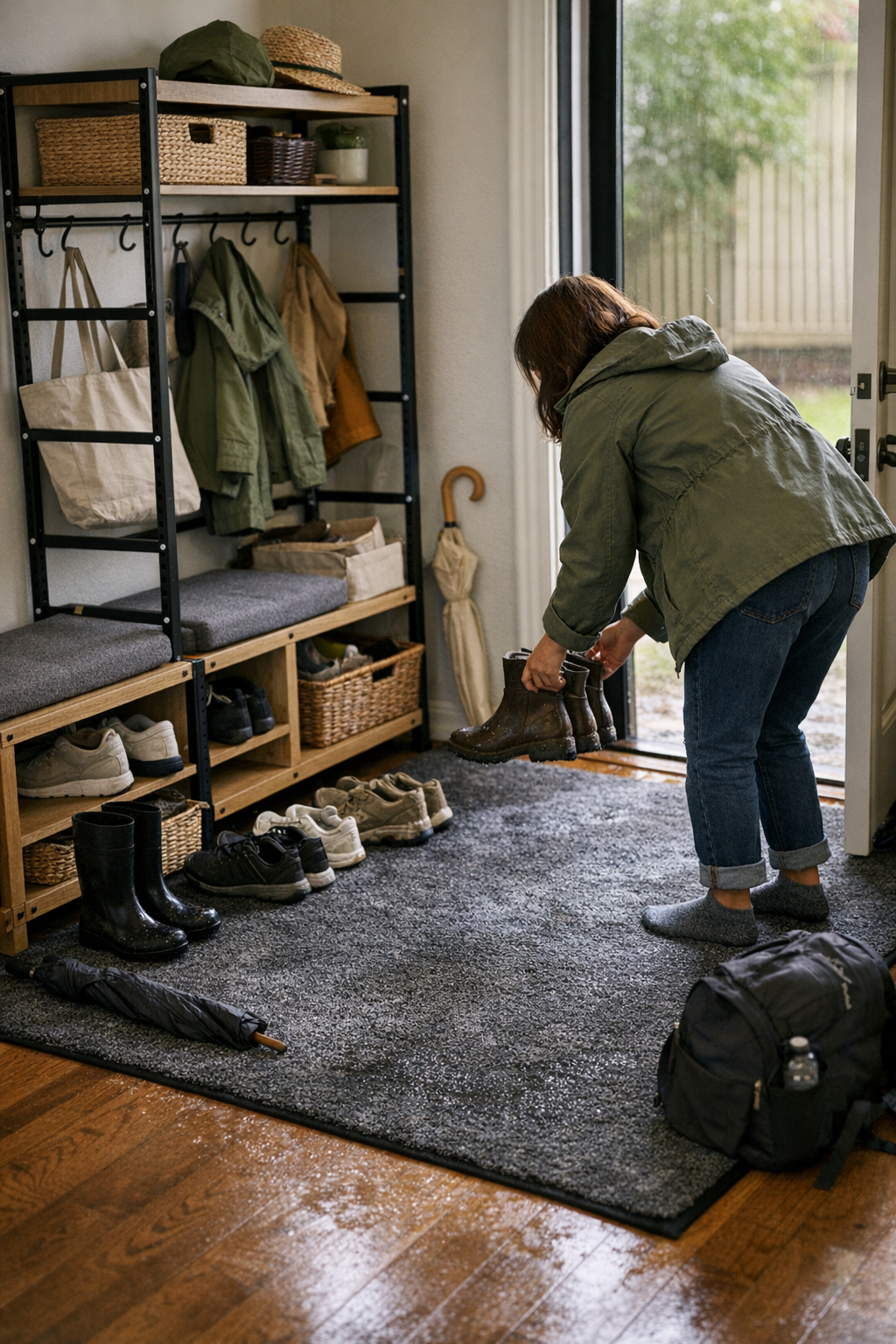
    Entryways fail fast when weather hits. By day three of rain, your so-called organized threshold starts showing real cracks: shoes nudge past the mat, water sneaks onto bare floors, and that thin “clean zone” fades under the strain of repeated comings and goings. Resetting the area is no longer just setting shoes straight—it’s wrestling damp backpacks off half-exposed flooring, mopping puddles that spread under the bench, and dragging furniture back toward the wall after each scramble. What looked tidy on Sunday collapses by Wednesday, and the damage—swollen wood seams, gritty stains, blocked passage—grows stubborn. For most homes, entry routines reveal their weakest points long before you notice the repair bills stacking up.

    Where Entry Setups Fall Short—And Why It Matters Over Time

    Weakness isn’t obvious until the routine repeats. One thin mat and a bench give the illusion of control, but rain and traffic expose how easily the area slips out of order. Mats are too narrow, or set an inch too far from the door, so wet shoes push onto vulnerable floors by necessity, not choice. The first few users line up shoes neatly—but as each new pair arrives, overflow hits. Boots dangle off the mat edge; bags drop wherever there’s space, straddling mat and wood, leaking water just past your line of defense. The intended containment zone slowly becomes a launchpad for wet mess. Benches, meant for calm and storage, turn into overflow collectors. The routine that made sense on the showroom collapses in the real midweek rush.

    How Drift and Overflow Quietly Compromise Your Threshold

    It’s not the puddle you see—it’s what seeps and spreads at the edges. Bags, dropped fast, slide past a shrinking mat and collect drips that splash into seams, not just on top. Shoes drift outward, inching the mat off alignment bit by bit. What started as a defined landing zone blurs into a wet sprawl. By Thursday, you’re nudging the bench aside, drying corners you didn’t know were wet, and awkwardly stepping around piled shoes just to get through the door. Oversight creeps in: a wall shelf holding hats can’t stop shoes from drifting out, and a vertical shoe rack loses its utility if wet soles miss the mat entirely. Real trouble doesn’t announce itself—it builds quietly at the threshold, outpacing every “good enough” fix.

    Real Entryway Routines: Where The Weakness Shows

    Actual entry flow exposes every flaw. Four roommates arrive within ten minutes—each tracks in rainwater, forced to step past an already soft, saturated mat. The final person just punts shoes to wherever there’s a dry patch—usually bare floor. Meanwhile, that utility bench acts as both seat and overflow shelf, inevitably blocked by a dropped gym bag or a soaking-wet backpack slung over the side, trailing a cold puddle underfoot. Getting through isn’t smooth: you have to side-step, step over, or risk a slip with every pass.

    A “staged” entry—bench, crisp mat, and neat shoe pairs—cracks under real use. The visit of a single guest doubles shoe chaos instantly. You scramble to wedge things closer, but now there’s a finger of water inching under the bench and shoes crowding the wall. With every reset, the mental line between “clean” and “contaminated” gets grayer, and the illusion of order erodes. By the end of the week, floor damage sets in quietly, and the sense of reliable structure gives way to just hoping the weather changes.

    The Anatomy of a Functional Wet Mat Zone

    Containment—not appearance—keeps damage in check. The real threshold needs a mat zone that meets the mess head-on: covering the full landing space, anchoring through scrambles, and defending the most-used footpath. Core requirements for real performance are:

    • Width: Run wall-to-wall if possible, or cover at least the span needed for all daily shoes side by side. Any shoes past the edge? Your mat is too narrow—water will escape and multiply cleanup.
    • Depth: Three feet minimum from door, so no one steps off early. Less, and you lose coverage as soon as two people arrive or one pair of boots enters the mix.
    • Placement: Position so that the first wet step lands squarely on the mat. Any gap—inches matter—means floors take the brunt before the mat even gets a shot.
    • Absorbency: Choose mats built to trap water and grit, not just show a greeting. Lightweight or purely decorative mats only move the problem into the next layer down.

    What Happens When Mat Zones Miss The Mark?

    Failure creeps in subtly. Shoes stacked just outside the mat gradually soak into the wood. Overflows at corners morph tidy resets into drawn-out routines—first a quick tidy, then a scramble to mop unseen wet spots under the bench, then a fight with warped seams. Wall storage or racks lose all value if the “zone” isn’t big or sticky enough to hold daily items in place. Once the floor feels spongy or seams ripple, you’re past routine fix and staring down repairs. Small flaws, repeated unnoticed, snowball into big cleanup and bigger costs.

    How A Well-Sized, Well-Placed Mat Changes The Routine

    A high-absorbency, boundary-hugging mat stabilizes chaos fast. Every shoe finds its place—there’s no room for drift. The border is visual and physical: you feel it with every step in and out, and stray water has nowhere to hide. Instead of crawling after hidden damp or lifting the bench to find secret puddles, a quick visual check shows you exactly where to reset. Lining up shoes post-rush becomes a matter of seconds. The difference isn’t aesthetic—it’s operational. Routine doesn’t require a rescue, just a practiced pass.

    Even on soaked days, a wall-to-wall mat holds the line: bags drop onto a defined strip, shoes stay sorted, and bare floor keeps dry the way you intended. Overflow pressure softens—multiple arrivals don’t overthrow the setup, and latecomers aren’t forced to improvise directly onto clean wood. While absorbent mats still hit their limit during heavy storms, the broad zone keeps water from spreading, and routine resets don’t spiral into full recoveries. The entryway acts like a true buffer, not a shaky first impression.

    Tips From Real-World Use

    • Measure the mess, not just the space: If you spot shoes or bags just outside the mat after busy days, your zone is undersized. Size up or place multiple mats where drop patterns split—cover the real spillover line, not just the visual one.
    • Time your reset, not just your cleaning: After the busiest return of your week, clock the full reset process. If you’re moving benches or drying where you can’t see, your layout isn’t holding up to actual flow.
    • Block off spill points directly: Shoes cluster at corners, or water creeps under furniture? Set a threshold bar, a distinct rug edge, or a shallow tray—clear physical boundaries tighten up routine and limit mess spread without daily micromanagement.

    Why Most “Organized” Entryways Don’t Hold Up—and What Actually Works

    Magazine-ready entryway setups hide weak links when real use kicks in. The actual pass-or-fail moments aren’t the staged photo or the clean Sunday—they’re back-to-back arrivals, muddy dog sprints, kid runs with raincoats dripping onto every surface. Decorative mats and narrow layouts flatter guests but unravel under pressure. Anchored, high-absorbency mats (sized and placed for your true routine) block, catch, and hold up against repeated friction that porous solutions can’t touch. Betweenry storage that fits the movement—modular, resistant to drift, and designed for reset speed—makes the entryway work beyond appearances. A setup matched to actual behavior is what keeps everything moving, not just looking sorted for visitors.

    Ultimately, form isn’t enough. Choose structure and placement with repeated entry routines in mind, and your entryway becomes the one part of the house that quietly stands up—rain, boots, bags, and all.

    Shop Betweenry transition-space solutions

  • How Pet Travel Gear Design Impacts Noise and Handling Efficiency

    The illusion of a “ready to go” pet carrier collapses the first time you fumble for wipes after a bathroom break—with your dog getting restless and the cleanup kit buried at the bottom. What feels organized at home can turn clumsy in the car or at a rest stop: bowls that disappear under a seat, leashes clipped awkwardly out of reach, or essentials wedged beneath a pile of comfort toys. Each stop, each shuffle, and each attempt to grab the right item on the first try exposes friction points that a tidy setup can’t hide once you’re actually moving. If you’ve ever reloaded a pet carrier in a parking lot and wondered why it feels messier than it looks, you’re already living the PawGoTravel problem.

    Where “Organized” Looks Can’t Keep Up: Real Travel, Real Friction

    Tidy means nothing if it’s not workable under pressure. You leave the driveway with every zip closed and every item stacked, but that neatness unravels during real movement—pulling the bag out quickly for a leash, or grabbing wipes without waking your pet. It’s always the same flaws: gear sliding, pockets blocked, the item you want trapped by the ones you don’t need yet. What starts as orderly becomes a scramble with every fast exit or seat-side reach—a setup that defies its own design once real stops begin.

    Repeated Stops Expose the Same Weak Points

    Pet travel isn’t a single stretch. It’s a pattern of short drives, quick breaks, rushed errands, and pauses that stack up. The same snags keep coming back: digging for a snack under tangled straps, flipping the carrier for wipes that migrated to the bottom, or fighting with a clasp that gets caught at an angle—again. Each pause turns into a mini obstacle course instead of a quick “grab and go,” and the routine never gets easier until the friction point is finally fixed.

    Reaching That One Item—Again and Again

    If the cleanup gear takes two hands and a full bag shuffle every single time, “being prepared” just means repeating the same drag. Wipes deep in the corner always cost you time and patience; a bowl wedged under a layer of toys means your pet waits while you dig—and the sense of having “just what you need” doesn’t survive more than one stop. Repetition reveals real usability, not first-glance order.

    Seat-Side Moments: When Access Matters Most

    Your pet’s calm travels with your flow—or breaks with your fumbling. A smooth rhythm is undone when you have to dig under owner wallets or shift a tight compartment for basic gear. These small, silent frictions—gear that blocks instead of helps; a storage trick that seems clever until it slows you down—add up. Restarting motion after a pause is when good setups prove themselves, and cluttered ones make you start over, each time less smoothly.

    Cleanup Gear: Present but Out of Reach

    No one forgets wipes or bags. The real problem is when everyday solutions vanish behind layers: wipes sunken behind soft gear, cleanup pouches wedged just out of reach. Instead of saving the day, your “well-packed” kit becomes a tangle—forcing you into awkward stretching, upending half the carrier just to fix a minor mess. A setup aimed at less visible clutter can still trade speed for neatness, and the cost shows during every routine stop.

    Comfort Items: Help and Hindrance

    Travel blankets, chews, or favorite plushies offer comfort—and instantly block access when stacked on top. That item calming your pet for the drive can slow your every reach, as you carefully move it off seat-side essentials. The same soft touch that keeps a pet settled often becomes your next hurdle, repeating with every stop-and-go and quietly interrupting what should be a quick restart.

    Why Small Setup Tweaks Change the Trip

    Switching from “most organized” to “most reachable” is where pet travel feels different in real use. Move a wipes pouch out of a deep pocket and into a zippered side slot, and every cleanup turns into a barely-noticed motion—three seconds, no searching, no reshuffling. The gear didn’t change. The placement and access pattern did—and that’s what cuts repeat friction. The ugliest bag can outperform a “showroom” carrier if you can actually reach what you want on the first try, at every pause.

    Experience Teaches What Looks Don’t Show

    Any setup that survives the first trip can still fall apart on the second and third. Treats end up under heavy items, the leash toggles in a spot that made sense only when you weren’t in a rush, and essential wipes wind up buried again. Noticing a single repeat snag—then fixing it—has a bigger impact than buying a flashier carrier. Real travel rewards those tiny, practical changes that pay off after multiple stops, not just on launch day.

    Repeated Movement, Less Disruption: Seeking the Right Balance

    There’s no perfect setup, but small, friction-cutting improvements save minutes and headaches. Better travel gear isn’t about max storage—it’s about smart splits: stable storage for what you won’t need until arrival; easy-access slots for the things you’ll reach for again and again. You know it’s working when you stop pausing, sighing, or shuffling gear mid-trip—and your pet feels that steadier, calmer transition too.

    The difference is blunt: Less fiddling, more moving. The calm comes from setups that shrink repeated tension, not ones that just hide clutter for one photo. Every tweak—moving a pouch, untangling a section, or choosing a layout that matches real stops—converts daily travel from “nearly works” to “actually fits.”

    Get more practical solutions for real-world pet travel at PawGoTravel.

  • How Dedicated Cable Paths Transform Your Workspace Efficiency

    Cable clutter on a workstation is rarely dramatic until you try to move—then it turns into an invisible snag that never quite leaves you alone. A single charging cord scraping the back of your hand, a mouse cable catching under a chair wheel, a notebook teetering on top of a wandering USB line: these are not one-off irritations. They’re the background friction that keeps desks from actually working smoothly, slowing down every reset, every device swap, and every return from a break, no matter how neat the surface looks at first.

    The break point isn’t when the desk looks messy, but when the setup refuses to cooperate the second time around. Grabbing a charger only to find it blocked by a drawer, dragging a cable as you shift screens, or getting your foot snagged on a charging line—these moments expose cable drift as more than cosmetic. They slow you down when you’re switching between notebook and keyboard, reaching for storage, or rolling your chair back after a long stretch at the screen. The pain point isn’t visual disorder; it’s friction in actual, repeated work.

    One neat surface, many hidden problems

    A fresh desk might look clear: cables tucked behind the monitor, no wires on the writing surface, floor empty beneath your feet. But regular use quietly reverses that order. Every loose wire is a repeat offender. Cables slouch back across the drawer you need, twine around chair casters, or creep onto your note-taking area. What seemed organized at setup becomes a scramble for a missing charger or an impromptu untangling session just to clear the way for actual work.

    Contrast this with a workstation using under-desk trays, adhesive clips, or cable boxes anchoring every line. Instead of improvising, every cable returns to a single, predictable route. There’s no hunting and less hesitation; your hand knows where to reach for a charger or USB line. This isn’t just tidy—it’s a shift in desk behavior. Especially in tight setups, or when opening a drawer or accessing storage interrupts your main workspace, reliable cable routing stops these hidden derailments before they build up.

    The moment friction accumulates

    Routine device switching is where cable chaos multiplies. If you’re moving daily between monitor, laptop, phone, and tablet, even a morning’s cable neatness will break down by lunchtime. Suddenly, a charger has slipped beneath your notebook, a headset wire weaves through a chair leg, or an extra line blocks access to an under-desk drawer. Each choice to let a cable dangle or drift is paid for when you have to dig a line out from under a pile or—worse—when you move hardware and find three different wires bunched up, yanking at the power strip.

    Every disruption stacks up: drawers jam against loose lines, unplugging means shifting two other cords out of the way, cable piles sabotage even small resets. The supposed ten-second fix takes five times as long—and the more hardware shifts or accessories you add, the more this drag grows persistent, not just annoying.

    Repeated resets expose the flaws

    Desk friction doesn’t hit all at once; it wears you down in increments. The first day, you barely notice pausing to clear a cable from a drawer’s path. By the end of the week, every switch—webcam in, monitor out, notebook on, new device plugged—demands a micro-reset just to keep the desk working. It’s not hours lost; it’s dozens of tiny interruptions that undermine focus and make the space less reliable, less ready every time you sit down.

    Setting one fixed route: a real-world upgrade

    At a certain threshold, clever arranging stops working—what you need is a structural fix. In practical terms, this means installing a cable tray right beneath the desk’s edge, wide enough to handle all major power, USB, and display lines. Every cable threads through the tray, emerging at one deliberate, reachable point—often at the monitor riser or the side most accessible while seated. The logic is simple: one repeatable path beats endless improvisation.

    This reroutes daily movement. No more cables yanked by your feet or chair, no extra time spent untangling after moving a monitor. Under-desk clearance improves, so legs don’t bump into bunched wires and chair wheels roll free—a daily nuisance, especially if your setup is shallow or doubles for multiple uses. Sitting back down after a meeting or break, and finding every cord exactly where you expect it, is a quiet advantage that stacks up over time.

    Common questions about cable control

    How can I keep cables from encroaching on my work surface?

    Force cables into a strict route. Use under-desk trays or adhesive clips, and make sure both entry and exit points are fixed. Take away a cable’s freedom to stray, and you strip out the cause of clutter—both seen and felt.

    Isn’t hiding cables behind the monitor enough?

    No. Cables stashed behind the screen usually find their way back out, jumble with bricks, block air flow, or smother ports. The first time you need to swap a device or reset the setup, the hidden nest is two steps messier than what you started with.

    How often will I need to adjust my cable setup?

    There is no “set and forget.” Any time you add, remove, or swap gear, you’ll want to assess and update what runs where. Rigid cable trays and cable sleeves make these tweaks smoother—far better than scrabbling to push loose wires into place after every change.

    Workstation behavior, not just appearance

    The difference between a desk that works and one that looks organized but fails under pressure is how resilient the setup is to routine disruption. A fixed cable route doesn’t just hide mess; it means the work surface is always ready for action, not waiting to be reset. Drifting, cluttered cables don’t just spoil appearances—they actively resist efficiency, making every minor reset slower and every return to work less automatic.

    This is not a small ergonomic footnote: cable control directly shapes whether you can reach the keyboard edge to jot notes, slide a chair cleanly, open a drawer, or actually reset the desk quickly. The risk isn’t just tangled lines, but bent USB heads, pinched power cords, or a good chair blocked by bundled mess every time you adjust your sitting position.

    The best-looking workstation is almost never the best for real work if cable behavior is ignored. Setting a path for every line—power, USB, display—silences the drip of micro-disruptions that pile up with each device change, drawer open, or chair reposition.

    If your setup involves frequent device swaps, compact desk depth, or demands clear reach paths for storage or open space, disciplined cable routing isn’t an aesthetic upgrade: it’s baseline infrastructure for rapid resets and steady workflow. Every time a charger drops behind a drawer, or your chair gets stopped by a cluster of wires, that isn’t just a nuisance—it’s a red flag. These are real, solvable signals that the workstation can do better with a structural change.

    Explore the full WorkBasic collection

  • Why Purpose-Based Storage Zones Transform Garage Efficiency Over Time

    There’s a rush that comes with a freshly arranged garage or workshop. Racks finally bolted level, every bin matched and snapped in place, the floor swept and tools lined up in satisfying symmetry—for a moment, it feels like you’ve unlocked a new system, one that will keep chaos at bay. But then Monday turns up. You’re halfway into a fix, lugging in supplies or cleaning up after a project, and the honeymoon is over. Suddenly, that pristine arrangement starts showing where it truly holds up—and where it quietly slows you down.

    When Storage Looks Tidy But Movement Stalls

    The biggest trap for any organized garage or workshop is this: storage that solves “the mess” but creates frustration beneath the surface. On the outside, rows of identical bins and matching cabinets promise order. But come cleanup time, you find yourself hesitating. Did you stash those screws in this bin, or the next? Now you’re prying open lids, swapping trays, and replaying last week’s logic. The uniform look is clean, but your actual movements are anything but efficient.

    Worse, when items are sorted simply by what fits—rather than what actually belongs together—things get muddled. The shovel sits next to a lug wrench. Extension cords end up jumbled with socket sets. And the solution? You shift a cart just to get to a shelf (again), or find yourself stretching awkwardly around a cabinet edge for something you need with one hand full. The wall might be lined, but it’s not working with you. And the floor—meant to be clear—becomes a holding pen for whatever doesn’t click neatly into your “system.” Every small stumble—overflow piles, blocked shelves—chips away at the smooth routine you set out to build.

    Where Uniform Storage Breaks Down in Everyday Use

    It’s under real, repeated use that most storage setups reveal their cracks. Sure, the matched system looks pristine and resets easily on a slow Sunday. But fast-forward to the next urgent repair or inventory restock, and you’re guessing which bin holds what, or which shelf silently shifted since last week’s cleanup. The ‘organized’ impression disappears as soon as you realize the rolling tool chest always sits in front of the one shelf you keep needing, but moving it means clearing a new cascade of piles every time.

    The friction isn’t dramatic, but it’s relentless. Over time, corners collect tools in limbo, shelves absorb loose bits that defy your labels, and one stray item—“just for now”—snowballs into an entire shelf of miscellaneous. An arrangement that started tidy drives micro-resets with every use: reshuffling, retagging, and backtracking. You don’t get obvious mess, but you lose easy flow—resetting the space becomes a sequence of small corrections instead of one satisfying action.

    Why Zones With a Single Mission Keep Work Flowing

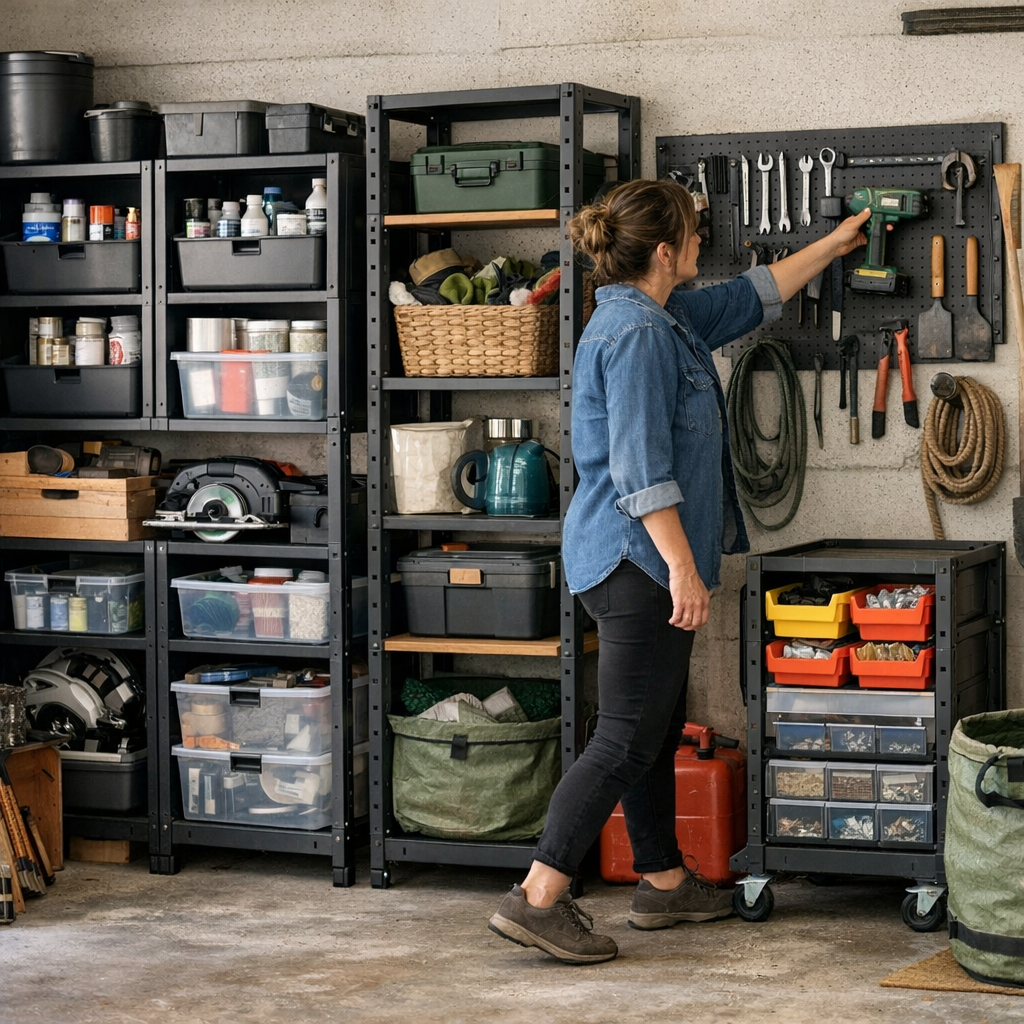
    The real breakthrough comes from trading showy uniformity for zones with one job each. It’s about function that fits the way you work, not just the way your hardware store display looked. Assigning a clear role to every section changes the pace. One wall becomes the tool area—shears, trowels, hand tools together, nowhere near the paints or power tools. A sturdy cart turns into the fastener hub: every screw, bolt, nail sorted by size, not just tucked away “somewhere.” Suddenly, movement gets automatic—returning an item means you already know exactly where it belongs. No more flipping labels or opening every bin to guess. The system works at the speed of your memory, not its appearance.

    This doesn’t demand elaborate label schemes or color codes. Sometimes the fix is the opposite: let the rows get asymmetric if it means categories stay sharp. Painting supplies isolated on their own high shelf. Garden hoses in a rolling bin that migrates with the seasons: near the door for summer, stashed out of the way by winter. Purpose-based zoning does more than tidy up—it warns you before overflow happens and keeps your everyday reset as simple as a single, deliberate motion.

    Spotting Early Warning Signs Before Zones Blur

    Pay attention to hesitation—when you reach for storage and stop because the “right” spot is suddenly unclear. One week it’s a drill that lands with the brushes, next it’s sandpaper blending into a drawer of old tape. These small slips signal a zone beginning to blur. The fixes don’t have to be big: shift a shelf’s contents, toss up a clear label, or roll in an extra bin for short-term spillover. These micro-adjustments keep things from devolving into another corner of confusion and save you the giant reorganizational weekend you’d rather never do again.

    Real Scenes: How Zones Outperform Shelf Symmetry

    After the dust settles from a busy weekend project, you can spot the pain points at a glance. The floor cart holds an odd array—old hose clamps, garden wire, December’s windshield scraper, and a roll of painter’s tape from last night. The cart’s side, never meant for storage, starts acting as a drop-off zone—slowing every attempt to put something back. The wall rack hides the wrench you need behind two backup hammers and a pry bar set you never actually use. That clear front of “organization” is now just a veneer over awkward reacharounds and missed cues.

    That’s when the difference becomes impossible to ignore. Systems that actually work are not the showy ones, but the ones where returning something is as natural as grabbing it in the first place. Even as new projects shift what you need or the seasons change the supplies in rotation, a clear, purpose-based setup lets the rhythm stay unbroken. It’s not about filling every inch, but about minimizing excuses for stray piles and repeat reshuffling.

    Making the Area Work With You—Not Against You

    The real test of any setup isn’t an empty, photo-ready workspace—it’s how unfussy it stays after weeks of real-world use. If every zone leads you instantly to the right move—no guessing, no side-stepping extra piles—then the routine clicks, especially on the busiest days. But if uniform setups hide all logic or demand daily dance steps to avoid overlap, most of your time goes to constant minor resets and workaround habits that never feel natural.

    The setups worth keeping are the ones you barely have to think about—the ones that allow you to work, clean up, and reset with barely a pause. The reward isn’t perfect looks; it’s real, persistent clarity. That’s why the simplest shift—ditching generic storage walls for clear, category-led zones—pays off well after the novelty wears off.

    Find practical storage and organization options for workshops, garages, and utility spaces at StackNest.

  • How Functional Storage Transforms Daily Routines Beyond Looks

    True storage success isn’t about how clean your closet looks on day one—it’s about whether the system still holds up once the everyday scramble actually begins. Most setups seem fine at first glance: baskets aligned, sweaters folded, shoes paired and parked. But real life is never still. Every weekday morning tests the system—blindly feeling for boots in a dark closet, digging past coats to find a single glove, shifting three bins just to fish out a gym bag. The difference between “organized” and genuinely functional storage is measured in these hurried, repeat-use moments that set the tone for the day.

    Everyday Storage Friction: Where It Really Shows Up

    The slow creep of chaos rarely shouts. It’s silent, steady, and familiar to anyone living with clutter that doesn’t start messy but slides there fast. By midweek, you’ve likely felt:

    • Stacks swelling to the edge of shelves, folded sweaters slipping into lopsided towers after just two grabs.
    • Baskets and bins losing their roles, turning from sorted categories to bottomless catch-alls—a winter hat tangled with outgoing mail, last week’s mittens buried under today’s scarf.
    • Entryways choking up with shoes and tote bags, making the only clear floor space the spot you’re about to cover with whatever you just walked in holding.
    • The daily shuffle and rearrange, where simply putting something away means sliding, restacking, and hoping it doesn’t all collapse by tomorrow.

    What’s subtle on Sunday becomes friction by Thursday. Small annoyances add up—each wasted motion tempting you to drop something “just for now,” setting off a chain of clutter that feels harder to undo every day. Unless the setup is built for this constant motion, it slowly loses shape and purpose.

    Surface Order vs. Real Function: When Good-Looking Systems Fail

    The right baskets, matching bins, and tidy shelves can fake order—for a while. But neatness doesn’t survive daily use if the logic behind the categories isn’t clear. Without firm dividers or visible boundaries, baskets slide into chaos: yesterday’s paperwork sinks beneath today’s scarf, and every search turns into a rummage.

    Open shelves are especially prone to slow drift. Placing things back never happens as neatly as the first time. Shoes inch forward. Sweater piles slouch left or right. Anything at the back turns invisible, impossible to reach without dislodging everything in front. The illusion of order erodes in minutes, and one hurried morning leaves the system looking ransacked until the next reset.

    Up Close: The Week in the Hall Closet

    Consider the overworked hall closet: wire shoe rack below, open shelving above. On Sunday, everything lines up. But by day three:

    • The front row of shoes has crept forward, cutting off access to any pair in the back row.
    • Snagging sneakers from the rear means balancing on one foot, removing boots, and causing the whole row to wobble.
    • Gloves have no clear landing spot—they’re draped over shoes or stuffed behind coats, gradually forming their own unplanned heap.
    • By Friday, you’re fishing for one mitten in a pile of hats, boots, and December’s forgotten lunch receipt—all layered and tangled together.

    Each “simple” grab takes longer. Every time you return something, the original order collapses further. The cost isn’t just mess—it’s lost time, extra effort, and frustration that leaks into the next part of your day.

    How Small Upgrades Create Lasting Categories

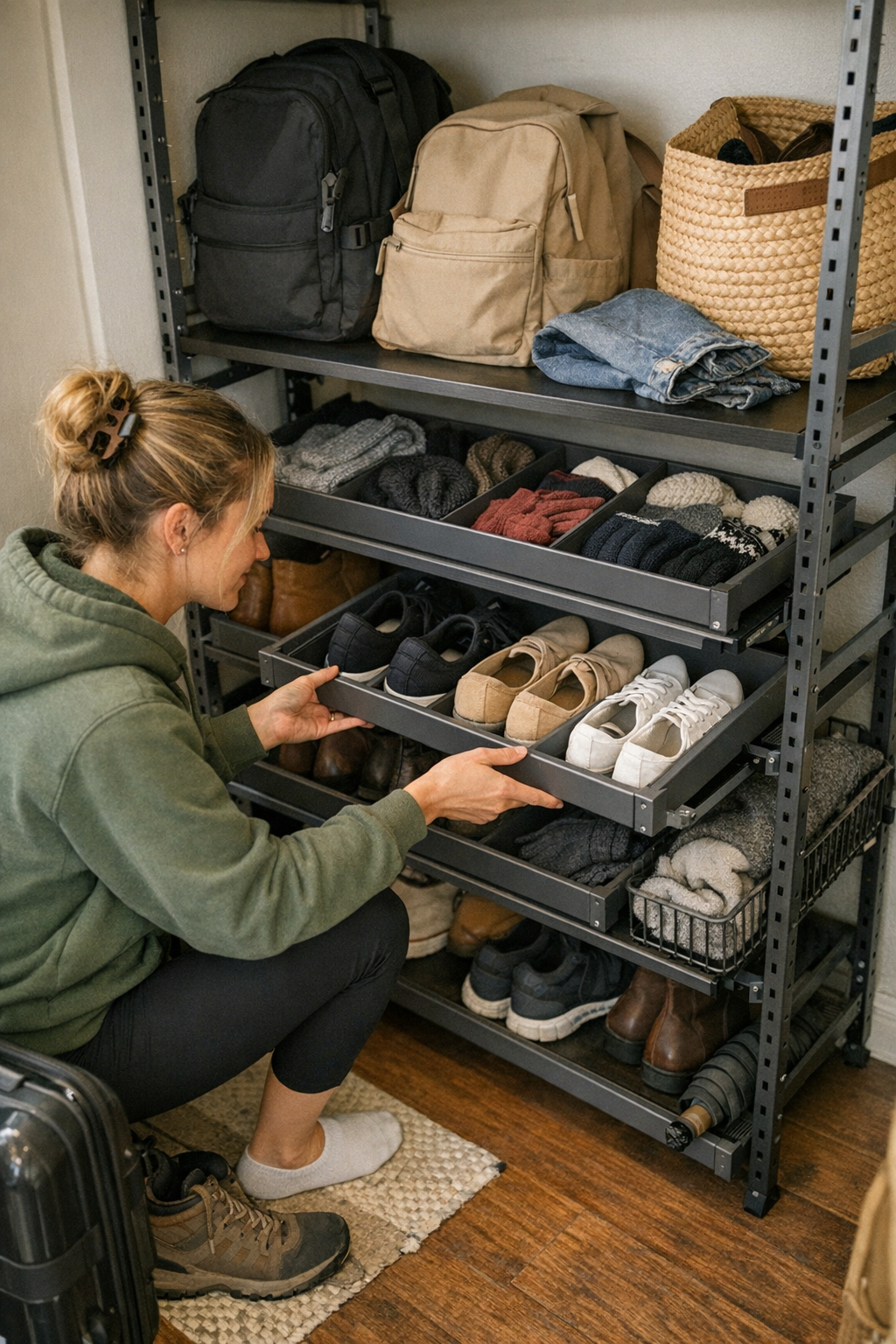
    Most friction in daily storage use comes from a lack of clear, anchored categories. Now picture that same crowded closet, but with shallow, pull-out trays segmented by adjustable dividers. Shoes each get their own lane. Gloves and hats land in labeled, see-through bins above. Suddenly, every item has a staying spot—even after repeat grabs:

    • Grab shoes without disturbing the whole row. No more digging or rescuing crushed pairs from the bottom of a heap.
    • Return gloves to a defined compartment, not a vague bin where patterns blur and items disappear.
    • Overflow is obvious—if a category fills, you see it instantly, rather than discovering the problem weeks later in a mountain of stray gear.
    • The closet not only stays visually together through the week, it feels reliable: no second-guessing what goes where or how much friction you’ll face Monday morning.

    This doesn’t require a full renovation. Sometimes, swapping a deep, mystery bin for a shallow, open-front tray—or installing one adjustable divider—shifts the whole routine. The way you move through the space changes. You stop double-handling items. The reset takes seconds, not minutes.

    Category Clarity: The Key to No-Guesswork Storage

    What works on Instagram isn’t always what lasts in a living home. The setups that endure are built around routines that repeat: pull, use, return—without thinking. If your system demands constant restacking or “resetting” means starting over each week, category clarity is missing.

    Test your setup: can you single out a category—a bag, workout clothes, winter hats—without touching everything else? If not, define a home for each frequent-use item. A shallow tray, a clearly divided shelf, or a set of labeled hooks can turn habitual clutter zones into permanent order. Ask honestly: are your keys, gym socks, or headphones actually within easy reach, or are you always fishing them out from behind something else?

    Tip: When In Doubt, Go Shallow

    Deep bins and thick stacks are hiding spots, not organizers. If you ever find yourself sifting, opt for storage that’s shallow and visible. The less you have to dig, the less mess you’ll make. Often the most sustainable fix is pulling out a bulky bin the system didn’t need and replacing it with a low-profile tray that leaves every item in plain sight.

    The True Test Is Reset Speed

    Clutter rarely explodes in a day—it creeps in when resetting the space starts to feel like work. When a storage setup lets you put things back in a matter of seconds, clutter never gets a foothold. Messes stay small, routines stay smoother, and your attention moves on to better things than tidying the closet—again.

    Watch out for these warning signs:

    • Category zones fading together—no one’s sure where anything belongs
    • Returning items that require three steps when one should do
    • Stacking, shuffling, and “quick fixes” becoming routine instead of rare

    If any sound familiar, the design is adding weight—not removing it.

    Function Over First Impressions—Every Time

    In homes that see real use, organization isn’t about staged photos or tidy surfaces that collapse under pressure. The right storage system holds steady through a full week of living: what you grab on Friday feels just as easy and obvious as it did on Sunday. Messes are brief, not embedded. The payoff isn’t just a cleaner space—it’s a smoother routine, less frustration, and a closet or entryway that fits the way you actually live.

    For storage solutions built for real routines, visit ClosetWorks.

  • How Open Shelf Bins Transform Pantry Organization and Speed Up Retrieval

    Every pantry looks organized for a day—rows of boxes, jars lined up, clean shelf lines. But let the week actually start, and those tidy setups show their fault lines fast. By Wednesday, what looked sorted is already breaking down: categories blur, someone reaches twice for the same snack, and finding the basics means shifting random overflow out of the way.

    The Disappearing Line: When Open Shelves Stop Holding Order

    Open shelves promise order by putting everything in view—cereal, grains, snacks all lined up neat. But visual calm doesn’t last past real use. Without built-in boundaries, every reach for oatmeal or a soup can slides something out of line. Groceries get restocked wherever there’s a gap, not necessarily in their old spot. Suddenly breakfast bars mingle with sauces, cans block rice, and what started organized turns into a daily search—especially in kitchens shared by more than one person.

    This drift isn’t dramatic, but it’s constant. One box moves left, a bottle tilts forward, a snack bag squeezes in sideways. Each day’s quick fix—just shove this here, just move that there—creates a new tangle. Over time, the shelf “system” dissolves. Finding what you need is slower, and putting things back rarely restores order.

    Routine Friction: The Hidden Cost of Unclear Zones

    The true issue is structure, not square footage. When shelf lines mean nothing, categories collapse into each other. Suddenly, pulling out the peanut butter knocks over spices. Grabbing flour means shifting coffee tins out of the way and guessing where the pasta disappeared to this time. The original category edges, once obvious, go missing in the shuffle.

    The pain points stack up in real use:

    • Second-guessing every grab because the “zone” for rice or soup is gone.
    • Dragging everything forward to chase down a single can, only to push it all back afterward.
    • Interrupting a recipe to look for what has slid behind bulk snacks.
    • Dealing with spills set off by balancing just one extra bag on a shelf that was already full.

    These aren’t disasters, but they repeat. Small delays multiply, clean-up gets more tedious, and the space only looks organized if nobody’s using it much. Put simply: easy access on day one fades into cluttered friction by day five.

    Enter the Open Bin: Setting Physical Boundaries Without Hiding Access

    Open shelf bins change the rules. Instead of a blank landscape of shelf, you get visible, physical zones—snacks in one bin, grains in another, cans with their own territory. Now, boundaries mean something. It’s not about looking nice—it’s about corralling drift before it starts.

    Physical edges do what shelf lines can’t: grab the grain bin, and you move the whole category in one motion, without bumping into oil bottles or extraneous boxes. Restocking gets clearer—lift the bin, see exactly what’s inside, spot hopeless drifters and reset them with one move. The open-top design keeps things fast: you see what’s missing, nothing gets buried, and there’s no wrestling with stuck lids or hidden surprises in the far back.”

    Shared Kitchens, Shared Success

    The bigger the cast, the more open bins matter. Different people see “where things go” their own way—open bins lay down rules everyone can follow. Misplaced snacks are obvious because they’re the only thing out of place. Return flow improves: even when rushed, most things land close to right. It’s not flawless, but the system recovers faster—and repair is built into the setup, not just the end-of-week panic sort.

    The Reset Difference: Faster, Less Frustrating Maintenance

    The crunch isn’t that the system fails, it’s what it takes to fix it. Before bins, resetting a pantry meant unloading half a shelf, reordering scattered items, and forcing things to fit. Fifteen minutes for a deep reset isn’t rare. With open bins, reset is, at worst, a few quick lifts and shuffles. Audit a whole category at once, identify drift, redistribute, and slide back. Spotting what’s off is natural, and three minutes later, order feels restored—without dreading the next round.

    Maintaining Bins, Not Fighting Clutter

    Bins can fail too if you ignore their boundaries. When “miscellaneous” becomes every bin’s theme, drift returns—snack overflow into pasta, breakfast bars hiding in the soup section. The fix: only let each bin have one clear purpose and correct small drift at every restock, not just at big resets. The less ambiguous the zone, the less mess you’ll face next time.

    Real-World Tips for Lasting Pantry Zones

    Fit bin sizes to how you actually restock and grab items. Bins need room to slide—leave about an inch of space so you’re not wedging bins out past shelf edges. Tight shelves turn bins into obstacles, not fixes. Choose mesh or see-through sides for instant inventory, or just label solid bins up front for the same effect. Skip lids for daily-use zones: open-tops keep everything quick and easy to spot.

    Multi-user homes benefit from a “misc” bin on a lower shelf, confined intentionally. This catches oddball snacks and orphan items before they corrupt the main zones. During regular cleanups, sweep these out to their right bins and reset—this tiny, fast task keeps your whole structure from unraveling under minor exceptions.

    Good Storage Doesn’t Eliminate Work—It Makes It Manageable

    Category bins don’t make daily life flawless. Some chaos survives: a rushed week, an unexpected haul, absent-minded returns. But the improvement is visible—order lasts longer, corrections require less work, and most of the routine organizing happens as part of use, not as a separate, dreaded project.

    With a true bin system, you see drift before it triggers a crisis, pulling things back into line with almost no resistance. Retrieval costs less effort, returning things feels obvious, and the shelf looks organized not just after a reset, but through a typical, messy week. Storage serves the routine, not just the setup photo.

    http://www.gridry.myshopify.com

  • How Consistent Stairway Lighting Enhances Safety and Comfort at Home

    Most stairway lighting failures have little to do with how a setup looks in daylight—or on paper. The real friction hits at the edges: a harsh glare that forces you to squint mid-step, a riser swallowed in shadow just when your hands are full, or cables that slip from tidy lines into your peripheral vision after a week of hurried routines. Stair safety can break down not from a lack of total brightness, but from sudden, jarring changes between overlit patches and hidden steps. If you’ve ever stopped short at an unexpectedly blinding step or tested the bottom edge with your foot, you’ve noticed how one lighting mistake turns every trip into a negotiation.

    Why Contrast Jumps Sabotage Stairway Comfort

    Stairway lighting is thrown into question the moment the light shifts without warning. One riser glares bright, the next fades into murk; a ceiling fixture beams overhead, but loses the last steps near the landing. Harsh, angled light can turn every descent into a messy test where your eyes scramble to process new edges. Instead of a quick, forgettable walk, you’re pausing, tiptoeing, and recalibrating step after step. A fixture that seems “good enough” on installation often becomes a weak link by the tenth trip—serving as a reminder that minor misfires add up daily.

    The issue scales up quickly: hesitate at a glaring patch, prod for a lost tread with a loaded arm, or flatten yourself to avoid a cable nudged loose by a backpack. Each small pause doesn’t simply interrupt the flow—it sticks in memory. What’s missing isn’t sheer power, but repeatable clarity—making every tread easy to find and each riser visible, whether your hands are free or you’re balancing a basket in low light.

    The Gap Between Looks and Daily Ease

    Many setups tidy up the appearance of a stairway only for repeated use to highlight the flaws. Common problems:

    • Ceiling fixtures—brighten the stair zone generally, but often flare overhead and fail to reach the first or last steps where footing matters most.
    • Wall-mounted lights—promise clean lines but can throw raking shadows, making foot placement uncertain, especially on textured steps or when shoes change the surface profile.
    • Handrail LED strips—read as gentle and indirect at first, but install one a half-inch off and foot shadows split the run, creating unpredictable dark bands.
    • Concealed cable paths—look crisp until a basket, vacuum, or coat sleeve nudges them crooked, sending a bright line sloping into view whenever you turn the corner.

    Small in theory, but as family routines layer on—kids darting, adults managing loads, the dog brushing a bracket—any slip or weak angle gets exposed faster than in a staged install photo. At corners and mid-flights, especially, even an “invisible” support can become the snag your hand grazes or the dark spot your foot second-guesses.

    Real Moments Where Lighting Choices Get Tested

    Picture the actual problem points: Evening, both hands full, you descend and the stairwell seems softly lit—until one edge disappears. Your step hitches as the next tread blurs into shadow. Instead of moving smoothly, you find yourself mentally repeating, “Don’t miss the next one.” It’s rarely about total output; it’s about unreliable step definition that forces a slower, distracted routine. At night, a bracket in the hand path, or a shifted cord, can be enough to break concentration and force a stop-and-check, even when the setup looked sharp at install.

    The difference reveals itself over days: an overhead fixture bounces glare into your eyes, or you start catching a cable edge when rounding the landing. Routines—finding a handhold, balancing a laundry basket, or guiding a half-asleep child—show where the setup unravels, one daily interruption at a time. Visual tidiness is quickly outpaced by the friction of repeated, real-life use.

    How Consistent Lighting Quietly Changes the Routine

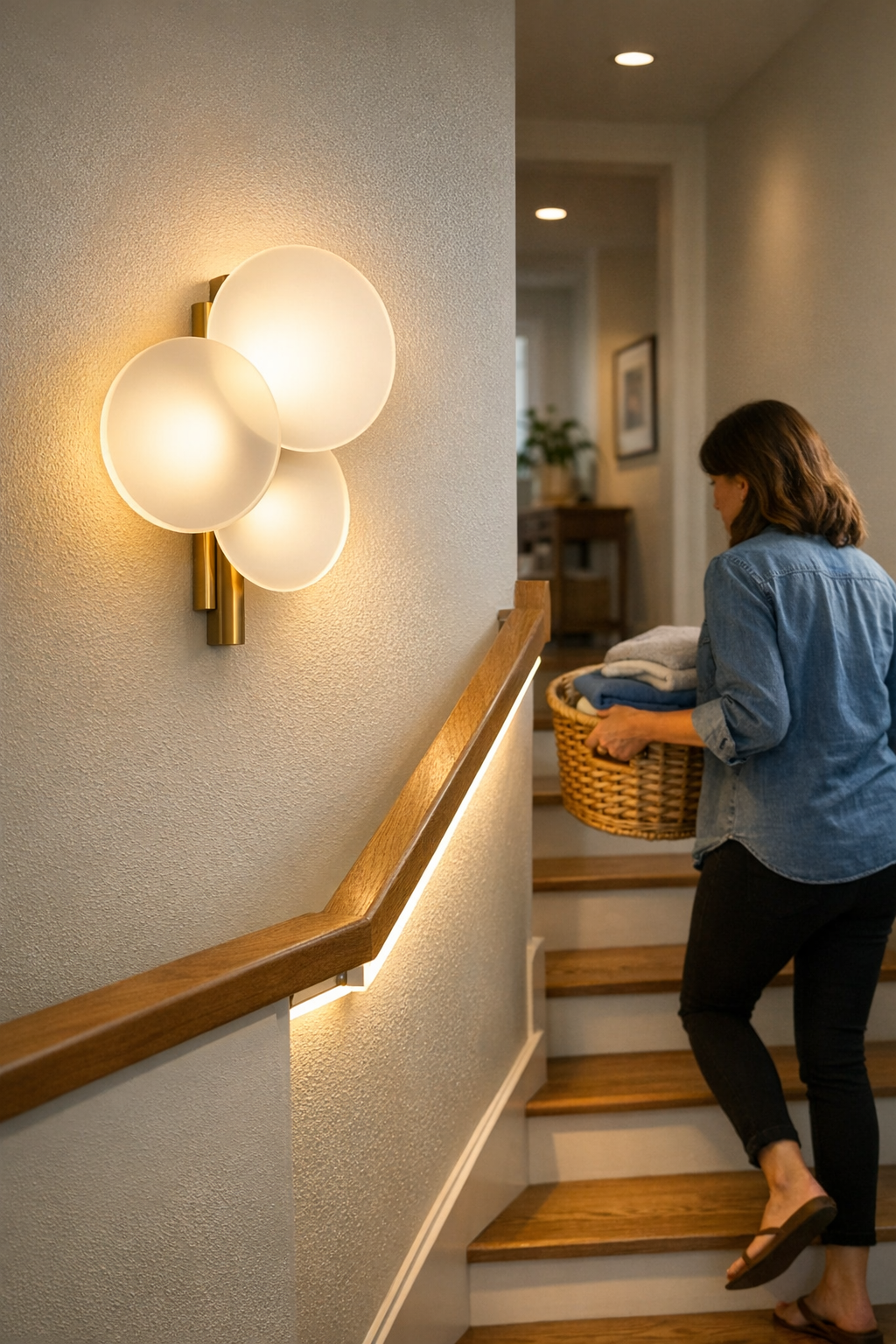
    Swapping scattered wall spots for a continuous, low-glare LED strip below the handrail rewires the experience. Placement matters—when the strip tracks just under the rail and avoids the sweep of the hand, the problem zones vanish. Over the first dozen trips, irritation fades: the last three treads, which vanished into shadow after dark, are now calmly defined even with both hands full.

    This isn’t a showy transformation—it’s a gradual erasure of small irritations: toe-searching for the bottom, swinging a basket for more light, or tensing for a missed edge. The reward isn’t drama, but the slow normalization of walking the stairs without a pause or second glance.

    Placement and Cable Management: Where Details Matter

    Brighter overheads may look impressive but introduce new contrast jumps where you’re least ready for them. Bracket placement that feels “invisible” when empty-handed can turn intrusive when you’re guiding a stroller or running late. Cables that aren’t locked out of every-day traffic migrate—sometimes into your sightline, sometimes underfoot.

    Field observations make a difference:

    • Blend cable covers to match nearby trim or wall, anchoring lines along existing seams or tucking them behind support brackets—making them nearly invisible and less likely to be snagged out of place.
    • Map cable routes out of the main walk path; even one exposed span at a corner attracts friction from backpacks or laundry baskets and slowly unravels a once-neat install.
    • Simulate real traffic—test both up and down, after dark and with full hands. What looks fine at install reveals friction only after a week of lived routines.

    Choosing Hardware for Real Life, Not Just the Blueprint

    There’s real value in a stairway where lighting and supports perform under pressure—where the right balance of clarity, unobtrusive cable routing, and bracket placement stands up to the messy rhythm of daily life. The solution that made the setup look done on day one can let hidden cables drift into view, or leave familiar steps in guesswork shadows, once the real routine kicks in. A bracket that “hides” at eye level may interrupt your grip on the 50th climb, not the first.

    The goal isn’t a perfect showroom finish—it’s fewer silent disruptions, fewer distracted hesitations with every trip, and a setup you stop noticing because it simply works. That kind of reliability outlasts first impressions.

    For more practical stairway lighting, mounting, and cable management solutions that hold up to real use, visit LightSupport.

  • Streamlining Travel: How Minimal Carry-Ons Can Hinder Your Focus

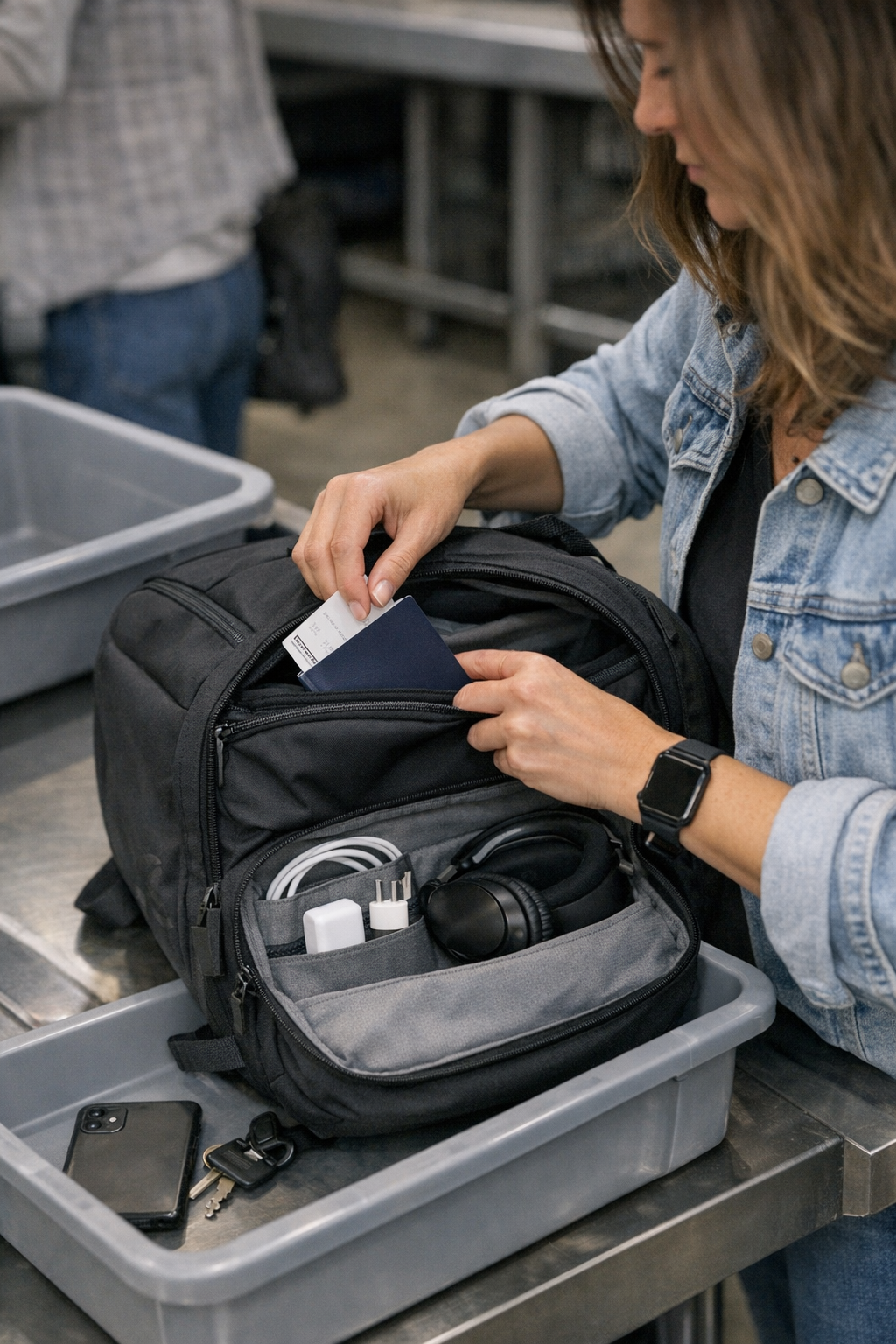
    Minimalist carry-on setups rarely survive real travel pressure without exposing new problems. A bag that looks streamlined at check-in starts to falter the moment you need your passport at security and your charger in the boarding lane. What feels sleek on the hotel bed—one compartment, two slim pouches—becomes friction in motion: cables tangled over passports, travel documents buried under headphones, repeated fumbles just to get through a checkpoint. The supposed clarity of “all-in-one” packing quickly turns against you during airport transitions, where every delay is magnified by a moving line, a crowded tray, or the pressure to clear the aisle quickly. Instead of efficiency, you get repeat interruptions—proving that a minimalist approach can quietly undo itself when the pace of travel speeds up and access demands become constant. Welcome to the overlooked world of everyday carry-on overlap, where CarryOnSupply products are built to target exactly this kind of real-in-use snag.

    The Problem with Minimalism in Motion

    One main pocket can’t separate your needs when it counts. Minimal packing looks orderly until you’re forced to access something mid-transit. After a single round of security-to-gate and boarding-to-seat, the promise of “less to sort” backfires. Every reach disturbs the whole setup: retrieving a passport tugs a USB cable loose, grabbing a charger shifts your boarding pass, returning your ID means you have to shuffle tech aside first. In fast-moving scenarios—security lines, impatient boarding groups, or the press of passengers behind you—each access becomes its own interruption, stacking invisible delays right when the pressure is highest.

    Real-World Delays Exposed

    The illusion of control breaks down fast in the security line. Open that “minimal” carry-on, and suddenly you’re balancing a phone, charger, cables, and passport in one hand while digging for a boarding pass that slid beneath the headphone pouch. There’s no solid surface. You’re juggling everything midair, hoping not to drop a travel document in front of tired strangers or security staff. Even when you zip your bag shut and it looks smooth again, you know the next move will mean repeating that awkward scramble—order outside, chaos underneath. No matter how well you started, the rhythm of repeated use exposes the gaps.

    Invisible Overlaps: When Simple Packing Loses Its Edge

    Slim setups hide messy trade-offs instead of removing them. As soon as the real trip begins, neat compartments blur—chargers slip into the document sleeve, paper edges stick to tech, and what started as two tidy pouches merges into one lumpy blend. That shallow at-home document pocket now folds under the thick reality of stamps, larger passports, extra passes. Reach for your ID and it drags out a cable, slow or silent but visibly annoying. Each movement becomes a micro-correction, chasing after a moment of order that looked achievable but keeps slipping under repeated shift and retrieval.

    Where “Order” Fails Under Real Pressure

    Boarding exposes every shortcut. As the line shuffles forward, you’re pressed to produce documents, headphones, and your phone in a space barely wide enough for a single bag. Suddenly, you need two hands and both elbows to get your ID or gate pass out without dropping something. Pockets overlap and items shift; what looked efficient now demands awkward maneuvers in front of an impatient crowd. Instead of flowing easily, you’re pausing in the aisle, hands full, bag slipping from your shoulder, grip slipping from your routine.

    Every Minute Counts: Where Bottlenecks Become Visible

    Between security and boarding, you might have less than two minutes to put your bag and yourself back in order. This is when small inefficiencies spread: pulling your phone from a shared sleeve tugs a charging cable free, picking out a boarding pass scatters headphones you didn’t intend to move. You look packed and organized, but real retrieval is always a step slower—or an extra shuffle deeper. With no spare surface and no privacy, there’s no easy repack until you reach your seat, so each tiny delay builds. By the aisle, three unnecessary steps now stand between you and your headphones, all thanks to a setup that was supposed to save time.

    Repeat-Use Weak Points Everyone Feels

    The test is never in that first clean pack. It’s halfway through the aisle, bent sideways as another passenger waits, fishing for a charger that’s slid beneath your passport. You pull one and the other comes, suddenly holding both in view of a full row—or worse, dropping them just as you squeeze past. Supposed minimalism has now turned basic access into a public juggling act, making every retrieval slower, messier, and harder to hide.

    What Actually Changes When You Split Essentials

    Layered separation isn’t more bulk—it’s less noise, fewer mid-journey resets. The first real fix isn’t a bag full of accessories; it’s separating core essentials by access task. Move your passport and boarding passes into a dedicated outer zip pocket—one you never share with tech. Group all chargers, cables, batteries into their own sealed pouch away from documents. The result: what you need appears in a single move, by muscle memory, with nothing else in the way. No more digging, no more items sliding out with every reach, no more juggling three tools to access the fourth. Even during quick tray dumps or cramped seat entries, the right thing comes to hand immediately, and everything returns to place without a repack routine.

    Streamlined on the Outside, Predictably Functional Inside

    You still keep that clean outside. But now, every repeated touch becomes direct—no friction, no mid-aisle struggle, no accidental repacking effort. That promise of minimalism is finally realized in function, not just form: no silent time leaks, no overlooked steps, no awkward trade-off between tidy and usable. Travel rhythm is restored. The smile is internal, but the flow is real—the moment where your setup actually makes movement easier, not just better looking.

    Find carry-on travel solutions that work the way you actually move at CarryOnSupply.

  • Reducing Cat Toy Clutter to Improve Home Flow and Daily Cleanup

    Scattered cat toys can seem harmless until they turn every normal routine—refilling the water, wiping a surface, even walking from one room to another—into a series of sidesteps and repeated pickups. What appears tidy after an evening sweep doesn’t survive a busy weekday: by midweek, balls and plush mice are once again blocking walkways, wedged under chairs, or parked right by the food dish. The problem isn’t the clutter itself—it’s the slow, constant pressure these toys put on daily movement, cleanup, and basic comfort. Every misplaced toy quietly borrows time from the next reset, and the “fixed” living room slips back into obstacle course mode before you notice.

    When “tidy enough” isn’t enough: The problem with toys on repeat

    Scattered toys rarely trigger alarm until they start breaking up every step of the day. A crinkle ball wedged under the table gets nudged aside out of habit; a fabric mouse appears at the hallway edge and is ignored unless someone trips. But the real snag is how these small interruptions never fully reset. By day three, you’re back to nudging toys in the way just to get to the water bowl, or pausing mid-routine to collect another hidden “surprise” from behind a dining chair. You might toss toys in a basket, line them against a wall, or sweep them away at night—only to find the pickup never lasts. The cycle always restarts: a buildup here, a concealed plush there, and the start of every task is delayed by toy rescue or detour.

    Over time, you realize you aren’t reacting to visible mess so much as ongoing interference. Each cleanup feels necessary, but the space is never truly “back to zero”—maintenance becomes a silent partner in every cat routine, outlasting your plan for order.

    Why keeping fewer toys out changes the entire flow

    Indoor cat homes tend to accumulate toys—some favorites, some ignored, others just passing through. Letting the pile grow seems harmless, but the more toys are left out, the more maintenance each day absorbs. After what feels like a clean sweep, stray toys quickly settle back in: lightweight ones slip under the sofa, others land right at a doorway, a few vanish until the broom finds them again. Each extra toy slows the next reset and shrinks the chance of ever getting an open floor again.

    This isn’t just about how things look. Rooms with too many toys get noisier and more distracting—cats dart between scattered options, play is less focused, and cleanup after each session sneaks into every other task. People end up choreographing around toy zones, not walking straight lines. Weeks pass before you notice that a “5-minute reset” now lasts half an hour—and even then, the room never quite feels open, only acceptably messy.

    The domino effect: Mess, missed resets, and creeping maintenance

    It’s missing one reset that pushes clutter from mild hassle to slow-moving headache. One night without collecting toys and you start the next day stepping over yesterday’s scatter: the blue felt mouse just reappeared by the water dish, three crinkle balls block the hallway, and any attempt at a quick floor wipe means kneeling, hunting, and prying toys from under furniture.

    As the accessible toy count climbs, cleanup becomes a drawn-out sequence—not just a toss into a bin, but a sweep, a reach behind plant stands, and awkward grabbing under tables. Each “put away” round gets unraveled the next day, the illusion of control replaced by a growing loop of scattered, returned, and scattered again.

    Interruption in the everyday

    This maintenance tax lands hardest in ordinary moments: grabbing the bowl and discovering a plush wedged in the path, hunting for spilled food only to find toys mixed in, or realizing a broom can’t reach another hidden ball behind the cabinet. Tiny inconveniences add up; movement is interrupted, rooms feel busier, and cleanup never fully disappears from the home routine.

    Setting a clear toy limit: Where small changes make the biggest impact

    Choosing a daily limit—three to five toys left out, with the rest tucked into a bin—flips the routine. Cleanup stops being exhausting and becomes a short, finishable step. The moment a familiar toy pops up where it shouldn’t—a blue mouse in the walkway, a crinkle ball at the foot of the stairs—it signals a one-minute reset, not a lost afternoon. Limiting what’s on the floor doesn’t mean less play, but it rebuilds control: people and cats share space again, paths stay open, and the reset after play is part of the flow, not a project to dread.

    Rotation keeps things interesting for both sides; new toys get swapped in weekly, favorites go back on the line-up, and every reset keeps the chaos from sprawling. The pile shrinks, and so does the temptation to leave half of it out “just in case.” Cats adapt quickly, resuming play with whatever’s accessible, and rooms stay clear for longer stretches without major intervention.

    Scene from the real room

    Test this for two weeks and it starts to show: the living room reverts from maze to open ground. Reset doesn’t mean crawling under the furniture—just a quick pickup, a bin within arm’s reach, and no more late-night hunt for the missing plush. Even if one stray toy sneaks out, it never tips the area into undoable chaos. Suddenly, “clean enough” actually holds for days, not just moments—less out means less to lose to drift, and resets snap back into place before the setup slides out of control.

    How toy limits help with other repeated home routines

    Strong toy control immediately lowers friction in other cat-home routines:

    • Feeding area access: You aren’t balancing dishes while nudging toys out of the way, or trying to reach the water bowl with a plush blocking the path.
    • Cleanup and wipe-down speed: There’s rarely a need to delay sweeping or wiping because toys are clogging under tables or mixed in with debris after a play burst.
    • Litter-adjacent management: Toys stopped drifting into the litter area, so there’s less cross-contamination and no accidental “burial” to discover during cleanup.
    • Shared space navigation: Family and visitors move freely—no more rerouting around surprise toy piles or toy-induced bottlenecks in doorways and halls.
    • Return and storage: Putting everything away is quick—just a handful each time, not a mass pickup, sorting, and reorganizing. Rotating in a new favorite is painless, not another excuse to delay.

    Keeping boredom at bay: Toy limits done right

    The worry that stashing toys might bore your cat rarely plays out. Cats tune into what’s new, not what’s abundant. Rotating through a small pool of toys resets their interest and keeps the clutter contained. Any toy reintroduced after a week becomes a novelty, often earning more attention than it did sitting in the pile. Track your cat’s favorites, switch out two or three at a time—and resist the urge to dump the entire toy box back on the floor. The bonus: the cleanup stays manageable and both play and order last longer.

    Practical resets: Reclaiming the routine

    For StillWhisker homes, the system stays simple: three or four toys left out, the rest up and away. If a toy crosses into a high-use walkthrough, pick it up immediately—it’s not a special task, it’s just part of real movement. After five days of this, resets don’t drag on, doorways remain clear, and the last sweep each night takes seconds instead of minutes.

    Measuring the difference: Not just tidy—truly easier

    The biggest change isn’t surface-level neatness, but a home that runs smoother. Walkways open. Cleanups no longer take over. Cat play holds interest without the usual trail of clutter filling every shared zone. No, resets won’t vanish—scattered toys still find their way out, and routines still demand the occasional hands-and-knees reach. But a hard toy limit means less maintenance, fewer broken flows, and a space that actually feels adapted for both cat and human routines—rather than always playing catch-up.

    This is how “just a few toys out” turns into reclaimed breathing room: walkways, play zones, and shared areas act as intended. The next refill, litter round, or floor wipe fits smoothly into the day, not around the mess. Setup matters—getting the right toy limit unlocks a home that still works after the routines pile up.

    Find more ways to make your cat’s space work for both of you at StillWhisker.