
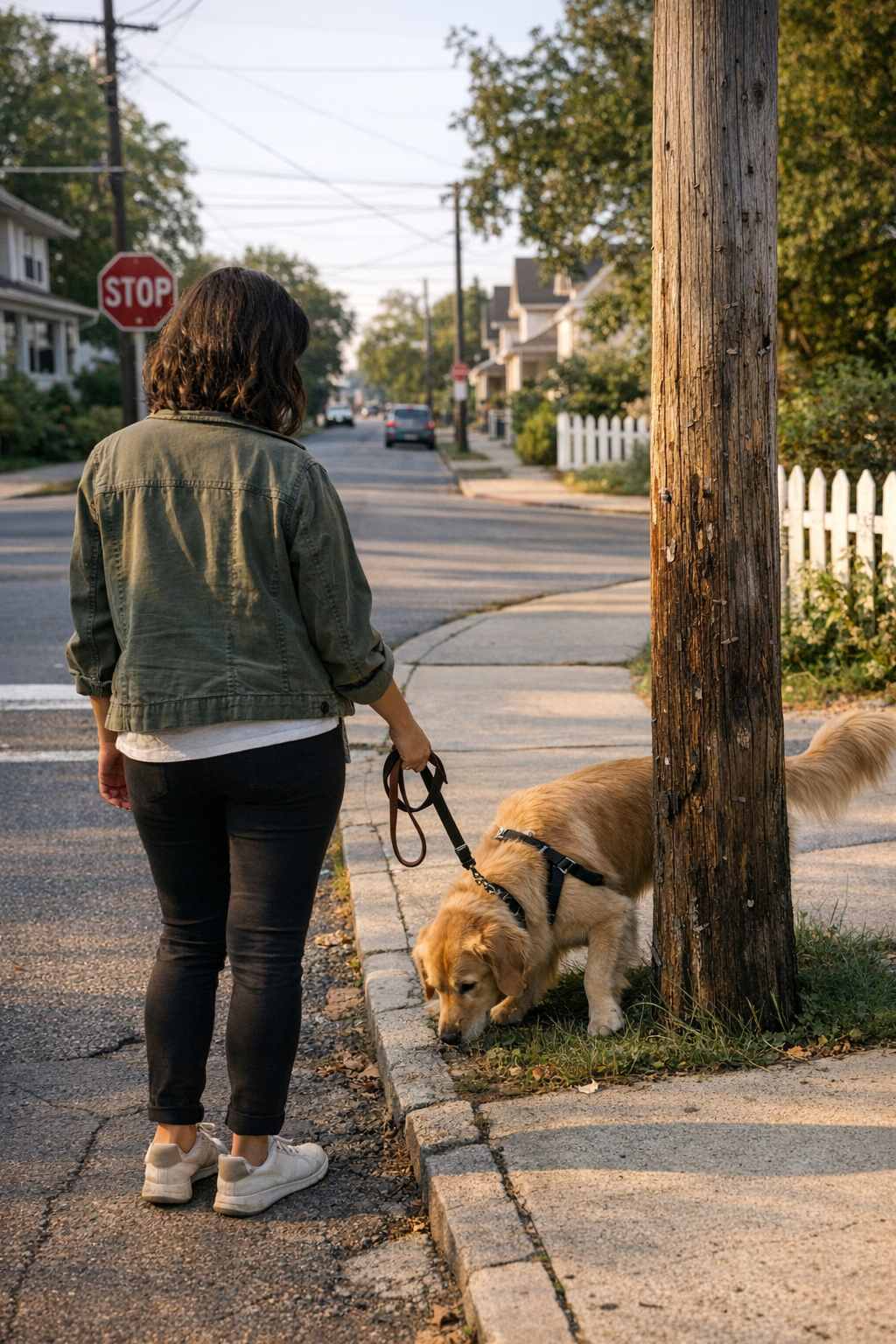
Here’s where most dog walks get derailed: you reach for the leash, a pile of bags or yesterday’s jacket blocks your hand, and by the time you nudge everything aside, the rhythm’s off before you even open the door. Out on the block—especially if it’s one you rarely walk—routine dissolves fast. You expect a steady, ten-minute loop, but a new scent, stray mailbox, or untamed hedge turns the walk into a constant reset: a leash tightens, your dog plants their feet, and you’re stuck juggling keys, treats, and a dog suddenly bent on investigating every inch of the unfamiliar street. It’s not chaos, but the stop-and-go churn chips away at any routine you thought you had. And the more it happens, the less you trust your own setup.
The Hidden Friction of Unfamiliar Streets
Most owners blame chaos on flukes—a racing squirrel, a delivery truck roaring by. But the real drag comes from small, predictable snags that only show up under repeat pressure. A dog that breezes down your usual block turns into an amateur detective just one street over. You see it immediately: on an unfamiliar route, every new smell, fence, or curbside distraction spawns a sudden stop or unexpected sideways pull. These micro-interruptions eat away at the pace you rely on back home.
Over a few days, the pattern locks in: the same weird corner triggers a nose dive, the same yard earns another delay. Your planned ten-minute walk now drags to fifteen. You feel this most in mornings—when time is tight—or evenings, when the next routine is waiting. Soon, you don’t just lose minutes; you start avoiding any route that’s not perfectly familiar, shrinking your dog’s world and your own patience.
Where Daily Walk Structure Cracks
No routine stays solid when small frictions pile up. You think you’re ready—leash in hand, bags tucked in a pocket. Yet a “quick” walk collapses into a mess of leash tangles, toy spillover blocking the entryway, or muddy paws tracked across the hall because the towel wasn’t where you needed it. Even when the gear is organized, the walk jams up on what’s missing: wipes just out of reach after a muddy patch, or a rest mat that blocks the crate right when you need to rush your dog back in from the rain.
It’s not just about new territory or distraction. The basic truth is that no system—no matter how neatly arranged—stays smooth if the walking pattern itself is fragile. The more unfamiliar blocks you test, the clearer it gets: when your leash hangs behind a coat or wipes are buried under toys, you feel the cost with every delayed cleanup or misfired reset. No amount of visual order fixes the breakdown when an awkward reach or misplaced item stalls you at the exact wrong moment.
Repeated Weak Points Surface
Friction exposes itself through repetition, not drama. The leash is ready, but wipes aren’t nearby when paws need cleaning; toys clog the walkway right as you rush out, forcing a shuffle; towels hang on a doorknob you can’t reach with your hands full. Each minor slowdown builds until you start feeling the weight every single outing. A single missed setup—a bowl placed where you always kick it, a treat pouch that slides behind the coats—turns what should be routine into a stumbling block you face again and again.
It’s not a mess problem—it’s a rhythm problem. The setup can look neat, but if the flow keeps breaking where you need it most, the routine never quite feels solid. Every pause at a new spot, every awkward grab for missing supplies, reminds you function outpaces form on real walk days.
The Accumulation of Small Delays
Count how many “quick” walks get bogged down by surprise: the dog halts at a mystery bush, a neighbor’s barking triggers a session of sniff-detective work, or a skipped wipe means muddy paws across your entryway. Each moment feels minor, but together, they erode your margin for keeping the rest of the day moving.
Owner habits collide with dog instinct. Telling your dog to “move along” or yanking the leash rarely solves anything—instead, the tension just sticks around and leaks into the next outing. Shortcuts backfire: the more you rush, the more stubbornly your dog resists. One missed reset leads to another—soon, you’re locked into a fight with the routine instead of flowing through it cleanly.
Busy Mornings, Thinner Margins
Nowhere does this snap more than on busy mornings. The leash tugs, your arms already full—bags in one pocket, keys in another—just as your dog hunkers down to investigate a new gate or unearths something in the grass. Every lost second negotiating a distraction stacks up, making the post-walk dash to cleanup or the next task even choppier. Instead of a reliable reset, it’s another piece of your schedule that runs off course.
Testing and Resetting Walk Structure
If you want your walks back on track, quit aiming for zero pauses. Instead, structure when the first pause happens. Let a new block or unfamiliar intersection serve as the designated “check it out” zone.
This isn’t just a theory—it changes how the routine feels. Enter the new stretch of street at the very start of the walk. Give your dog a single, focused minute to take in the scene. One planned investigation right away means less scattershot stopping later. Moving on after this first window (firm but fair) signals that curiosity is allowed—but only right here and now. Every block along the way isn’t another opportunity to restart the sniff cycle.
From Scatter to Predictable Flow
A seeded pause transforms the walk. Instead of random slowdowns tripping both of you up, there’s a clear pattern: “We pause here. Then we walk.” Fewer drawn-out tugs. More fluid progress. The push-pull tension between dog curiosity and owner schedule thins out. Within a few days, you get back a routine that feels smooth under repeat pressure—not flawless, but reliable enough to hold up even on offbeat routes or in rushed moments.
Adapting to New Routes Without Losing Rhythm
Sticking to the same loop solves nothing long-term—dogs need occasional novelty to stay engaged and flexible. But the real trick is not letting fresh ground wreck the rest of your routine. Letting one new stretch kick things off, setting a specific discovery slot, then snapping back to business removes the uncontrolled slowdowns that otherwise ripple through every “special” walk.
Planned structure protects both sides: your schedule gets a reset that doesn’t drag, and your dog’s curiosity stays satisfied without hijacking the whole outing. It helps your dog handle changes. It keeps you from dreading new blocks or post-walk cleanup. Once the pattern sticks, you stop shrinking your routes and start regaining control—even amid unpredictability.
Actual Routine Shifts, Not Perfection
Stick with the new front-loaded pause for a week—same total walk time, less scattered delay—and the improvement is obvious. Where a winding, unfamiliar block once spelled chaos, now it fits into the rhythm without swallowing the rest of the day. The flow won’t always be perfect: surprising distractions still pop up. But you gain a setup that bounces back instead of breaking down, and a walk that supports, rather than controls, the pace of daily life.
Why Flow Matters More Than Appearance
Neat rows of leashes, bags, and towels look good in photos. But routine tests don’t happen on camera. The difference shows after a storm: can you grab a towel one-handed to wipe muddy paws before your dog leaps into the hall? Do your bags run out without warning, forcing a scavenger hunt mid-walk? Has that entryway rest mat shifted so it’s now in the way instead of a help? In the real world, it’s not about looking organized—it’s about eliminating what keeps slowing you down, wherever it happens to pop up next week.
A walk that looks smooth means nothing if it keeps failing under new conditions. Functional setups let you handle the unknown—leash fast off the hook, wipes always visible at the door, bowls that never block your exit path. Every item’s placement, every habit’s structure, counts twice as much on repeat. If something seems just “okay” at first and then wears thin, that’s the spot to watch. The test is not if the entry looks clear but if your setup keeps friction out of your routine when the environment throws you a curve.
Resetting the Repeated Weak Points
Fixing the walk’s flow is only half the battle. As soon as you shore up one problem, another minor friction creeps into view—a treat pouch hiding underneath jackets, shoes blocking the entry, wipes migrated just out of reach. Every dog routine collects these traps: they’re not headline failures, just daily annoyances that add up. The real solution isn’t aiming for total perfection. It’s seeing the spot that keeps tripping you—and adjusting, again, before it becomes the norm.
Some friction never disappears, but a structure that works under pressure keeps making your routine easier, not harder,