
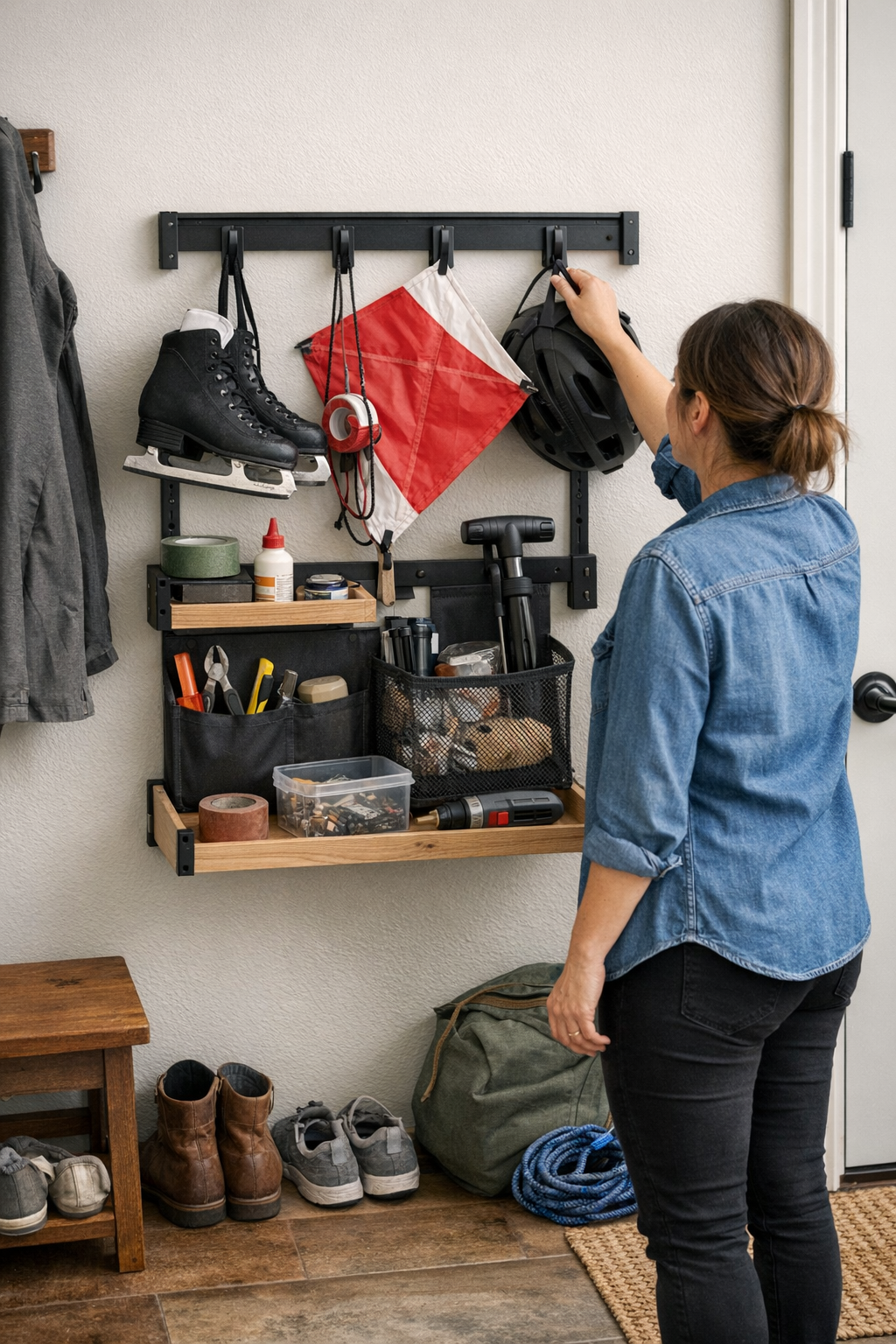
The entryway begins as a controlled crossing—clear path, shoes arranged, bench ready—but that order breaks down fast. One muddy boot, a loose drawer pull, or a busted umbrella lands by the door “just for now.” Soon enough, a catchall repair bin installs itself at the threshold. Meant as a temporary fix, it swallows loose ends and floor hazards—until it drifts from solution to stumbling block. This is how the zone that should absorb daily in-and-out ends up crowding every exit and return.
How the “Temporary” Repair Box Quietly Grows Roots
The repair bin feels only temporary at first—a spot for quick fixes, not a lasting fixture. But its presence invites creep. Sports gear goes in “just until Saturday.” Outgrown gloves and bags with mystery contents find a home. The bin spreads sideways, pulling in whatever is awkward to store or “on the list.” Now, grabbing your everyday shoes or dropping bags turns into a shuffle: move the bin, rebalance what’s stacked, hope nothing blocks the path. What should be a reset point at the entry becomes a bottleneck that slows every routine, with small items lingering for weeks and the weekday flow grinding against accumulated odds and ends.
Each pass through the entryway becomes a negotiation. The bin sits, a reminder and an obstacle at once—its bulk absorbs clutter, but also disguises how much backs up. Missed repairs layer with things you meant to move last week. Soon, rerouting yourself or nudging the container aside feels like part of the routine. The “quick fix” station becomes the main reason resets get skipped.
From Floor Calm to Daily Friction: Where Bins Break Down
Large containers promise control but breed hidden chaos. A rugged bin seems like a quick solve—sweep small parts in, lid down, problem gone. But unlike a sectioned wall rack, that big box turns into a mix of priorities: today’s broken umbrella, last month’s skate, a stray glove stuffed beneath. Every retrieval becomes a tangle—bend, dig, balance, and hope you don’t spill odd shapes or fine grit across the entry. The bin is no longer relief; it’s friction disguised as storage.
This friction accumulates in details: a shoe row nudged out of line, the bench edge re-claimed as overflow, blocked access to a hook or the pathway narrowing under a slow press of clutter. Even one return trip after work can mean swapping bags, shifting repairs, and feeling the reset get heavier every week. The illusion of order erodes as fast as you can fill a “temporary” container.
Real Use, Real Clutter: Recognizing the Signs
Most entryway backlogs show up without warning—and stay visible if you look closely:
- Blocked movement: If pulling shoes or dropping bags gets tangled with shifting bins, your entry’s flow is already suffering.
- Overflow turns semi-permanent: Forgotten repairs and off-season gear now mingle; last week’s projects have faded into the background.
- Heavier resets: What started as quick maintenance means excavating a pile, not a simple step. Retrieval drags; the space feels more closed off with each day.
It’s easy to catch yourself dropping a screwdriver “for now.” A week later, it’s wedged beneath boots from a forgotten season, and the bench has transformed into an overflow ledge. Everyday use chips away the utility of your transition space until it stores things well but supports movement poorly.
Why Slim and Sectioned Storage Changes the Game
Separation creates movement. Swapping a single large bin for an array—hooks for repairs, a slim wall pouch for small fixes—forces both visibility and action. Imagine a narrow entry: one wall, a bench, space for a quick change of shoes. Now, every pending “to-do” demands its own place. The broken cabinet handle hangs in sight until fixed, not buried. The loose skate sits on a dedicated hook, not blocking the shoe row. No more hunting; no more hiding backlog with a lid.
Limiting clutter to small, named spaces cuts the urge to blend categories or stuff new problems into old containers. Everyday items can return to their place without navigating a catchall zone. The entryway returns to what it should be: a pass-through, not a backlogged side project or stalled reset area.
Practical Tips for Beating Entryway Backlog
- Enforce a visible limit. Use only as many hooks, slim racks, or pockets as match your normal repair rhythm. If you rarely tackle more than two fixes at once, don’t install more storage than you’ll actually use.
- Keep clear divisions. Store off-season or non-urgent gear elsewhere. Let repairs live separately—the more visible, the less likely they’ll stall into long-term clutter.
- Design the flow, not just the storage. Every addition to the entry should feel lighter to retrieve than to ignore. Hanging or stashing a project should support coming and going, not add another step or pile.
The difference isn’t just aesthetics—it’s how easily you can spot what needs action and how quickly you can clear a reset without rediscovering neglected clutter. When every item claims a precise space, overflow can’t build. Your entry remains a route, not a dead zone.
Troubleshooting: Is Your Entry Storage Quietly Working Against You?
- Do resets keep getting slower as you relocate bins to open a path?
- Does your container conceal overdue fixes—masking problems instead of sorting them?
- Are you stepping over the same obstacles long after the “quick fix” was meant to be cleared out?
If so, your setup isn’t just storing objects—it’s storing delay. The difference shows up in lost time and daily frustration, even if the mess stays hidden until you have to move something in a hurry.
Restoring Real Entryway Flow
A transition space that works in real life isn’t about impressing guests or showing off neatness; it’s about how the area supports—and recovers from—every day’s cycle of arrivals and exits. Don’t let the temporary box dictate movement. Choose slim, split, or vertical storage that matches your actual use: every repair or “to-do” gets its own clear spot, so resets don’t stack up out of sight or spill into the path. Flow stays functional; reset pressure lifts.