
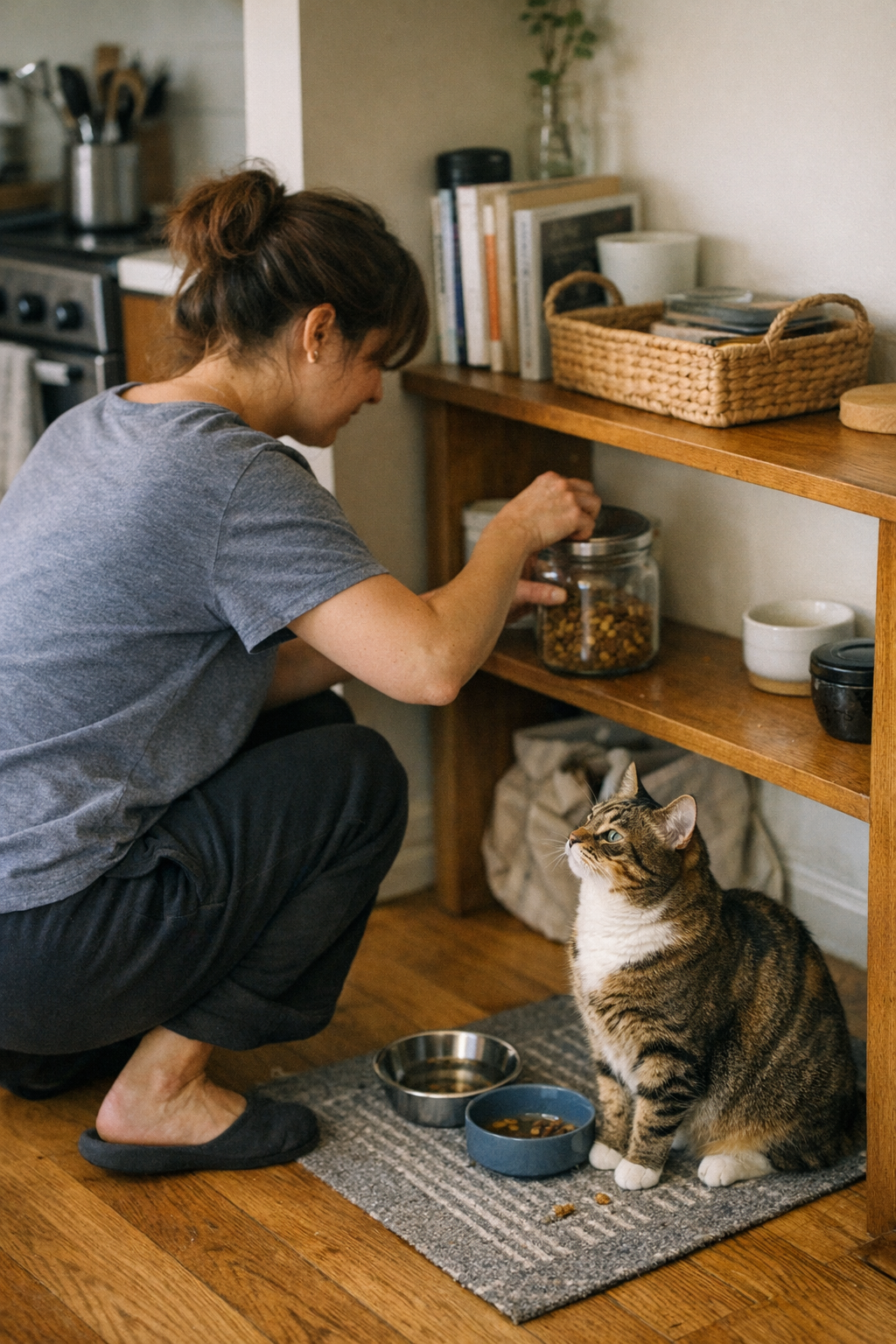
Rewarding your indoor cat for calm seems harmless—until it quietly rewrites your daily flow. What began as a quick treat for silence soon leaves you wiping up crumbs wedged at mat edges, steering around cats camping by the treat shelf, and slowing down every feeding reset for an extra cleanup pass. The friction is never dramatic, but the cost is visible: what should feel like a smooth, low-effort part of cat life quietly becomes a string of micro-interruptions—all rooted in how those “calm cat” treats fit (or don’t fit) the routine structure you already have.
When Positive Reinforcement Becomes Repeated Friction
Day one feels easy. You toss a bite-sized treat, no mess, your cat’s happy, and nothing slows you down. But by midweek, every treat handout is a new ripple. The bowl you once grabbed without thinking now drags attention—paper towels join the routine, the mat never seems fully cleaned, and you catch your cat posting up by the treat station with every kitchen pass. The surface still looks in order, but your routine takes more steps: a wipe here, a steered paw there, constant brief pauses that accumulate into low-grade resistance you can feel.
The wear shows up fast: instead of calming your cat and clearing space in your day, unplanned treat rituals scatter the flow—pulling you into repeated reset cycles that didn’t exist before.
Crumbs at the Edges, Interruptions in the Flow
The early symptom isn’t noise—it’s placement drift. Mats that needed a light wipe only once a week now show crumb rings after a day or two. Large or loosely stored treats break up, landing debris anywhere you handle them: slipping under water bowls, trailing past the litter corner, or grinding into walkways on the next step through. Suddenly, you’re chasing stray bits under the table or fishing a half-dissolved treat fragment from the hallway before anyone tracks it further.
Behavior Shifts: When Cats Anticipate the Reward
It’s not just mess. Most cats adapt quickly, turning casual treat locations—bowl, jar, open pouch—into points of expectation. By week’s end, you’re no longer steering the routine. Cats camp out early, start sidetracking you for every trip near the treat spot, and the “good behavior” you’re trying to encourage begins doubling as a quiet demand.
The effect isn’t dramatic enough to call disruptive, but it’s persistent. Each treat becomes a new mental negotiation: Do you pause to give in? Dodge around the cluster? Add one more thing to the reset list? Each answer takes a small toll on the day’s flow, replacing calm with low-level tension—extra time, extra reaching, a chain of decisions you didn’t need before.
What Really Slows Down the Treat Ritual?
Break the process into real-world sticking points and the weak spots jump out:
- The treat container slides behind dry food bags, making you hunt or reshuffle just to reach it.
- Crumbs tumble from counter to floor, requiring a sweep—or stick to socks and track through the kitchen before you notice.
- Water bowls placed too close to the treat area pick up stray debris, forcing an extra wipe or water change that wasn’t in the plan.
- Refilling anything near the treat zone now draws a cat who expects another handout, lengthening every chore into a mini standoff.
- Dipping into a pouch or bag leaves treat dust or oil on your fingers, nudging you toward the sink between each routine step.
No single detail is a household emergency, but these moments pile up—creating a pattern where the reward scheme quietly demands more maintenance, not less, even if outward order holds. A system that looked “set” now sprouts weak points at the join: longer resets, small interruptions, friction that lingers in your mind each time you round the corner.
Setup Structure: Where Routines Break Down—or Recover
The real leverage isn’t the treat—it’s how and where you deliver it. Small rewards can support calm, but there’s a reason some routines collapse and others run quietly in the background. Uncontained, “grab-and-go” treat setups lead directly to clutter and anticipation spirals; contained, structured delivery reduces both mess and the repetitive prompt cycle.
Treat Storage: Seal, Sightline, and Snoop-Proofing
Leave a pouch open on the counter and you’ll attract noise, spills, and a cat always listening for the crinkle. Contain treats in a jar with a calm, tight lid and you gain control in two ways: fewer stray crumbs, and less audio signaling to your cat that it’s treat time. A mid-shelf jar—high enough to put out of paw’s reach, low enough for you to snag without a stretch—shrinks the treat zone back to something neutral: not an invitation for clustering, but another tool at your calm home setup.
Treat Format: Bite-Size Wins, Mess Loses
Oversized treats fracture, scatter, or roll, spreading cleanup into every room you cross. Single-bite, compressed treats are easier to portion out, cut down on residue, and rarely end up wedged beneath furniture. You spend less time on your knees fishing for “just a crumb” and more time sliding straight through daily chores.
Routine Timing: From All-Hours to Predictable Pauses
The more random the delivery, the more cats hover and routines unravel. Tying treat handouts to anchored moments (after breakfast, post-evening meal, or only in the rest corner) makes “calm” treat time finite—not an open-ended negotiation. Your cat adapts within days, the clustering fades, and the rest of your living spaces start to feel less disrupted by off-schedule reminders.
Setup in Action: Real Households, Noticeable Change
One household shifted treats from an open dish beside the table to a closed jar on a pantry shelf, swapped out crumbly bars for denser single bites, and only opened the container in timed evening windows. Within days, the mat that used to collect residue daily held its first week of undisturbed, crumb-free surface. Walkways stopped catching stray bits, water bowls stayed free of drifted debris, and the litter-adjacent area lost its constant treat-dust drift. For the first time, resetting didn’t feel like catch-up work—it became background maintenance, not a source of ongoing interruption.
The effect on behavior was nearly as clear. No more silent stakeouts at the treat spot, no constant dance to reroute cats underfoot. With the trigger contained, both human and cat routines moved back toward a less interrupted flow.
Limits of the Fix: When Structure Still Trips You Up
Even a controlled system finds new tangles. The sealed jar can end up wedged behind other items, making one-handed grabs awkward just as you’re finishing a water refill. Or a stray envelope gets left by the treat shelf, introducing a new layer of reach-around just when you think you’ve solved it. As conditions shift, the old friction returns—one weak link smoothed out, another exposed—which quietly reminds you that “organized” isn’t once-and-done, but ongoing containment and easy re-tuning. The payoff comes from repeated reach struggles and random resets slowly dropping away, not from abandoning the routine altogether.
Clean-Up and Mental Fatigue: The Actual Stakes
Containing your treat routine isn’t just about a neat countertop. The bigger difference is what it does to your attention: fewer negotiation points, fewer messy hands, less need to review every zone before you sit down. Cleanliness is only part of the reward. What you really gain is a sense of the day staying close to its plan—treat encouragement for your cat without the seepage of extra chores into every corner.
Even in tight spaces, this matters. Small apartments can feel overrun when treat routines leak into living zones, while an optimized setup keeps mess boxed in and treats as real breaks—not an endless, circulating distraction. The space becomes ready for regular life: not photo-studio tidy, but reliably easy to settle, reset, and move on from.
Time to Rethink? See the Warning Signs
Wondering if your system is pushing back more than you realized? Watch for:
- Wipedowns slipping later or being skipped until mess is obvious
- Treats or wrappers drifting away from their home zone
- Chores stretching as you field repeated cat interruptions for treats
- The room looking orderly, but cleanup taking just as long as before
- Small new frustrations creeping in around the “quiet” reward moments
These aren’t just quirks—they’re build-up signals the current setup needs a nudge: maybe tighter container control, smaller portions, or a firmer routine boundary to keep the cycle in check.
Locked-In Habits or Flexible Flow?
Tidy is good, but your routine wins or loses in the grind of repeated use. A treat setup that actually supports daily flow is silent about its success—it doesn’t need rescue resets or repeat negotiation to hold together. When structure, location, and