
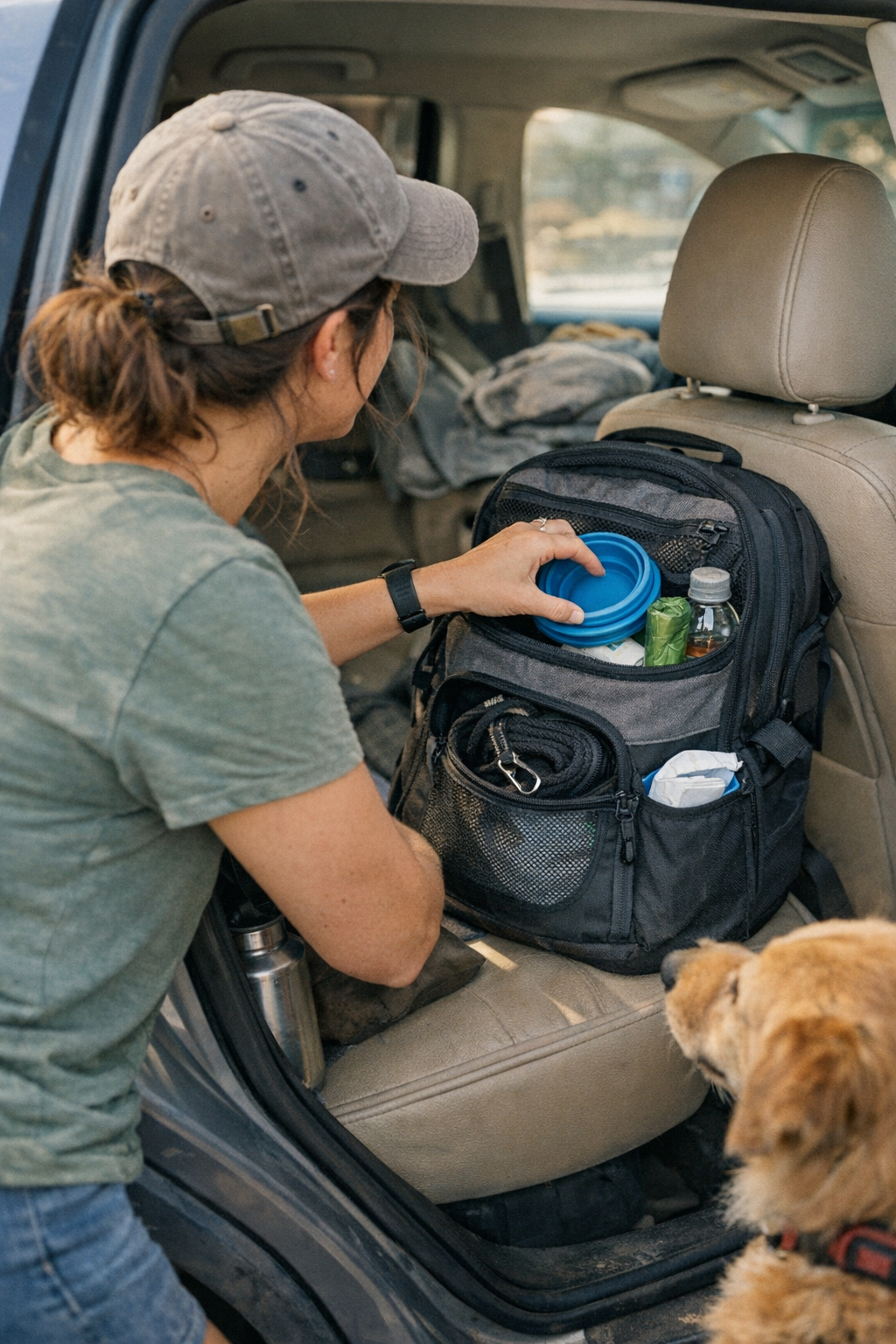
Pet travel setups fool you at the start—they look organized, but the real test begins the moment you’re on the move. At home, everything fits: waste bags zipped in, wipes stashed, bowls nested, pockets closed. But just a couple of stops into the trip, neatness collapses into friction. That seemingly tidy pet travel kit becomes a slow-motion problem. A leash gets trapped under a blanket, wipes are buried when you need them fast, and what should be a quick seat-side grab turns into a game of trial and error. Instead of keeping pace with your pet, you’re stuck untangling gear you thought you’d already solved.
Where “Looks Ready” Falls Apart: The Realities of Repeated Stops
Your kit promises order, but repeated use strips away that first impression. You park, reach for the leash—only to find it snagged beneath a tangle of backups. Waste bags? Technically there, practically missing under a towel. Essentials meant for the next pause sink deeper, locked up by new layers every mile. Traveling with pets isn’t one long journey; it’s dozens of short transitions, each one exposing how a “prepped” bag actually creates new micro-delays.
Minor hang-ups multiply into real drag. Each awkward pause—finding the right pouch, unwinding a tangled leash, or searching for wipes—breaks your flow. A routine that should be simple grows choppy, your energy drains, and your confidence in the setup fades a little more with every stop-and-go.
The Hidden Weak Point: Access That Breaks Down in Action
An organized bag is only as good as its behavior in the field. Repeated stops reveal a design problem: most travel kits make quick access harder, not easier, after a few uses. The more you layer, categorize, or double up compartments for “organization,” the more your essentials slow you down.
Typical scene: you park, open the door, and reach for the leash. But a wipe pouch, supposedly in the “easy spot,” has slid or snagged on the harness. You dig past a collapsed bowl and knock treats onto the mat, just to find waste bags in the last place you’d expect. It’s not a one-off. Each stop triggers more item migration and overlap, turning “organization” into obstacles you have to solve again and again.
Real-World Repeat Friction
- The bag gets heavier. Not because of added gear, but because you start bracing for the awkward reach, the blocked pocket, or whatever surprises you again this time.
- You pick the wrong pocket. In the split second you reach, you guess, unzip—wrong section. Every fumble adds a little mental friction.
- Cleanup delays stack up. Wipes stashed for “clean access” now jammed behind a food bowl. What should be fast becomes a scavenger hunt for the simplest supplies.
- Comfort vs access. The travel blanket settles your pet, then covers the pocket you need, forcing another full shuffle just to grab a basic item.
- Owner and pet items blend until flow breaks. One quick reach for your phone, now complicated by stray dog treats or a damp waste pouch.
When the Bag Holds Its Shape, Yet Slows Everything Down
“Prepared” isn’t enough if you’re stuck midway through the same access puzzle every stop. Even a pristine-looking setup starts to feel like a prop the moment the third or fourth stop hits. Wipes blocked by spare towels, leashes trapped once again, and each quick grab needs a little re-sort. The outside stays neat, but inside, movement turns clumsy—every return to motion is slowed by preventable resets.
Pocket count and sleek lines don’t matter if you hesitate every time you re-enter the car. What actually works is a setup that stays responsive when handled again and again, not just once at the start. If every stop equals another mini-shuffle, your “system” is a brake on your trip—and you feel it most on routine legs, not just rare emergencies.
Dissecting the Main Pain Points: How Flow Breaks Down
High-Pressure Pauses
When your pet’s at the door and you’re hunting for a leash, your kit’s real design shows. The bowl blocks the wipes, or the waste bag roll is laced through a side tether. Each second spent fighting structure, your momentum and attention split. Quick stops turn into scrambles—just as your pet’s ready to jump out, you’re solving another avoidable tangle. The more these moments repeat, the less in control you feel at the very times you need efficiency.
Repeated Restarts
Every stop triggers some version of the same routine: shifting bowls, digging for bags, moving a blanket, and playing pocket roulette. Repacking just resets the puzzle until it inevitably falls apart again. Over time—even on ordinary errands—you notice the pattern: travel stops aren’t smooth transitions, but a series of half-solved mini-problems.
A Practical Reset: Changing Your Access Logic
Better pet travel doesn’t start with more pockets—it starts with separating true essentials from occasional-use stuff, on purpose. Lumping everything “convenient” into big multi-use pockets backfires under real use. Instead, make each item’s repeat-use role clear and its position consistent every trip.
Give Seat-Side Access to True Essentials
Dedicate an external or mesh pocket to every-stop gear: leash, waste bags, wipes, travel bowl. These items should never compete with backup towels, rarely used medications, or random extras. Routine access should be predictable, never layered behind things you touch once a day.
Demote Backups to Side Storage
Rarely used items—spares, “just-in-case” gear, backup supplies—should stay clearly out of your everyday workflow, either in side/rear pouches or a mini internal bag. This stops the primary pocket traffic jam and gives you one less thing to rearrange each stop. Now, essentials don’t migrate or get buried, and every restart moves faster without sacrificing preparedness.
What Changes in Real Travel?
The real win: fewer pocket reshuffles, more reliable grab-and-go access—trip after trip. Coming back to the car, pulling the leash and waste bags is instant, not a multi-step search. Bowls stay above wipes. Backups don’t murk up your go-to routine. After a rainy walk or a muddy-paws break, you don’t wonder if you buried the only cleaning wipe that matters. Your bag still looks organized—but now it holds up under the real pressures of repeated travel.
This isn’t just a “first-trip” fix. The big difference appears over time: rainy stops, car rides with sudden needs, pet detours you didn’t factor in. The structure you set up at the start stays mapped through dozens of transitions, so you spend less time second-guessing or repacking—and more actually keeping pace with your pet.
Spotting the Warning Signs: When to Refresh Your Structure
Notice yourself pausing before every grab—or dreading another reach into a “solved” pocket? That’s your kit lagging behind your actual travel rhythm. A pet-travel setup that works in theory will always fail when your practical needs repeatedly outpace its logic. A true fit becomes clear through friction: when routine stops make you hesitate, sigh, or redo the same reshuffle, it’s time to overhaul.
Watch for these warning signs:
- You hesitate or stall before opening a compartment you used to trust.
- Retrieving one needed item creates a minor reshuffle and a mental note it’ll annoy you again next time.
- The more organized your setup looks, the less efficient you feel during actual stops and starts.
The Difference Between Looking Prepared—and Moving Smoothly
Bags that only look calm but jam up your stop-and-go flow aren’t solving anything. Good organization isn’t about neat packing; it’s about whether your kit can handle quick access and repeated action without extra steps. When you separate high-frequency gear from every-once-in-a-while items, your travel stops feeling like a series of small obstacle courses. Every restart gets smoother—not just neater.
For setups that seem “sorted” at first glance, the real test is repetition: does the order last after several true-use cycles, or does it break down the first day you need rapid-fire access? Structure built for the look won’t keep up with a trip. Structure built for actual seat-side, restart, and moving routines—tested and tuned—will.
Make your next pet trip less about fixing old snags and more about consistent, comfortable movement. Explore travel setups and solutions at PawGoTravel.