
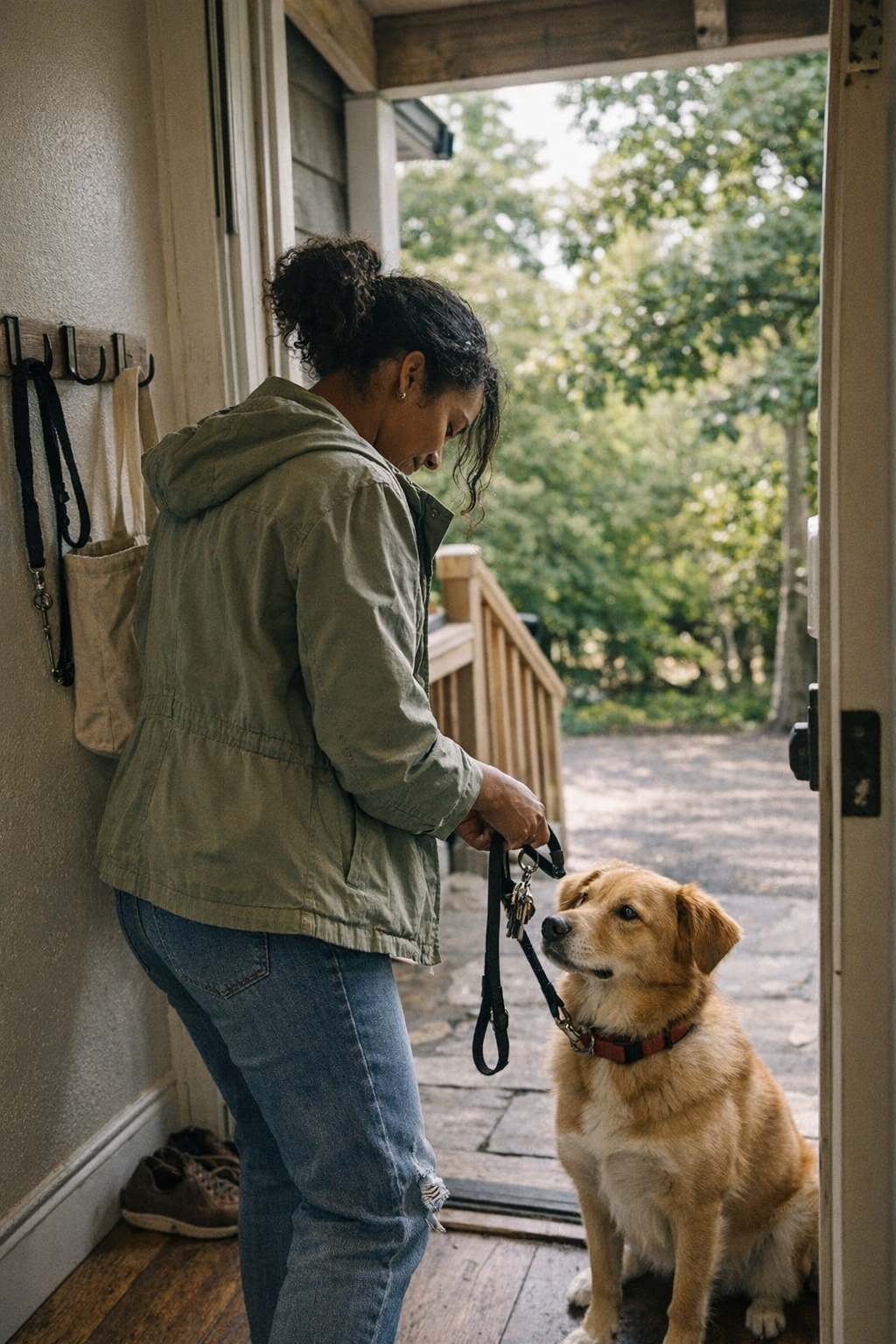
The chaos of daily dog life usually doesn’t explode—it creeps in, one bad reach or missed setup at a time. The leash hangs just out of range, the bowl’s too tucked away, the wipe is never on-hand when muddy paws hit the floor. These tiny routine stalls—the awkward half-turn, the pause at the door, the double-back for supplies—don’t look dramatic, but together, they grind down what should be a quick flow. Suddenly, the “simple” walk, feed, or cleanup is always one step more complicated than it should be. The setup you trusted quietly becomes a daily obstacle, and any sense of smooth routine vanishes—visible mostly in the moments when you lurch or stop instead of move.
Where the Routine Stalls: Recognizing Repeated Friction Points
This isn’t about major disasters; it’s about the repeated, silent slowdowns you only notice under pressure. The leash that never lives where your hand expects. Shoes crowding the door so the leash is buried. Now, each step out means reaching, untangling, or shifting the pile yet again. The delay stacks up fast, especially when your dog is keyed up and ready, feet clicking out a nervous rhythm on the tile. One beat lost, then another. A process that should move in one line starts zigzagging—first for a leash, then for shoes, then for the dog, who’s somehow blocked the path again.
These micro-delays don’t just eat time, they eat routine sanity. Each missing towel, off-center bowl, or absent wipe forces a detour. At first, you brush it off—a shrug, a quick backtrack. But as days stack up, you notice: habits rerouted, timing thrown, and a creeping feeling that you’re always compensating for something the “organized” setup didn’t solve. The routine that’s supposed to be second nature gets heavier, slower, stickier, and you end up dreading the part of the day you used to power through.
The Ripple Effect of Little Delays
What starts as a skipped beat becomes a pattern. Without warning, mornings stall in the hallway. Feeding crashes into cleanup, and that leash-fetch moment puts the whole routine out of sync. You hear yourself calling twice, or pushing for your dog to move, because it takes too long to get what you need. Your dog’s not refusing—it’s the setup refusing you. Watch how your hand hovers, searching for a wipe that should be near the door. See how your body pivots, dodging clutter that “neatened up” the space but now blocks your fastest route. These are not one-off annoyances; they’re the fingerprints of a setup that opposes its own routine.
The Subtle Build-Up: How Micro-Delays Shape the Day
At first, the friction barely registers: just a slight stall when you grab the leash, or a pause clipping in as your dog waits behind the half-open door. But what’s tiny on day one becomes a nuisance by day ten—a choreographed tangle of sidesteps, elbow swings, moving a crate, nudging a bowl. Each awkward moment joins the next. Soon you’re bracing for the same hassle even before it happens, mentally mapping out workarounds: which foot to plant, which hand gets the leash, how to scoop food without stepping on your dog. The house might look neat, but under the surface, all the extra movement exposes the places where the setup still falls short.
It’s no longer just about physical clutter; it’s about invisible drag. The arrangement might win you compliments for tidiness, but the workflow is fractured, and each chore costs more effort. By the week’s end, you’re counting steps, feeling that heaviness in all the places where function breaks down as the routine repeats.
A Closer Look: Real-Life Setups Derailing the Flow
Case Study: The Walk That Never Just Starts
Take the “quick walk” that refuses to be quick. The leash looks close, but is snagged under a bag. Shoes clog the path, so now there’s a twist and reach. Your dog hovers—half-eager, half-blocking. Tick, tick, tick—each second, your frustration grows, and so does theirs. All before the first step outside. And when walks start with tension, that feeling follows you out the door, souring what’s supposed to reset the day.
Feeding Flow Interrupted
Or look at feeding: bowls tucked for appearance rather than access. To avoid a messy kitchen, you slide the bowl out of the way—then trip over your dog while carrying kibble, or cross to another room for the wipe after every meal. Bowls look pretty but interrupt your path. The dog camps out in a tight spot that pinches every breakfast, and “tidy” turns out to be code for “hard to use.”
Grooming and Cleanup Choreography
Grooming is more of the same: the towel’s out of reach, wipes are too many steps away. Each muddy paw means crossing back and forth, footprints multiplying before you find the supplies. You try for comfort—soft beds, plush mats—but now you’re forced to work around them, nearly tripping as you wrestle a wet dog, wishing cleanup followed the rhythm of the mess instead of the logic of storage. Every reset is a minor ordeal, and the “nicer” the setup, the more it resists quick recovery.
The Real-World Consequences of Small Setup Weaknesses
These aren’t rare events—they’re routine failures so predictable you stop noticing except for how tired you feel at the end of each loop. To get anything done, you build in extra time and double movements. Instead of feeling prepared, you’re always chasing after the next missing piece. The problem doesn’t vanish with better storage or visual order. That kitchen looks great—until you rush through and realize a backtracking loop has wormed its way into your day. You thought you “fixed” it, yet every leash tug, muddy print, or bowl refill sends you searching for what should already be in your hand.
Organized space does not guarantee organized action. What looks improved may still break down once the rush of repeated use exposes a weak point—echoing the same frustration, just behind a tidier facade.
Why These Blocks Keep Returning—And Why They Don’t Fix Themselves
The temptation is to blame your dog: they pause, hover, hesitate. But the invisible culprit is usually the setup itself—how far you reach, where you bend, what you can grab without shifting your weight. It’s rarely laziness or distraction. One item a half-step further, a bowl hidden from sight, a wipe tucked away in a “system”—all of these are small demands the space makes on you every single use. The result is a learned pattern: push through, compensate, put up with mini-obstacles instead of solving them. One pause multiplies across the week, then solidifies into a routine you never chose, stuck on repeat.
Making the Fix: Nudging the Setup Toward Real Flow
One Measurable Change, One Smoother Routine
It rarely takes a full remodel to cut these frictions. Instead, look for practical, targeted nudges. One example: after too many pre-walk stalls, moving the leash hook just a step closer to the door erased the lag—no more retreat, no more tangle. The time from open door to outside dropped to three seconds, and exits lost their nagging frustration. With less drama up front, even the return reset felt less frantic. One change—one less point of repeated failure. The win wasn’t the number on a clock, but feeling the routine finally match its promise of being quick and ready.
Think Placement, Not Just Tidiness
Apply that eye everywhere. Bowls away from traffic, wipes in arm’s reach right at the back door, beds not tripping up your path—every shift is about shaving off the next detour, not earning points for a showroom look. The difference is in the lived day: less doubling back, fewer sidesteps, little bits of calm returned to routines that used to sap your patience. None of these fixes shout for attention, but their absence is instantly obvious. The flow that returns is quieter and sturdier than visual order—because nothing interrupts it, not even the gear you rely on.
Observing and Resetting: The Habit of Noticing What’s Slowing You Down
The progress isn’t set-and-forget—it’s sustained by noticing, again and again, where you break stride, even in setups that looked perfect last week. Every repeated patch of friction is an alarm: another bowl in the wrong spot, another reach for a wipe in the next room, another crate lid sticking out where you trip. Pause at every stumble—these are your troubleshooting map. Sometimes the fix is a new hook, a single basket, a swap of locations. Sometimes it’s just breaking the habit of adapting to bad flow. The strength of your routine settles in these micro-adjustments—the more you notice, the smoother tomorrow feels.
Most “better” setups start as a reaction to obvious clutter. The ones that hold up are the ones you’re willing to n