
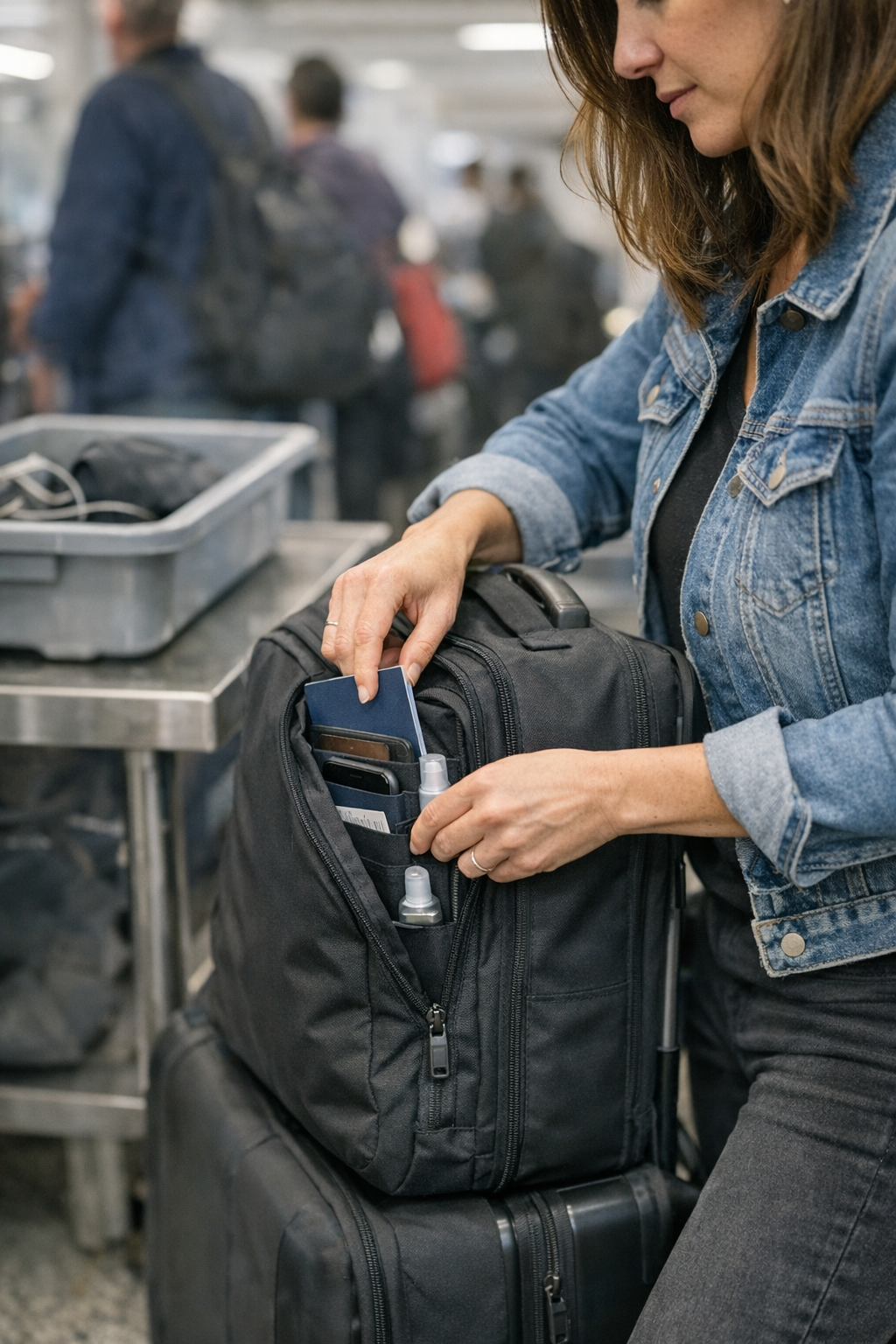
The real test of a carry-on isn’t how clean it looks at the start—it’s what happens after your third unexpected gate change or the fifth time you dig for your passport in a moving security line. What works on your hotel bed can become a minor disaster on airport carpet: pouches that seemed perfectly labeled rearrange themselves into a barrier course; outer pockets meant for “quick access” turn into black holes mid-rush. If you’ve ever stood still, unzipping one compartment after another with people queuing behind you and a tray teetering on your arm, you already know—friction isn’t about mess, it’s about interruptions that multiply every time you reach for something that should be ready but isn’t.
Where Carry-On Friction Builds Up in Real Travel
Your packing system feels solid—until it’s actually in transit, not just staged for photos. The first cracks show up in the constant churn of real airport traffic:
- Security lines: You reach for your passport, but it’s layered below a web of chargers or tangled up with unrelated paperwork, forcing stop-and-go digging under strict time pressure.
- Gate changes: Suddenly you’re pulling headphones from a tangle, then shoving things back together as the gate crowds shift. What was “neatly wound” in the hotel is loose and confusing two hours later.
- Boarding and seat entry: A slim bag shows off its silhouette, but every grab for sanitizer or ID turns into a blind search through nested pen loops and stray cables. Movement stops cold while you detangle, with aisle traffic stacking up behind you.
- Overhead bin access: Want one thing? Instead, you unload a whole layer of pouches onto your lap—or worse, the floor—just to get to that single needed item.
The real drag isn’t clutter—it’s compounding delay. Every time a zipper, compartment, or tangled pouch stalls you, it quietly drains your spare seconds and steadiness. By your third repack or the fourth misplaced passport check, the original “order” feels more like a script for minor failure, chipping away at your focus and patience.
When ‘Organized’ Isn’t Actually Usable
It’s easy to trust your setup while stationary—coiled chargers, tidy folders, everything slotted with care. But the first unscheduled check or tray shuffle exposes the gap: suddenly, pulling a simple document means digging through a puzzling stack in front of other travelers and impatient staff.
- You unzip the front pocket and find only boarding passes—passport is wedged behind a battery pack, separated from what actually needs to be together.
- That pouch you thought streamlined? The zipper grabs a charging cable, unspooling both just to access your wallet.
- Moving lines force you to shove items back anywhere, breaking your original order and leaving you second-guessing if something vital slipped loose.
What holds up to a photo collapses under real travel pressure. If “organized” means stacking, hiding, or overlapping compartments, the system buckles—each access stalling the process, breaking your stride, making common airport moments feel oddly complicated. The difference isn’t in design—it’s in repeat use: some bags perform, others just look like they might.
The Hidden Cost of Repeated Repacking
On a tight layover, you feel it. You’re moving fast, juggling ID retrieval, grabbing headphones, unearthing a snack—all while balancing your bag on a bench edge or your forearm. What looked “streamlined” translates into multiple failed searches and resets:
- Miss the intended pocket, and the rest become a guessing game of pouches—slower, less precise each round.
- Every new access slides items further out of place, stacking the mess even as you try to keep up.
- No real reset is possible: you stuff things wherever they fit, knowing you’ll pay for the disorder at the next checkpoint or seat squeeze.
- The outer pocket holds everything—but makes you claw past the wrong objects every single time you simply want your boarding pass.
Stillness hides most errors. The moment you step back into motion—moving from terminal to gate, from queue to scan—the weak structure shows itself. Cables pile in the wrong pocket, documents vanish under toiletries, and sanitizer hides somewhere you can’t reach on the move. You feel it in fumbled trays, in the sideways glance from a flight attendant as you block the aisle to repack—again.
Simple Shifts That Change the Travel Experience
Not every weak spot needs a fancy product. A single change—a proper exterior access pocket, a no-overlap document compartment, or a stand-alone quick-essentials section—can eliminate nearly all the slowdowns that pile up in airport flow:
- Single-path retrieval: Place passport, phone, boarding pass each in a discrete, quick-access spot—no nested digging, no cross-pouch confusion. One zipper, one grab, done.
- Vertical stacking minimized: Essentials aren’t buried; immediate-use items ride at the top or outer edge. No need to scatter contents chasing a single object deep in the pile.
- Consistent access after real use: Whether after multiple gate changes or repeat security screenings, your structure holds—access speed and order don’t degrade over time, and your trip doesn’t turn into a cycle of correction.
Switching to a setup where every “hot” item sits in one simple, wide-access pocket is the silent fix: gate rushes, in-seat retrieval, even double-backing for documents becomes routine, not a reset. Unconscious reach replaces conscious anxiety—your system preserves your flow. You notice not because it’s perfect, but because the obstacles that made you pause before have mostly disappeared.
Spotting Small Weak Points Before They Grow
New organizers, fresh pouches, or trendy wallet inserts often look effective—until the third access in busy conditions. Weak points are rarely dramatic; they’re the slow leak of efficiency you notice too late:
- Documents drift out of place during a quick walk, ending up out of reach when it matters.
- Small, tight-fitting pouches become blind spots—good for order, terrible when in-transit hands are busy.
- Cables or pens catch on zippers, snagging every opening, adding seconds that matter in a moving line.
- A configuration that wins “tidy” points at first but fails to move fluidly, forcing resets and resets again with use.
Test your setup in motion, not in stasis: Can you reach for documents, chargers, and sanitizer with one hand while standing? Does order persist after two rushed repacks? How quickly can you move from security tray to boarding pass, from seat stow to midflight snack—all without hesitation? If you’re constantly restoring “organization” just to keep up appearances, your structure is out of sync with actual travel pace.
When Small Changes Make All the Difference
The point isn’t a perfectly photographed layout—it’s a structure designed for live, repeated movement: no pileups, no buried must-haves, no extra steps every time you need what you actually use. Structural choices—clear path to documents, non-tangling organizers, single-motion outer access—swap stress for flow. After a dozen short retrievals or rushed repacks, the “small” changes separate a bag you can live with from one that quietly messes with every trip.
At CarryOnSupply, the focus is never just on packing smart—it’s on setups that remove these real friction points so your carry-on actually does its job, not just hides the mess. Shop at CarryOnSupply