
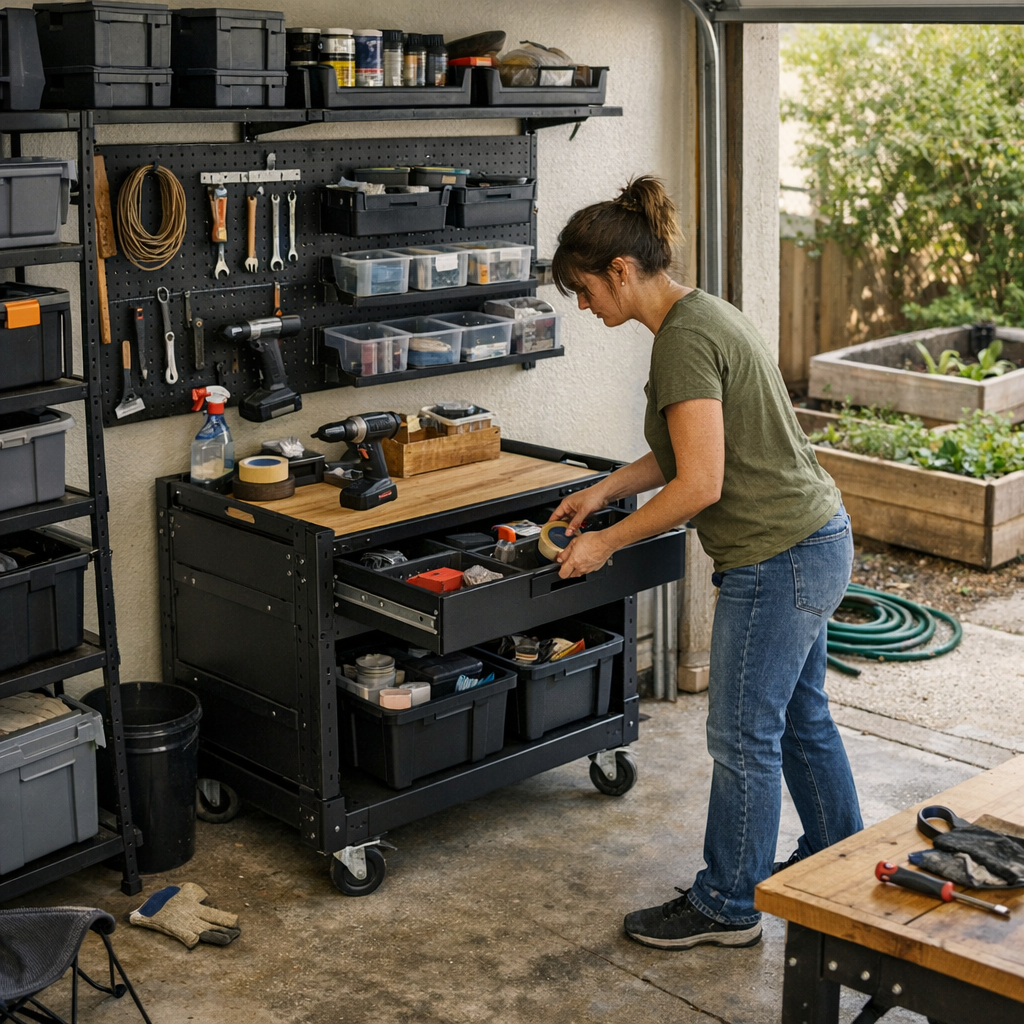
The showroom promise of modular carts and wall racks is irresistible—the sleek storage, the illusion of a spotless garage, a workshop that finally stays under control. You bring in that new system, arrange the bins, hang up the tools, and at first, everything looks solved. But then you start living with it. Not a month later, a new kind of mess sneaks in: not loose parts or wayward cords, but the constant, almost invisible contortions you make just to do simple things.
Where the Trouble Hides in a “Clean” Setup
The illusion holds up for a few days. Everything’s in its place, at least until you actually need to get things done. That’s when the cracks show: You double back for a wrench because the right bin is just out of reach. You thread your arm past the lip of a cart to fish out painter’s tape. You shuffle sideways between a tool chest and the wall—never quite fitting through—only to realize you’ve blocked your own escape route. One awkward step here, a bin moved there—none of it feels dramatic. But by the end of a real work session, your routine has been sliced apart by a dozen tiny, repeating annoyances.
This is the friction nobody warns you about. The space still looks organized, but your workflow keeps snagging—hidden obstacles and off-kilter footprints turn everyday resets into stop-start marathons. It isn’t junk, it’s the geometry of your own system quietly working against you.
Why “More Storage” Doesn’t Equal a Better Setup
The problem almost never starts with too little storage. Instead, it’s the ugly mismatch between what looks organized by the numbers and what feels effortless in use. Your wall system eats up the only reachable spot, bins stack high right where you need legroom, and your mobile rack—so tidy at first—ends up collecting overflow at the far end of every job. You get more places to put things, but fewer ways to move naturally.
Picture mounting a big tool board above a rolling cart. Sensible—until you realize the cart blocks access. Now every project begins with pushing, angling, or pulling everything out just to get started. The storage “solution” adds work to the simplest task.
How “Almost Right” Layouts Steal Your Time
It’s a familiar scene: a rolling cart shoved almost but never quite close enough to your main table. Each time you grab for supplies, you angle your body around the edge, careful not to send a bin tumbling. Dragging a cord or carrying a rake means a whole extra detour. By Wednesday, you know the exact dance—you move inefficiently out of habit, not convenience. It’s not truly disorganized, but it’s just wrong enough that you burn minutes and patience every time you work.
Counting the Costs of a Poor Flow
Every time you slide a cart to clear a path or shift a bin to find the piece you need, you’re giving up seconds—and focus. These adjustments fade into the background so quickly, you stop noticing them. But over a week, they take over:
- Return flow gets jammed: You abandon tools in the “close enough” spot because the real home is a hassle to reach.
- Overflow takes over dead corners—nothing ever resets all the way.
- The main walkway narrows a little more after every session, now blocked by a cart or an awkwardly angled box.
- Resetting for the next project turns into a scavenger hunt, not a smooth transition.
The neat look is a lie. Unless the movement flows cleanly—unless tools and supplies come and go without gymnastics—no shelf or rack is truly working for you, no matter how perfectly labeled the bins are.
Resetting Your Setup Around Actual Movement
You won’t fix these pain points by buying another organizer. The answer is to study exactly how you work—for real, not in theory—and make the smallest changes with the biggest effects. Sometimes, moving a cart 18 inches, turning it parallel with your bench, or clearing a single “return lane” is enough. Suddenly, the tools you use daily are right where your hand expects them; the long-way-around shuffle disappears.
In one ordinary garage, simply nudging a garden supply cart out of a walkway and rotating it meant tools could be put away in a straight line, without stepping sideways every time. That flow didn’t just look different—it felt like instant breathing room.
Test Yourself: Where’s the Grind?
Do you find yourself circling the same obstacle to drop off a drill? Always reaching around the broad edge of a cart for tape, or shifting two bins because the thing you need hides in back? That’s your setup fighting you—even if every label faces front.
Here’s a five-minute audit: run your full space-reset routine, start to finish, five times in a row. If any bottleneck slows you every lap, it isn’t a fluke—it’s a flaw baked into your layout. Map those friction points, and you’ll know exactly what’s worth fixing.
Small Tweaks, Real Flow: How to Unlock Your Space
Perfection isn’t the goal, and it isn’t possible—but real improvement is always specific, never cosmetic. Forget another wave of reorganizing just for looks. Instead, try:
- Bring your highest-use carts or cabinets into your natural flow, not blocking walkways or stacked at awkward angles.
- Shift bulky wall racks to hold rarely used items—freeing up clear landing spots for daily gear.
- Protect one straight “return lane” so you can reset tools and bins without zig-zags or backsteps.
- Open up corners and the ends of rows, so overflow can’t quietly pile up and choke your movement.
These surgical changes deliver more relief than any new shelf ever could. Each solved friction point turns a clutter-battle into a real, usable space—the kind you forget to complain about, because it simply works.
The Feel of a Setup That Actually Works
The right tweaks leave your space feeling lighter, not just neater. You step through without weaving. Tools snap back into place without a multi-step dance. There might still be a crowded shelf or a rough edge, but the path you actually use is clear, the routine unbroken. The urge to reshuffle every session fades—you return to work, not to rearrangement.
This is the payoff: storage and layout that matches real movement, every time you show up—not just in the photos, but in the day-to-day loop.
Find practical storage and modular solutions built for daily flow at StackNest.