
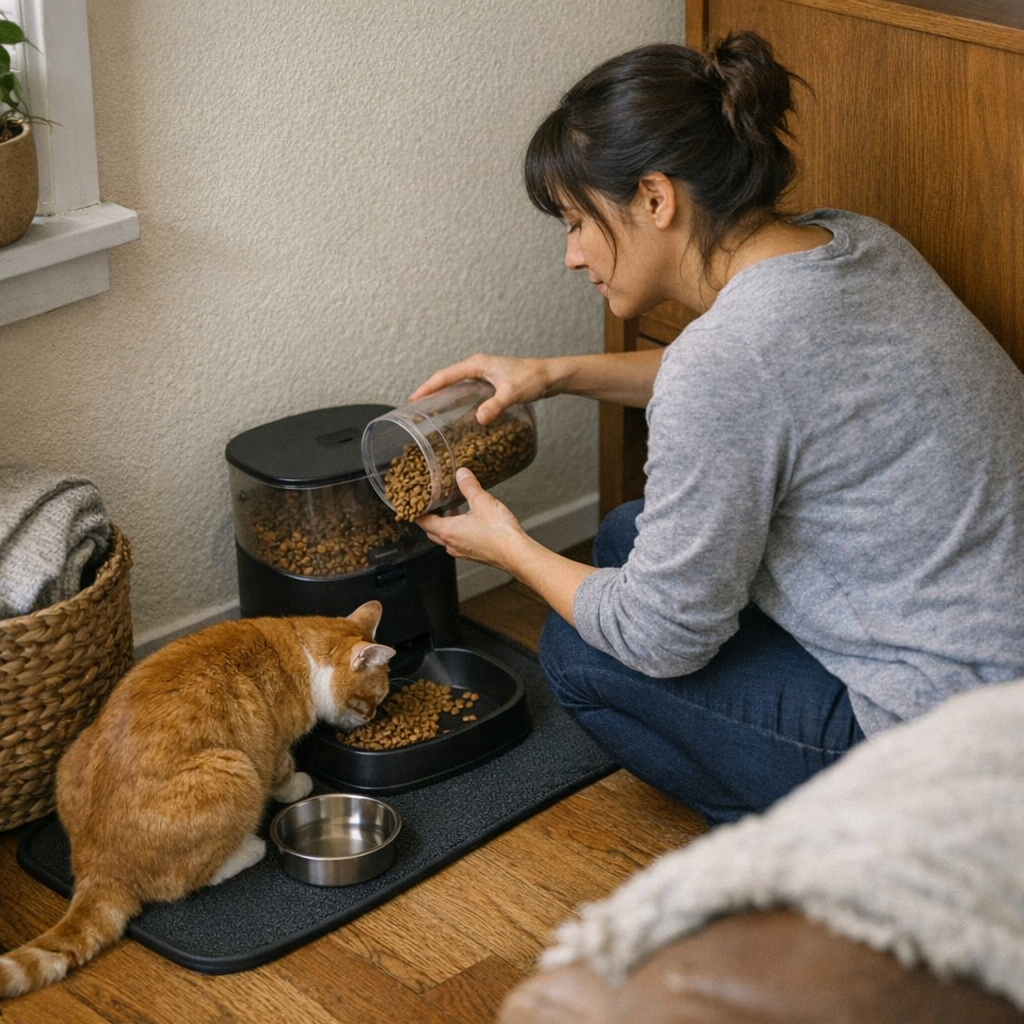
Add a timed feeder to your indoor multi-cat setup and you expect smoother routines—but friction shifts fast. Instead of ending bowl duels, a poorly anchored station turns meal resets into a chore loop: you’re forever nudging the mat back, picking kibble from corners, and sliding the whole feeder away from walkways that cats and humans both keep crossing. What looked organized on the first day quickly turns into a high-traffic zone where feeding time spills out, and cleanup creeps across the room. That’s where StillWhisker’s structure-first approach makes the difference: less about appearances, more about what stops your setup from falling apart after the third refill.
Why Feeding Time Still Gets Messy—Even With a Timed Feeder
Timed feeders sound like a solved problem: portioned meals on schedule, less food anxiety, calmer cats. But when the tray spins and cats swarm, one always rushes the bowl—scattering food and shifting the setup. Two days in, the routine grows lopsided: dried food rings appear on a mat that won’t stay put, crumbs roll just under the edge of the cabinet, and every refill becomes a messy pause, not a smooth move. You bend down, realign the mat, wipe off residue, and slide the feeder back for the second or third time. That’s not meal control—it’s repeated, slow-motion cleanup.
The Routine That Looks Settled—But Never Really Is
The feeding corner might seem stable after initial setup, but small frustrations keep stacking up. Bowls slide, mats drift, and a quick glance turns into a spot-check: is everything lined up, or did a cat nudge the bowl halfway under the fridge again? Every pass through the room means another interruption—scraping stuck kibble off tile, fixing the feeder’s angle, or swatting loose crumbs out of your own path. Instead of stability, you get an endless micro-reset, each time just off enough to slow you down.
The Hidden Cost of Mess That Moves—And Grows
Here’s where “looks tidy” falls short of “stays easy”: once mess starts moving, it grows. The feeder isn’t anchored, so bowls inch away from their zone, mats bunch underfoot, and stray bites track out to walkways or under sofas. Each nudge, whether from a cat’s paw or your morning rush, inches the whole setup out of its lane. Instead of reducing work, every subtle shift creates one more cleanup job—for you, not the cats.
- Bowl edges cross onto the kitchen path
- Mats fold and crumple under doors or furniture
- Kibble and crumbs slip into gaps you can’t reach without moving everything
Instead of one controlled area, you fight a slow, spreading mess that resists any quick fix.
The Real-Life Feeding Zone: Small Decisions, Big Effects
Watch the pattern after a few cycles: does one cat muscle the other out, shoving the bowl with every bite? Does the mat jump the gap between wall and feeder over and over? Find yourself picking crumbs from the same corner night after night? Those patterns show up fast. Within days, you know if your setup contains chaos or just scatters it further into your space—adding new resets to each feeding routine.
Split Bowls: The Problem Hides, But Never Leaves
Adding extra bowls in different spots can mask tension but rarely solves it. One empties faster, “backup” bowls start collecting uneaten food or sticky rings, and before you know it, you’re on daily patrol for where today’s mess hid. Assertive cats double-dip, quieter cats wait out the chaos, and your refill routine breaks down into scattered checks and surprise finds. It’s not less competition—it’s more surface area to cover and more time spent wondering what you missed.
- Uneven food disappearance—one bowl raids, one ignored
- Persistent buildup in the “secondary” dish
- Cleanup hunt as bowls drift out of sight or under foot
- Refill routine that never finishes in one loop
The symmetry looks tidy—but the daily work just multiplies out of view.
The Slow Creep: How a Weak Setup Makes More Work
Mats migrate, feeders drift, and that unnoticed trail under the table waits for you to finally move a chair—or, worse, not notice until crumbs build up. Meals become a series of small tasks: repositioning the feeder, shaking out the mat, running a cloth over sticky patches, or moving objects out of the way just to refill. That’s time lost every single day to a setup that keeps slipping out of alignment—even when it looks neat at a glance.
The Walkway Trap: Mess Finds Its Way Out
Feeder placement isn’t cosmetic—set it near a walkway or shortcut and every foot or tail will push the boundaries wider. Mats ride up over thresholds, the feeder noses its way into cooking space, and within a week crumbs show up in hallway corners or under the couch. Mistaken “neutral” spots become accidental spread zones:
- Crunch under your heel on the coffee run
- Mat pushed against or half-under the fridge
- Kibble dust collecting where no vacuum reaches easily
Now you’re not just resetting the feeder—you’re chasing a mess that broke into the rest of the house.
Everyday Examples: When the Feeding Zone Doesn’t Hold
You step into the kitchen and immediately feel one: a gritty crumb underfoot right by the sink—again. After dinner, you see the feeder at a new angle, mat folded up, crumbs radiating out like it’s been swept by a fast tail. You “fixed” this yesterday. But the reset never sticks. The feeding zone is a moving target, always a little more chaotic than you left it.
How Anchored Structure Changes the Routine
The right structure turns the feeder from a fragile guest into a fixed part of the room.
The practical upgrade? Set the feeder and mat in a guarded corner, far from walkways, with a mat that has a raised lip—just half an inch, but enough to catch most sprawl. That detail resists the sideways push from paw or foot, keeps the mat where you put it, and stops routine slides. Now, the full reset is one contained cycle: move the bowl, wipe a single area, shake the mat, refill. One check, one pass. Cleanup happens where you expect it—not everywhere else.
Why a Raised-Lip Mat Is a Game-Changer
Not all mats are equal; a simple raised edge marks the boundary. Kibble paws can’t fling food as far. The feeder, nudged by hungry cats, holds position instead of drifting with every meal. When feeding gets chaotic, the chaos stays boxed in. Cleanup time and effort shrink. Instead of multitasking your way through scattered sites, you find mess contained and returns predictable.
The Role of Surface Underneath
Miss this detail and you fight the same battle: mats on slick wood or tile just slide, no matter how neat the rest looks. Non-slip backing, adhesive pads, or simply pressing the mat flush against two walls changes everything. The less the base moves, the fewer resets sneak in—and you stop burning attention on a zone that’s always in motion.
Anchoring for Both Cats and Humans
A feeding zone must work for you—not just the cats. Invisible placements mean surprise spills behind the feeder or stale buildup hiding where you never check. It’s not enough to look organized once—usability needs to survive every refill.
Check your space for:
- Visibility: Can each cat approach with a clear line of sight—no blocking or blind turns?
- Reach: Can you lift bowls and sweep mats without shuffling other items first?
- Cleanup access: Are the right supplies already at hand when spills hit—or do you lose time fetching paper towels from another room?
- Reset speed: Does everything return in a single movement, or does “almost done” drag out with one more trip?
A strong structure cuts not just mess, but the friction that makes daily meals a string of little extra jobs. The goal isn’t spotless looks—it’s setups that don’t keep interrupting you at every pass.
Spotting When Your Setup Isn’t Working
How do you know it’s time for a structural feeding fix? Watch for these cues:
- Your cleanup takes longer than the refill itself
- You keep finding stray food outside the feeding zone
- Bowels or mats migrate even when you “just fixed” the area
- Cleanup supplies are present—but never the moment you actually need them
- The setup looks organized, but still forces you into mini-reset mode with every meal
The difference between a setup that