
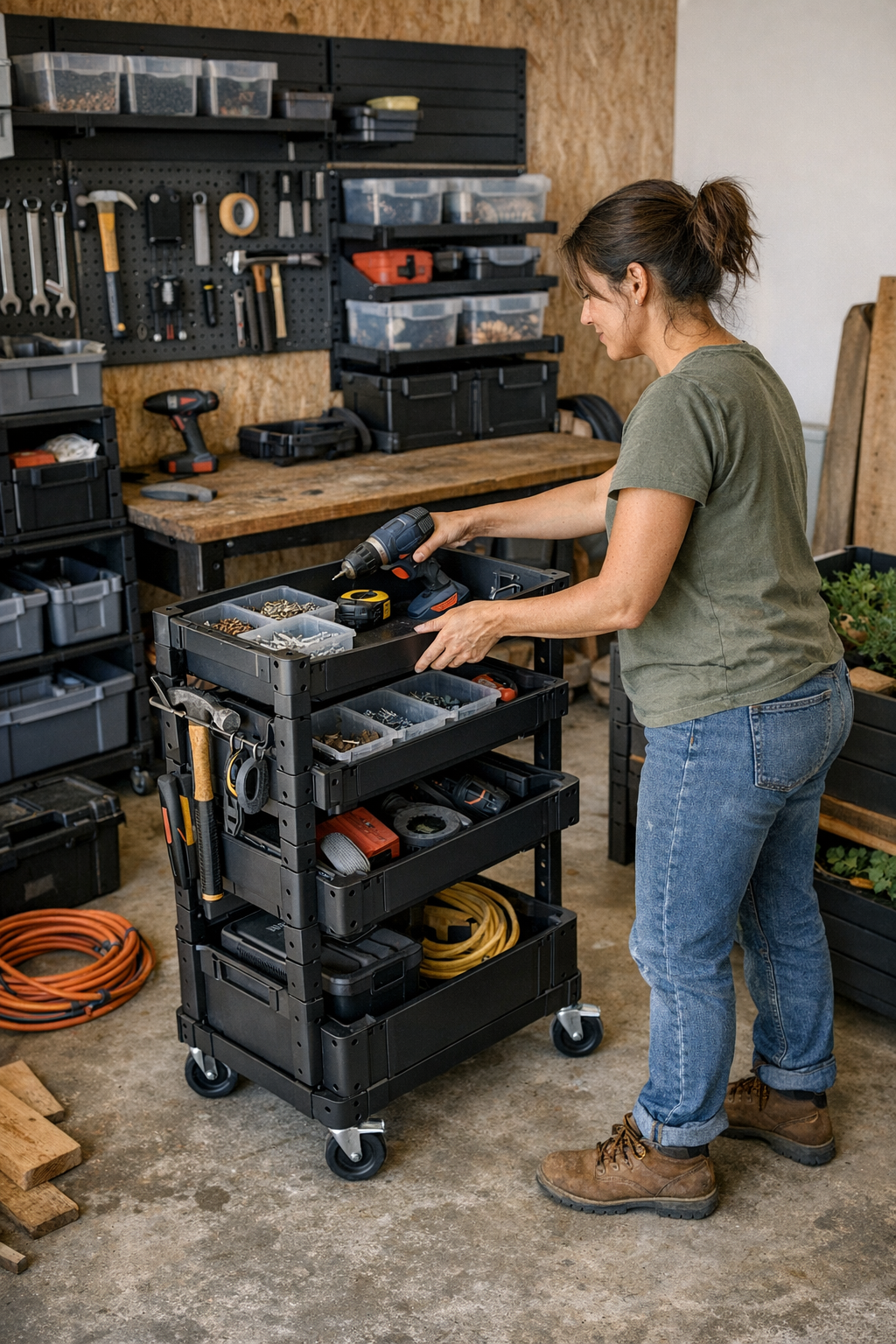
A “perfectly organized” garage or workshop looks impressive—for seventy-two hours, maybe. On day one, every shelf lines up, bins stack with military precision, wall hooks gleam with potential. But return mid-week, arms loaded with tools or materials, and that order blurs into a slow grind. The floor is still clear, the bins are still labeled, but suddenly, what seemed efficient on Sunday leaves you stepping around obstacles on Wednesday. The friction isn’t dramatic—it’s the tiny, repeated delays that quietly drag on your routine.
When Order Becomes an Obstacle
Designing a “clean” storage system looks sensible on paper. Towering cabinets, neat stacks of labeled bins, every square foot allocated. But run through a typical week and the realities set in:
- Grabbing a part means unstacking bins for the third time before lunch.
- That pristine wall corner is a dead zone, cutting off movement and quietly collecting scattered overflow after each rush.
- Heavier tools force a crouch, a twist, or an awkward two-handed lift from a low shelf yet again.
- The “tight” layout that once looked smart turns into a blocked pathway by Friday—just when you’re ready to speed up, not slow down.
This isn’t clutter. It’s subtle structural friction built into setups that look right in theory, but stall routines in reality. The result? Your “order” demands more work just to keep basic access flowing.
Static Storage: The Setup That Pushes Back
Picture the classic arrangement: a closed cabinet packed with bins, wedged tight against the wall to maximize open floor. For a moment, it’s the model of efficiency. But reach for anything on a busy afternoon and the problems pop up fast:
- Bending low to yank out a bin—because, of course, the one you need is at the bottom.
- Lifting two containers just to grab a drill or socket you swore you left up top.
- Dodging the swinging cabinet door again, cramped between wall and workbench with no wiggle room.
None of these are show-stopping disasters. But every grab, reach, and restack breaks your stride. What started sleek now saps energy in constant, invisible redirects. After two or three cycles, it’s clear: you’re spending more time working around the storage than actually working.
When Storage Moves, Everything Else Gets Easier
There’s no magic in “more bins.” The real shift comes with equipment that moves as your work moves. Rolling carts, modular trays on wheels—these small adjustments flip the script:
- Instead of rearranging yourself, slide the cart aside with your knee to clear the path or open up workspace.
- Reach at bench height, not three feet below or behind your shoulder. Your main tools are always at hand, not buried in the stack.
- When routines change or another person joins, the storage pivots with the moment—no reshuffling or squeezing past fixed barriers.
It’s a chain of tiny gains. The cart shifts—so you don’t have to. Hand tools drift back to where you need them. Resetting the zone is a slide, not a chore. Suddenly, the area adapts to your pace, not the other way around.
On-the-Job Adjustment That Actually Pays Off
Put daily-use items in the top tray or front slots of your rolling cart—right at hand height. That one change cuts out the zig-zagging, crouching, and reshuffling that slow down every small project, especially when you’re trading back and forth between jobs all day.
The Quiet Price of Crammed Footprints and Forgotten Corners
Layouts that “maximize wall use” or claim zero floor clutter can look sharp—until you try to move. What happens next?
- The overflow zone appears—the shelf or tray that always holds whatever you couldn’t quickly deal with, building into a mess by default.
- Dead corners become a fixture: awkward wedges too tight for real storage but impossible to ignore, so you shuffle around them every time.
- The “full” wall leaves resets harder, slowing each return trip and stretching the end of your day into overtime.
The real value of modular, movable storage doesn’t come from a sleeker empty space. It’s the end of workflows that stall and stack up. A mobile cart glides out of the way; a tray parks right where tasks wrap up—no blocked zones, no routine broken for the sake of aesthetics. Even in tight garages or narrow garden sheds, the difference is obvious: fewer detours, faster cleanup, and a zone that feels ready, not rigid, each round.
Is It Time to Rethink Your Setup?
If ordinary routines become obstacle courses, your setup is signaling for change. Notice if:
- The same corners are jammed by Wednesday—no matter how often you reset.
- Supplies or tools land on the floor “just for now”—and stay there all week.
- Gear clusters by the exit because the “proper” spot is a ten-step hassle.
- Most days, you’re shuffling bins and boxes just to pull off normal tasks—not just at peak rush.
The answer isn’t a mega-cabinet, but a smarter flow. Open trays for the stuff you use every session. Add movement so equipment follows the workbench, not the wall. Let your storage park at the finish line of each job, not where it fits best on a blueprint.
One Small Shift Makes Every Session Easier
Swap out those top-heavy, fixed-bin stacks for wheeled carts with shallow trays. See measurable, repeatable returns in your own space:
- Your daily loop across the floor shrinks by several trips.
- No more splitting time unstacking bins just to grab a screwdriver.
- Tools actually go back to their haul spot because it’s right where your hand lands.
These aren’t pipe dreams. They’re the practical shifts that stay with you project after project—easier access, fewer obstacles, and a zone that holds up to everyday use. It may not look showroom-perfect, but it works every time you step in.
Find practical storage options for real workspaces at StackNest.