
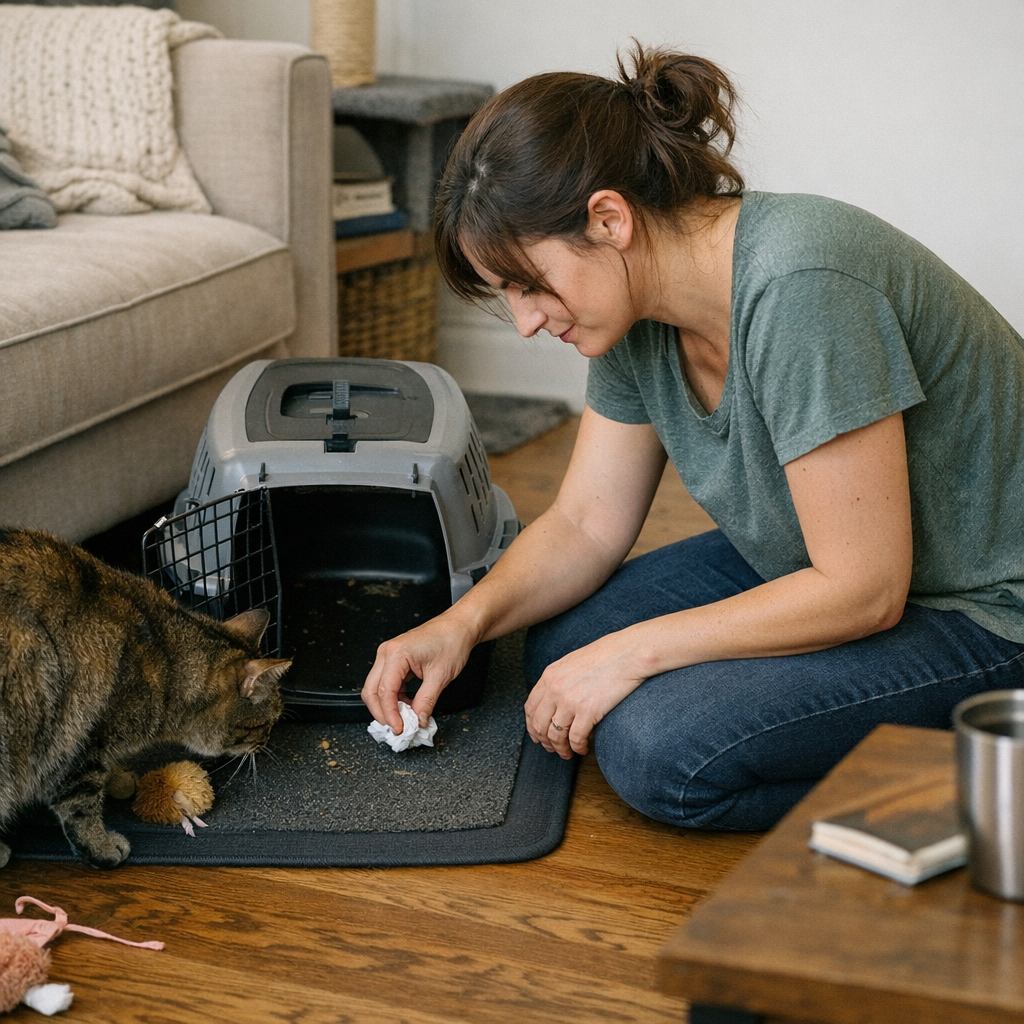
The plan: leave the carrier out, toss in a few treats, and soon it’ll just be part of the furniture—no battle at vet day. What actually happens: the treats sit untouched, crumbs harden along the carrier grooves, fur gathers in the corner, and by the next week the only thing “normalized” is the new pocket of mess. For indoor cat owners, a carrier isn’t a neutral box; it’s a constant fixture tripping up daily flow, changing how you refill, wipe down, or even just pass through a room. The real test isn’t whether the carrier looks settled—it’s whether it keeps grinding up routines or finally fits the stop-and-start of real home upkeep. StillWhisker homes notice these frictions early.
When a Carrier Just Sits There—The Hidden Friction
Most indoor cats treat carriers as a threat, not a hangout. Owners hope to break the cycle by “normalizing” the carrier: leave it open, scatter a treat, walk away. But in actual living rooms and hallways, an unused carrier picks up more trouble than trust. The open door nudges into the walking path. Laundry baskets bump hard edges. Toys ricochet underneath and stay lost until the next deep clean. Meanwhile, cat fur and grit pile up wherever the carrier sits, all while you sidestep one extra obstacle on the way to refill a water bowl or fetch the scoop from the closet.
The deeper problem creeps in over repeated routines. At first, the carrier looks harmless—a corner placeholder. But each day, the overlap increases: you bend around the carrier to refresh food, trip on toys wedged below, and realize you’ve skipped the wipe-down yet again. The carrier’s original purpose—to calm—gives way to a new burden nobody really tracked until now: perpetual slowdowns, small room bottlenecks, one more sideline hassle wherever routines run tight.
The Trap of Casual Treat Placement
Dropping treats in the carrier is the classic “good enough” move for easing feline nerves. It works the first day—curiosity wins, crumbs disappear. After that, the cycle shifts. Treat dust grinds into the mat. Unclaimed bits get kicked out or stuck inside the carrier’s grooves, where they trap fur and dirt every time a cat brushes past. The area around the carrier gets visually worse, not neutralized—now every step through the area sends dust or flakes wider, sticking to paws and trailing across the floor.
This is not like maintaining a food or water setup. Bowls anchor themselves: the mess is predictable, the reset simple. But the carrier resists easy integration. It never quite lines up with traffic flow, and every “normalizing” attempt creates extra, awkward cleanup work. Each time you miss sweeping up after a treat session, the aggravation carries into the next day, turning encouragement into a repetitive cleanup hole.
Cluttered Access, Slower Routines, and Shared-Space Spillover
Letting the carrier park in a shared room links its problems across routines. Suddenly, plugging in a vacuum means twisting around its edge, and quick sweeps drag on as you angle around the base. Litter supplies are just over there—but the carrier blocks the best route, its open gate swinging at shin or knee height. Toys, once visible, vanish under the rim and only get pulled free on the fourth reminder, not the first. End-of-day resets now always include a carrier-and-mat detour you never intended.
Residue and fur tell you what’s spreading. After a few cleaning delays, a greasy patch appears along the carrier’s base—a warning that mess, once hidden, has migrated into shared living space. Unlike a rest bed you can shake clean in seconds, the carrier is heavy, awkward, and if it sits directly on bare floor, the grime boundary steadily creeps outward. Each missed reset makes next time slower; the “contained” clutter isn’t really contained at all.
The silent trap: A carrier that blends into the corner at first slowly destabilizes the room. The gap between tidy-looking and easy-to-live-with only grows—until daily movement exposes every skipped reset and every corner now out of sync with the rest of your setup.
How an Anchored Carrier Makes Cleanup and Flow Easier
Solving this isn’t just a matter of “trying harder.” Structure changes everything. Assign the carrier a defined place on a washable mat—with a noticeable edge—and keep it near, but not in, main walking paths. Now there’s a cleanup boundary: crumbs and fur hit the mat, and don’t drift across the room. Treats go on the mat, not loose in the carrier, so you can vacuum or sweep up messes in one go. The carrier doesn’t slide around unpredictably, so neither does your cleaning routine.
- Reduced spread: The mat contains the mess. The rest of the floor stays in better shape for longer stretches.
- No more toy limbo: Balls and plush mice stop rolling under the carrier and re-emerge at reset time. No more accidental toy graveyard.
The biggest difference: the carrier becomes part of your daily rhythm. The mat’s edge marks a clear, predictable stop for your sweep or quick vacuum. Wipe downs happen without delay because the carrier spot is contained—no need for an extra cleanup circuit, no unplanned pause in the flow as you jump from litter box to water bowl to reset.
Resetting the Flow: Daily Upkeep That Doesn’t Slow You Down
With a carrier on a proper mat, the benefits aren’t theoretical. After a few days, the pattern is obvious. End-of-night cleaning means a single loop: sweep over the mat, shake it out, grab toys at the edge, quick wipe along the carrier, and move on. Instead of hunting stray dust or crawling after lost objects, the maintenance zone shrinks and resets blend into your actual habits. The area no longer blocks the room’s reset pace; it keeps up.
But this system isn’t effortless. Consistency still matters. Ignore a day’s sweep, let crumbs settle into the mat line, and the creep returns. The difference: cleanup is now easier to stick to and fold into ordinary tasks. Instead of dreading an extra step, you handle it in real time—right after water refills, on your path back from the litter edge—before buildup reclaims its ground.
The Little Tension Points—And Why They Return
However neat it looks, the carrier area develops routine annoyances. Sometimes the door won’t stay at the angle you want; sometimes it swings open at the worst moment. Morning sprints mean blankets get jostled or mats slide off-center, putting the obstacle right back in a bad spot. Crumb piles slip under the edge and get spotted later, not sooner. Each awkward step or shifted mat edge is the system reminding you: arrangement alone never fixes everything—illicit buildup and repeated detours don’t disappear, they just return in new forms.
The goal isn’t to win total order, just to outpace slow leaks into your daily reset. Regular sweeps, mat checks, toy grabs—these steps, built into the reset pattern, keep the carrier from mutating back into a disruption. The moment setup starts blocking more routines than it saves, it’s your cue: shift, scan, and anchor before the friction multiplies again.
Integrating for Both Cat Comfort and Human Routine
Leaving the carrier open with a treat may make travel day less traumatic, but the bigger benefit is for the daily keeper of the room. An anchored carrier, defined by a mat, does more than look intentional—it resists clutter buildup, avoids turning into a mess factory, and streamlines the flow between feeding, play, and cleanup.
- Clear placement: Consistent, mat-bounded, not drifting through the house with every errand.
- Planned treat use: Only what’s easy to sweep—never left to crust or scatter.
- Built-in maintenance: The mat and carrier get a scan and spot clean as part of your existing room reset, not as a separate, frustrating chore.
The carrier stops being a lurking obstacle and becomes part of the furniture you actually use—without stealing time from all the other upkeep you’re already doing for feeding, water, litter, and rest.
Room Function vs. Looks: Beyond the First Glance
It’s not about picture-perfect order on day one—it’s whether the area works after regular life happens. A carrier on a mat stands up to real routines: everything lands where one quick pass collects the loose ends, and the cleanup fits the way you already move through the room. Real improvement isn’t spotless; it’s a reset that holds after busy days and rushed nights, no matter how many times you walk by.
For realistic, practical structural help—feeding, water, litter, rest, and more—visit StillWhisker.