
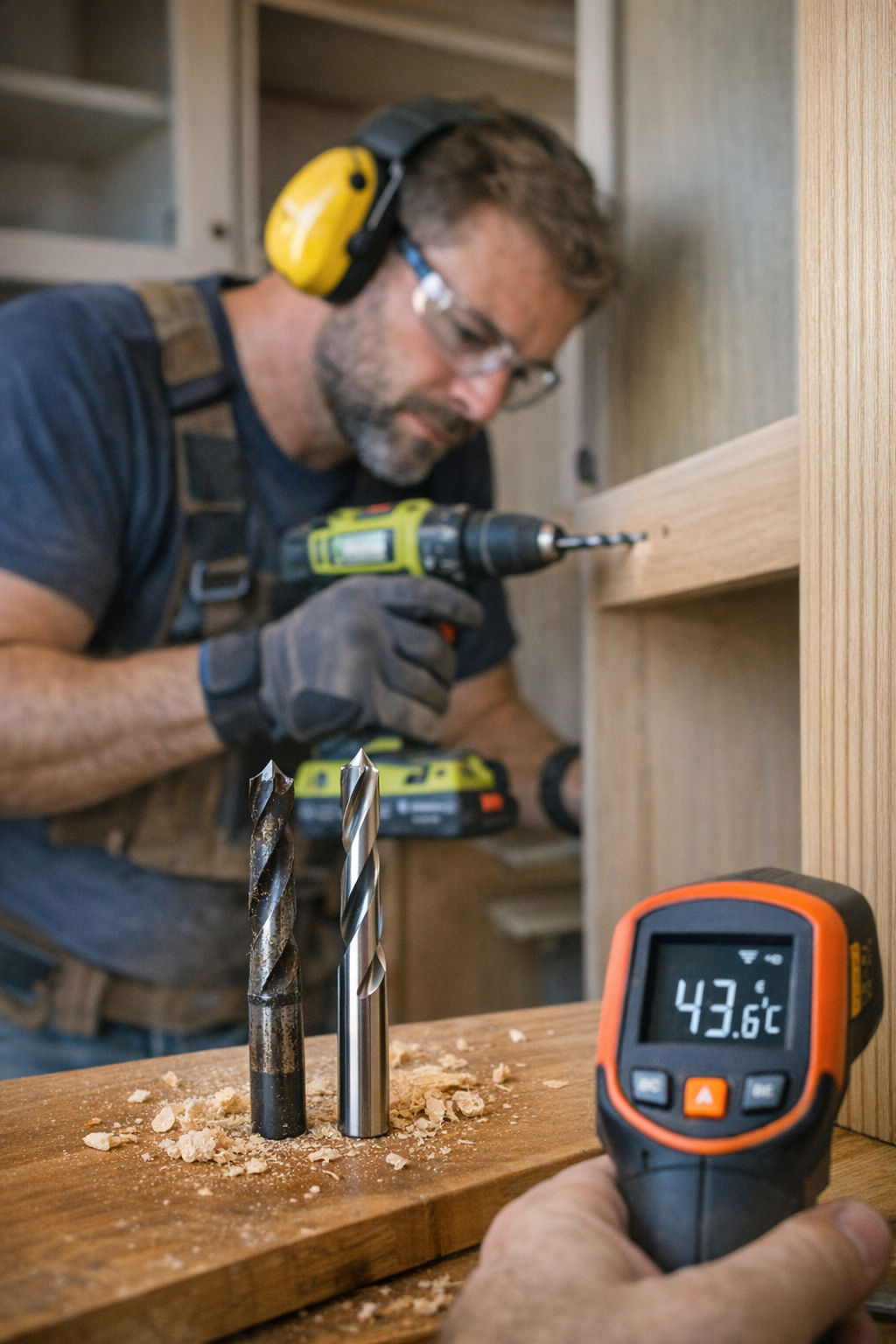
The gap between “fast” and “frustrating” appears after just a few holes. If you’ve ever marked out pilot holes across a run of shelves or knocked out pocket screws across a hardwood face frame, the rhythm is familiar—and the slowdown even more so. The early holes are crisp; you’re in control, bits bite easy. But by hole seven or eight, something shifts: resistance builds, the drill pitches higher, your wrist aches a little more. Next thing you know, progress drags and clean work turns messy, all because the bit isn’t keeping up.
The Bit Choice That Sneaks Up on You
When you’re standing in front of your toolbox, drill bits all lined up, every one of them can look ready for action—shiny edges, sharp spirals, slick with a new-coat shine. But that sameness disappears in real use. A junk-drawer bit and a truly good one only show their difference after repeated jobs: precision holes versus ragged tear-out, steady hands versus fatigue, real momentum versus forced stops just to shake out gummed-up flutes.
Friction Builds—And So Does Every Hassle
Your hands know when a bit is failing, even before your eyes do. Every extra ounce of pressure, every little shudder in the trigger hand—it’s the bit fighting the material, not cutting it. As a dull or low-grade bit overheats against hardwood or MDF, noise shifts up, the motor labors, and your grip gets tighter just to control wandering. Workpieces tell the truth: fuzzy-edged holes, singed rims, dust clinging to the flutes, bits too hot to pocket. The fix? More sanding, more cleanup, more stops than intended.
When Repetition Exposes Weakness
Nothing stresses a bit like real volume work. Drilling a dozen shelf pin holes, zipping fasteners through deck frames, or batch-joining casework—this is where a mediocre bit crumbles. By hole six, resistance mounts; by hole ten, you’re compensating for the tool:
- Edge tear-out and chipped holes that eat up finishing hours
- Drill strain—sometimes tripping safety cutoffs if you push through
- Forearm and wrist fatigue as you muscle the bit to finish the job
- Uneven cut, reduced controllability, and more battery draw
The cycle is predictable: work slows, mistakes creep in, you use time fixing what a sharper bit could have avoided. All the while, the sense of control—the most important thing—slips away.
That Moment You Swap—What Actually Changes
There’s relief in reaching for a pro-grade, low-friction bit after you’ve battled through with a basic one. A real world run—drilling ten holes in kiln-dried maple—makes the difference plain. With a sharp, coated bit, the holes run cool (under 45°C checked by infrared), your drill stays steady, vibration is barely there. More importantly, you’re not chasing burnt edges or scraping battery packs before lunch. Each hole is as clean and accurate as the first, and your hands can focus on placement, not just forcing progress.
Right Bit, Right Moment
There’s a temptation to use one bit for every material, but anyone who’s chewed through plywood with a hardwood bit knows better. The feel changes: feed rate slows, dust clogs up, and the tool’s control drops off. Swapping in a bit specific to the wood at hand—maple, pine, or ply—lets the drill maintain speed, cuts remain sharp, and you get more holes per battery. It’s the difference between staying in flow or watching your tempo die out halfway through the project.
Listen for the Signals Mid-Task
A good bit going bad doesn’t always announce itself, but the sharp operator notices:
- Heat and smell: The tip is hot to the touch and the faint bite of burnt wood hits your nose
- Rising vibration: The tool starts to chatter and shake, grip becomes tense
- Annoying noise: Drill noise ramps up, getting shriller with every hole
- Messy results: Charred edges, chipped surfaces, even holes that refuse to stay round
Any one is a warning: keep pushing, and you’re not just working harder—you’re wasting tool life and, worse, your own energy. Ignoring these cues costs time you’ll never get back.
Quick Habit: The 30-Second Pre-Flight Bit Test
Don’t let a cheap bit dictate your day. Just before kicking off repetitive drilling, take a half-minute:
- Spin the bit—does it glide between your fingers or drag over a nick?
- Test on a scrap—does it bite cleanly or skate and burn?
- If there’s any hesitation, switch in a fresh one before it winds up costing you double in rework
That habit deflects the most aggravating work—fixing holes that shouldn’t have gone wrong in the first place.
Bit Quality Pays Off—Especially on Long Runs
Over an afternoon, or a week, the differences stack up. With a truly sharp, well-matched bit, every step of the build gets easier: fewer slowdowns, less muscle strain, fewer surprise changeouts, smoother control as the job goes on. You start responding to slight shifts—more vibration, rougher edges—before they derail the task. It’s rarely about instant perfection or showroom results. It’s about less wasted motion, straighter holes, a finish that doesn’t need disguising. When you’re powering through real jobs—fitting shelves, building out a benchtop, hanging cabinets—the right bit feels less like an upgrade and more like the baseline you deserved all along.