
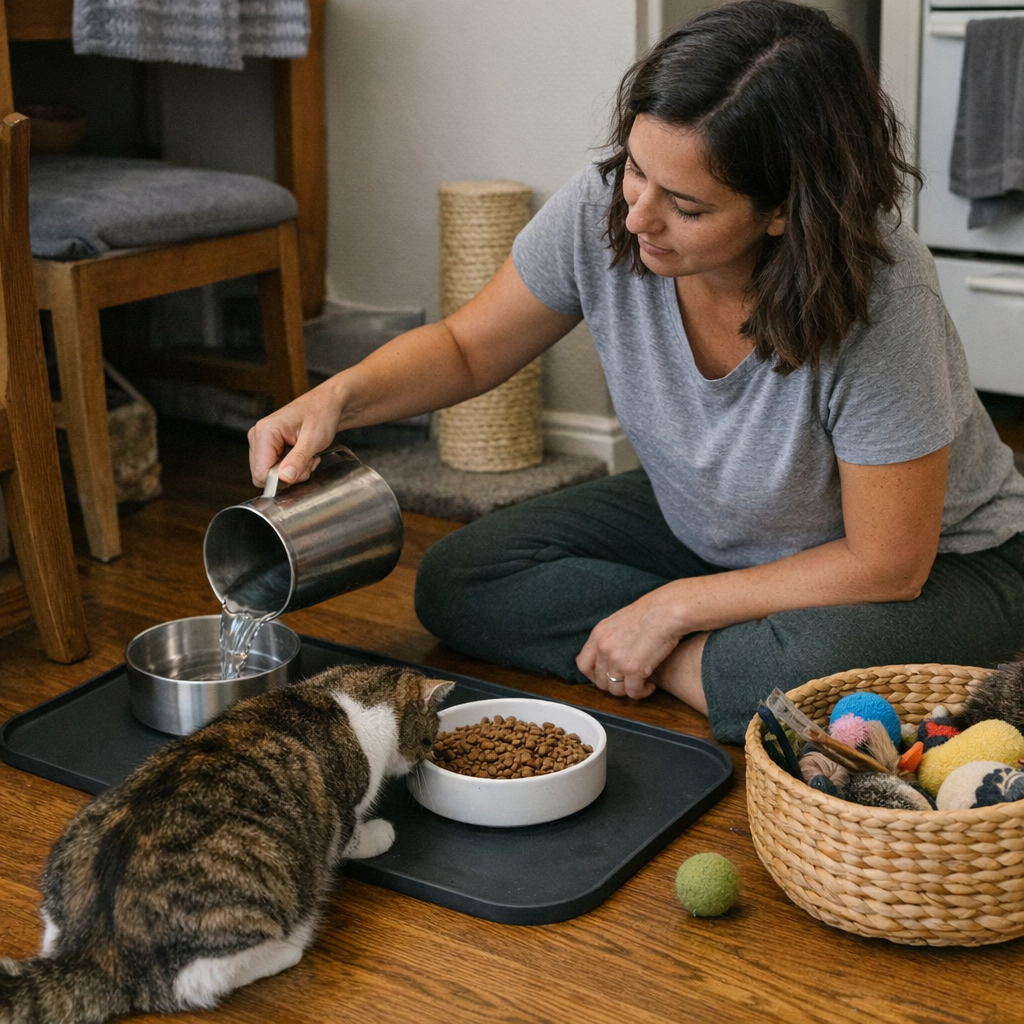
The real test of an indoor-cat feeding setup isn’t how neat it looks after one tidy—it’s what starts to go wrong by the third day of daily routines. The mat that promised to corral the mess is now collecting a fresh fringe of kibble, a supposedly anchored bowl has slipped just far enough to block your cabinet door, and the same one-eyed toy keeps reappearing right where your foot wants to go. Resetting the area starts taking longer each time. Soon, you’re not just wiping down—you’re nudging bowls, clearing a new path for water refills, and moving that “quick-fix” storage bin out of the way yet again. The surface looks managed in photos, but the real-life strain piles up, leaving every reset a little slower and less convincing. For most cat owners, this friction isn’t dramatic. It’s unrelenting: small chores multiplying, messes creeping farther into shared space, and the whole area drifting away from the “easy upkeep” you meant to build.
The “Almost Tidy” Trap: Why Setup Shape Matters More Than Surface Order
It’s easy to judge a cat zone by how fast it snaps into visual order for unexpected guests. But after a day or two, the chaos reasserts itself: bowls edge into the walkway, toys trickle from their bin, and a constellation of crumbs resettles between mat and floor. You notice it right when you want to do something else— another refill pause, another sweep for scattered food, another tray drag just to reach the water bowl without bumping elbows with your own cat or shifting three other things first.
Each “organization upgrade”—an extra bin here, a cuter mat there—offers a brief sense of progress but quietly increases daily handling. The real work just shuffles around. Instead of lessening your burden, these patches build a maintenance loop: another thing to move, align, or wipe down at every turn.
Everyday Friction in Real Home Use
The pain points that push you to reset aren’t dramatic—they’re relentlessly practical. There’s the grit line sneaking out from under the food mat, the cleaning wipes stranded behind a toppled bowl, or the barefoot trip into the kitchen where you step on last night’s plastic ball. “Managed” becomes constant interruption: every refill, every wipe-down, every sweep finds an item in the way or a surface you can’t quite clear in one motion.
A week of this, and you’re losing time: trays drift off their mark, letting litter spread into the hallway; a comfort mat, once helpful, turns refilling the water bowl into an awkward sidestep; toy bins multiply but sprawl wider as the week wears on. Resets get slower, and the border between your cat’s zone and the rest of the house blurs as pieces leak into main walkways and shared rooms.
The Repeated Reset: Where Most Setups Fall Short
Even the most organized feeding area looks fine immediately after a reset, but gaps reveal themselves in real use. A bin labeled “toys” or “clean-up” only helps until a needed item is buried or tipping one thing dislodges half its contents. A mat that filled the space when you set it up now leaves windows for crumbs, and cleanup tools are always just far enough away to slow you down.
Here’s what breaks down: bowls and bins clump up and block each other, so even a simple refill becomes a three-step diagonal shuffle. Mats don’t catch every spill, and wipes or dustpans are “close”—but out of practical reach right when you actually need them at the spill site. Tidy in principle, high-friction in practice.
The Slow Creep: How Cat Items Push Into Shared Spaces
You start with a compact, defined spot for cat life. But after a few weeks, a trail of stray litter points toward the bathroom, and plush mice dot the floor from the fridge to your desk. It’s not a dramatic mess but a repeated seep—each tidy-up fades fast, and the “cat zone” quietly expands, interrupting your day at odd angles.
This isn’t just about having to clean—it’s about how often. The misaligned bowl or knocked-over bin is never where you expect it. That feeling of control dissolves under stacks of micro-messes and repeated tweaks you never planned to spend time on.
Instant-Fix Purchases: Short-Term Calm, Long-Term Work
Every new irritation—a drifting food bowl, a mat that sheds instead of containing—pushes you into another online search (“This one might solve it, right?”). But each fix plants its own burden: another place to stoop, another edge to line up, another surface to monitor. You don’t get freedom; you inherit more steps. The root routine—refill, wipe, reset—rarely gets lighter.
Real Relief: The Impact of Simple, Anchored Layouts
The setups that hold up over time don’t just look better; they act as friction-breakers. The most valuable improvement comes from layouts and materials that prevent drift, sprawl, and routine disarray. A basic, broad silicone mat that actually fits both bowls and cuts off side mess—paired with open, reachable storage for toys—makes a difference in lived use, not only in theory:
- Bowls stay anchored—no creeping into main traffic paths or needing a midweek reset. Reaching for a refill doesn’t mean rearranging the whole area first.
- Kibble gets stopped at the edge, not the far corner. Clean-up shrinks to a single swipe, not a furniture-corner hunt for lost crumbs.
- Toys stay contained but accessible. An open bin—close to the play zone but not camouflaged—means lost foam balls are found before midnight and dropped back in with zero search-and-rescue effort.
- Refill and reset break the full-cycle grind. When every item returns to its spot without conscious effort, you don’t keep reaching for more organizers, and the daily wipe-down happens at the right moment—less often, less annoyingly.
Example: A Week with an Improved Feeding & Play Area
The change isn’t instant. Day one and two feel familiar, but by day three the difference lands: you’re not bending twice to move a sliding bowl; the mat actually collects mealtime debris instead of letting it sneak onto tile; toys get played with but always find their way back to a visible bin. The urge to buy another bin or realign the whole area fades away—reset gets quicker, and that stubborn crumb line becomes an easy, one-pass fix instead of a drawn-out routine under baseboards.
Recognizing Signals: When Your Setups Need a Change
The most obvious sign your setup is broken? Repeated reset friction. If you’re sliding bowls around just to wipe, lifting mats to reach a spill, or still stepping over the same tired toy no matter how many resets you do, your system is fighting your actual patterns. Every “solution” that doesn’t fit how you live just creates another maintenance job.
Ask yourself: Does the area keep pulling you into more fixes, or is it basically stable between resets? Stop-gaps that keep spills and messes contained, and arrangements with storage within true reach—not theoretical but real—are what cut down repeated work. Upgrades work when they let you refill or clean without extra shuffling or new purchases each week.
Lasting Control Comes from Structure, Not Surface Calm
The feeding setups that actually lighten routine aren’t just visually neat; they’re built for reset speed and repeated use. That usually means fewer total items—but ones that anchor, separate, and open the right way. Storage within natural reach, mats that do their job at the boundary instead of hiding fallout at the edges, and bowls that resist creep save daily seconds and keep “clean” from turning into a background chore loop.
Nothing is perfect. But the difference shows in the ordinary: water gets topped up without dragging a mat, sweeping doesn’t mean threading your way around bins, and you forget about new organizers because the space finally matches the rhythm of real use. Improvement isn’t about more stuff or constant upgrading. It’s about making resets easier—and daily cat life smoother—without turning every day into another rearrange-and-tidy session.
Find practical, real-use solutions for your feeding, water, litter, and shared home-cat zones at StillWhisker.