
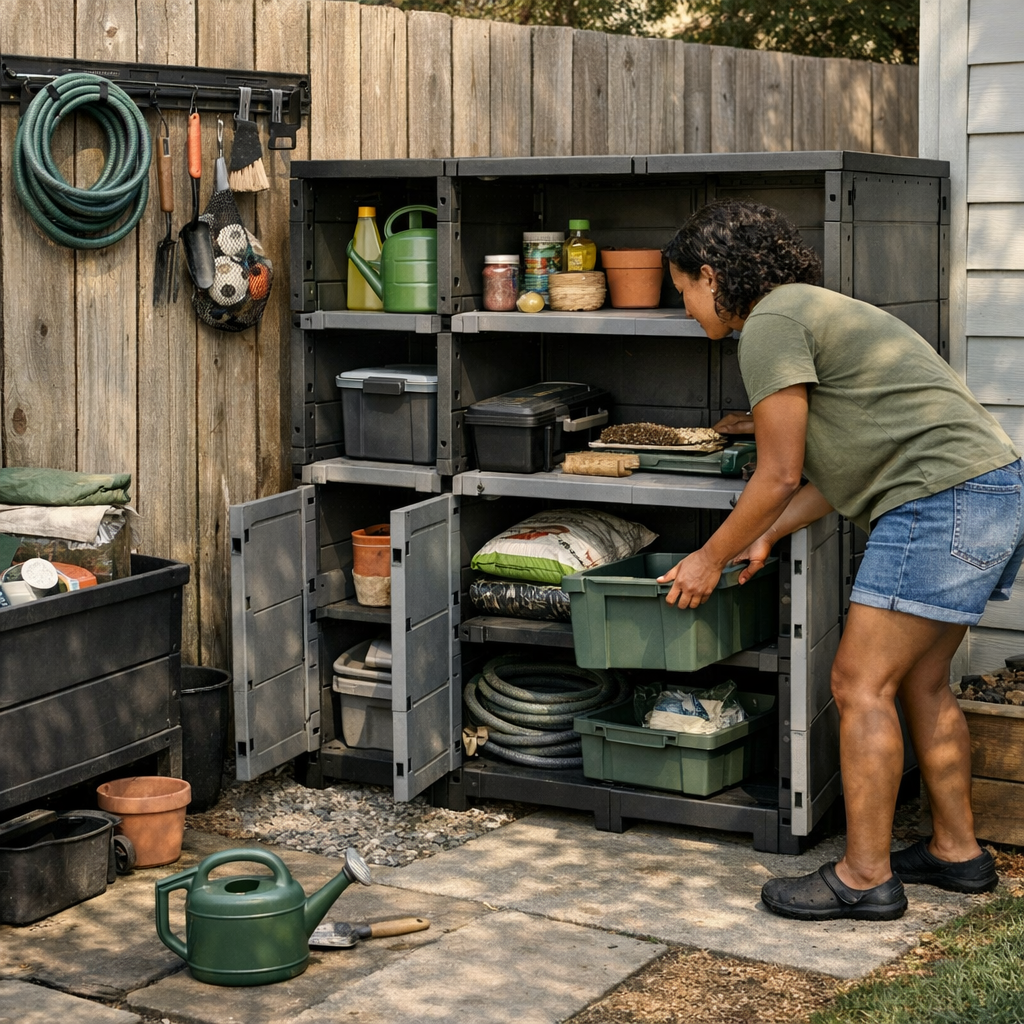
The difference between an outdoor setup that actually works and one that quietly wears on you shows up the first time you try to put something back in a hurry. Out here, it’s not about how much storage you line up along the fence or how clean the shelves look to visitors. The test is what happens after three weeks—a regular Saturday, kids’ gear back from the grass, garden tools trailing fresh dirt, and barely a square foot left uncluttered on the patio edge. Suddenly, the question isn’t “Does it fit?” but “Can anyone move through here without redoing yesterday’s whole reset?”
When Outdoor Storage Looks Right But Doesn’t Work
That new wall rack or modular cabinet promises order at first—bikes lifted, hoses untangled, bins off the patio. And yes, for the first week, the visual is strong. But real use starts to expose each small friction. The side-yard wall system fits—until it blocks the only path to the outdoor faucet. Those tall hooks you installed for floaties work—until they require a two-handed reach after a long swim. Shelving that measured out perfectly on paper feels pinched in real life, hemmed in by deck rails and grill wheels, forcing you to sidestep around every “just for now” pile that accumulates by day three.
The real break isn’t sudden mess. It’s when returning something takes a workaround—a pause, a shuffle, a “just put it here for now”. The storage starts to look efficient, but it feels interruptive. That’s where most setups reveal if they actually hold up under repeat use.
Where Friction Builds Up: Ordinary Use, Real Blockages
If It’s Easier to Set It Down Than Put It Back, the Setup’s Losing
End of the afternoon: the chalk bucket and scooter in hand, you head to the garage wall. But now the track system is buried behind the bikes, and the idea of threading everything into place is more chore than incentive. So the “temporary” stack grows next to the racks. Each round, the pile gets more permanent—and returning things, in theory, gets slower in practice.
The ‘Front Row/Back Row’ Trap
Wall racks with two or three rows: great in the store, crammed in reality. Reach for a saw behind the trimmer and you’re wiggling past the last three things you managed to hang up. Less-used gear creeps deeper behind the regulars, and every Saturday becomes a low-level reshuffle just to get out a ball or clip a hanging basket. More rows don’t help when the path through them gets tighter every week.
Stand-Up Cabinets and “Door Pinch”
Big, vertical storage units promise space—until you try to open the doors with the patio chairs pressed close, or the grill halfway rolled into the zone. Each trip becomes a shuffle: swing the door, dodge the edge, nudge a chair, wedge in the rake. Soon enough, doors are left half open, and what you meant to clear just piles up at the entry—staring you down next time you pass by. “Door pinch” only shows up when the daily flow gets squeezed sideways.
Modular Promise vs. Modular Pile-Up
Flexible modules—one for trowels, another for soccer balls, maybe a tall one for yard bags. But when pieces are heavy or only fit one way, the flexibility is mostly theoretical. Need to swap bins? You unload half of what’s there. Modules become static islands that attract overflow rather than fix it. The “move it anywhere” pitch dissolves when moving it anywhere requires a complete empty-and-shift.
Rolling Bins: Fast Access, Fast Chaos
Bins on casters solve quick resets—until you’ve got two crowding the only path or one drifting sideways into the side-yard route. In tight utility strips, mobile bins become obstacles. They’re designed to speed up cleanup, yet often block the very thoroughfare they’re supposed to clear. Not anchored, they turn into stray item magnets and reason for roundabout detours on the way in and out.
Mixed-Use Zones: The Setup Tension Appears Fast
No backyard or garage edge stays single-use. The soccer patch becomes an outdoor dining spot, the spot for tools flips to bikes, and summer’s perfect cube storage serves as July’s overflow pit. Actual use always pushes against the original footprint: that one fence corner swallows all the forgotten gear, the patch near the gate becomes a dead zone for wayward shoes and bags. It’s not just clutter—it’s a signal the system’s traffic lanes aren’t keeping up with reality.
Day one, the layout looks tight. By week three, you’re squeezing the mower past a rolling bin that’s drifted half a foot too far, or shifting a stand-up shelf two inches just to clear the gate. It feels minor until it happens every weekend—slowly stealing walkway space, making daily resets drag out, and crowding out the clean lines you started with. “Fits outside” turns out to guarantee nothing about movement or reset.
How to Know When Your Setup Actually Works
Forget how tidy it looks right after setup. The test is how easily you can return things after a regular day—with kids, projects, and guests in the mix. Do you end up blocked, or does the loop flow? Here’s what to watch for:
- You don’t have to pull out three things just to put one back.
- There’s no overflow pile that keeps returning to the same edge, week after week.
- Main walkways stay open—no matter how much gets used and returned.
- Putting away one thing doesn’t trap what you put away yesterday.
- The reset gets faster (not slower) the more familiar you are with the setup.
The goal isn’t maximum storage. It’s a smoother loop: fewer roadblocks, less double-handling, no mystery piles building up at the boundaries. When the setup takes care of the return flow with minimal thought, you see the actual difference between organized and just “organized-looking.”
Setup That Holds Up: Built For Repeat Use, Not for Show
A storage system that works makes itself nearly invisible—paths stay open, the right wall spots do the heavy lifting, and return trips don’t trigger a new mess. There’s no such thing as flawless: the fence still blocks a door some days, or the deck eats up half the available floor space. But a setup that fits the odd angles, avoids corner pile-ups, and doesn’t let a single clumsy bin rule the reset changes the entire rhythm of outdoor life. You’ll still bump into the occasional bottleneck, but you won’t keep circling the same frustration, over and over.
The real win isn’t visual—it’s practical. When moving through your space doesn’t require detours, shuffling, or repeated second-guessing about where something should go, the setup is doing its job. When every reset spirals back into the old pattern—blocking access, stacking in dead corners, forcing a two-step just to use the patio or side yard—it’s time to reevaluate. Not for appearances, but for flow and function.
Find solutions built for real outdoor routines at TidyYard.