
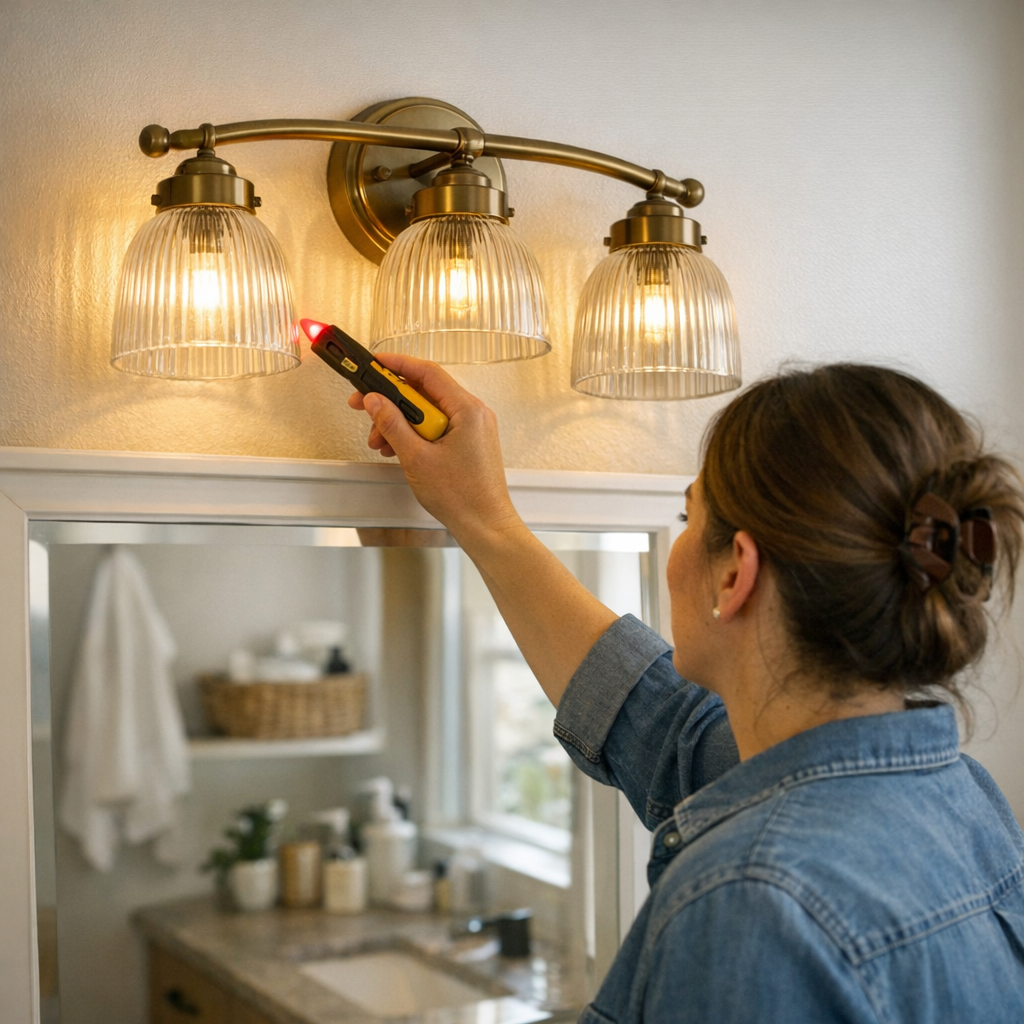
The moment you flip the light switch and the room still feels uncertain, the problem is immediate—and common. In entryways, awkward stair turns, cramped laundry corners, or overbright bathrooms, safe movement collides with the limits of your indoor lighting. Flush mounts and sconces may fill the space with light, but the setup can still fail you right when it matters: hesitating at the top of the stairs, reaching blind behind a mirror, tracing wires through a laundry ceiling and guessing which fixture is really powered down. Here, lighting isn’t just about brightness—it’s about knowing for sure if it’s actually safe to reach, touch, or repair what’s overhead. Every time the fixture looks “off” but the wiring tells another story, risk hides behind routine, and what seemed like just another lighting job becomes a quiet walk through uncertainty.
Real Lighting Friction: When Safe Access Isn’t Obvious
Even in well-lit rooms, weak points reveal themselves as soon as you try to swap, clean, or fix a fixture. That flush mount in the laundry seems bright—until you find yourself up on a stool fighting reflected glare and guessing which of three cables is really dead at the switch. Stair sconces set up an even trickier problem: two wall switches, odd wiring colors, and an uncomfortable moment spent wondering if both the landing and hall circuits are truly off. In tight bathrooms, a “simple” vanity upgrade becomes a tangle of shadow, condensation, and hidden feeder lines—where looks deceive and a supposedly dead light stays quietly live. These are the places most likely to trip you up, especially when standard brightness and switch logic mask the gaps.
When spaces like these see repeated use, the routines you trust—flipping the breaker, testing the switch, relying on your memory—break down. That laundry gets awkward when another switch somewhere else controls a feed you didn’t expect. Visual cues fail exactly where you want clear, reliable knowledge of what’s live and safe.
The Non-Contact Voltage Tester: Cutting Through Guesswork
A non-contact voltage tester turns that moment of hesitation—hand hovering, uncertain—into a clear yes-or-no. Especially where lighting logic is a mess: multi-way stair switches, overlapping bathroom circuits, shared feeds across laundry and hall. Instead of trusting that the switch position means safety, the tester gives you an answer the wiring can’t fake. The difference isn’t just peace of mind—it’s concrete: no gamble, no burning time dragging out a spare bulb or toggling random switches, no risking a live touch because you’re sure you killed the right breaker. One quick check, and you know for sure before you move.
But the simple existence of a tester isn’t enough. The real change is in making it always accessible: clipped to your shirt, on your tool belt, or beside your stepladder—never buried under spackle knives or lost in a junk drawer. The urge to skip this step comes fast when you’re tired or hurrying. Friction wins any time safety gear isn’t instantly there, and in the pressure of real work, forgetting the tester is when mistakes multiply.
Everyday Trouble Spots Where This Matters
- At a stair setback: Ceiling and wall lights look “off,” but a third switch at the base might power a stray circuit—one fast test calms the nerves, especially in shadowed corners where the visual logic breaks down.
- Reaching behind a bathroom mirror: Damp patches and erratic shadows unsettle your routine—the “off” illusion means nothing if the tester buzzes behind the vanity.
- Under an overhead cabinet run: Clean surfaces, then a sudden dark band cast by undercabinet lighting—a touch test is only safe if the wiring doesn’t stay mysteriously hot, even when the room feels silent.
Where Standard Lighting Habits Fail to Deliver Safety
Ceiling fixtures, wall sconces, and even new LED flush mounts rarely account for bad wiring, extra feeds, or half-labeled breaker boxes. A missed side-feed in the hallway, or an old ceiling junction in the bathroom, quietly wreck the assumption that “dark” equals “safe.” That’s why jobs that feel routine—replacing a warm-glow bulb or untangling a cover plate—still force you to slow down, fumble with your phone flashlight, and wonder if you’re missing something. The risk compounds as you move faster: glare from a semi-flush, shadow across the edge of a wall light, bright but poorly directed light that distracts from real wiring paths. Every shortcut around safety is a chance for the wiring under ‘finished’ ceilings to fight back.
The Added Risk in Damp and Utility Spaces
In bathrooms, laundry nooks, and entry alcoves—where flush ceiling lights are closest and air stays humid—access is tight and footing less certain. Condensation beads on covers, and standing on a stool in a haze of steam, small wiring flaws blend into the background. Shared circuits, unexpected splices, and “just-in-case” feed runs amplify the confusion in ways bright bulbs can’t resolve. Flipping breakers becomes a guessing game, especially when a single circuit feeds both lights and a hidden outlet. Every attempt at “just trusting it” pulls you closer to a real mistake.
Making the Safety Step Unmissable
The game changes not when you buy a tester, but when you make it part of your automatic reach: clipped inside your tool apron, living next to your driver bit, or always on the tray with your stepladder. The habit doesn’t just save time—it rewires the sequence. Before you loosen a sconce, pop a mirror, or twist a flush-mount, the quick check becomes reflex. No guessing, no charting out which breaker probably matches the kitchen. One touch, confirm, move on. Over time, this shift becomes as normal as grabbing your screwdriver—removing doubt and freeing you to work faster and safer every time you face unpredictable home wiring.
Frequently Noticed Questions in Real Use
Can looks or switch position ever guarantee the wire is safe?
Not reliably. Fixtures may look dark but still carry current, especially with multi-way switches and overlapping feeds. Only direct testing proves a wire is dead—never let visual cues replace a real check.
What makes damp-rated zones uniquely risky?
Moisture blurs the boundaries. Humidity increases both wiring risk and access difficulty, turning small mistakes or lazy checks into real hazards—condensation plus poor footing means you get only one chance to check right.
Do all testers work equally on LEDs, dimmers, and tight fixture spaces?
Most quality testers can detect standard voltage whether you’re working around dimmable LEDs, compact ceiling panels, or crowded wall boxes. In dense setups, slow down: a thorough pass with the tester is worth a few extra seconds for certainty.
Better Lighting Habits Start With One Small Shift
Real indoor-lighting safety isn’t about endlessly upgrading fixtures or maxing out wattage—it’s about repeated routines shaped by clear, fast checks. With a non-contact voltage tester within actual reach, even the trickiest setups—mirror lighting, stair turns, narrow laundry runs, entryway semi-flush—become less a guessing game and more a series of controlled, predictable steps. Instead of pausing for uncertainty or assuming the wiring follows the look of the switch, you move with confidence in spaces that may look bright but still behave unpredictably. That’s the quiet line between rooms that just look good and ones you can trust, week after week for every real-world job.