Category: Pet Life

  • How Anchoring Pet-Care Essentials Simplifies Your Daily Routine

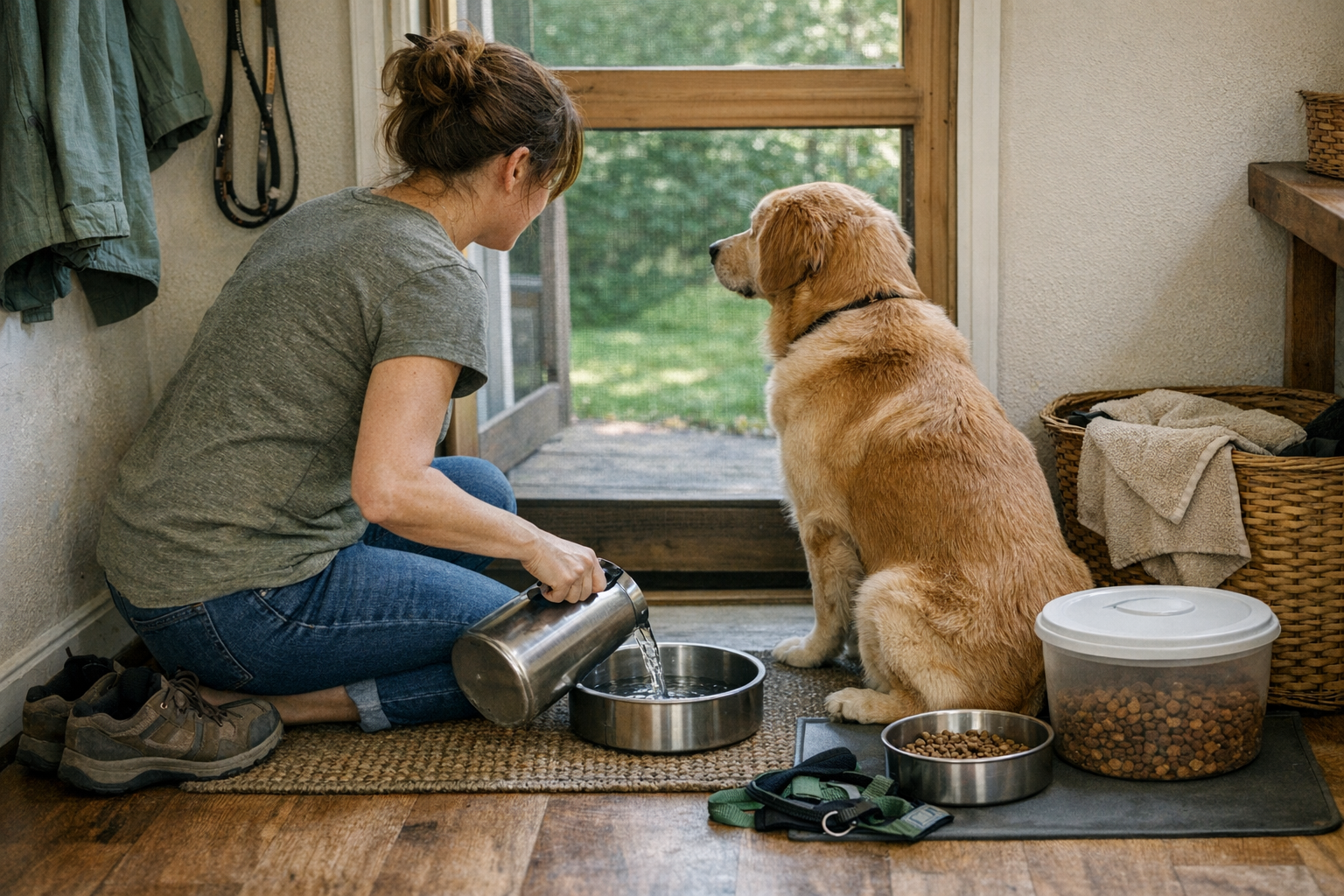
    Pet care routines break down fast in daily use—even when they start out looking organized. You line up food and water bowls, set a grooming brush within reach, stash quick-clean wipes close by, and convince yourself the routine is handled. But by day three, a towel is missing from its hook, the water bowl is low again, or you’re shuffling supplies buried behind shopping bags. Each tiny delay—waiting, reaching, re-stacking—interrupts a simple reset, turning a ten-minute job into twenty. The problem isn’t a messy pet area; it’s a setup that can’t defend itself against real-life friction. CalmPetSupply products live in this gap: they’re not just for “looking ready,” but for cutting out the repeat work and surprise setbacks that creep in after the first round of use.

    The Illusion of Readiness: Why Pet Areas Don’t Stay Functional

    A prepared pet-care space looks finished—full dishes, mats in place, supplies within easy reach. But real routines stress-test setups faster than most owners anticipate. Pets nudge bowls out of alignment. Toys drift under furniture. The brush you ‘always’ keep next to the feeder finds its way into the laundry basket or behind a storage bin after just a few days. At night, you run inventory: water gone dry, stray kibble trapped under the console table, cleaning spray nowhere within arm’s reach. The weak link isn’t visual mess, but repeated small failures that become friction points with every pass through the routine.

    How Small Disruptions Build Into Major Friction

    Say it’s after work and you want the evening pet care cycle to flow. But now the cleaning towel is still in the laundry, so you improvise with paper towels—hunting for the roll, bending under the sink. You fetch the refill bottle, only to find the brush obscured by shopping bags from yesterday. At each stop, the system lags. It’s not about lost items, but about what’s blocked, misplaced, or too far out of reach when speed actually matters.

    Over a week, these disruptions snowball. Quick resets demand extra moves: bending to grab wipes from a low drawer, clearing toys before water can be refilled, shifting bowls that keep migrating into walkways. Even a tidy setup by Sunday starts leaking into living spaces, with bowls edging into traffic paths and mats curling under passing feet. Every night ends up with more “quick” fixes—each one avoidable, but real.

    The Problem with Quick Fixes and Visual Tidy-Ups

    Setting up looks simple: bowls straight, supplies clustered, mats uncurled. But most quick fixes trade daily speed for temporary order. Cleaning sprays relegated under the sink slow down spill response. Grooming tools land neatly back in storage—until one busy morning pulls them into another room, where they sit out of sight for days. The routine works until a missing item or an awkward reach turns a five-minute maintenance into a full round of searching, shifting, and sometimes just leaving the cleanup for tomorrow.

    The moment a pet knocks over water or tracks fur behind the bowls, you realize whether your “system” is built for actual use—or just for clean lines. Tasks stretch out, not because you’re unprepared, but because supplies ended up one room away, or tucked behind closed cabinets. Most missed steps aren’t laziness, but from systems that fail routine stress.

    Daily Chore Chains: When One Weak Link Slows Everything Down

    Real-world breakdowns usually hide in lag—not disaster. Towels drift from hooks to laundry for two days, letting pet hair pile up and making every future wipe take longer. The water bottle isn’t at hand, so refills get skipped or rushed. After-walk care pauses because the towel is wet or stored in the wrong bathroom. You might labor to keep other parts neat, but the weak spot reappears: supplies out of reach at the exact moment you want a seamless reset. No matter how tidy the space looks at breakfast, mis-anchored essentials guarantee drag by night.

    Functional Over Decorative: What Actually Keeps Pet Care Flowing

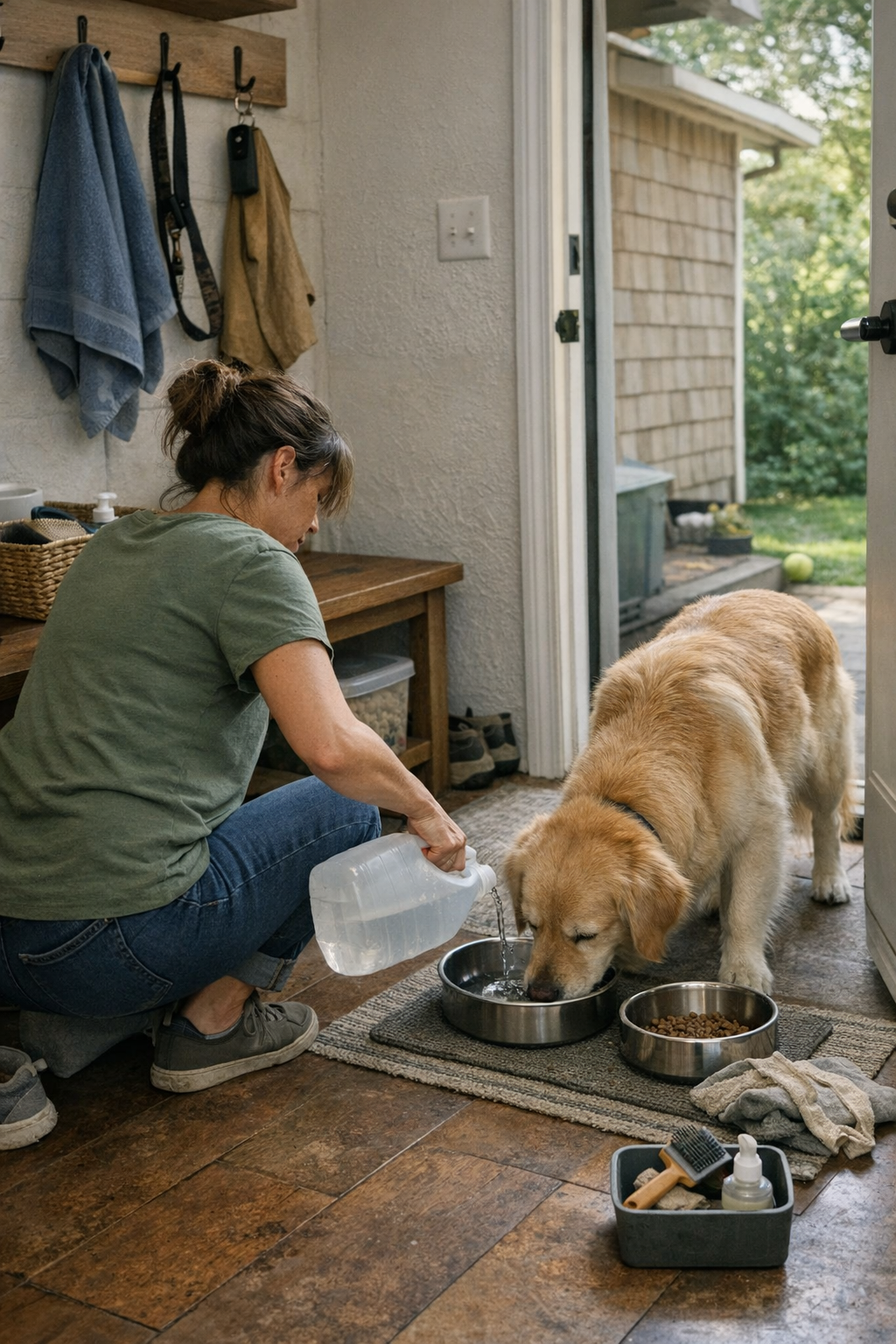
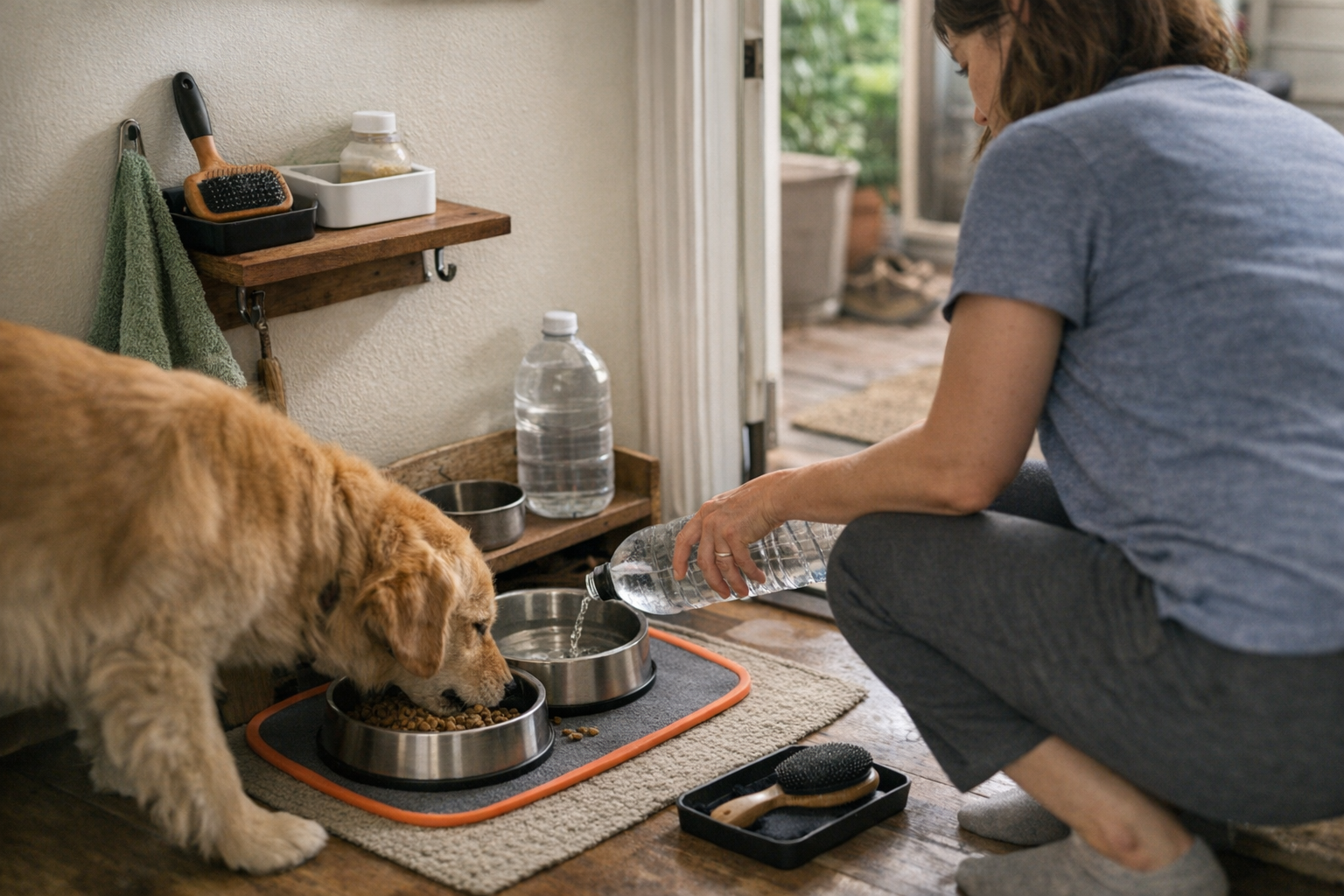
    Reliable routines depend on essentials that don’t drift. A silicone mat with a wide edge anchors bowls and traps spills—no more gradual bowl migration. Hanging a towel hook directly above the pet zone means a missing towel is obvious right away, not discovered after the fact. Shallow, open trays for brushes or sprays put the basics within eyeshot and arms-reach, which matters under actual time pressure. The right products don’t multiply clutter; they stop a dozen minor shuffles and repeated “make do” substitutions.

    The point isn’t to add more gear or to make a pet area photogenic. It’s to cut out the repeat friction—less bending, less hunting, fewer steps back and forth—so feeding, cleaning, and grooming actually link together. Every reset becomes smoother because fewer things migrate and basic supplies stay anchored and visible at the pinch points of your daily flow.

    Real-World Results: Why Anchored Supplies Change the Routine

    With supplies anchored—towels right where spills happen, water bottles always under the bowl shelf, grooming brushes returning to their tray—each daily care block shrinks. Cleanups happen at the right moment, not an hour later. Refills stop being last-minute chores. Pet hair and stray kibble don’t accumulate in dead zones. Most crucially, less time is wasted on repeat searching and recovery. Care doesn’t just look easier: it is.

    In practice, this means fewer half-done resets, less spillover clutter, and much less “mental drag” after the day is already long. The clutter reduction is visible, but what matters is the relief from invisible interruptions: fewer stops, fewer lost minutes, and a routine you don’t have to force yourself through. Organization stops being cosmetic and starts showing up where it actually matters—at the hand grab, at the cleanup moment, during the refill routine, and throughout every daily handoff between you and your pet.

    CalmPetSupply isn’t about decoration—it’s for setups designed to hold up against daily stress, so the right item never drifts out of daily reach.
    See the CalmPetSupply difference here.

  • How a Simple Morning Ritual Eases Tension Between You and Your Dog

    You’ve just finished feeding your dog. Bowls are rinsed, surfaces wiped. But as you try to get your own morning started, your dog plants himself near the door—half-expecting, half-waiting, blocking the hall as you grab your shoes. It’s a predictable friction point: routine says breakfast is over, yet your dog hasn’t fully “switched off.” Instead, he silently interrupts the next steps, shadowing your movements, sneaking back for crumbs, or staring at door handles waiting for a cue. Whatever setup you use—a tidy feeding station, baskets for toys, bed in the sun—the trouble keeps coming back: the space might look organized, but it doesn’t run smooth.

    That Post-Breakfast Door Hover: More Than a Quirk

    We tend to dismiss after-breakfast pacing, door-hovering, or kitchen patrols as random dog behaviors. But these are signals—signposts that your morning routine still has an unfinished seam. As you move on to your own tasks (coffee, emails, getting dressed), your dog lingers directly in your path, drawn by the absence of real closure. Ignore it, and the cost is easy to spot: a paw on your calf while tying shoes, bursts of interest at the smallest sound, water bowl visits with no thirst—each a micro-interruption that drags out the “settling down” window. These aren’t isolated quirks. They stack up and reset your morning around the dog’s limbo.

    Identifying the Routine Weak Point

    This isn’t about burning off extra energy. It’s a logistical miss: when the morning routine lacks a visible seal, neither dog nor owner can settle. Look for these daily clues:

    • Your dog does hallway loops or shadows you from room to room after breakfast
    • Detours back to the bed or feeding spot before finally giving up and lying down
    • The softest household noises snap your dog’s attention right back to you, as if he’s waiting for the “real” next step

    Even if the rest area is plush and bowls are lined up, a missing signal means the underlying cycle repeats. You get the illusion of order, but the hidden work never ends: restlessness, unnecessary retracing, and constant resetting for both sides.

    The Small Frictions Add Up

    The real pain isn’t dramatic—it’s the quiet grind of daily inconvenience. Shoelaces blocked by a hovering dog. Leash hooks perfectly placed—but you’re fumbling keys and gear because you never actually grab them in flow. Cleanup wipes live one room away, always a few steps late for muddy paws. A tidy feeding corner might be visually calm but is stranded far from the quickest exit, forcing awkward double-backs. Rest corners look luxurious, but their position means the dog pops up mid-transition, never getting into deep rest before the next interruption.

    Looking tidy isn’t the same as living easy. Visual “order” can even mask bottlenecks: items are technically put away, yet leak right back into main walkways, or require detouring back for something forgotten. The result? More shuffling, more mess, more tension—just out of the spotlight.

    Signs the Routine Isn’t Really Over

    So what do incomplete routines look like in real life? Not chaos—just constant, low-grade friction:

    • Bowls need a “surprise” second rinse when the dog circles back after you thought feeding was finished
    • Water splashes, kibbles, or tracked crumbs turn up repeatedly as the dog patrols the bowl area
    • Paws make it deeper into the living room before you remember the towel is still out of reach
    • The leash sits untouched, even as your dog hangs by the door, unsure whether to ask for a walk or return to bed

    Put together, these moments puncture any chance for either of you to fully shift gears. The morning that “should” bring calm instead scatters into small resets and fetches. Both you and your dog end up more alert than at ease—routine becomes disruption, not anchor.

    Creating a Reliable Closing Step

    You don’t need a flashy solution. The fix is a practical, physical marker that tells both you and your dog: “routine closed.” This could mean:

    • A short pause at the door every time after breakfast (even if you’re not heading out)
    • A deliberate “all done” sound or gesture at the water bowl as you put things away
    • Delivering a chew or comfort toy straight to the dog’s regular resting spot—so he knows that’s the next move, not more patrol
    • A repeated, predictable phrase every time you finish the feeding routine

    It’s not novelty—it’s consistency that works. When that ending step stays the same day after day, your dog learns what signals the shift from “morning action” to “rest mode.” The more clearly you mark the transition, the less strain on both sides.

    Real-Life Example: The Leash Pause Trick

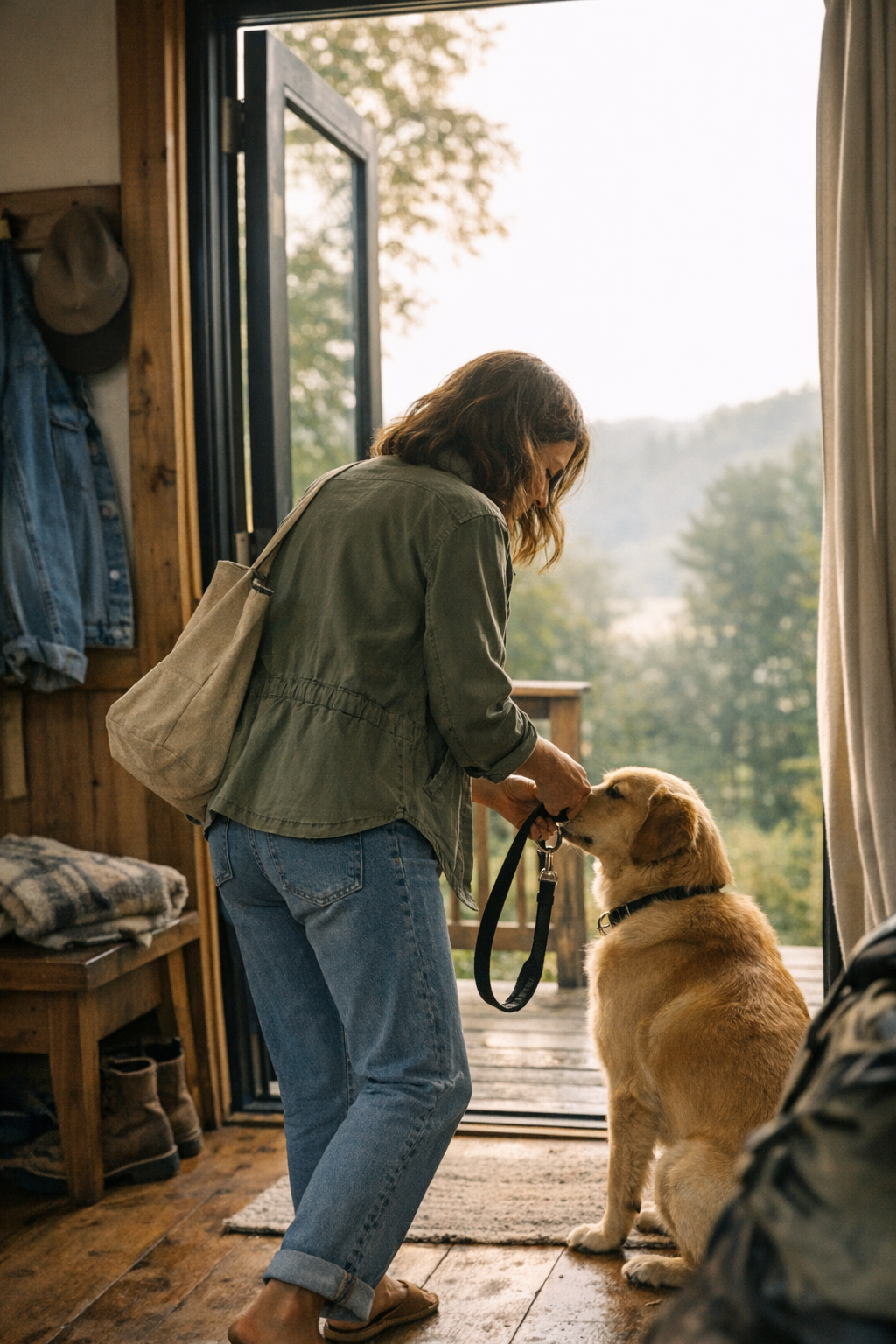
    Here’s how a tiny adjustment resets real friction: after weeks where the dog circled back to the bowl and hounded the hallway, one owner tried a post-breakfast “leash pause” at the door—not for a walk, just as ritual. Clip leash on, dog stands by, leash off, and both pause together for a beat. The result? No nagging need to patrol the kitchen, no ramped-up waiting energy. The dog began heading for his rest spot right after, and the owner could finish her own prep without side-stepping or backtracking. Seven days in, the “background” problem simply stopped repeating. Both sides landed their mornings faster and more cleanly.

    Why These Endings Work—Even When the Routine Looks “Good Enough”

    Organization alone misses something crucial: actual, daily closure that holds up under repeated use. Your setup can look staged for Instagram—bowl, leash, basket, pads (even labeled), nothing left out—yet if you skip a defining “end,” unwanted resets creep back in. Visual neatness does not mean flow. In fact, over-tweaking for aesthetics alone can make sequences longer or more awkward if the routine isn’t backed by a strong signal that says, “We’re done.” The gap hides until a spill, a missed wipe, or another morning spent tracing your dog’s path instead of your own.

    It’s a pattern most owners recognize: you move the supplies for cleanliness or reach, only to realize you’re still retracing your steps two weeks later—friction survived the shuffle.

    Tweaking Your Setup: Spot the Single Weak Point

    Dog routines rarely need a “makeover.” One stubborn kink—one bowl that’s always one step too far, or a towel you never remember to move before the exit—can drive most of the visible trouble. To break the cycle, look for where routine stalls:

    • Does your dog hover where he can’t see you prepping, because the rest spot is out of sight?
    • Do your feeding and door zones force back-and-forths, so cues blur together and neither task really finishes?
    • Is cleanup gear actually reachable in the moment or just “stored” conveniently out of play?

    Pick one tweak—move the bowl, shift the bed, keep the wipes within reach, or add a pause at the door—and measure if the after-breakfast shadowing drops by the third or fourth morning. Most setups need only this: a micro-adjustment to break the loop of constant resets.

    The Difference a Consistent Finish Makes

    When you land the routine with a concrete closing act, the payoff is immediate: your dog gives up anxious following, you stop losing minutes to looping tasks, and the post-breakfast window finally supports the rest of the day. It’s not about perfection—it’s about a repeatable step that holds up in practice, even when mornings run late or your hands are full. That’s when the hidden friction evaporates, and “settle” becomes something both sides actually feel.

    What If Restlessness Persists?

    Persistent door-hovering or trailing can mean one last kink is hiding in your sequence. Try reviewing the full flow for a few days: Does the water bowl stay accessible? Have you accidentally skipped a needed outdoor trip? Are you jumping from food to silence too abruptly? Extra pacing, tracking, or new messes usually flag a missed transition, not a misbehaving pet. Small, structure-based changes—not big lifestyle overhauls—almost always resolve it within a week.

    Morning Calm Isn’t an Accident—It’s Built In

    Dog-life friction doesn’t have to be tolerated: it’s a symptom of a setup that doesn’t support repeated use in real time. The difference between “looks good” and “works under pressure” is where small daily adjustments matter most. Catch the hidden weak point, tweak the closure, and the result isn’t just a better organized space—it’s smoother, more trustworthy mornings built from the ground up.

  • Optimizing Toy Storage Placement to Simplify Indoor Cat Play Cleanup

    Cleanup always sounds simple until you run it on repeat. A toy storage bin fixes scattered “cat stuff” for the first day: the room looks clear, and chasing a wand toy doesn’t have to mean crumbs in every corner. But reality sets in the third or fourth time your knee clips the bin edge as you refill the water bowl—or the moment a stray plush squeezes underfoot right where groceries come through or the next meal is prepped. Suddenly, it’s not about less mess. It’s about constant, minor reshuffles that stack up across the day and quietly reverse your win.

    When Convenience Becomes Collision

    At first, the logic is obvious: keep the toy bin by the play mat, clear the clutter in one scoop, and get space back immediately. It works—if you reset every session and never rush. But in actual use, routines overlap: you’re tidying toys at breakfast when the cat dashes for kibble, or you sweep up after play while juggling an armful of laundry. That’s when a once-perfect setup starts crowding everything else. The bin drifts into pathways, a crinkle ball rolls under the water station, and the one bin meant to fix chaos becomes the obstacle you keep bumping on every short trip. Each skipped reset, even one in a busy week, spreads toys and storage just enough to get in your way.

    It’s rarely a meltdown—but it’s never “done,” either. A space can look presentable and still snag snacks, snag feet, even slow down the next refill loop. Overlapping routines—feeding, playing, sweeping up—turn neatness into a daily maze.

    How Toy Drift Breaks the Daily Reset

    Routine is relentless: you feed, clean up, play, reset, and repeat. The failure point isn’t dramatic; it’s one skipped or distracted reset when something else needs attention—like scooping litter or dealing with a water spill. That’s when system cracks show:

    • Toys find the wrong areas. Stuffed mice wedge under feeding mats, or catnip fleece ends up soggy on the edge of the water tray. Mealtime means taking one extra minute to fish toys out of spill zones—or worse, missing them until the next accidental step.
    • The bin turns obstacle. Drift just a couple inches, and suddenly it blocks the path to refilling the fountain or sweeping up shed fur. What felt “tucked away” in the morning juts into your route by afternoon.
    • Micro-adjustments drain time. Instead of a single pass, pickups turn into two or three sweeps: move the bin again, nab that runaway spring, clear the mat line. The upgrades you hoped would save cycles only create new friction.

    The space doesn’t collapse into chaos, but the routine is slower, and the reset never feels complete. Every shortcut today adds a complication tomorrow.

    Why the “Perfect” Spot Decays Over Time

    Every setup looks organized when freshly reset: toys neat, mats aligned, bins in position. What you don’t see is how quickly convenience sours as tasks pile up. By midday, the “tidy” zone feels crammed, and the energy needed for one more adjustment outpaces any initial time saved. True weak points show up only as the day layers: the bin blocking the hallway for a second time, a plush mouse dusted with shed fur after a sweep, a toy spring sitting damp by the water dish. One rushed moment, and the order blurs fast.

    • You sidestep the storage every feeding refill and nudge toys aside, again.
    • Playtime leftovers show up where cleaning can’t reach—like in front of a drippy water fountain or pinned behind furniture legs.
    • Quick sweeps miss what’s beneath the visible layer, so tomorrow’s mess drifts out where it interrupts something else.

    What once took seconds now takes minutes, and each reset only half fixes the overlap. Chores start to repeat themselves—but slightly more awkward each time.

    Seeing the Difference Between Tidy and Truly Usable

    An indoor setup can look under control and still jam up your basic movements when things get busy. Toy bins rarely block you outright at first. But the pace of daily life forces small compromises: you step over a lid, dig for a wanted toy while two others tip out, or find reset routines dragging as you avoid knocking the whole thing sideways again. Over time, tidiness without boundaries only creates extra layers to undo.

    • The shortest walking line gets blocked by a bin corner you barely notice until your shin brushes it, again.
    • You spot a favorite cat toy but have to empty half the bin to reach it—meaning more mess after you’re done.
    • Each pass-through gives you an extra reminder that even “put away” can still mean “in the way.”

    Real convenience isn’t about proximity—it’s about staying out of the crossover. The most common mistake? Using visible tidiness to hide daily friction. The wrong fix always trades one small problem for another that you notice the next time you move.

    One Adjustment That Loosens the Chore Cycle

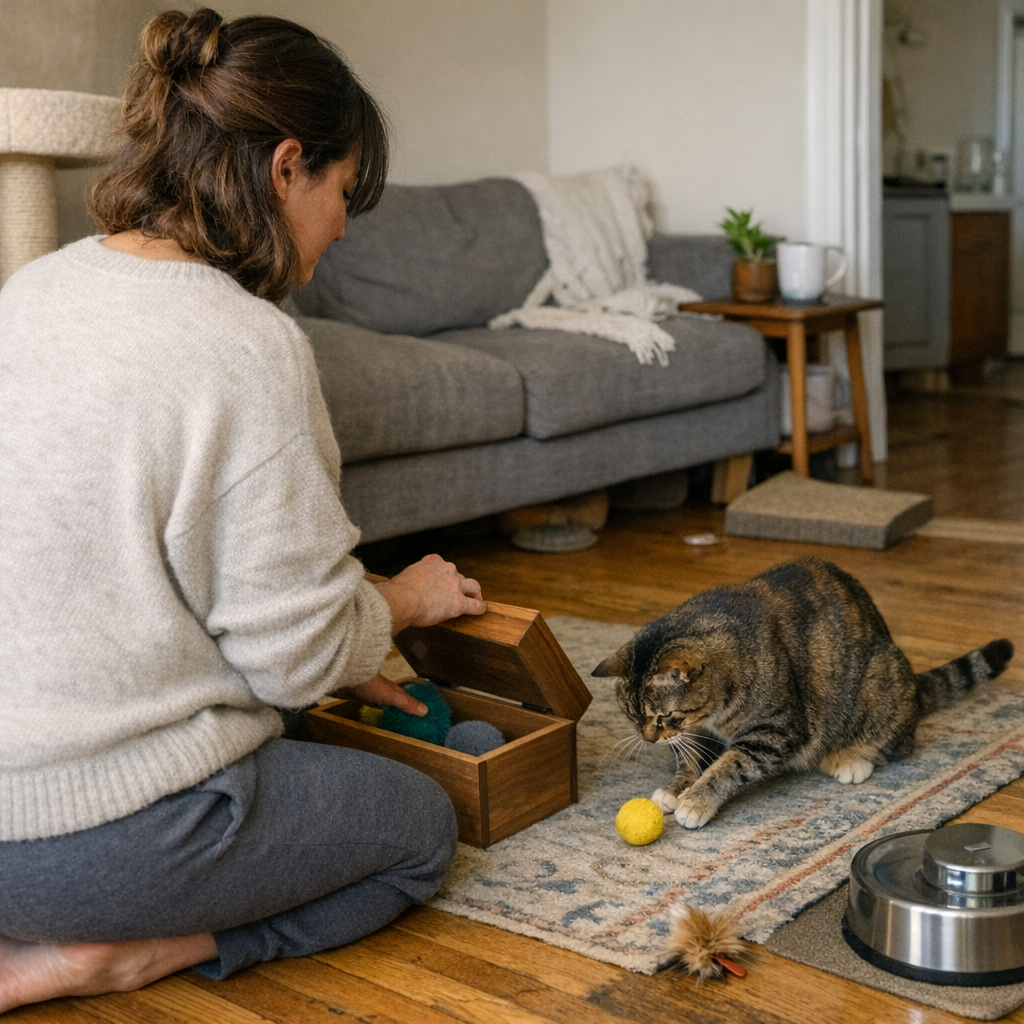
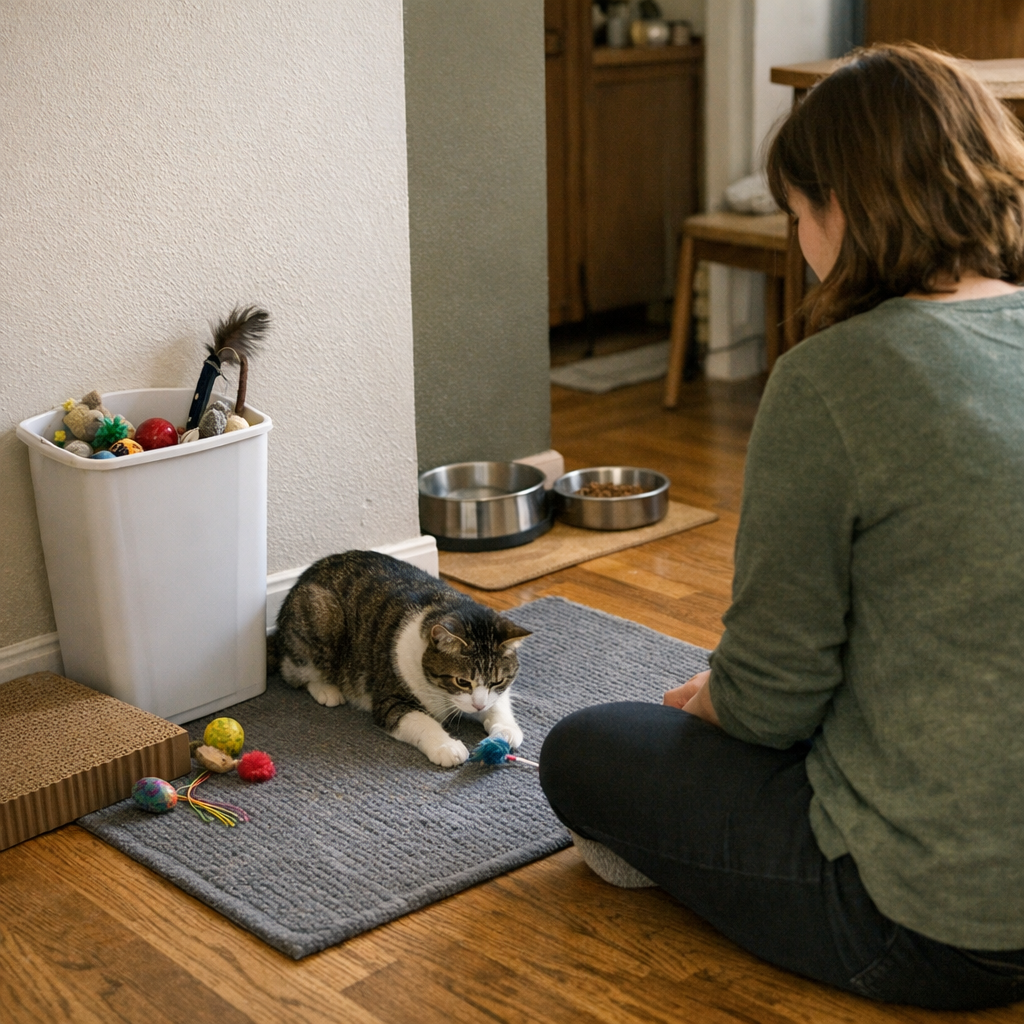
    The single most effective shift isn’t a new organizer, but moving your current setup just outside daily collision zones. That means the toy bin lives a mat’s width away from food and water—far enough not to snag a refill pass, close enough for cleanup to stay quick. Out of the main path, and just past the “cat chaos” spill line. In reality, that’s a couple feet, or the edge of a bench, or one square of floor your cat doesn’t race past at top speed.

    • Toys collected after play don’t bleed into meal prep or get stuck by the water.
    • Resetting happens once; hunted-for objects don’t require second sweeps under or behind stands.
    • You avoid working around your own cleanup. Access stays easy, but nothing blocks the next run-through of basic chores.
    • Now, when routines overlap—scooping bowls, toy pickup, mat wipe-down—they don’t force you into makeshift fixes that only last until the next rush hour in your home.

    The smallest move changes the feel: instead of “fixing things again,” those chores stop interrupting one another. The shift is easy to miss at first, but after three days you’ll notice what you haven’t had to redo.

    Practical Boundaries: Small Changes, Real Results

    Create a hard boundary between play and feeding. Just one mat’s width—about 18–24 inches—acts as a neutral zone, stopping toys from drifting into food and water territory. The result: less cross-contamination, no more feathery debris appearing mid-meal, and a lot fewer plush toys getting caught up in dried kibbles or water splashes. The bin itself is easier to access but never blocks the hand-off between one cat routine and the next.

    Choose bins that reinforce the boundary, not just hold clutter:

    • Open bins let you scoop and drop without pausing. Reset cycles stay quick, even on busy mornings.
    • Lidded or fully enclosed bins trade off a few seconds of visual calm for longer stalling—most people skip the extra step, leaving toys out to “get later.”
    • Slim, corner-hugging options fit behind low benches or next to shelf lines, keeping the boundary visible and blocking drift without taking over the whole room.

    If there’s no defined border, use a mat as much for your own cue as for the cat’s. Everything inside the edge gets put back, everything outside is out of play. In time, your cat’s habits help—less toy spread, less guessing games with what you’ll find underfoot when the lights go out.

    How Repeated Routines Reveal Weakness—and the Solution

    Repetition is what exposes every setup’s flaw, and repetition is daily life with indoor cats. Maybe the same plush mouse turns up four times a week behind the trash can, or the bin gets kicked out of position each time you pass with groceries. These aren’t failures, just bright signals for precisely where your structure needs its nudge—or a new boundary to divert mess before it interrupts another routine.

    Moving toy storage out of the overlap zone won’t make your home magazine-clean, but it does break the loop of endless re-dos. Over the course of a normal week, you’ll spend less effort battling sideways sprawl, and more time actually enjoying what works—letting cleanup and comfort reinforce each other instead of fighting for space and attention.

    For more ideas on practical indoor-cat arrangements that reset easily and work under real conditions, visit StillWhisker.

  • How Temporary Pet Care Spots Quietly Disrupt Your Daily Routine

    Every dog or cat routine comes with a weak point that creeps in faster than you expect: a water bowl wedged behind shoes, a half-empty kibble bag sitting just inside the kitchen, a towel slung on the first doorknob you can reach. These “temporary” fixes don’t just clutter up the corners—they quietly decide how every feeding, cleanup, and after-walk moment unfolds. Before long, one missed refill or slow grab for a tool becomes a daily annoyance, and the friction adds up whether the space looks tidy or not. CalmPetSupply exists to challenge the idea that the way things are today is “good enough”—because the wrong setup never stays invisible for long.

    How Temporary Spots Become the Routine

    Leave a backup bowl under the table for one rushed morning, and it silently becomes a fixture. The shuffle starts small—a towel tossed on a hook because you only had one hand free, the scoop drifting away from the bin. These half-solutions stack up in plain sight. Each one asks you to bend, reroute, or pause a little longer. It’s rarely just visual clutter: you notice it when the secondary bowl’s bone-dry and you’re already running late, or the towel never fully dries and greets you with a damp shock when you need it. The setup promises less work, but the burden quietly grows.

    Everyday Scenes: Where Slowdowns Sneak In

    Picture a real morning: You bend down to refill the dog’s bowl, but yesterday’s laundry blocks your arm. After a soggy walk, the towel you meant to have ready is crumpled and cold by the door—just when muddy paws are already stepping across the floor. The grooming brush that was “always close” now hides between couch cushions or lands in a closet after a quick sweep. On their own, none of these are disasters. But together, they force repeated detours, shuffling, and half-pauses that stack on every routine. Feeding and cleaning, which should be five-minute habits, drag out as you search, move, or settle for an awkward alternative.

    The cost isn’t just in minutes lost. It’s in second-guessing: was the water bowl actually topped off—or will you hear restless paws later? Was the brush put away anywhere useful, or only wherever fit at the time? Attention keeps breaking for “little things” that don’t stay little when they come up daily.

    When Setup Helps—and When It Hinders

    Sometimes you really do need a towel by the door—when the weather and your pet both insist on it. A second water bowl near the bedroom means a thirsty pet doesn’t wake you up. But any helpful extra has a flip side. A towel hung wrong keeps staying damp, turning your quick wipe down into a reluctant pat. A bowl never refilled becomes pure clutter, doubling your walk to refill both and tripling cleanup later after a spill. What helped one piece of the routine exposes just how awkward the next step can get if setup and use don’t match.

    Pet Care Items Spreading—and Interrupting Home Flow

    Spread supplies too widely, and simple routines start tripping up the rest of your day. A stray bag of kibble blocks the path during dinner prep. Bowls just out of sight turn into ankle hazards where foot traffic is heaviest. You reorganize, but some trouble spot keeps coming back—maybe the brush disappears right after you need it most, or the litter scoop lands on the wrong shelf again after every use. Every “temporary” workaround becomes a regular interruption: sidestepping for a bowl, picking up supplies so you can actually reach the counter, repeating steps you thought you’d already finished.

    One weak spot—never quite fixed, always slightly misplaced—sets the stage for tomorrow’s shuffle. Repeated enough times, it’s not a fluke, but the new baseline of how pet care drains your energy.

    The Real Difference: Tidy vs. Truly Smooth Routines

    A pet care nook can look beautifully calm while still slowing you down. All wipes hidden away? It keeps surfaces bare, but if the cabinet is a room away or locked, supplies creep back to countertops “just for tonight”—and then never leave. It’s the difference between visual order and physical ease: if you still reroute mid-routine, the system isn’t helping. The real challenge is not making your pet setup look organized, but building it so that everything falls into place, right where your hands already go.

    Concrete Steps: Resetting for Ease, Not Just Tidiness

    The real fix is nearly always subtraction, not addition. Strip back to a single, reliable spot for each tool—anchored to where you actually use it. Make the feeding scoop return to the bin after every meal, instead of drifting toward the counter. Hang one towel close by the exit, where air can reach both sides and it dries before the next turn. If you keep two bowls, each should be where you’ll notice and refill as part of your real walking path—not just where they “fit.”

    Build reset habits into the routine: shut the bin, rehang the towel, snap the lid. If an item keeps slowing you down—always out of reach, always in the way—it’s a warning, not something to endure. Redesign where it lands, or simplify until each care step flows without a second thought.

    The Payoff: More Predictable, Less Demanding Care

    Assign every essential item a spot that matches real use—food scoop in the bin, bowl on the mat, towel on an open hook—while trimming away extra gear. Instantly, your routines stop dragging. Feeding, watering, wiping paws, clearing up after dinner: these tasks shrink back down to what they should be—quick, straightforward, low fuss. You’re not doubling back or working around clutter. Most days, you only realize something’s changed when you finally stop thinking about it.

    The result isn’t just neater surfaces—it’s a care system that quietly reduces missed steps and hidden hassles. When your setup fits your daily pattern, both you and your pet get an unbroken routine that’s easier to keep up with, no matter how busy the day.

    See everyday setups that keep routines simple at CalmPetSupply.

  • How Small Evening Changes Can Transform Your Dog’s Morning Routine

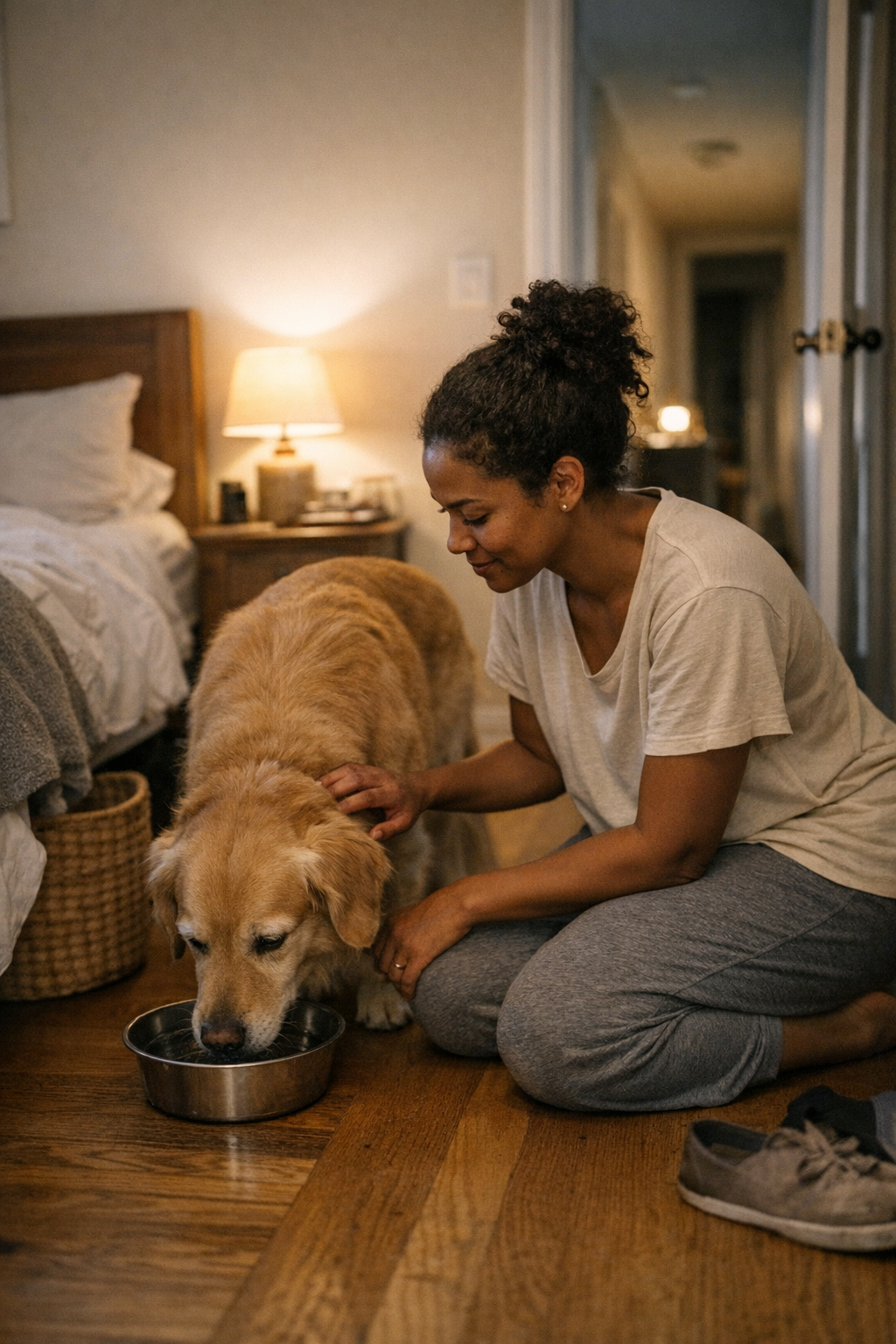
    The last quiet hour before bed: it’s supposed to wind down, but for most dog owners, it’s where the day keeps snagging. You organize the bowls, gather up toys, wipe muddy paws—then notice your dog pacing the hallway, hesitating by the water bowl, or giving you that expectant look near the bedroom door. These aren’t random quirks. They are friction points that keep popping up, forcing you to shuffle cleaning rags, step over spilled chews, or make a second trip for that bowl you thought was already in place. When the routine feels “done” but your dog keeps hovering, you know tomorrow’s morning will start on shaky ground—featuring an amped-up dog, awkward leash grabs, or a feeding scramble before you’ve even had coffee. Surface calm hides a restless cycle that builds up, not down, making every reset just a little heavier.

    Unrest That Doesn’t Shout—But Still Wears at the Routine

    Pre-bed tension isn’t explosive, but it lingers. Maybe it’s a dog restlessly circling the hallway, or stalling between water checks and the bedroom. One night it’s an extra lap, the next it’s standing in the way as you try to drop your keys. Over and over, the same friction: you step around a bed placed just a stride too close to the door, or fumble for a towel that’s tucked behind a bag. By the third morning, you’re coaxing your dog out—a pull at the leash or a scramble for the bowl means the “routine” isn’t smooth at all. This dull friction adds up. It isn’t dramatic, but it drags every part of the reset sequence.

    Not All Calm Means Restful

    Even when your home looks dialed in—water fresh, toys gathered, bed fluffed—fragmented signals show through: your dog gets up to double-check the bowl, repositions close to your movements, or pauses just outside the light. It reads as calm, but underneath is a fidgety tension carried into morning. The result: you’re running interference from the jump, already managing a dog who never switched off—and the whole day starts slower, requiring more adjustments from you at every step.

    Where Most Setups Quietly Miss the Mark

    Putting every item “in place” looks like the finish line. But most setups fail at flow, not organization. A water bowl shoved against a high-traffic wall seems neat but blocks the quick pass to bed. A soft, out-of-the-way bed requires an awkward detour for the dog. Toys clustered by the entryway only to spill into the walkway after lights go out. Over time, it adds up to a routine that looks good but keeps pulling you—literally—back for another adjustment, and keeps your dog guessing about what comes next. A setup that’s photo-ready isn’t always routine-ready.

    Repeating Friction Hides in the Edges

    You rarely spot the real issue until it’s routine: you’re double-backing for leashes, nudging aside bowls, or picking up a towel mid-hallway while your dog waits, half-settled, for the next move. Each small loop—extra water checks, edge pacing, toys in your path—signals the system isn’t working for the actual nightly flow. It’s less “my dog won’t settle” and more “my setup keeps asking for fixes.” Over days, the result is the same: unsettled sleep, unsettled start.

    Small Nighttime Signals with Next-Day Consequences

    Spot these signals—they’re easy to ignore, but they build:

    • Dog returns to the water bowl after lights-out—despite just drinking
    • Pausing in hallways, especially in doorways or at bedroom thresholds
    • Repeating circles before settling, instead of flopping down and staying
    • Shadowing you during end-of-day tasks, tail thumping lightly or eyes fixed for a cue

    No single moment is dramatic. But put together, they create leftover energy—restlessness that spills over into morning. This is how you end up juggling an early leash tug, racing through breakfast, or tripping over toys you’d “put away” the night before. The wrong setup doesn’t cause chaos, but it reliably steals smoothness from your next day.

    When the “Quiet Hour” Isn’t Actually Quiet

    It becomes clear after a string of choppy mornings: you’re grabbing at a leash wedged under a stray towel, dodging a dog waiting in the hallway as if still expecting to go outside, or finding a water bowl blocking the doorway while you try to slip back to bed. Even when everything looks organized, the routine still resists. Your dog’s “wait” is really a stall, their rest is interrupted, and your supposedly end-of-day calm keeps requiring another fix. Underneath the order, the setup is working against you.

    The Missing Reset: Why Access and Placement Matter

    It’s not about having the right items—it’s about where and when they’re put to use. If the bed is in a dead corner but unreachable without crossing your own path five times, or the water bowl is in the main walkway, your dog must choose between comfort and access. Each awkward pause, stall, or redirected path is a missed reset. Dogs react to these spatial blocks in real time—with hesitations that ripple into your next routine. Routine friction isn’t about the number of supplies; it’s about the flow they allow or block when the same steps are repeated nightly.

    One Setup Change—A Real Routine Shift

    Think about a hallway water bowl, always accessible—but only by running interference with the rest of the house. Move that bowl a few feet to a quiet, open corner thirty minutes before lights-out and suddenly: your dog checks water once, pads calmly to the bed, and doesn’t double back or pace. For the owner: there’s no sidestepping bowls, no leash tangles, no blocked exit during bedtime cleanups. The shift isn’t about adding more—it’s about stopping the need for repeated shuffles. Over the week, this small fix removes the root of morning rust: fewer pre-dawn interruptions, less scramble, and a dog that resets without leftover friction.

    Not About More Steps—About Fewer Sticky Transitions

    Most owners try to patch tension with more: extra treats, longer wind-down, added cues. But what works is removing the drag points: that bowl in the main crossing, the pile of toys in walkway spillover, the crate with the tricky latch facing the wrong way. Dropping friction means fewer sticky transitions—your dog stops looping the hall, you stop rerouting routines. The evidence is in the shift: one clear movement from water to rest, fewer circles, no last-minute pacing. The setup supports default calm, not ongoing adjustment.

    Recognizing and Responding to Routine Clues

    Problem setups show up as clusters, not one-offs. Watch for:

    • Increasing evening pacing after what should have been a calm day
    • Your dog blocking, waiting, or lying across doorways before bed
    • Leash moments getting clumsy—snags, double backs, tangled hands
    • Feeding times inching earlier because your dog is already pushing for reset

    These clues mean your setup isn’t matching real routine flow—it looks neat, but works against lived experience. Friction repeats until the arrangement allows the night to move forward without extra signals or repeated interruptions.

    Everyday Example: When Organization Isn’t Enough

    Picture your routine: post-walk, keys and leash into bins, towel by the door. But the water bowl sits in a high-traffic zone—your dog hovers right where you’re putting shoes away. By the time the house goes quiet, your dog isn’t settled, just tracking your moves, ready to get up when you do. The space looks managed, but every step feels delayed. These mismatches aren’t obvious at first—they show up after nights of repeating the same awkward dance.

    What Actually Shows Progress? Small Pattern Changes

    Don’t look for dramatic scenes. The proof is:

    • Your dog checks water once, then chooses a spot and stays put
    • Less hallway crossing, fewer late laps, more direct movement to bed
    • Morning transitions feel smoother—no rushing, fewer leash standoffs, feeding without a scramble
    • The sequence becomes repeatable: bed, water, settle, done—without negotiation

    You won’t notice a magical drop in mess. You’ll notice tension slipping out of your routines, fewer backtracks, and a system that finally supports how you and your dog actually move through the day—not just how the area looks at night.

    Better Setup, Smoother Days

    There’s no need to chase a perfect evening. The win is in finding and breaking the repeating friction—the bowl in the wrong place, the rest area always in the cross-traffic zone, the toy pile spilling into the walkway. Every time mornings

  • Why One Bin for Cat Toys Often Fails to Solve Clutter Issues

    One storage bin for cat toys promises a tidy win—a neater room, a quiet surface, an escape from scattered clutter. But within a week, the friction returns in small, repeatable ways. Toys block your path to the food bowl, a crinkle ball grinds beneath the kitchen mat, and quick sweeps stall as you fish behind furniture. The bin that was meant to solve the problem becomes part of the cycle: it looks organized, but the work of retrieving, chasing, and re-resetting scattered toys never really leaves your routine. For anyone living with indoor-cat flow, the difference is clear: what calms the room at first rarely keeps it calm when routines repeat.

    The One-Bin Illusion: Clean Surface, Hidden Friction

    Stacking every toy in a single storage bin hides clutter, but it hides repeated inconvenience too. On day one, the reset feels complete—everything dumped away, nothing left to trip over. But a few play sessions in, the bin’s limits show. Toys reappear in kitchen thresholds, favorite mice wedge themselves under the couch, and the ‘clean’ storage sits distant and untouched. Instead of solving scatter, the bin acts as a visual band-aid. Every night, you hunt for lost pieces, bend to snag them from shadowy gaps, and spend more energy undoing toy drift than the bin saves. The home looks calmer; your routine does not.

    The hidden cost is the cycle that the storage never breaks. Pickups get slower. You stop for the same banana by the door, the same jingle ball in the bathroom. Each clean surface costs steps and reach—reruns of yesterday’s hunt that creep into every reset.

    How Toy Drift Actually Shows Up During the Week

    The visible floor on day one quickly dissolves: plush toys creep behind chairs, plastic balls ring out from under mats, and each errand—refilling water, checking the food zone—brings a pause to step around some new surprise. Vacuuming turns from a single sweep into a series of mini-toy rescues. Navigating late at night means stepping carefully, bracing for the sound—or squish—of something soft underfoot. Toy drift never spreads evenly; it collects in threshold spaces, high-traffic corners, and right where your hand isn’t.

    The friction stacks up exactly where you live it:

    • Every day, the “pickup” point shifts farther from actual play—the reset isn’t where the mess happens.
    • Toys leak into walkways, kitchen lines, and resting corners—especially in places you’d rather keep clear.
    • Preparing meals or morning coffee? A rogue catnip mouse appears on the mat, breaking your flow.
    • Vacuuming stalls every few steps to clear runaway toys from blocked zones instead of simply cleaning through.
    • The setup you thought was settled keeps interrupting real routines—maintenance, but out of sync with daily use.

    Instead of reducing your work, the single-bin approach creates a new routine: repeatedly fetching toys from out-of-reach spots, only for the cycle to start again the next day, especially with a high-energy cat always probing new gaps and corners.

    Why “Tidy” Doesn’t Always Mean “Usable”

    Indoor-cat life quietly shapes the day. It’s easy to trust that a lone storage bin—tucked out of sight, down by the wall—solves the clutter. But when the play ends, your cat abandons toys wherever the action stops: window ledges, sun patches, under the TV stand. The bin, neat and distant, anchors your own cleanup—not the cat’s—so resets mean crossing the room for every stray piece, not gathering where use actually happens. Organization that looks right from the door rarely matches real movement or what endures through a week.

    Surface tidiness is only the first step. The real gain comes from setups that survive and shape repeated routines—spaces that reduce the need to think about maintenance at all. When toy return matches where toys are dropped, resets shrink and slow friction fades. That shift isn’t about hiding the problem; it’s about structuring the routine so cleanup becomes background, not another point of effort.

    What Real-World Reset Looks Like: Daily Problem, Daily Return

    The cleanup loop is always the same: a sweep at night uncovers toys in a crescent from the living room carpet to the window, plus a few outliers—one wedged behind an armchair, another just visible under the radiator. Gathering them means bending, weaving, and detouring around furniture, then heading for the distant bin. It isn’t a long job, but it slices up your end-of-day flow. And as you leave, there’s almost always one toy reappearing—right where you just cleared—daring you to start again.

    The issue isn’t mess alone—it’s the cycle of interruption that a pretty bin can’t absorb. Each “solved” visual moment regenerates as soon as normal living resumes, and your effort never truly gets smaller. The system looks less messy but is no easier to sustain when routines pressure the same weak points.

    How to Make Cat Toy Storage Actually Work in Real Homes

    Real improvement came not from stricter tidying or more rules, but from observing what failed through side-by-side daily use. Repeated friction faded only when storage zones shifted closer to where toys actually landed—not where the room looked neatest. Instead of a single, deep bin parked by the wall, the fix was to give the toys places that matched lived-in movement:

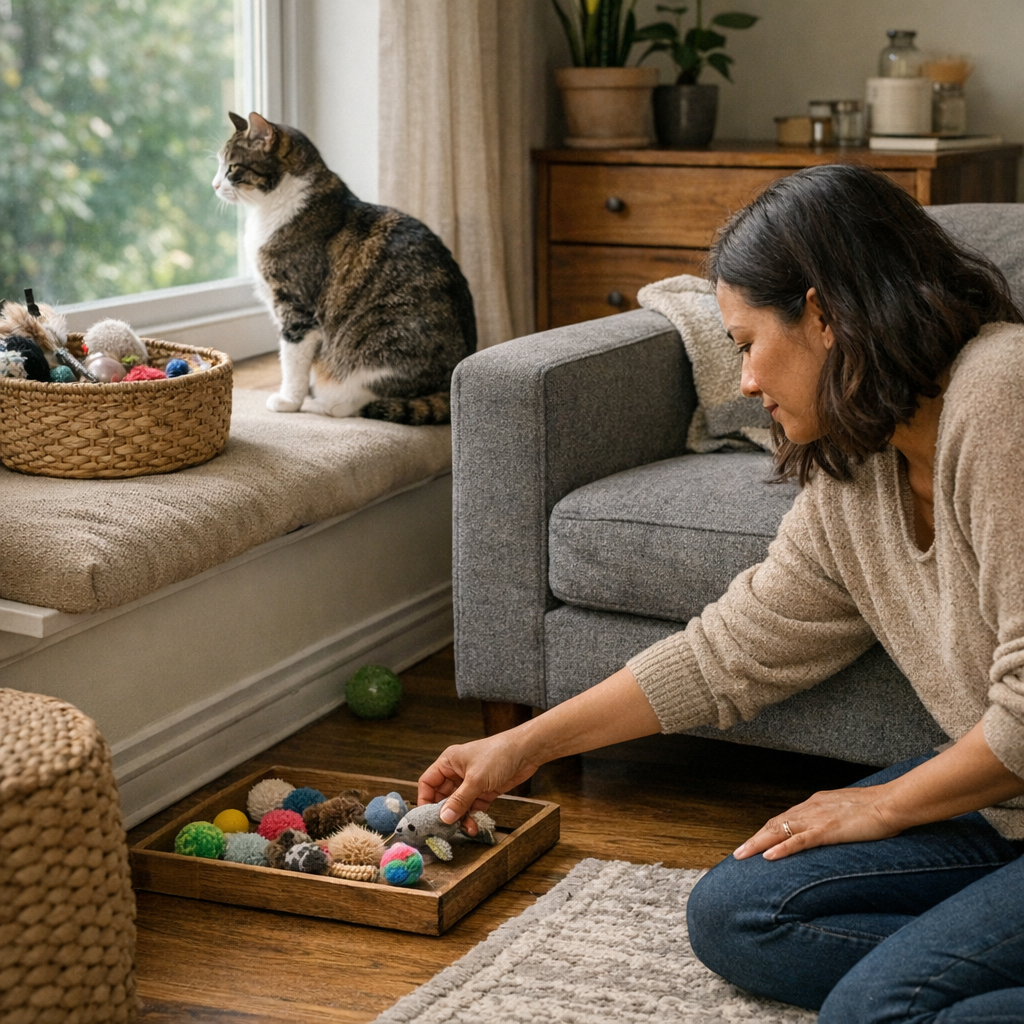
    • Set a shallow tray beside a main napping spot. Toys batted aside during wind-down are within easy reach for end-of-day pickup—no hunt needed.
    • Drop a small open basket near the favorite window or perch. Toys drift here by use, and the open design matches both your cat’s interest and your own pass-through paths.
    • Block access under couches and dressers with towels or storage strips. One simple adjustment keeps most toys visible, stopping them from disappearing into black holes or derailing the next cleanup.

    This shift is immediate: toys get deposited naturally, pickups shrink to seconds, and the “big bin” is rarely out of step with what happens on the ground. No elaborate containers—just structure that fits both human and cat rhythm, cutting the reset steps in half and lowering mental overhead for the next round.

    The Role of Open Storage: Why Bins and Lids Rarely Win

    Lidded bins feel final—closed, dust-free, visually satisfying. But in repeated use, they get bypassed by both cat and owner: their distance from the daily routine turns cleanup into a separate, avoidable chore. Each closed bin adds steps—walk, open, drop, close—and most days that friction means skipping a reset altogether. The result? Toys spread further, the bin gathers dust, and the original mess reclaims the space.

    Open baskets, low trays, fabric bowls—anything shallow, light, and close to actual play zones—encourage quick returns. Cats sniff, re-use, and move toys in and out, while your own routines fold pickup into other home movements. Cleanup stops being a project; it becomes a background motion, blended with traffic through your own space.

    The Shared-Home Challenge: When Cat Zones and Human Zones Collide

    No layout holds up forever, especially in a home where cat activity lines cross human habits. Play drifts—starting by the sofa, ending at the bathroom door, with toys clustering inconveniently along every step. High-traffic areas pay the price, and both floor space and mood get tested by repeated stop-and-go. The right storage isn’t just about visibility—it’s about minimizing these daily collisions so routines run with less interruption, not more.

    The best setups shift as patterns emerge: is there a recurring trail blocking the hallway? Move or double up containers within reach of those friction points. Losing toys under the same piece of furniture week after week? Block it off. Shared sun corner for both cat and human? Add a “quick drop” basket there—so one end-of-day pass gets it all, not half. The tweak is small, but the daily lift is real.

    Reset, Don’t Rearrange: What Changes When Storage Follows Use

    Once containers track actual use—not just design or symmetry—the endless cycle of “toy sweep” shrinks. Sudden detours fade, because pickups happen as you cross the space, not as a separate job. The floor may never be perfectly clear, but the repeat interruption no longer wears you down or drags out basic resets. Maintenance doesn’t vanish, but it stops eating into every evening’s comfort.

    • Distributing a few small containers lets you gather up toys in-the-moment, rather than traveling the room to feed a single bin.
    • Open storage keeps the reset process friction-light and visible, turning toy return into a shared habit for both you and your cat.
    • Blocking lost zones means fewer missing toys, less bending, and less repeat frustration.

  • Transform Your Pet Care Routine by Eliminating Small Daily Obstacles

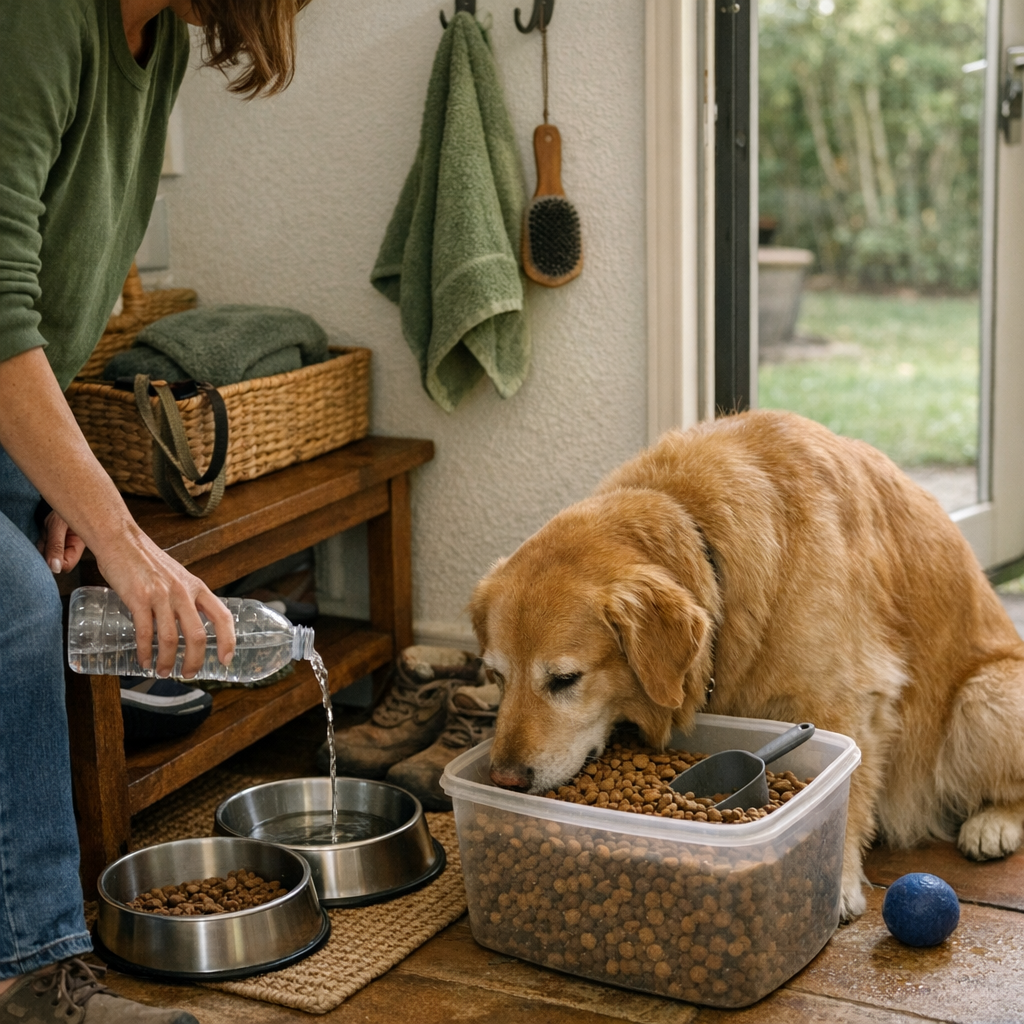
    A pet care setup doesn’t fall apart in one day—it wears down through repeat frustration. The first hint is always small: a water bowl sits empty after breakfast, food bags gather near the entry because the bin is just out of reach, or wipes go missing when you need them for muddy paws. The system still looks organized at a glance, but one by one, the basics slip. You reach for a brush and find it stacked under bath supplies, or start refilling a bowl only to hunt for the right scoop while your pet circles the kitchen. These aren’t dramatic failures—they’re daily slowdowns. It’s the same care steps, but every move asks for extra work you weren’t counting on.

    The biggest loss isn’t time—it’s trust in the routine. When setups stall, the day’s flow breaks: a water dish left dry because something blocked your reach, another wipe-down skipped because towels aren’t at hand. What claims to be “tidy” becomes another cycle of fixing, shuffling, and repeating tasks.

    Small Friction, Big Drag: How Minor Obstacles Creep In

    Routines break down when friction sneaks in through tiny, repeated misalignments. Feeding means reaching for a bowl—but someone stashed mail in the way, or the refill container’s further from the action than you remembered. Cleanup means finding wipes, but they’re high on a shelf or stashed behind cleaners. The brush for quick grooming drifts out of the rotation because lifting a box off it feels like a hassle. Each ask is minor, but in real repeated use, these micro-hurdles are what push the system from “grab and go” to “skip and delay.”

    Most setup trouble comes from storage that looks right but ignores actual habits. Maybe you “put away” pet food in a container by the laundry—just a little out of the usual path—so the bag sits by the door meal after meal, slightly stale, always an extra shuffle to handle. These aren’t lapses—they’re the cost of needing an extra step every time.

    Ordinary Scenes: Where the Routine Breaks Down

    The gap between an organized setup and a usable one shows up in daily scenes. The dog drips across the entry after a walk. You reach for a towel by the door, but it’s gone—laundry again. The floor dries before you get back, so quick cleaning is skipped. In the kitchen, pet bowls wait in a sink already packed with pans, so breakfast starts late while you reshuffle dishes. Refilling water is one more delay, and after a few rounds, refill “later” turns into “forgotten.” Tidy bins and baskets impress no one if the basics aren’t there when you look for them.

    Even a reorganization can just reshuffle where pressure lands. Maybe a new food bin closes tight and looks clean, but now the stiff lid means you avoid sealing it all the way, or leave bags unreturned. Stylish storage or toy baskets under a table reduce visible mess, but if you rarely reach them, yesterday’s toys drift across the living room by dinnertime. Surface order doesn’t guarantee function if access feels like work.

    Why “Looking Tidy” Doesn’t Guarantee Smooth Function

    Giving everything a “spot” on the shelf looks finished but can stall actual routines. When your most-used items live in closed bins, behind extra containers, or somewhere out of easy reach, you’re being asked to clear a path every time you reset. Attractive containers and high hooks make clutter vanish visually, but add just enough delay that you save cleanup for later—until later never comes.

    If reaching a grooming brush means moving three boxes, it won’t be used daily. If wipes are stylishly stored but break the flow, messes linger until there’s more to clean, not less. Design and placement create invisible barriers; it only takes one extra move to push a needed reset further down the list.

    The Role of Placement and Access in Daily Flow

    Practical change comes by cutting steps between you and the actual care moment. That means bringing most-used supplies into direct, open access—right where your routine begins. Feeding gets easier when the food bin sits within arm’s reach of the bowls. One-hand-open containers and open-top bins leave no gap for delay, turning refill into part of the walk-through, not a side mission. Lowering towel hooks to door-handle height solves the wet-paws scramble—you’ll reach it even with hands full, not after the print dries.

    Toys that live near your pet’s favorite spot return to the basket more often than those stored across the room. Wipes or sprays mounted along the main kitchen or entryway path shift cleanup from “something to get to” to “something you grab on the way.” If supplies are on your daily route, resets and spot-cleans happen almost without thought—and friction points quietly vanish.

    Repeated Use Reveals the Weak Points

    “Good enough” setups reveal their cracks after a few days. That food scoop always goes missing, the container’s lid jams or never closes fully, or too many backup bags stack up on the counter. You find yourself improvising—using spoons as scoops, working around towels that never left the laundry, letting wipedowns slide to the bottom of the list. Each of these is the signal that the setup prioritizes order over motion, and the routine eventually slows to a crawl.

    Even after a cleanup blitz, the friction returns—awkward lids, unreachable towels, brushes that only surface once a week—if your setup wasn’t built to match your real patterns. The area may look calm, but actual care gets patchier, more repetitive, and a little less reliable with every missed reset.

    From Looking Good to Working Well: Practical Steps

    Reliable routines aren’t about hiding everything neatly—they’re about instant access to essentials right where care happens. Move backups or specialty supplies out of daily zones and into a closet or high bin, so daily workspace stays clear. For anything touched multiple times a day, use open containers and put them on shelves or hooks at the height you naturally work. At the end of each day, don’t just tidy—check that nothing blocks tomorrow’s first step. If a system resists you, strip it back: less closed storage, more open access, so friction never has time to build up in the first place.

    Calm isn’t about hiding; it’s about setups that keep you moving. When nothing is in your way, keeping up becomes the easiest part.

    Making Pet Care Reliable (and Easier to Repeat)

    The best pet care setups erase every excuse to delay. Bowls don’t hide behind dishes. Brushes live within reach—not at the bottom of a bin. Water gets refilled as part of walking past—not as a separate task that drags out. When your setup removes every last snag, resets happen in stride, and missed routines stop sneaking up on you. Your care keeps pace with your day, even when things get crowded or unpredictable.

    It’s not about getting to “perfect.” It’s about making day-to-day care too easy to stall—so your pet’s routine sticks, messes don’t pile up, and you stop chasing a system that kept looking ready but never felt easy to use.

    For practical setups and everyday pet care tools that stay out of your way, visit CalmPetSupply.

  • How Small Entryway Habits Disrupt Your Dog’s Homecoming Routine

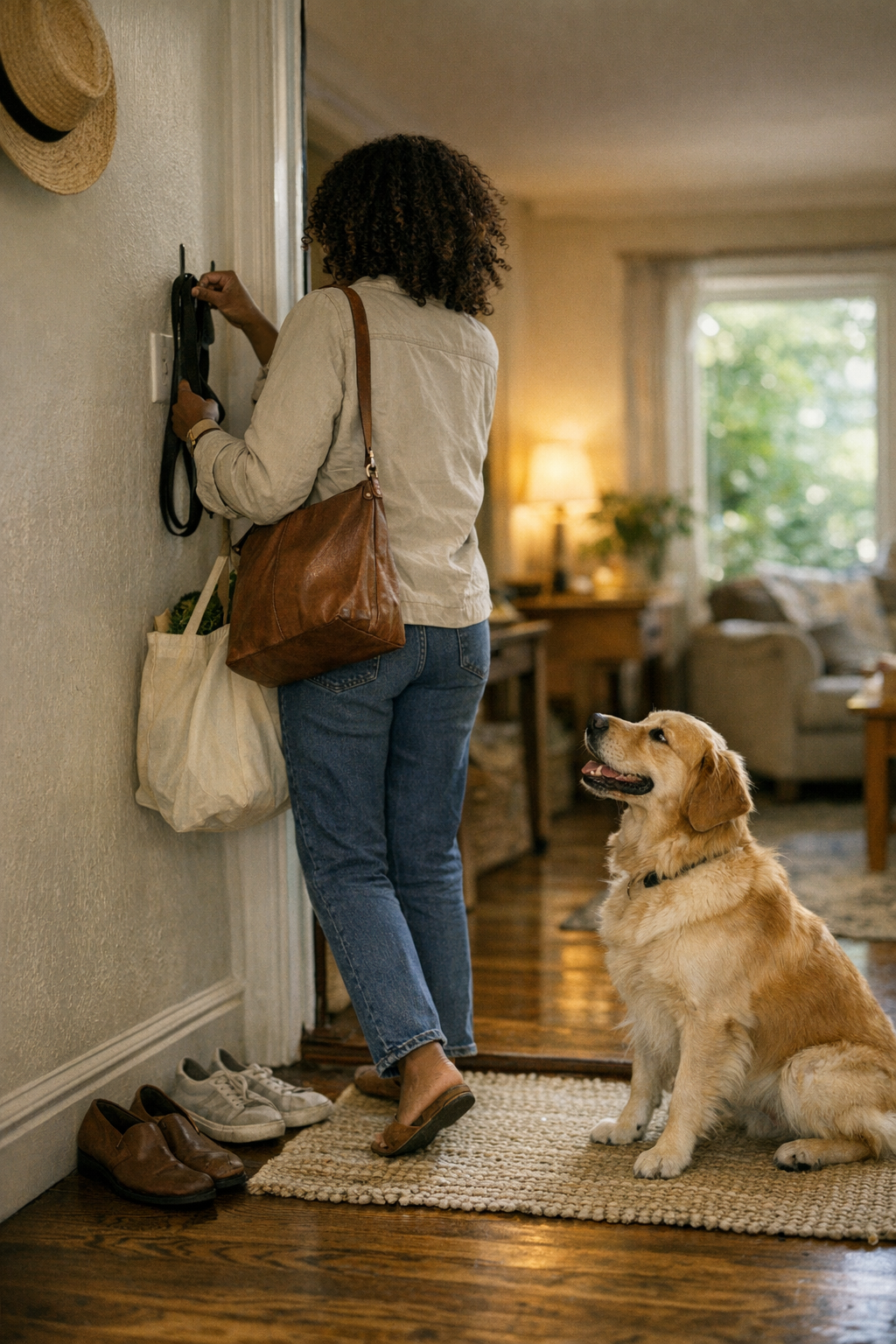
    Most dog owners know the after-walk entry isn’t the easy reset it looks like from outside. The routine stutters at the same friction points: you juggle keys and groceries while your dog circles, pausing and peeking for cues. Under the usual excitement, there’s an invisible logjam—a shoe blocking the path to their mat, a bag left in the landing zone, the leash dropped in a pile instead of hung within reach. It only takes one misplaced item to turn homecoming into stop-and-go chaos, adding up to a routine that feels more tangled than welcoming. What appears tidy at first glance often breaks down exactly where dog and owner need a clear handoff.

    Entryway Friction: Where the Routine Really Gets Stuck

    Everyday home entries set the tempo for the evening—yet most doorways quietly sabotage the flow. You enter, balancing a bag, maybe dripping rain, and automatically step around a shoe you keep meaning to move. Your dog tracks your motions, nose low, looping awkwardly because the spot they expect to claim is squeezed off by something you dropped “just for now.” Your leash, supposed to hang by the door, is instead tangled with a jacket or under a week’s mail. The setup might seem under control, but the actual sequence — bags shuffled, leash scrambled for, paws dodging human clutter — gums up even the best-planned routine.

    This isn’t just excitement. It’s repeated misfires, triggered by a path that’s blocked or a handoff that’s never clean. One loose boot shifts a calm greeting into confusion. A leash stashed on a chair becomes a choke point: now you’re elbow-deep in clutter while your dog circles for direction.

    The Unseen Costs of a Blocked Path

    Clutter doesn’t just slow things down—it drags the reset across the whole routine. The longer a dog’s re-entry gets snagged, the more everything else stalls: dinner is later, you’re still cleaning mud off mail while also reshuffling bags, and that “settle-in” feeling slips further away. The friction stacks quietly until nobody lands in the evening calm—just a pile-up of small annoyances both sides come to expect but never accept.

    What Actually Happens During Settling: Real Scenes from Daily Life

    After a rainy walk, you’re tracking mud, arms full, thinking about dinner. The towel is never where it should be—blocked by a recycling bin or lost behind bags. Your dog aims for their spot but tiptoes, diverted by whatever’s crowding the mat. A soaked paw slaps a dropped envelope. Before you can even hang a leash, you’ve got damp mail, a restless dog, and off-track momentum. These aren’t rare emergencies—this is standard entry protocol for most homes.

    At night, coming back from that last outing, you reach for the leash, but boots have migrated in front of the wall hook again. You fumble, get the leash free, but the dog has already circled twice, not sure if this means “wait,” “go,” or “just lie anywhere.” Each minor block forces a micro-decision, scattering the homecoming into separate, slower steps. What should be a handoff becomes a repeated stall.

    When Organization Isn’t Enough

    Visual order doesn’t fix practical breakdowns. The corner that looks decluttered at noon turns into a barricade by evening, the thing you “set aside” turns into yet another block, and the leash “put handy” gets buried in the run of daily life. Most setups look better than they work. If routine stalling sneaks up despite what appears under control, the structure—not the dog, not your energy—is slowing the flow.

    Recognizing Disguised Routine Trouble

    There’s a sharp distinction between an entry that works and one that wears you both down with micro-friction. If you’re forced to reshuffle bags nightly, or your dog whines and stops at that same cluttered edge, it’s not a personality issue—it’s a structural problem. Stay alert for signs: are you always stepping over one bag too many to drop the leash? Does your dog detour or delay—even when you want them to settle quickly? Every micro-stall is feedback that the system favors appearance over function. Under repeated use, comfort is lost not to affection but to setup neglect.

    How After-Work Frustration Creeps In

    Small blocks pile up quickest when you’re tired. After a long workday, you want to unwind, but the first five minutes collapse into leash-finding, shoe-moving, and swapping places with a restless dog who can’t find what they’re supposed to do. That’s not a “rough day”—it’s a routine built on friction. Evening calm evaporates, replaced by quiet irritation that’s tough to spot but real in cumulative effect.

    Fixing the Flow: Small Shifts with Big Impact

    The unlock isn’t full remodeling. It’s identifying where momentum dies, then making just enough change that your routine becomes repeatable—and survivable. One fix: keep bags and shoes a full step past your dog’s “entry line,” not just out of your own path. Get a leash hook high enough to stay visible, low enough to grab without bending past clutter. If you hang the leash up every time, even in a hurry, it becomes a visible reset for you and the dog: outside is over, now we settle. A towel within reach—never behind boxes—means paws get wiped when it matters, not after the damage is done.

    Putting It Into Practice

    • Create a “clear zone.” The first step inside is reserved—no random drops, no shoes, no parcels. This strip is a guaranteed runway: you and your dog both get space to pause and reset, not trip and scatter.
    • Hang the leash, every single time. Pick a wall hook at entry level and use it, not the nearest chair or shelf. Over time, both you and your dog link “leash there” with “walk done.”
    • Tidy as you arrive, not as a chore later. Shift bags and shoes out of the zone before you relax—even if it nags in the moment. That quick reset relieves the worst routine pressure points.

    You’re not erasing all clutter—you’re targeting the spots where mess turns functional flow into a tripwire. Dog life is messy. But the most stubborn friction is where dropped items keep blocking the same threshold, trapping you both where you least want to stall.

    The Real-World Payoff: Smoother Transitions, Less Waiting

    When the entry is actually clear, the leash is easy to hang, and paws are wiped right at the door, routines compress fast. The dog goes straight from door to mat—no detours. You walk in and head for dinner or rest without circling back, and those early-evening interruptions shrink by half. The impact shows in fewer missed cues, less repeated circling, and a routine that finally feels as smooth as it looks in your head.

    It feels minor—until you stop having to fix the same hang-ups night after night.

    When Good Looks Aren’t Good Enough

    Photo-ready setups often hide the same weak links: a box that organizes supplies, but edges into the dog’s landing zone; a tidy mat crowded by last-minute shoes. A routine only works if your dog’s hesitation vanishes and you stop stumbling—even when things get messy. If the same corner keeps absorbing stray items and breaking your rhythm, it’s time to fix what blocks easy movement, not just what “looks right.” Consistency in path and placement beats appearance every single day. If a single friction point stays stubborn despite your efforts, direct correction beats another round of tidying.

    Let Your Daily Return Actually Reset

    Homecoming shouldn’t be flawless—just workable, every single time. Setups that clarify what goes where, that remove repeat friction and give your dog an unblocked line to their own reset, make every return cleaner, calmer, and easier to keep up. Fix the bottleneck, and the rest of your dog-life routine starts to fall in line.

    For practical entryway tools, leash hooks, and everyday gear that actually fits the lived-in routine, visit DogPile.

  • Why Small Storage Choices Make or Break Your Pet Care Routine

    You set up your pet’s area—bowls lined up, supplies tucked out of sight, everything looks calm. But day two of real use, friction creeps in. The brush you need is missing again. A damp towel sits folded and never dries. The food bowl is dirty right as your pet starts pacing for breakfast. What looks orderly rarely holds up once daily care kicks in. The smallest slip—one item not back in place, one tool out of reach—shifts the whole routine from smooth to a string of stalled moments. A setup that looks calm doesn’t always mean your next refill, wipe, or grooming session won’t get blocked by the leftovers of yesterday’s pattern. The CalmPetSupply world isn’t about a perfect reset—it’s about setups that actually survive repeat use without turning care into a scavenger hunt.

    Order Versus Real Readiness

    There’s a difference between tidy surfaces and daily function. It’s easy to stack bins or close drawers, but if the scoop you reach for is trapped under a row of treat jars, the order is just blocking the routine. Every round of daily care exposes what doesn’t work: the brush that’s slid behind cleaning supplies, wipes stored under a sink instead of within arm’s reach, or towels that never dry because they’re out of airflow. What first felt “organized” quickly trips you up when you’re moving fast and one core item is buried or just plain missing.

    Morning rush: you’re ready for a quick water refill, but last weekend’s new “system” means the jug is boxed in behind neat but totally impractical treat jars. Meal time: you need wipes for a quick spill, except now the container is under the bathroom sink instead of shelf-side. These aren’t emergencies, but the routine drag grows bigger with each search, each detour, each delay—making pet care heavier with invisible friction.

    How Small Delays Multiply in Daily Pet Care

    Delay one cleanup, and you notice it keeps coming back worse. Crumbs and water spots that could have been wiped down in seconds start caking into real mess, making next time slower. That towel you meant to dry? If it stays folded on a shelf, it’s clammy and nearly useless after the next walk. Each misplaced or hidden item adds at least one awkward step: hunting for the brush, detouring for the scoop, or running to get a dry towel when your hands are already full.

    Even after a reset, friction creeps back. By day three, the brush is back on the coffee table, wipes drift to the hallway, food scoops buried by other bags. The dog leash is easy to see, but the cleanup mitts are stored two rooms away. The space might look neat at a glance, but every part of your care routine slows down. Clean resets don’t fix setups that can’t keep tools at the edge of reach.

    Real-World Interruptions: A Day in Use

    Actual routines don’t run on one deep clean. You finish up at night—bowls washed, things stowed—but morning means new problems: a half-dried bowl, a towel missing, supplies not where you need them. Your pet’s eager for breakfast, but you’re stuck sorting gear before the real task.

    After a walk, your dog heads into the house, but the towel for paws is balled up in the laundry basket. You make do with a paper towel, sapping time and missing spots. Paw prints trail further because your plan for quick cleanup failed at the starting line. When care tools aren’t truly ready, interruptions don’t stay contained—they spread into shared spaces and throw off the flow for everyone in the home.

    Setup Weak Points: Repeated Corrections, Hidden Friction

    Real clutter is rarely obvious chaos—it’s subtle, steady friction. Calm-looking spaces hide tools trapped behind bins, wipes shuffled out of sight, spray bottles buried after the last cleanup. These hidden bottlenecks never quite leave; they just trade places. Organization feels satisfying until the routine calls for that one tool—nowhere to be found, or blocked by nicer-looking storage.

    Certain weak points always resurface. Maybe your wipe bin keeps sliding off the counter and vanishing, or your go-to groomer is constantly traveling between rooms. You reorganize, but next week you’re still catching yourself improvising a fix. Improved “storage” solves nothing unless the items that matter most reliably land within easy reach where they’re actually used. When convenience fails, every routine adds another restart.

    Designing for Daily Reach, Not Just Visual Calm

    Function trumps the fresh-start feeling. Instead of constant resets, fix items where you use them: a towel always on the same hook near the door, a wipe bin anchored to the feeding shelf, the water jug left beside the sink. These habits cut down tool drift, and every return lands right where tomorrow will need it—sidestepping fresh friction before it starts.

    Hang the drying towel by the exit, every single use. Keep the food scoop in a cup at the bin edge, not hidden under “neat” stacks. After a week, you notice you’re searching less, stalling less, and spending less time backtracking. The visual difference is subtle; the functional difference is real—fewer delayed cleanups, fewer chores festering overnight.

    Reducing Friction: Habits Over Surface Order

    Practical calm follows one rule: put each essential back in its single, reachable spot. Skip the tidy shuffle—make visibility and grab-ability the priority. Wipes by the bowls, brushes at arm’s reach, towels where paws actually enter the door. It’s the everyday returns, not the once-a-week deep clean, that actually reduce cleanup delays and keep messes contained.

    If you find yourself repeatedly “fixing” a setup—rewinding your steps after feeding, retracing for a missing tool, or dreading the late-night reset—pause. Look for what’s consistently out of reach or always migrating away from the action. Strong setups aren’t just tidy after hours of cleaning; they survive the randomness of daily care because the essentials never wander far.

    True calm isn’t about spotless surfaces—it’s when routines tackle most of themselves, and the real work stays minor day after day.

    See setups that prioritize daily reach and routine flow at CalmPetSupply.

  • Managing Indoor Cat Toys: Balancing Play and Clutter in Shared Spaces

    If you keep tripping over cat toys in the hallway or fishing a wand from behind the fridge just before bed, you’re not alone. Managing toys for indoor cats quietly shapes your day in ways you notice most during the worst moments: a crinkle ball wedged right in front of the food bowl when you’re just trying to refill water, or a pile of plush mice left in the walkway after a late-night cleaning sprint. These aren’t dramatic crises, but tiny friction points—a morning derailed by cleanup, a hidden toy blocking your fast sweep, a play zone that leaks into every other corner you need uncluttered. Over weeks, routine upsets like these add up, and what started as a small mess becomes a repeated hassle. Every cat owner reaches a point where keeping enough toys out for play turns into keeping themselves caught in a cycle of endless retrieval, stray clutter, and routines that never quite stay set.

    The Slow Creep: How Toy Setups Turn Into Traps

    Letting toys roam free feels simple—at first. One open basket, a few favorites scattered around, and for a few days, it almost works. Then the patterns settle in:

    • The same stuffed fish slides behind the couch after every play session—and pulling it out means moving the sofa again.
    • Plastic balls collect under the radiator, out of reach unless you’re willing to crawl or tip furniture.
    • A wand toy is always just far enough under a chair leg to demand an awkward crouch—not a disaster, just a slow drain.

    Individually, none of these is much. But stack them on top of 6 a.m. routines, unplanned guest visits, or a mad dash to tidy before dinner, and each misplaced toy becomes a fresh interruption. Tidy in theory is not tidy in practice—especially after a week of cat-life cycles.

    Why Less Isn’t Always Less—And More Isn’t Always More

    Your cat finds favorites: a certain wand, a small plush, the feather that somehow becomes territory. But the more toys stay out, the faster they migrate to exactly the wrong places. The problem isn’t just what you see; it’s what you keep having to move:

    • Cat toys in feeding, water, or litter areas turn a fast reset into a multi-step process—now you move a ball before you can refill a bowl or sweep up the litter scatter.
    • Toys end up crowding rest spots, transforming what should be a quiet nap space into a messy catchall—so a cat’s comfort zone becomes part play-pen, part obstacle course.
    • Worst of all, you stop noticing until you step on one at night, or grab a broom only to find the floor blocked—again.

    The invisible pattern: left unchecked, open-access toys quietly undermine your routine, bleeding play clutter into every shared home zone. And unlike litter tracked onto a mat or a water spill under the bowl (handled once and gone), stray toys return day after day.

    Rotation vs. Open Access: Does a Predictable System Help?

    All-in vs. steady rotation isn’t about preference—it’s about what eventually breaks down and what keeps you going. If every toy is out all the time, resets get slower, and cleaning sidetracks multiply. By deliberately limiting toys in circulation and swapping them on a schedule, the chaos doesn’t just look smaller—it actually feels lighter. Here’s where it shows:

    • Open Access: At first, tidying up means tossing everything in the basket. But every week, strays reappear, and each cleaning takes longer than last time.
    • Rotation: Two or three toys out, swapped every few days means less to trip over, less to retrieve from under furniture, and cleanup that becomes predictable rather than urgent.

    Your floorplan dictates some of this. In a small apartment, the difference between a scatter zone and a set zone is immediate; even larger homes develop blind spots where toys pile up until the next full sweep. Either way, the weak point is revealed when you’re forced to clean in a hurry—or when an unexpected guest makes the disorder impossible to ignore.

    Recognizing Trouble: Signals You’re Due for a Change

    Repeated friction sends warnings, even if routine makes them easy to miss. These are the common signals that your toy handling isn’t working:

    • You can’t swap water bowls or pick up litter without moving stray toys out of the way.
    • Ball toys sneak against window ledges, interfering with the one jump path your cat uses every morning.
    • Cleanup takes twice as long—not from actual dirt, but because toys have to be relocated before wiping or vacuuming can start.
    • Toys migrate into storage areas meant for grooming gear, or under laundry baskets—sparking those inconvenient scavenger hunts during already busy routines.

    If you keep pausing to move a toy out of reach or rearrange play items in the middle of ordinary chores, the system isn’t helping—it’s quietly sabotaging your routine.

    Containment Doesn’t Mean Banishment: Resetting Without Losing Play

    What’s worked for other frustrated cat owners? Move from an open basket to a closed bin or box, limiting access to two or three toys at a time and rotating the rest in every three to seven days. This structure:

    • Keeps play interesting by letting toys regain novelty on reentry.
    • Makes resets predictable—what’s out, what’s away, where stray toys belong at the end of the day.
    • Means “lost” toys (under tables, behind chairs) crop up less and, if they do, require far less effort to keep in check.

    The visible order is only half the effect. The deeper improvement is the shift in your daily minutes—retrievals drop, interruptions shrink, and you can actually finish your routine without surprise kneeling or sudden detours. Toy management isn’t about making things look perfect; it’s about not letting play create new friction in every routine reset.

    A Measurable Difference: One Real-World Detail

    Take the felt ball that always settles beneath the dining set. Previously, you’d be on your knees prying it out almost every day—a pause, a reach, an awkward head bump. Once you limit toys in circulation and start rotations, that same ball needs rescuing maybe every few days, sometimes only once per week. The surface looks a little better, but your day feels much lighter—because you’ve taken out a repeat burden without losing play value.

    Pacing the Rotation: How Often To Swap Toys

    Rotating toys every three to seven days gives most indoor cats a balance between novelty and comfort. It’s enough time for a toy to feel familiar and for your cat to miss it by the time it reemerges.

    • If your cat ignores a toy, tuck it away for a week or two before bringing it back—cycling prevents toys from becoming invisible clutter.
    • Skip the urge to buy new toys every time interest dips—familiar favorites resurface as novel during the next routine swap.

    This cuts urgent cleanup moments and reduces the pressure to constantly expand the toy collection. Most cats build favorites through repeated exposure, not constant novelty.

    Finding the Balance in Shared Spaces

    In rooms that get double use—where your cat’s “zone” shares space with your eating, working, or passing through—the cost of toy overflow goes up fast. Too many toys in a small space clog paths, overlap with feeding and litter routines, and increase unexpected, recurring cleanup. The fix isn’t less play; it’s more structured containment: closed boxes, fewer toys visible, reliable rotations, and clear zone boundaries.

    Watch for silent creep: a favored resting mat drifting into food prep area, a pile of toys blocking the hallway, or a cat ball always under your desk chair. Each signals cleanup pressure and demand a system fix, not just another quick tidy.

    When Setups Seem Fixed But Trouble Returns

    The tidy basket solution is seductive, but often short-lived. You clean, sort, and for a day or two—maybe even a week—everything appears in place. Then routines crack: old retrievals return, stray toys slip back into weak spots, and you’re kneeling on the hard floor for the third time before breakfast. This gap between “organized” and “repeat-proof” reveals why most setups falter under steady home use, even when they look fine at a glance.

    Every routine exposes the real structure—especially with indoor cats who test every edge and return clutter to the same high-friction spots. The right containment can’t banish play, but it can shave hidden minutes off the places where your patience and your floor plan keep colliding.

    If your routines keep circling back to the same toy traps, it’s time to upgrade your system—for less retrieval, less cleanup drag, and smoother resets. See real-world