Author: jaesoon_admin

  • How Thoughtful Closet Storage Cuts Clutter and Boosts Daily Efficiency

    When the Closet Looks Right, But Works Against You

    That “after” photo moment—the closet where every shoe is lined up and every basket is tagged—only matters for a snap. The real test comes at 7:15 am, when shoes are missing, bags are buried, and the morning routine leaves fresh piles in its wake. This is where many so-called organized closets actually fail: not in how they look, but in how they get used. The corners start catching overflow, hooks go ignored because they require an awkward reach, and the reset never quite happens. If your closet starts each week picture-perfect but by Thursday feels like a detour and a balancing act, the problem isn’t you—it’s the setup that isn’t designed for the friction of real life.

    Every Extra Step Grows the Mess

    Small obstacles add up fast. The tiniest inconvenience—reaching behind a basket, crouching for shoes stashed beneath a low shelf, sidestepping a bench—sends people into shortcut mode. That means sneakers collect by the door instead of going up on the shelf. Bags slide from hooks to floors. Even a little extra walking or a single blocked spot is enough to derail good intentions. All it takes is one busy evening, and suddenly you’ve got leaning towers of laundry, bins swallowing random odds and ends, and “just this once” clutter that never fully disappears.

    It’s not laziness; it’s human nature. If you have to maneuver around hanging coats, you’ll drop your hat on the nearest surface. If shoe storage is one step too far, shoes start gathering in the hallway. What starts as a small detour quickly multiplies: a few missed spots become a full reset job, not a quick tidy-up. Habits always beat layouts designed for empty spaces, not hectic weekdays.

    Where Organized Closets Actually Break Down

    Pay attention to closets in heavy daily use—a family entryway, a shared coat closet, even an overstuffed guest closet. Friction points show up fast:

    • Reaching behind stacks erodes order quickly. That go-to hoodie somehow ends up behind boxes of rarely used hats, so every retrieval turns into a mini teardown. Within days, neatness turns to chaos—just to get dressed.
    • Bins become black holes. Those deep, pretty baskets near the door start with neat gloves and mail, but soon swallow receipts, headphones, and everything else that doesn’t have a place. Categories blur, and you’re digging instead of grabbing.
    • Folded stacks can’t survive real use. Stiff, straight piles look fine on laundry day but soften and slide into one another after a couple of searches. Instead of a quick reset, you’re restacking shirts and guessing what belongs where.

    Once storage categories lose their clarity, or putting something back means making extra decisions, “organized” becomes another form of hidden clutter. The system’s failing not because it got messy, but because it asks too much in real time.

    Looking Organized ≠ Actually Organized

    Crisp shelving setups, new rods, or matched bins might impress right after install. But run your real routine for a week and see what holds. Are shoes still paired on the rack, or spilling across the hallway again? Do shelves still show open space, or are they a jumble of mittens, hats, and forgotten bags? Good looks can mask underlying friction—because if the closet demands workarounds, the chaos creeps back fast.

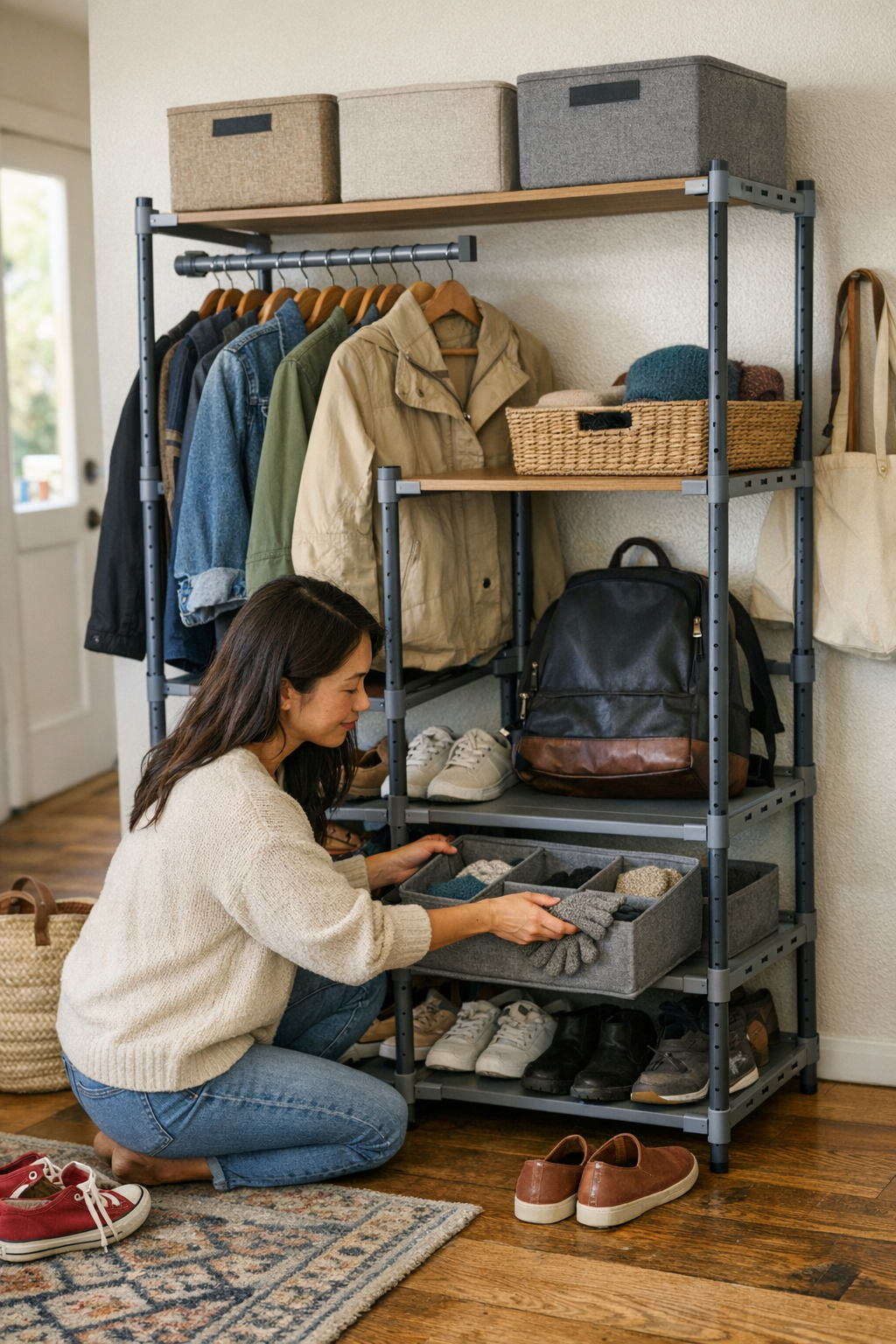
    Micro-adjustments can have outsized results. One family’s hallway closet always overflowed with hats and gloves beside the door—until they lowered a shelf just six inches and added a divided bin right at hip level. Suddenly, even the quickest drop-off worked. No more overflow in the hallway—even though nothing looked that different. Some of the best fixes barely change the photo, but completely change how the closet handles normal wear and tear.

    Building Storage for the Way You Actually Use It

    Stop organizing for “someday” and build for right now. The best storage isn’t about perfect labels or everything matching—it’s about making the routine routes friction-free. Everyday grab-and-go items should live at the height you naturally reach, not on an aspirational upper shelf. If kids use the closet, double rods or low baskets mean they can actually put things away themselves, without reminders or an adult swooping in.

    Press pause on the showroom logic and look at your patterns:

    • Main shelves near the door get the most action. If putting boots away means a traffic jam or walking around someone else, expect piles to start creeping past the threshold.
    • Bins are only useful if they match your grab spots. Too big, too deep, or tucked in the back? They’ll become bottomless catch-alls, not tidy categories.
    • Deep shelves tempt you with the promise of extra storage, but the stuff in the back almost always gets lost. That’s when overflow begins: it’s easier to throw new things onto a growing pile than to wrestle with tight corners.

    Map the repeated breakdowns—where items never seem to stay put, or piles keep forming—and you’ll see where the layout fights your habits. The trick is to make it easier to put things away properly than to leave them out “for now.”

    Spot the Early Warning Signs of Clutter

    Storage doesn’t usually collapse in one big disaster. The slow creep is the real threat. Look out for:

    • Needing to unstack or move an item daily just to access something else.
    • Feeling like putting things away means more shuffling than actual organizing—a sign your system is fighting back.
    • Opening a bin and realizing you can’t tell what’s inside anymore—categories vanished, and labels ignored or forgotten.

    These are signals, not shortcomings. Sometimes all it takes is lowering a shelf, adding dividers, or shifting a bin closer to your true drop zone for the space to keep pace with your routines, not the other way around.

    Small Shifts, Real Wins: Tweaks That Actually Last

    You don’t have to gut the closet to make it work better. Start with:

    • Dropping a shelf just enough to add a slim, easy-reach basket—so grab-and-go items always land where you need them most.
    • Adding or moving dividers inside bins to stop category creep, so you don’t have to resort each week.
    • Swapping out unreachable shelves for dual rods or hooks at the height of your youngest user, turning routine storage into an easy, automatic habit.

    The best system is one that keeps its balance even as life gets busier. If clearing up after yourself and others feels faster, steadier, and less frustrating with each passing week, then your closet is working—finally matching the way you actually live, not just the way it looked right after organizing.

    For more solutions designed for real homes and real routines, visit ClosetWorks.
  • Small Setup Changes That Make Pet Care Routines More Efficient and Less Messy

    The spot where you feed your pet might look organized first thing in the morning—until the routine starts to repeat. Fast-forward past breakfast: the food bowl is empty and pushed under the cabinet, the water bowl is running low, the wipe you meant to keep nearby now sits damp in another room. Each missing item becomes another pause, another trip, another moment retracing steps instead of moving forward. What began as a “tidy setup” can unravel midweek, especially when bowls or brushes drift, bins aren’t fully closed, and cleanup tools are never in reach when the dirt actually arrives. A setup that seems ready at 8 AM is often no match for daily feeding, quick paw wipes, refills, and shared-space resets—the spots that CalmPetSupply tries to simplify.

    The Hidden Friction of Daily Pet Care

    In daily pet care, what slows you down usually isn’t the size of the mess—it’s the silent friction from tools that leave you hunting for basics in the middle of a routine. You come to refill water and the clean towel’s gone again, or you reach for kibble only to find the scoop missing under a bag left open the night before. Delays add up: every time you detour for a leash, reach over a landing scattered with toys, or unearth wipes from the bottom of a bin, you multiply the drag exactly when your attention is limited. Repeated care cycles expose what simple organization can’t fix—if access isn’t easy, friction keeps returning.

    Real-Life Disruptions (and Why They Happen)

    Picture the overlap: after a muddy walk, groceries dangling, you reach the door with your pet eager to get in. You want to wipe paws quickly, but the towel is missing—maybe in the laundry, maybe somewhere not obvious. Now, you’re left juggling muddy paws, hopping bins, and refilling a water bowl that’s lower than expected. Even as you handle one task, the next thing you need isn’t where it belongs. Over a few days, these gaps become routine stumbles: the brush goes missing again, the same bin lid isn’t shut, a quick reset turns into a back-and-forth through three rooms. These aren’t isolated annoyances—they’re frictions that slow care down whenever you can least afford the drag.

    The cause isn’t missing supplies—it’s weak return points. If the towel doesn’t have a visible hook right by the bowl, it walks away. A scoop without a single home gets swallowed in clutter. “Organized” stations break down with ordinary use: bowls drift underfoot, brushes left out mean cleanup gets delayed, wipes disappear behind stacked items. Look past the initial tidy—most breakdowns begin the first time you don’t reset everything on autopilot.

    Setup That Looks Orderly, But Slows You Down

    After a weekend re-set, the area feels in control for a day—until you start repeating normal care. Suddenly, the scoop’s been knocked behind the bin, the mat under the bowls bunches up and catches crumbs you can’t sweep easily, the brush makes a round-trip to the living room and never returns. The result: feeding gets slower, cleanup slips behind, and you start cleaning more after care—not less. The routine that looked smooth on Sunday stalls out on Tuesday night, and “temporary” missing basics linger just long enough to slow down every step.

    Patterns repeat. The bin lid’s left open overnight, so supplies disappear deeper into clutter. The “just-for-now” towel settles elsewhere and isn’t found when paws are muddy again. Small, recurring breakdowns make every round of feeding or grooming slower—and the fact that the space looked organized becomes irrelevant. Visual order that doesn’t survive repeated use is a trap: it hides the return of daily friction until you’re forced to repeat work.

    Practical Adjustments for Smoother Care

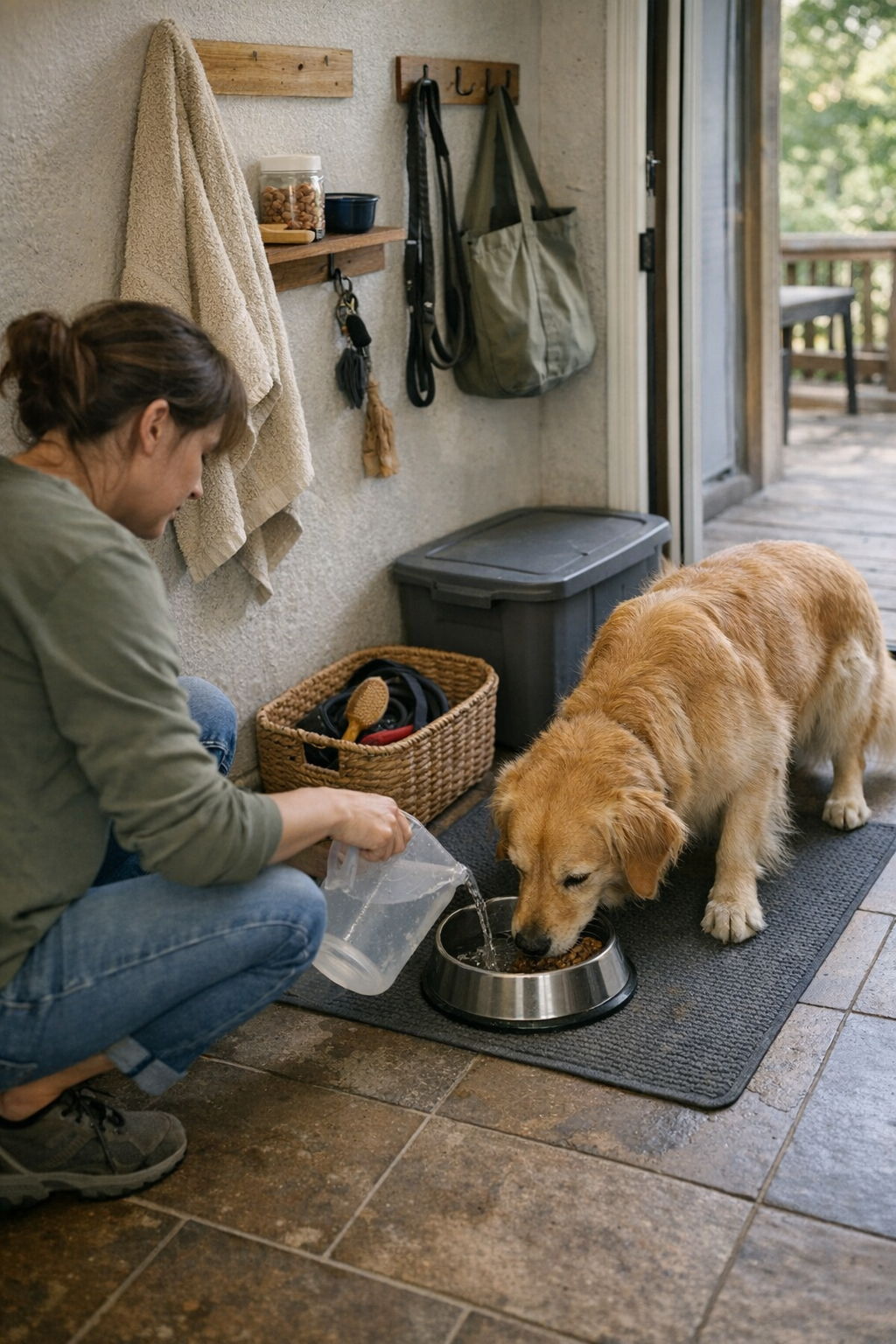
    Actual improvement comes from fixing placement and return—not buying more tools. Mount a towel hook directly above the water bowl so it’s never out of sight when you need it. Use a marker or edge cue on the water bowl so you spot low water before the next mess. Designate a single reachable spot by the door for wipes and brushes: basic items land there as soon as you’re back inside, not wherever you empty your hands. If storage bins aren’t easy to snap shut, clutter escapes by evening even if things were tidy at lunch.

    Keep all quick-grab supplies—towel, wipes, grooming brush—within the same gesture’s reach by the main entry. If you’re moving more than a step to get basics, mess or delay follows. A habit as small as closing a bin every time matters: what’s left open returns as a nighttime hazard or a missing wipe when you need one in the morning. Zeroing in on repeated weak points makes every reset after feeding or an outdoor loop happen with less drag, not just less “visual mess.”

    Defining the Pet Area and Containing Spread

    Set a feeding station well out of hallway traffic and place a washable, non-slip mat underneath. That prevents early-morning spills or quick bowl shuffles from spreading food bits through the week. Keep a shelf, bin, or basket within reach—not in view of the kitchen but not hidden in another room—for scoops, packets, and brushes. Group dailies together, and create a traffic boundary for pet gear: leads, wipes, and towels by the door, not scattered on countertops. You’ll spend fewer steps backtracking and have less pet gear leaking into main living areas—so cleanup, night resets, and last-minute care become simpler and faster even when routines get busy.

    Seeing the Real Difference: Appearance Versus Function

    Over four or five days, you spot the shift: water and food bowls don’t walk off or run dry by accident, towels hang where you expect them, the brush shows up on command—just as you finish a walk, not half an hour later. The floor stays clearer and bins hold their contents, but the real difference is in time saved: you aren’t detouring or delaying every care step. A space that resets quickly after each round of feeding, grooming, or a late-night check-in sheds invisible friction that, left unchecked, turns pet care into a chore pile. What matters isn’t a space that stays “tidy”—it’s one that stays usable after a real day with a real pet.

    In the end, the calm in daily care comes from setups that work as hard on day five as they did on day one. Small, structural fixes—clear return spots, one-grab supply zones, better bowl placement—quietly cut repeat work and make resets something you do as you go, instead of something you must fix later. The smartest improvements vanish into the routine—which is often the real signal you’ve found a setup that works.

    Looking for more ideas on simple, daily pet care setups? Visit CalmPetSupply for practical tools and routines to keep your day running smooth.

  • Why Easy Return Storage Transforms Outdoor Organization Efforts

    Most outdoor setups don’t fail because they’re too small—they fail because the reset breaks down. In the real world, side-yard strips and patio corners look organized for about a week. Then you hit the slow part: gloves draped over the hose reel, the trowel from Tuesday left on the grill ledge, that one rake you meant to return but never quite did. Every awkward return, every tool perched where it doesn’t belong, every slow shuffle through a too-deep bin—this is where “organized” quietly unravels into another edge pile nobody claims. It isn’t a lack of space; it’s the way reset friction turns each lived-in corner into clutter’s favorite hiding place.

    The Real Test: After the Job, Where Does Everything Go?

    The freshest setup always looks full of promise: tools lined up, bins labeled, wide walkways cleared. Then a normal Saturday hits. You pull a weeder, reach for a pair of gloves, toss the hose aside to run after a kid or finish lunch. That fast, the first items stall just outside their proper spots. A week later, they haven’t moved. Why?

    Because return friction is built into the details. The lid’s too heavy. The bin’s just deep enough to require digging. You have to move a bag of soil just to make space. Nothing dramatic—just enough micro-hassle, every time, that the fastest route becomes “leave it here for now.” One “later” at a time, the clear path around the garage or fence line turns into a sidestep course over abandoned tools and bags that never got put back.

    Closed Boxes: Tidy Promise, Hidden Trouble

    Closed bins tempt with the look of control: toss whatever inside, close the lid, no mess in sight. It works until you need one pruning shear lost under extension cords—so you dig, unstack, reshuffle—and the next time, that tool lands on the patio instead. The heavier or fussier the setup, the more likely the return just gets skipped. By Sunday, the “overflow” sits quietly outside the box, blocking the same path the box was meant to clear.

    Closed bins can hide a mess—but they can’t prevent the reset from breaking down. The area looks staged only at first. Give it two busy weekends, and the same gloves, empty pots, or tangled hose ends show up in the footpath, begging for another round of tidying that takes longer every week.

    Open Racks: Never Perfect, Always Easier

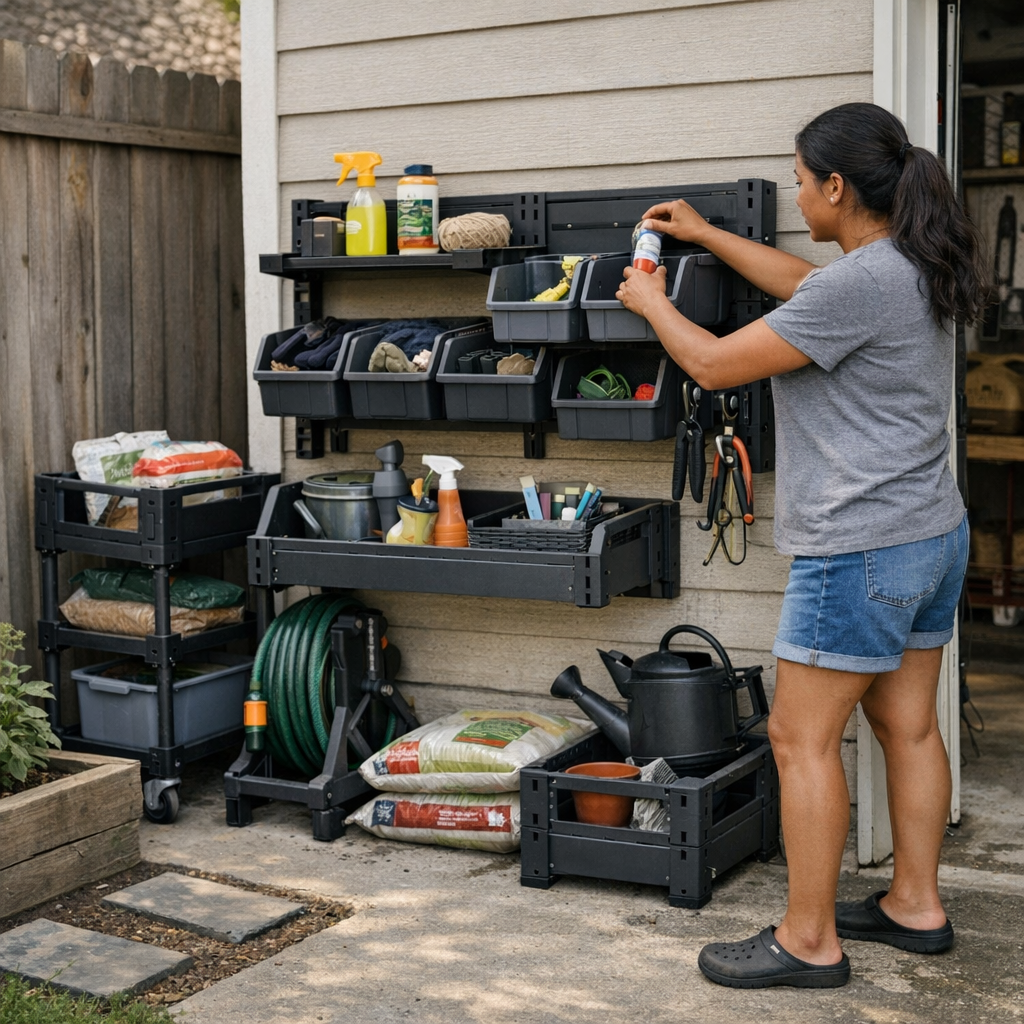
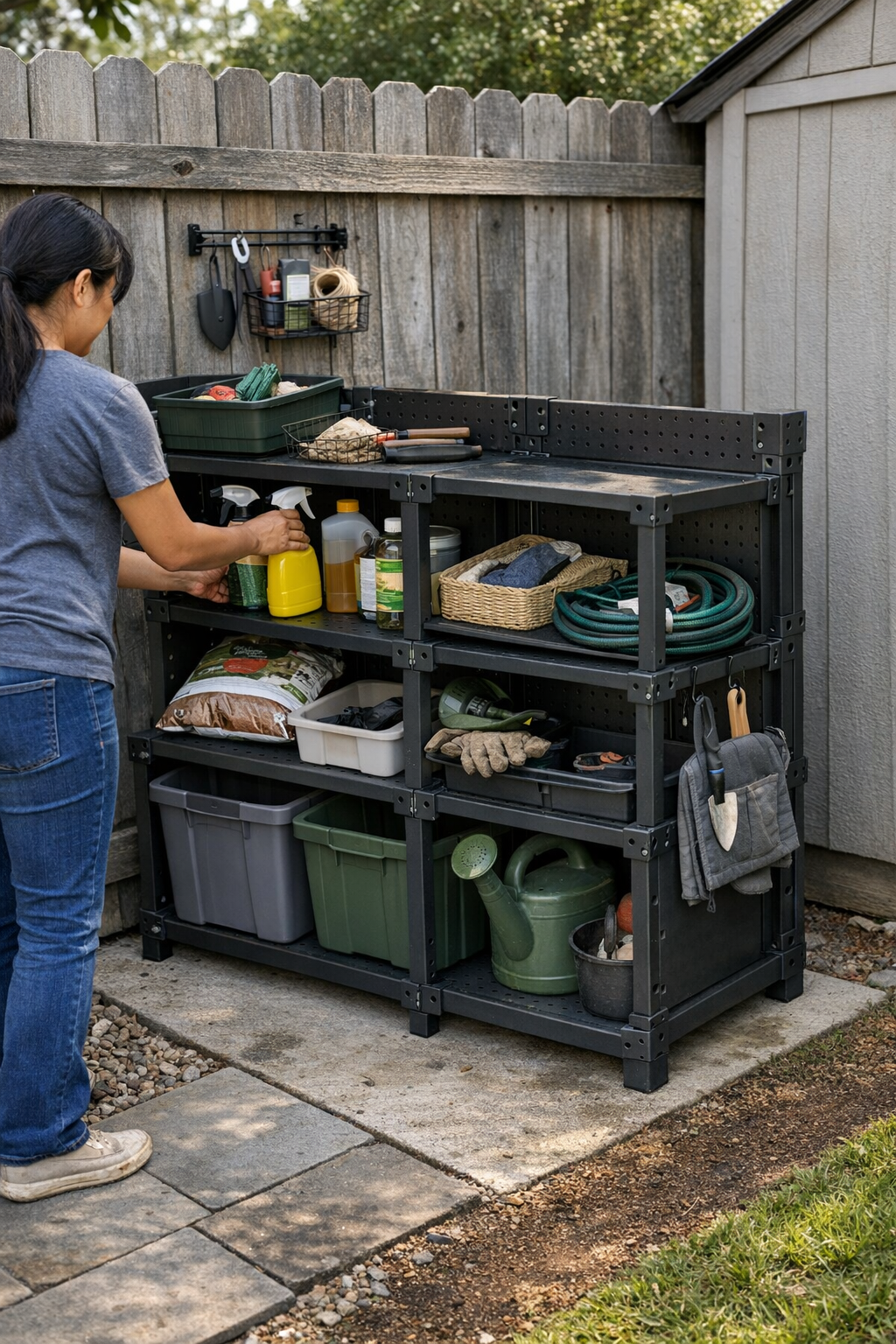
    Open racks and cubbies look exposed—hooks with garden snips, wall baskets holding spray bottles, open slots along the garage edge. But when the reset is just drop-and-go, clutter has fewer places to collect. Return a trowel? One motion, back on the hook. Grab gloves? Toss them on the open shelf as you leave the yard. No lids to fumble, no stacks to move, no out-of-sight layers. You see what’s out and what’s missing, so nothing quietly rots in a dark box for a season. It isn’t a catalog spread, but it’s workable and fast enough that the system holds even on the messiest days.

    This “mess visible, friction low” balance is what makes the open setup more than a compromise—it’s a live counter to the way outdoor zones want to slide right back to blocked movement and quiet spillover.

    Raise It to Elbow Height, Cut the Excuses

    The reset gets even smoother when open cubbies sit at elbow height—right where your hand already travels. Mount a row 16–20 inches up along your garage, fence, or patio wall. There’s no extra bending, stacking, or reaching over packed bins on the ground. Dropping clippers in a cubby or hanging the hose sprayer takes the same effort as abandoning them on the lawn—and with the right reach, the excuses disappear. Daily-use gear runs on muscle memory, the “leave it here for now” pile shrinks, and the path stays open without conscious effort.

    How Setups Turn Against Themselves

    • Floor bins that become blockers. The big storage cube against the fence seemed smart until quick-grab gear covers its lid and you quit opening it entirely.
    • Items orbit their homes instead of returning inside them. If it takes more than one step to put something away, the “just for now” pile becomes a permanent speed bump by the door or along the garage threshold.
    • Every reset begins with reshuffling. Moving three items to get to one? That’s a friction point. The more you have to clear a path, the less likely you’ll keep clearing at all.

    These aren’t accidents—they’re symptoms of setups designed to look organized, not to survive a real day’s movement. The setup isn’t the problem. The layout—where the work actually happens—isn’t matching the routine that needs to flow through it.

    Real Scenes: When the Routine Meets the Reset

    Visualize an average weekend. A set of hedge clippers hangs on the open rack just inside the garage door. Ten seconds, they’re back up after use—you keep moving. Shift that same hook too high, or tuck it behind a stack of reused planters, and suddenly the “temporary landing zone” becomes the real final stop. Four days later, you’re working around an obstacle you made by accident. Multiply this pattern by every tool and bottle you touch, and the zone goes from frictionless to blocked, fast.

    The classic deck box tells the same story. It fits the footprint, but the lid’s heavy, inside is a scramble, and the nearest tool always ends up living outside, easy to grab but never quite put away. The box doesn’t fix the clutter—it just pushes the reset further down the line. Once you’re tripping over overflow, you’re not storing smarter, you’re just shifting the pile.

    Tweaks That Actually Shift the Routine

    • Raise open storage off the ground—hung racks or wall cubbies don’t eat into floor space, so walkways stay open and gear doesn’t slide underfoot.
    • Push daily-use zones to your entry points—store gloves, pruners, and hoses by the gate, the patio edge, or just inside the garage so you’re not crossing the whole yard to reset.
    • Put quick-grab gear on the wall, not the floor—if the first thing your feet hit is a pile of loose items, the setup is already losing to clutter.

    If items pile up in front of a container or a bin goes unopened for weeks, that’s not a user error—it’s the setup sending a clear signal of friction. Shorten the reach, cut the busywork, and the overflow shrinks because there’s no labor barrier. This isn’t about impressing with order or matching magazine shots. Practical storage is about setups that run themselves between resets, not setups that demand one giant fix every Saturday.

    Choosing Systems That Match What Happens, Not Just What Looks Good

    Open storage belongs in high-turnover zones: toys, hand tools, gloves, gear that moves in and out. Closed bins make sense for bulk or off-season—cushions, holiday lights, bags of seed you use twice a year. But if a system slows you down, even by a few seconds, the clutter will work around it, and you’ll spend more time bending, stacking, or searching than actually using the space. Judge the setup by the return: When the burst of activity is over, did putting things away help you move forward, or did it just add another step to the next reset?

    The Real Difference Is in the Return Flow

    You don’t need more containers. You need setups that clear the path. Most outdoor spaces drift into chaos not from lack of storage but from layouts that ignore daily movement. Build for return flow and resets become invisible. Over time, open racks and elbow-high cubbies end up “unstaged” but quietly functional—the gear moves in and out, nothing stalls, and the zone doesn’t demand your Saturday just to look reasonable. When the setup reduces effort instead of shifting it, the space stays usable, even when it’s not picture-perfect. That’s what lasting organization looks like in practice.

    Find setups built for real return flow and weekend momentum at TidyYard.

  • Why Easy Access in Carry-Ons Transforms Your Flight Experience

    An organized carry-on isn’t truly “ready” until it can keep up with you in real airports, boarding lines, and cramped seats—when quick access matters most. That neat, compartmentalized layout you perfected on the hotel bed can backfire the instant you’re shoulder-to-shoulder at the gate or reaching for your passport while pushed along by the boarding queue. What looks orderly at rest can become a source of slow-down and missed moments in motion—especially the second or third time you need to dig for headphones, documents, or a charger before your row shuffles past.

    The Hidden Friction Behind a “Tidy” Carry-On

    Perfectly aligned pouches and maxed-out pockets sell a feeling of control. But that “hotel neat” reveals its cost at security and on the plane. Each extra layer, nested pouch, or tightly-packed cube inserts a small pause: unzip, sift, half-unpack—just to retrieve a high-use item. No amount of careful folding changes the reality that if your passport slides under organizers, or your charger blends into a web of cubes, you slow down each time access is needed.

    This is not a theoretical complaint. If you’ve stood at a scanning tray awkwardly hunting for ID or felt boarding pressure as you shuffle half your bag to find a travel document, the tradeoff becomes obvious fast. Those small holdups do not “even out” later; they add up with every checkpoint and seat change, turning neatness into repeat interruption.

    Cramped Space and Repeated Reach: Where Things Fall Apart

    The real test of a carry-on layout is how it behaves after hours in the system: five security checks, three different gate lines, or two unpredictable flights. Weakness shows when you twist in a crowded aisle to find your cable, only for it to surface tangled beneath the headphones that looked fine together during packing—but now block the only open zipper.

    Fast-forward to a boarding group lineup—one hand dragging your wheelie, the other scrabbling for your boarding pass. If that single high-frequency item lives under a stack, or requires undoing two layers of pouches, every stop piles on a sense of friction. Try it across several flight legs and watch as small inconveniences compound: wrong pouch on the first try, repeated shuffling, and the nagging sense your system is working against you.

    Typical Scenario: The Mid-Flight Retrieval Trap

    Cruise altitude, seatbelt sign off—you want your glasses, but they’re in a zipped organizer buried under two others. Cabin lights are dim, both neighbors deep in Netflix, and your carefully planned compartments suddenly force a lap-load shuffle. Each attempt means elbows near strangers and cold glances as you disturb the row. What starts as “organized” quickly becomes disruptive, proving the real cost isn’t mess—it’s the repeated, comfort-draining pause every time you reach for what should be instantly available.

    Why Full Use of Every Cubic Inch Isn’t Always Your Friend

    The urge to leverage every internal pocket is strong. Organizer loyalists fill every slip and sleeve, believing more structure equals more efficiency. But the tighter the fit, the slower the access. If your top-use essentials—passport, sanitizer, charger, earbuds—don’t live in a quick-grab spot, the friction shows up on every reach.

    Travel routines rarely stick to plan. After takeoff, you realize your phone charger is locked up in a main compartment under toiletry kits and cables. At descent, you need your ID but it’s in the bottom layer, and the clock’s ticking. Now you have a choice: uncork the entire bag in a tight seat, or do without. That “all packed away” look does nothing for in-transit flow, and the more flights you string together, the more these little failures make you question the system.

    A Practical Shift: Dedicated Pockets for Repeat-Use Essentials

    Too many sluggish retrievals make the case for a dedicated, obstruction-free pocket impossible to ignore. The outer or top section—reserved only for your highest-frequency use—changes the rhythm: one zipper, nothing stacked in front, no re-arranging required. No matter the routine shift—boarding, landing, tray tables up or down—your essentials ride in a single-use pocket. Reach, retrieve, repack: each action mirrors the last, cutting repacking drag to a minimum.

    Over several flights, this single change becomes visible: no more spreading pouches across the tray, no second-guessing where things landed after a rush, no frustration-tinted laps as you try to repack between service carts. Access and return merge into one motion—no “hack,” just less interruption and less stress looped through every segment of the trip.

    Real Use: Recognizing—and Fixing—Repeated Weak Points

    Each airport trek and seat shuffle diagnoses your setup. If you spot yourself repacking after every minor access, or hunting through two wrong pockets before hitting the right one, your layout is hiding avoidable obstacles. Rework it: separate the must-grab items, keep them at the very top or in their own dedicated side. Let real use—not static organization—dictate what stays within reach. Every routine flight becomes a field test: what slows you down signals where friction still hides.

    Movement Happens—Comfort Follows Smart Access

    Visual neatness guarantees nothing once you enter the airport’s push-pull flow. If you lose sight of your documents mid-security, or still dig for earplugs on every trip, there’s a structural flaw—not just a bad packing day. Your comfort relies on removing overlap and access-fighting layers, so your bag flexes with actual movement, not idealized order. Travel smoothness comes not from focusing on the “perfect pack,” but from cutting out those tiny, constant stops that slow you between gates.

    To find tools and organizers designed for repeat-access and real travel movement, visit CarryOnSupply.

  • Why One Ceiling Fixture Often Fails to Light Hallways Properly

    The Single Fixture Trap: Why “Bright Enough” Fails on Day Two

    Install one ceiling or wall light and the job looks finished—until real life exposes the shadow zones. The most common complaint isn’t that a room is dark, but that parts of it become unusable just when you need them: staircase landings where the next step disappears, hallway corners where keys drop out of sight, a laundry counter that’s perfectly visible at noon but falls into obscurity every morning or night. The illusion of a “bright enough” space shatters quickly in places meant for movement and tasks. One fixture might light the center, but it leaves edges, thresholds, and critical surfaces in partial shadow—the exact spots you step, reach, or search in every single day.

    Where the Light Fails: Centered Fixtures vs. Real Paths

    Lighting trouble rarely comes from weak bulbs or dull fixtures. The problem is misdirected spread and placement. A flush mount in the center of a square room might look balanced on paper, but take that setup into a narrow hallway, a stair turn, or a galley work zone, and dark patches start building up. These aren’t just cosmetic gaps. They dictate how confidently you move, whether you stop at doorways to scan the floor, or find yourself squinting into a closet that, hours before, seemed fully illuminated.

    Consider the last time you walked a hallway after dark. Did you trust your footing from wall to wall, or did you slow down near the stair turn or search for a light switch before stepping into an uncertain patch? Ceiling fixtures that seem bright overhead often cast long shadows down the wall, putting the most-used thresholds and corners out of reach. The real test comes not when you admire the room from the doorway, but when your routine puts every weak spot under pressure—pausing at a stair turn, missing a dropped shoe near the closet, or tilting an envelope under the only clear spot of light.

    Hallways and Stair Turns: Where the Setup Breaks Down

    Picture a traditional hallway: one flush-mount ceiling light, looking sleek and “done.” Stand dead center—visibility’s fine. Take a few steps toward the end, head for a closet, or turn a stair corner, and suddenly the floor blurs, profiles dissolve, and there’s a distinct urge to slow down. Kids hesitate at dim landings, adults misjudge a step with a basket in hand, and every turn becomes a pause point—not because the room is dark, but because the light’s spread doesn’t match the way people really move. Awkward hesitations cling to these friction spots, no matter how many lumens you throw at the fix.

    Work Surfaces: The Underlit Face and Counter Problem

    The single-fixture mindset is especially brutal for tasks: bathroom mirrors with shadowed cheeks, laundry counters where one half gleams and the rest fades after sundown, entry tables that pull you in to squint at paperwork or screens. You start adapting—leaning closer at the mirror, sliding a basket into that one usable patch, or shifting position to dodge the flash of ceiling-glare on tile or steel. Cranking up the wattage only makes the brightest spot harsher, does nothing for lost edges, and amplifies uncomfortable glare on glossy finishes. The divide between what looks bright and what actually works grows wider each day you use the space as intended.

    The Repeat Offender: Everyday Friction, Not Just Dimness

    Poor lighting isn’t an obvious red flag on installation day. What shows up is the accumulating irritation—each morning you slow down to check the closet floor, each night you fumble at the bottom stair or nudge laundry baskets blindly through a corridor missing just one sliver of light. Not pitch-black, but an undercurrent of frustration: pausing, double-checking, missing handles, or stepping more tentatively than necessary. Over time, these small breakdowns harden into routine. What once seemed “done” now interrupts every task that counts.

    Why More Bulbs Don’t Solve It: Placement and Layering Win

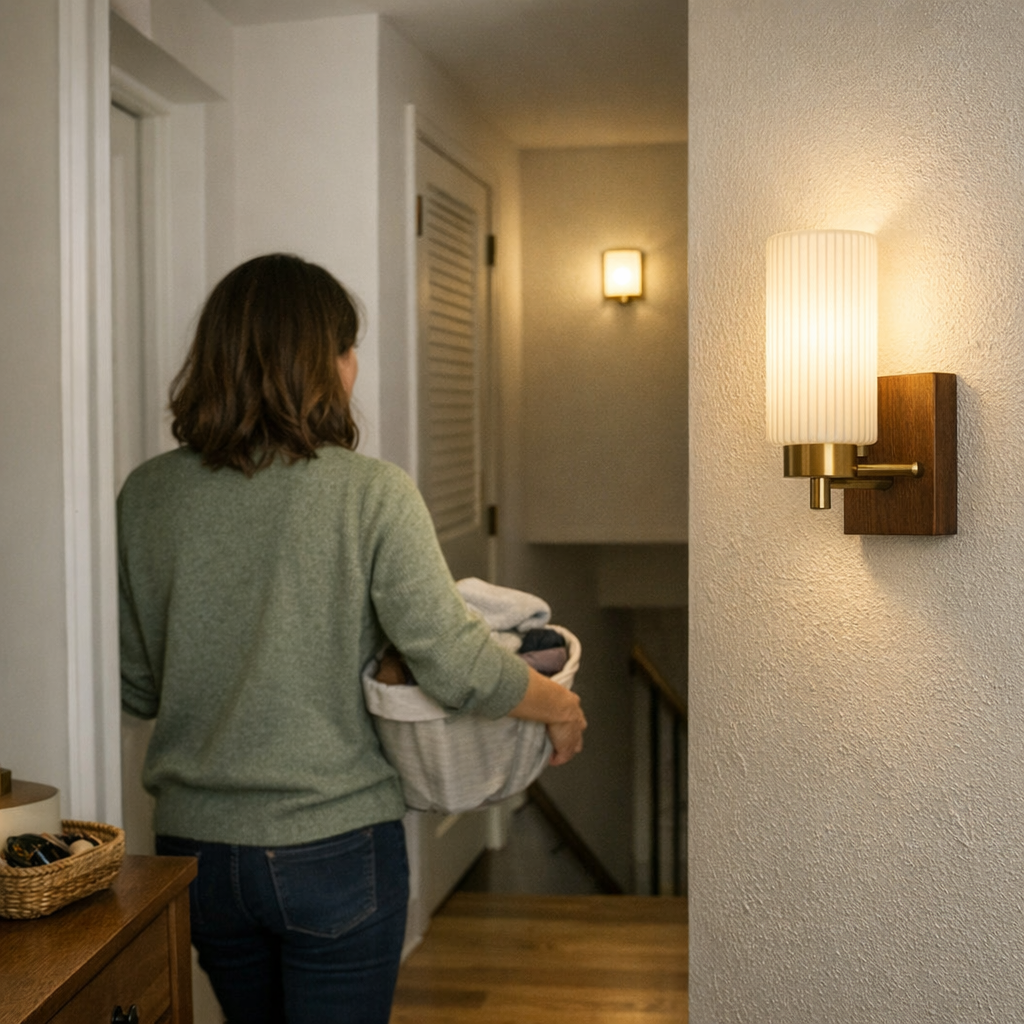
    Trying to fix spread gaps with bigger, brighter fixtures almost never works. Stronger bulbs simply spotlight the same central zone, while stubborn shadows hug the edges. The shift comes from layout: add a low-profile wall sconce near a stair bend, or a hardwired light near a closet, and you erase the most persistent dark lines—the exact places feet search and hands fumble. Layering doesn’t mean a flood of extra light. It means filling the empty strips just beyond a main fixture’s reach, smoothing the experience so movement is continuous, not tentative, and surfaces work evenly for every routine. The difference is felt immediately the next time a child rounds a stair corner, or someone crosses a once-dim threshold without missing a step.

    The Power of Two: Targeted Correction Beats Power Alone

    Long, L-shaped corridors and stair landings are repeat offenders for dark pools. One centered ceiling mount guarantees faded corners and shadow-soaked entryways on repeat. A second source—wall sconce, directional wall light, or soft panel—breaks the monopoly of overhead lighting, pushes gentle illumination horizontally, and targets the trouble spots. This isn’t about overall brightness, but about giving visibility where your feet, hands, and eyes actually go. Coverage becomes a question of path, not just square footage. Every added layer directly attacks the shadow lines that overhead fixtures habitually miss.

    Lighting Built for the Real Routine

    The best lighting isn’t measured by initial impressions; it’s measured by how little you have to adjust yourself in the third week. If you catch yourself shifting your walk at the hall’s end, angling for better mirror visibility, or bracing at a stair turn, the setup is subtly failing you every day. Recurrent pressure points include:

    • Stairway bends where the bottom step isn’t visible until after you’ve hovered a foot
    • Hallways with offset thresholds—crossing means stepping from glare to gloom without warning
    • Bathroom sinks and vanity mirrors split by uneven lighting so the face is half in shadow, half in glare
    • Utility counters lost at the edges, even though the fixture passes the “brightness test” just overhead

    None of these problems are solved by style. They’re structural signals you need even, layered light matched to the real movements your routine demands.

    Quick Fix: Field-Tested Ways to Reveal Spread Gaps

    • Trace your daily route: Stand at every door, corner, or stair you cross each day. Is the floor as visible at the edge as it is at center?
    • Layer on a mission: Add a wall sconce or directional wall light at task points or hall turns. Don’t just opt for a brighter ceiling light—fill in the shadow pools where you actually pause, pivot, or reach.
    • Test after dark or at dawn: Walk the area at low-light hours. Pay attention to steps, handle visibility, and whether the edge of a counter or basket shows clearly, not simply whether the space “looks” illuminated from a glance.

    The Real Benefit: Comfort That Survives Repetition

    What fails with “just one fixture” is most obvious on a rushed morning, when awkward pauses, blind corners, or lost surface edges slow you down or double your steps. Lighting that adapts to lived-in movement—layered, low-profile, and positioned for human routines—doesn’t just look finished, it functions fluidly day after day. The mark of a truly usable setup is when you stop noticing lighting at all—because every spot you use is finally, quietly, visible.

    For lighting that works beyond the first week, match your layout to movement, not just symmetry. Even, shadow-free light transforms a space from “bright enough, sort of” into a room that actually supports the way you live and work—no extra thought or clumsy workaround required.

    Shop LightHelper for practical indoor lighting solutions.

  • How Clear Sideboard Storage Rules Transform Household Organization

    A sideboard looks organized only until real life rewrites its rules. The smooth, closed doors promise control—a clean dining area, a reset entryway, a place for everything. But by week two, the flaws leak out over the edges: chargers creep onto the wine shelf, last week’s mail piles in the napkin corner, and the broad top is a magnet for everything you couldn’t decide on putting away. What felt like an upgrade quickly becomes a slow friction—retrievals that stall, drawers that catch, and clutter that hides better than it disappears. Suddenly, your storage solution is part of the daily reset problem.

    The Slow Fade: When Organized Looks Don’t Hold Up

    The promise is classic: sideboards tuck clutter out of sight and free up your routine. But closed storage without clear category boundaries turns fast into a catch-all. The cost shows up when you’re in motion—needing dinner napkins now but finding receipts, or reaching for a charger and sending a spill of menu cards across the drawer. You’re opening two sections to get one item, moving stacks to close what should shut easily, and each small hassle compounds. Organization doesn’t decay loudly; it just interferes quietly, until you’re spending mornings untangling cables or forgetting where the spare keys wound up last.

    This breakdown sharpens in busy, high-traffic areas. Mixed-use sideboards—trying to absorb dishes, tech, linens, mail, and the chaos of family life—lose their lines fast. With no enforced categories, anything becomes fair game, and it takes only a few rushed weekdays to blur the original setup. What was supposed to be “hidden order” becomes blind drift, with every search slowing and surfaces refilling just as quickly as you clear them.

    Beyond the Showroom—Practical Friction In Real Use

    If you’ve hesitated in front of a sideboard, mentally replaying moves—where’s the charger, which drawer for remotes—you’ve seen the danger in trusting good looks over good logic. Closed doors aren’t a fix; they’re a delay. Well-arranged shelves mask the problem until a quick retrieval turns into a block: drawers that need shuffling, a stack of folded cloth pinching a hidden pile, items wedged deep enough that “out of sight” means “as good as lost.” Supposedly smooth routines jam on the smallest snags, turning resets into scavenger hunts.

    It’s not just about missing things. When boundaries blur, every return becomes negotiable. What once stopped you from spreading out becomes its own overflow zone—mail gravitates to the kitchen or gets stacked on top, napkins float to the hallway instead of returning below, remotes land wherever there’s less hassle. Out-of-place items spark workarounds. Soon, the system’s logjam reroutes your habits: shortcuts get taken, drawers fill up unevenly, and the door becomes a physical barrier in your path rather than a helper.

    Category Drift: The Real Source of Blocked Flow

    Category drift quietly unravels any sense of order. That “miscellaneous” drawer? A symptom of fading boundaries. At first, it’s only an extra minute spent searching or shuffling. But by the end of the week, drawers resist closing, bundles wedge in corners, and items you needed for tonight’s dinner or task are unretrievable without a full reshuffle. Each convenience becomes a slow tradeoff—less time spent on initial sorting means much more lost in daily disruption.

    In family or shared rooms, this drift shows up fast: a flat surface that stays clear only until the next drop-off, sideboard doors blocking paths because no one wants to empty the pile behind them, guests slowing down the evening as they fumble to help. The true cost isn’t visible mess—it’s lost flow, blocked motion, and habits that change only to work around the latest jam.

    Giving Every Section a Role: Where Structure Beats Storage

    Resilient sideboards assign each drawer or shelf a strict single use. “Top left: chargers and daily mail only. Lower right: extra linens. Center tray: keys.” Not a loose intention, but a visible limit. The difference is sharp: clutter stops accumulating, flips and shortcuts get blocked, and the time to retrieve or return drops fast.

    In one clear reset, a dining room sideboard went from tangled catch-all to stable helper. By stripping a central drawer of its floating contents and reassigning it—one category per section, a shallow tray to stop tech from wandering—morning logjams vanished. After a week, no double-searches, no blocked drawers, no hidden piles. The upgrade wasn’t about gadgets or more organizers; it was pure rule structure fitting real-life traffic, and it held up when things got busy, not just when freshly sorted.

    Reset Routines: Keeping Structure Alive Beyond Day One

    Even the right categories slip without a reset pattern. Regular, fast resets—not deep cleans—hold the boundary. Think end-of-day shuffles: chargers to tray, mail to the assigned slot, napkins to their shelf. The repeat matters more than decorations or labels. With hidden storage, “muscle memory” is the true guide—always the same hand to the same spot, the same action building internal coordination so anyone can help, even without a label or list.

    This isn’t about stricter rules; it’s about keeping friction out of the daily path. Location reliability—reaching once, returning easily, not thinking twice—is how sideboards become assets, not obstacles.

    Signs the Setup Works—And Where It Usually Breaks Down

    When the categories make sense, you don’t notice the sideboard at all—you move through, grab what’s needed, close what was opened, and space stays open without a second thought. One-touch access, flat surfaces that don’t re-pile, and the ability for guests or family to help without searching: these are the side-effects of a working structure.

    When it’s off, the signs are impossible to ignore: paths blocked by open doors, retrievals that send you shuffling from end to end, and clutter climbing the top edge as each “just for now” turns permanent. These aren’t just aesthetics gone wrong; they’re the cost of too little structure and too much drift. The right storage doesn’t add steps, it removes friction—first, in motion, then in memory.

    Simple Tweaks That Last Through Real Life

    Small, structure-first corrections keep a sideboard in service, not in the way:

    • If a drawer keeps jamming, strip it bare and go back to one clear purpose. Only then add a divider or tray—never before categories are sharp.
    • If mixed-use pressure is high (tech, papers, keys), the top drawer needs hard limits: set it to just what’s handled and returned daily, veto overflow.
    • Try a nightly “one-minute reset”—not a full sort, only what’s needed to return stray items, smooth out napkins, and clear the landing zone. The impact is noticeable: less stalled movement, faster access, rarely a need to “fix” the whole cabinet at once.

    Most sideboards don’t fail on size—they fail when their layout fights real usage. Baskets and containers help only if you first walk through categories that survive your routine: a return flow as simple as the retrieval, not crushed by the first busy week.

    See Gridry’s full range of practical sideboards and storage systems to build your own lasting setup.

  • How Adjusting Your Grooming Setup Can Ease Indoor Cat Stress

    If grooming your indoor cat feels like a small battle each week—tense shoulders, cat inching away, fur clinging everywhere—it’s rarely about the brush or the cat’s “mood.” The real friction starts with the setup itself: a spot that looked convenient at first, but puts you and your cat at odds every time. Most owners repeat the same pattern without seeing the structural trap—awkward height, tight space, slippery floor, and tools just out of reach. This isn’t just about organization; it’s about how much extra reaching, shifting, and cleanup you accept as “normal” until it wears you down. The StillWhisker world isn’t about showpiece cat areas—it’s about spotting where repeated home setups quietly slow you and turn routine grooming into maintenance that lingers long after the brush is down.

    When a “Tidy” Grooming Spot Turns Into a Repeating Headache

    An armchair by the window or a small patch of hard flooring can look polished in a photo, but these “tidy” setups often hide daily friction. The cat grows wary well before you sit down. Each session, you nudge a chair, reach around a lamp, slide a bin closer with your foot—minor moves that stack up. Your cat, sensing your shifting or looming posture, starts tensing or ducking away right from the approach. Suddenly, something that looked controlled at first now takes longer, leaves more mess, and feels more draining every week you repeat it.

    The posture you fall into—twisted, half-standing, or always reaching over something—creates invisible pushback. Each session, that strain leaks out: a hand steadying the supply basket while holding a squirmy cat, fur drifting toward the hallway, cleanup supplies buried behind yesterday’s attempt at “swift reset.” The tidy look disappears as each awkward reach or incomplete wipe-down adds to the residue you spend weekends fighting off.

    How Setup Choices Quietly Derail Cat Grooming Routines

    It’s easy to miss how much surface and posture shape a grooming session. Sit on a chair, and almost every move becomes an “overhead” gesture—your cat shrinks away or bolts at the hint of your shadow. That two-foot height gap is all it takes to flip a calm brushing into a standoff. When the setup pits gravity against you, fur escapes under couches, brushes tumble off laps, and you find yourself running cleanup along baseboards days after “finishing.”

    These patterns aren’t random. Over weeks, you notice your cat sidestepping the supplies, or holding a tense posture the moment you approach the “grooming corner.” You clean up fur in odd corners, notice the brush is never where you left it, and spend more time prepping or resetting than actually brushing. The session now feels like a two-part job—get through the struggle, then sweep up the aftermath.

    The Accumulated Burden of an Almost-Right Setup

    Almost right is where the pain accumulates. Your cat won’t settle, so you keep “fixing” by shifting towels, moving baskets, or tackling stray fur a day late. Little by little, grooming starts to invade the rest of your space, spilling fur into entryways, storing supplies in random corners, and demanding repeat cleanups. Finishing the session doesn’t clear the slate—you’re still tripping on hair or tools hours later, staring at a supply bin wedged next to the TV stand because it never quite has a stable spot. Over time, this slow friction feels heavier than a simple reset ever should.

    Changing the Pattern: The Impact of Sit-Down Level and Surface

    The routines that work long-term share one pattern: your posture lets you meet your cat at their level, and the surface under you supports a clean finish. Dropping from a chair to the floor isn’t just symbolic—it removes the looming threat, halves the reach, and hands back control of the moment to you both. A proper mat or rug breaks up floor chill, keeps fur contained, and makes cleanup part of the session—not a separate hassle an hour later.

    At floor level with a stable mat under you, several changes hit immediately:

    • No more looming overhead—your cat stays calmer, less triggered by sudden reach-ins
    • Fur lands on the mat, not across the whole floor or under every leg of furniture
    • Shorter, direct reach—steadying and brushing is easier for both sides
    • Cleanup becomes one movement—shake out the mat, tools back to caddy, session finished

    This adjustment—low, stable seating with a surface that contains mess—often flips grooming from “get it over with” to a quick, low-stress part of the day that doesn’t bleed into every other room.

    Routine in Real Life: A Typical Grooming Scene, Improved

    Picture the standard scramble: your cat’s on the sofa, you climb a chair, tools balanced on one knee, hoping for cooperation. What actually plays out? Twisting, reaching, the brush slipping, your cat repositioning before you can finish, fur falling everywhere but the spot you intended. Now picture: you pull over a solid mat, sit cross-legged on the floor, align at eye level. Suddenly, your hands move naturally, the session runs quietly, and fur stays on the containment surface—not the wooden floor or halfway under a cabinet. Your cat’s tail stays soft, body uncoiled, and you don’t need five “almost done” resets as the session drags on.

    Clean up? The mat collects it all. One shake, done. The tools tuck away without a scavenger hunt. You’re not rerouted by stray hair or a supply pile later in the day. The difference isn’t dramatic until you repeat it for a few weeks—and then it’s hard to go back.

    What Routine Strains Really Tell You

    The warning sign isn’t in dramatic resistance—it’s in the tiny cues: the cat weaving away from your reach, fur gathering under the spot you “fixed” last weekend, the supply bin never truly finding a home. Each workaround—throwing down a towel, moving the ottoman, leaving out the brush—works for one day, but multiplies the cycle of micro-fixes. Every small inefficiency grows in weight because it keeps coming back, making each session harder to start and slower to finish. This is the real cost of a setup that looks fine but works badly when routines repeat.

    How Lowering Yourself Changes Cat Comfort—and Your Maintenance

    Sitting lower with your cat—kneeling, cross-legged on a solid mat—does more than calm them. It also shrinks the radius of cleanup and resets maintenance into a simple step. There’s no more chasing fur under bed frames or fishing for a lost brush; everything lands where you and your cat are aligned. The “looming” effect that made each approach a new struggle simply fades, and the post-session burden is now a quick shake, not a hidden project for later. This split-second reset is the difference: setup and finish are finally part of a cycle you don’t avoid.

    The Difference Between Presentable and Livable

    A basket of supplies sit neatly by the chair. The mat looks fresh. But if you’re untangling tools, repositioning yourself three times, or sweeping up fur in every corner, then the setup is passing for “presentable” and failing at “livable.” Setup isn’t just what looks good after a reset—it’s what doesn’t disrupt routine every time you repeat it. True grooming comfort shows up in the aftermath: cat relaxed, quick reset, no lingering project left behind, and nothing out of place in the rest of your home. That’s the StillWhisker setup—minimum friction, repeat-use payoff.

    Small Shifts, Lasting Effect: Rethinking the Grooming Zone

    If you’re stuck in a grooming routine that always leaves you adjusting, look for structural sticking points. Don’t hunt for more gear—trace the cycle instead: where you sit, what’s beneath you, where fur ends up, and how easily everything packs away. Watch the small resistances—a restless cat as you loom, a mat that slips out from under you, a caddy that never lands within arm’s reach. Change these, and routine maintenance shrinks down. Over a few weeks, you’ll find cleanup simpler, your cat calmer, and no slow-creeping supply pile invading joint space.

    The best sign? Your cat doesn’t bolt when the brush comes out. You handle what’s needed, reset in a single movement, and your space doesn’t betray every session with fresh little messes. It’s not about perfection or single-session magic—it’s about setups that vanish friction, session after session. That’s where practical indoor-cat life shifts from small defeats to quiet, lasting comfort. See more practical setups at StillWhisker.

  • Why Plug-In Accessory Placement Transforms Everyday Lighting Use

    If you have to twist, dig under a shelf, or reach behind clutter just to turn on a desk lamp or under-cabinet light, you’re not alone. A plug-in switch that looks “minimal” on day one often becomes a daily hassle: misplaced inline controls, low-hanging adapters, or bracketed buttons end up breaking your flow every time you need light. The fix isn’t just cosmetic—a smart lighting setup depends on whether switches, cables, and hardware actually match your routine, not just the furniture edge or wall face they’re meant to tidy up. How your light operates in regular use will show every compromise you made in placing controls and support hardware, for better or worse.

    When Placement Breaks Your Flow

    It’s easy to underestimate the impact of poorly placed lighting controls—until they start getting in your way. Maybe you hid an inline switch behind a row of books, or tucked a power brick out of sight under a shelf. For a brief moment the space looks clean, but soon the routine cracks: you freeze mid-task, nudge aside a pile of notebooks, or hunt behind a printer just to toggle the light. Each reach becomes a small interruption you never planned for.

    This friction isn’t rare. At a crowded desk, on a slim kitchen counter, or with wall-mounted LED strips, nearly everyone tries to banish cables and switches for a cleaner look. But once you start working, the “neat” finish resists the way you actually move—until the setup feels slow and slightly incorrect, day after day.

    Real Examples from Everyday Corners

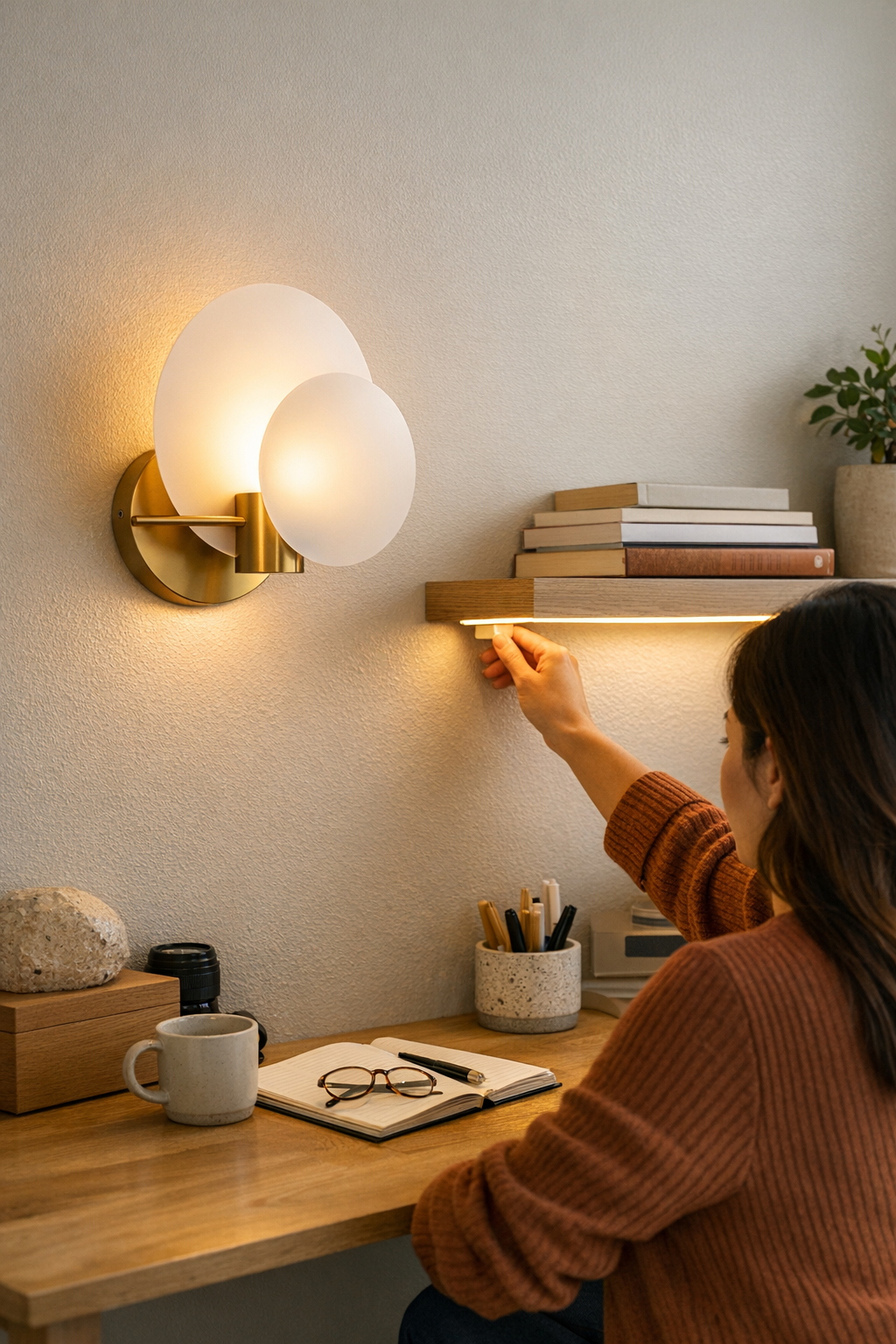
    Take a floating shelf with a low-profile LED strip: you race the cable along the back, stash the controller behind books, and step back to admire a seamless glow. But every morning proves what the setup missed:

    • Turning on the light means shifting books or reaching blind behind the display, risking a loose cord every time.
    • The inline switch dangles off the back edge, often sliding down and vanishing behind the desk. Retrieval becomes its own ritual of tiny annoyance.
    • If more than one person uses the space, the first question becomes “Where’s the switch?”—and the hidden controller forces books, cables, and small objects into constant migration.

    Or picture under-cabinet kitchen lighting: the bracket hides the cable from view, but each use demands a stretch behind jars and appliances to fumble for a stubborn toggle. What photographs as orderly quickly exposes its weak point—good for looks, clumsy for anything you actually do in the space.

    The Difference One Adjustment Makes

    Now imagine that same controller repositioned right at the forward edge of the shelf, within easy reach—no more moving stacks, no need to trail cables over your workspace. One small move, and the interruption disappears: switching the light becomes automatic, and the cable path finally respects your hand’s real pattern through the day. Suddenly, the setup aligns with how you live, not just how it looks.

    Spotting Setup Friction Beyond First Impressions

    Lighting and cable arrangements that appear neat at first can quietly unravel during actual use. You can spot a non-working setup by its friction:

    • Dragging cables and switches: Lines catch, lift, or scuff every time you shift something nearby, adding repeated stress to both hardware and patience.
    • Awkward reach-zones: Controls dangle or hide in spots that demand bending, twisting, or unnatural stretches—rarely where your hand expects them.
    • Visual clutter returning: Trying to fix the annoyance, you or others start pulling cables back into view or rearranging items, which slowly defeats the original “clean” intent.
    • Routine interruptions: Split-second pauses—just to chase a switch, secure a bracket, or fish out a power supply—add up as the real price of a not-quite-finished solution.

    Each of these was “only a small hassle” at first. But in daily cycles, the inconvenience compounds, making you notice the setup more than the comfort it should bring. A lighting plan that merely looks good isn’t enough if it stumbles every time you need it to just work.

    Better Placement Guidelines for Smoother Daily Use

    So how do you actually make a lighting setup that feels right in repeated use? Start with these patterns:

    • Stay in the action zone: Place every control directly along your natural reach path: the nearest desk edge, the forward lip of a shelf, or within relaxed arm’s length from wherever you sit or prep daily.
    • Keep cables clear of movement lanes: Route cords so they skip visible surfaces and don’t need to move every time you grab something. Avoid cable paths that snag or distract.
    • Test practicality over looks: Set the control position with painter’s tape first and run through your normal routine for a couple days. Your hand will reveal the spot that makes the most sense before you commit with brackets or adhesive.

    Good lighting and support hardware disappear into your workflow not because they’re invisible, but because you never think about them at all—they simply fit. Testing in real time exposes every “visual win” that doesn’t hold up against everyday repetition.

    The Silent Power of Support Accessories

    No lighting setup is stronger than its weakest support part. Switches, power packs, and brackets might seem like afterthoughts, but they decide whether every lamp, desk light, or under-shelf strip works with you or drains your patience. A setup built just for a portfolio photo will always lose to real-life inconvenience—visible cables, stubborn switches, unstable placements, dim task edges, or glare waiting at the wrong height. If the support logic isn’t right, every use feels heavier than it should.

    You don’t need everything hidden—you need it integrated with the way you actually use the surface, wall, or room edge. That’s when lighting goes from decorative to decisive. If your setup still slows you down, chances are it’s not the lamp’s fault—it’s how the little pieces fit the structure and habits you really have.

    For lighting and support solutions that hold up to daily use—not just appearances—explore options at LightSupport.

  • How Small Changes in Dog Routines Can Transform Evening Calm

    Your dog stands stranded between rooms. Not in the kitchen, not on their bed—just in the way, halfway to water, waiting for a signal you didn’t realize was missing. What starts as a routine afternoon—leash off, shoes kicked aside—spills into awkward pauses: blocked by bowls shoved near the cupboard, towel draped out of reach, toys tangled underfoot. That five-minute stall at the hallway threshold doesn’t just eat time; it ripples through every step: feeding, cleanup, even winding down at night.

    A Common, Overlooked Slowdown in the Dog-Owner Day

    The friction isn’t dramatic—it’s the slow drag of misalignment. Each day your dog stalls in the same spot; each time you hesitate, caught between nudging them to the mat or recalling if you prepped the water bowl. These everyday micro-pauses chase each other through the schedule: dinner lands later, walks feel rushed, and nothing resets fully before bedtime.

    It’s a scene you start dreading in repeat: You try to slide smoothly from walk to water to rest, but instead, you find a leash hooked on a drawer blocked by a food bowl, your dog circling as if waiting for a new plan. While you debate between feeding now or toweling off first, the window for a calm transition closes. The next thing you know, pre-bed feels scrambled, your energy frays, and your dog’s cues get harder to read.

    Why These Pauses Don’t Go Away on Their Own

    The hesitation slides under the radar because it’s subtle. Day after day, you adjust: a little nudge here, a quick reshuffle there. But when the same slowdown shows up every evening—hallway circles, toy roadblocks, a water bowl “just out of the way” actually in the way—it starts costing you. The dog stakes out territory in high-traffic zones, bowls get left awkwardly placed for the next reset, and every handoff—walk to towel, food to rest—gets five minutes slower.

    • Perpetual pacing before the dog truly settles
    • Toy stashes where you least need them—under the path from door to bowl
    • A dog locked in indecision, watching you for a cue you haven’t given
    • Cleanup supplies visible but never actually reachable at the right second

    The more you shuffle, the more the house drifts out of sync. That’s how you wind up cleaning up after feeding, only to find bowls in your walking path, towels somewhere inconvenient, and dinner sliding later into the evening—again. The cost isn’t obvious mess; it’s the steady drain of time and flow.

    Spotting the Pattern: Small Pauses, Big Disruption

    This is not “once in a while.” A pattern emerges: your dog stops just short of the kitchen, hovers at the water bowl, stares down the hallway instead of moving through it. The gear all looks right—leash, hooks, towels lined up, bowls at attention—but the routine snags at the same junction every night.

    The routine exposes its weak point every single day: You reach for the leash to hang it up, but a food bowl is blocking the drawer. The hallway collects toys meant for play, now tripping hazards. The noise isn’t energy—it’s indecision: claws on the floor, bowls shifting, your own path bent around dog and gear that should have cleared five minutes ago. You clean, you arrange, but the friction remains.

    The Impact on Routine: Pacing, Clutter, and Missed Cues

    Once hesitation creeps in, every step jams up behind it. Instead of: walk, wipe paws, water, bed—each action gets tangled:

    • You try to grab a towel but find it trapped behind a kitchen chair moved “to look neater.”
    • Your dog hovers in limbo—not ready for bed, not asking to eat, just shifting uneasily between corners.
    • Beds and mats migrate from resting zones to walkways, turning easy resets into sidesteps and obstacle dodging.
    • You realize, too late, that looking organized hasn’t made the routine easier—because nothing is in reach at the right moment anyway.

    By bedtime, a “put-together” setup has quietly spun into clutter, dog agitation, and you second-guessing what needs moving again tomorrow. What you thought was a small delay now loads up tomorrow’s routine with the same sticky friction, one misaligned piece at a time.

    What’s Actually Causing This Routine Weak Point?

    At its core, the problem hides under the surface: organized-looking setups that fail under real use. Water bowls are placed for aesthetic neatness, not flow; comfort mats are tucked away, blocking the dog’s path from door to rest; toys drift into high-traffic spots, just where you’ll want to stand while toweling muddy paws. Or it’s a timing miss—walk ends, but there’s no obvious first step back inside.

    The frictions aren’t about tidy vs. messy—they’re about repeated-use breakdowns at actual pressure points. You catch yourself moving bowls a foot back, toys a foot over, bed a foot out—only to circle the problem a day later because the pause, and the uncertainty, just shift locations.

    Looks Neat, but Still Feels Slow

    There’s a stubborn frustration when the dog area “looks” good, but you still hit snags. Water sits ready, towel rolled just so, yet the transition from outside to true settle keeps dragging. The pain point isn’t storage or appearance—it’s whether actual access lines up with your real, repeated traffic and hesitation zones.

    Everyday Home Scenes: Where the Routine Breaks Down

    See if these feel familiar:

    • Post-walk return: You come in juggling a muddy leash and a fidgety dog, but the towel you need is blocked by a chair moved for tidiness. You scramble; the pause stalls both you and the dog, slowing the entire reset.
    • Evening feeding: Your dog shadows the water bowl but lingers—your reach for the food bin is blocked by a rogue toy. A five-minute meal becomes a drawn-out, back-and-forth shuffle.
    • Transition to rest: Your dog circles the food area, unsure whether to stay or settle. The bed is in the corner, but it jams the space so neither you nor the dog can actually stretch out. Bedtime inches later, energy lingers long after lights-out.

    None of this is accident—it’s the echo of an almost-right setup that looks fine but keeps kicking up friction where you move and need immediate, repeated access.

    How a Small Adjustment Can Break the Cycle

    You don’t need a design overhaul. A focused adjustment—paying attention to where the pause repeats—resets far more than you expect. If the water bowl moves two feet closer to the hallway stall point, or if the rest mat slides into direct line from door to kitchen, the routine changes immediately. The win isn’t about looks—it’s about flow.

    Real fix, real shift: After three nights of hallway pacing, you test moving the water bowl to the edge of the pause zone. Next walk, your dog pauses, drinks, then takes your cue straight to their mat—no circling, no waiting, no toy detours. What took thirty agitated minutes collapses into three calm ones: walk in, towel off, settle. You see it again each night: less mess, less backtracking, more predictable, usable calm—even with the same gear, just in better reach.

    Testing Changes: Don’t Ignore the New Weak Point

    But no fix is forever. Adjust one sticking point, and another may reveal itself—a towel now blocks the drawer, or the toy bin slides into a new traffic path. The trick is watching for that next pause, adjusting again, and letting real-life feedback lead. A couple days spent noticing where routine resistance returns will show you the true sticky spots worth moving.

    Week by week, the loop gets smoother: Once the stall point aligns with actual reach and dog traffic, you recover time and headspace. Cleanup resets easily; your dog finds flow. The rest of your evening, and the next morning after, move faster—with less gear-tidying and less dog-side confusion.

    From Tidy Looking to Truly Usable: Guiding the Flow

    Don’t get fooled by the appearance of organization. The only thing that matters: where the repeated friction hits and whether your setup actually clears it. Any setup—bowl placement, toy stash, towel hang, crate shift—that keeps you from smooth motion is worth rethinking. The difference is real: fewer mid-hallway stalls, faster reset after walks, easier reach for cleanup, and a dog who “gets” the routine cue from a setup that finally fits how both of you move.

    That’s the real reward—not neatness, but less friction tugging at every

  • How Smart Organization Keeps Your Windshield Clear and Driving Calm

    A windshield that stays clear isn’t about perfect glass—it’s about stopping the clutter and loose items that keep drifting into your field of view, reach, and drive path, no matter how often you clean. Step into a car right after a tidy-up, and everything feels orderly for a moment. But after a week of school drop-offs, back-to-back errands, or quick commutes, the same friction points reappear. Cables that looked tamed snake into the footwell. Half-used wipes and receipts wedge along the dash edge, blocking where your phone should rest, or jamming up your quick grab for a charger. The car might look decluttered, but hidden mess just shifts location, not away—reminding you that surface cleaning without structure means problems quietly stack up again.

    The Overlooked Trouble Zones: Where Clutter Creeps Back In

    Most recurring mess isn’t random—it’s the direct result of repeated use without the right anchors or organizers. You can sweep away obvious clutter, but if the real structure behind the dash, center console, and seat edge stays weak, you’ll notice the same cycle: cables slip from the console onto the floor mat, stray wipes drift toward the windshield base, and lightweight receipts slide out of “storage” into your eyeline. The more you drive—if you ferry kids, swap drivers, park and jump out for errands—the more clutter seems to target these return points:

    • Charging cables dropping into the pedal area, snagging or tangling by your feet
    • Receipts and wrappers popping from cupholders, ending up right where you reach for your phone
    • Wipes and sunglass sleeves bunching into the dash gap or windshield line on every turn
    • Supposed “quick grab” items turning into new blockers for the charger or mount area

    Each piece alone is nothing—until you keep pausing to nudge things aside, dig out a cable, or check the windshield base before reversing. Those seconds lost and frustrations building up are your sign: “good enough” organization doesn’t survive real use.

    Why Quick Cleanups Keep Failing: The Hidden Cost of Surface Solutions

    Slotting items out of the way feels tidy—for a few hours. But real-world driving always breaks temporary fixes. Every cable carefully looped or wipe hidden away tends to unravel under real conditions. A single bumpy commute, a fast corner, or a quick parking job and your makeshift “order” is exposed: chargers uncoil into footwells, wipes crawl free of pockets, and wrappers swerve back into view.

    The frustration isn’t the mess itself—it’s reliving the same hassle after every day, especially when:

    • The car is shared, and someone else stows things differently or repositions a mount
    • Parking and re-entry jostle unsecured goods into the next problem spot
    • Stop-and-go traffic shakes out light items, moving them from concealed to obstructive

    The divide is real: a car staged for a photo shoot versus one that can actually take daily wear without unraveling under repeated routines.

    When Good Looks Fail Under Real Use: Recognizable Friction Points

    Most setups survive until real-world patterns reveal their weak points. You drop change or stash cables neatly, but by the fifth drive:

    • The cable you coiled now snakes around the brake pedal
    • Receipts “parked” in a pocket spill out every time someone shifts the seat
    • Phone mounts block the very dash slots where wipes and wrappers keep catching

    Looks don’t last: the daily cycle of sitting, reaching, adjusting, and returning exposes what was never anchored for repeated use—we see the difference not in static tidiness but in how easily the system breaks down at full speed.

    Daily Driving: How Small Overlaps Drag Down Every Routine

    Consider three straight days commuting or running errands. You leave a cable across the console “just for now,” tuck wipes in a low door pocket, lay a bottle by the passenger seat. Each stop and restart unravels order:

    • Cables catch on bags or wrappers, tangling by the gearshift
    • Bottles roll underfoot, becoming a moving distraction
    • Sunshades and wipes crawl out of their intended spaces, bunching at the dash seam

    The repeated seconds lost—clearing, correcting, reaching—add up, making you ask: “Why does this spot keep tripping me up, drive after drive, even though I cleaned it?”

    The First Real Fix: Anchoring, Not Hiding, Your Essentials

    Improvement comes not by hiding, but by anchoring. Example: trading a loose console bin for a slim, anchored organizer on the passenger floor. This stops the daily creep—chargers routed entirely behind seat tracks, wipes anchored beside but never invading the drive space. Suddenly, the cable can’t drift to your feet. Dash-edge mess dries up. Phone mounts and emergency tools become reliable grab-and-go, not random obstructions. Every entry after a trip feels as smooth as it did right after organizing—the organization actually holds up to being used, not just looked at.

    How to Spot the Need for a Reset

    It only takes a few days for small items to break ranks. If you catch yourself nudging wipes aside before buckling in, or the charger seems tangled up by something new every morning, your setup isn’t holding. If grabbing essentials means sorting or shifting, or leftovers from a short trip end up in your field of view, it’s time to reset—not just reclean.

    Real-world setups prevent re-lapse by controlling the route and rest spot for every cable, mount, and organizer—not by chasing after every new piece of clutter each night.

    Designing Your Interior for Uninterrupted Driving

    The solution: combine smart phone mounts, anchored cable routing, and organizers with defined barriers. Cables stay fixed behind seat edges, not dropped loose. Door pocket storage gets a rethink—nothing lightweight left unanchored to wander into the pedal or dash gap. When you run back-to-back errands, share the car, or simply hurry in and out, the friction points don’t creep back because their paths are blocked by design, not habit.

    Effective setups block common failure points: cords never float across the floor, small items can’t drift to the pedal area or windshield base, seat covers or organizers don’t bunch or shift with normal re-entry. This isn’t complicated—just a change from hiding to physically structuring what’s allowed to move.

    Seeing the True Result: Long-Term Ease, Not Just Short-Term Clean

    The pain of clutter isn’t how it looks for a day—it’s the nagging friction that returns after every real trip. That’s why the appearance/performance gap matters. Without real structure, cables and loose items drift into new hot zones, and the cycle returns. With deliberate anchors and defined spots for essentials, the daily drag—the constant clean-and-reset—finally stops showing up in your routines.

    The real benefit: drives, entries, and re-grabs just work. No new obstacles, no time lost clearing a view, no random cable under your heel. Not a perfectly clean car, but a car organized for actual use—that’s what holds up to real life.

    Explore proven car-use solutions at DriveWellSupply