Author: jaesoon_admin

  • Why Upgrading Tool Storage Beats Buying New Tools Every Time

    There’s a reason “organized” doesn’t always feel organized—especially after a week in the workshop or garage. The setup is crisp on day one: wall racks lined up, bins labeled, the new rolling cabinet snapped into the perfect showcase spot. It’s the moment everything looks under control. Fast forward a few days, and the illusion starts to crack. That cabinet’s now wedged in, narrowing your path every time you squeeze by. The rolling cart gets nudged around to clear space—then sits awkwardly, half in the walkway, until your next project. Bins fill unevenly: “Sockets” spills over, while Phillips screwdrivers end up loose somewhere closer, because you just need them more. The gap between “looks organized” and “actually works, every day” becomes impossible to ignore.

    When Storage Structure Steals Your Flow

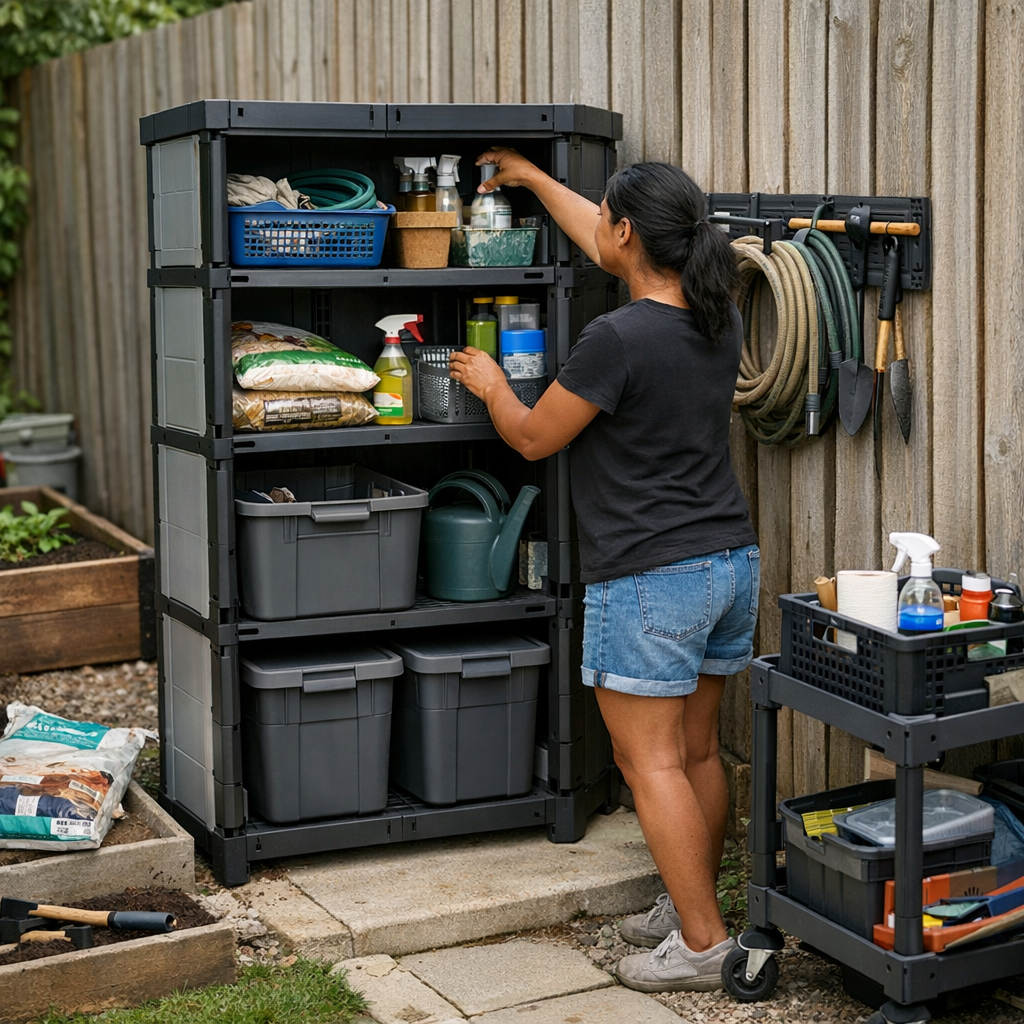
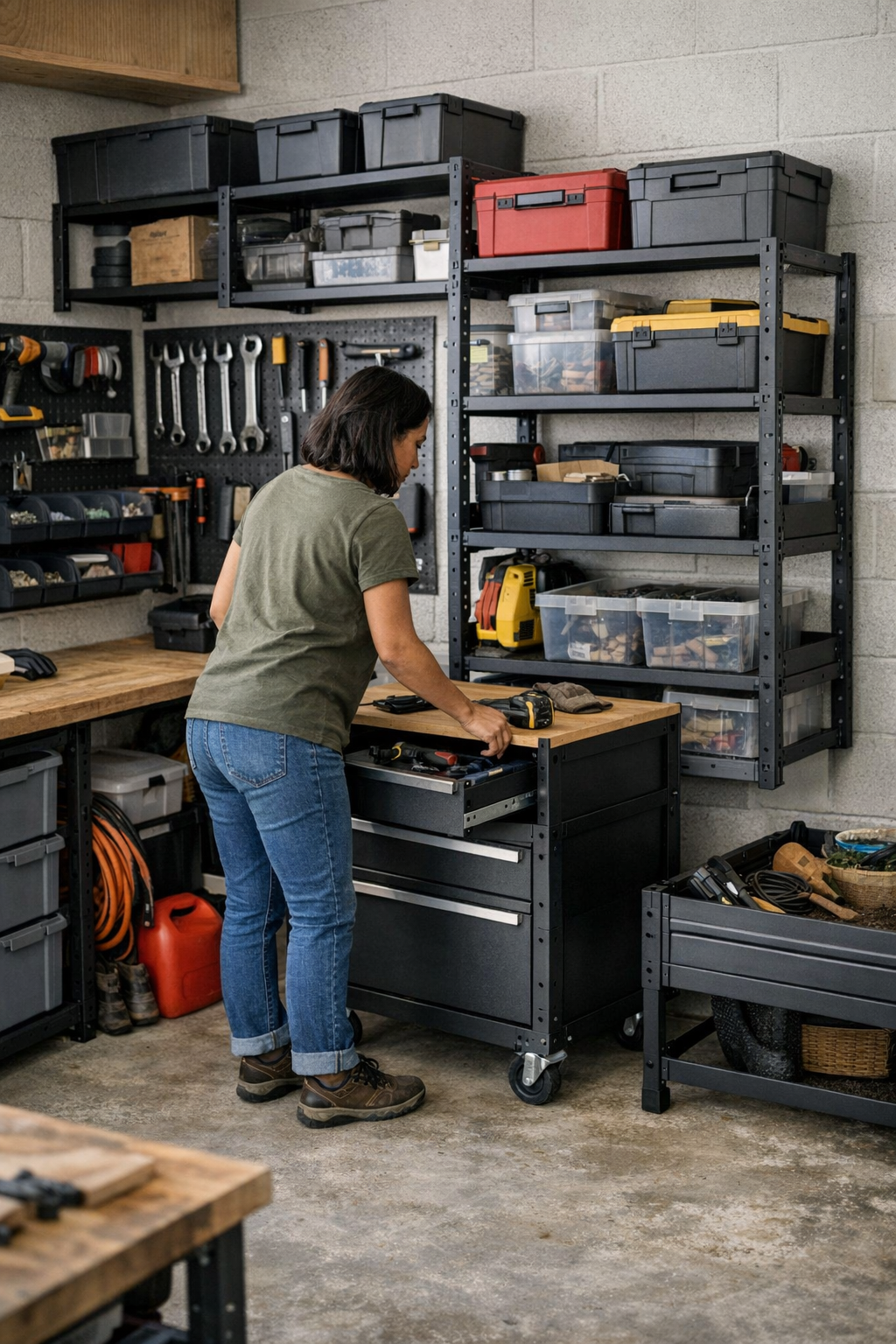
    It’s easy to blame clutter on a lack of bins or fancy cabinets, but most of the real friction comes from the bones of your layout. Maybe your wall panel sits six inches too high—the top hooks go unused, or worse, demand a stepstool for anything you put there. A floor cabinet might keep gear hidden, but suddenly its open drawer blocks your route whenever you need the drill. The visible order fades as new habits take hold. Instead, what remains is a network of small, consistent annoyances: the aisle that could be clear if only that rolling cart had somewhere better to live; the back corner that gets used as a dumping ground for awkward-size clamps because nothing else fits; the regular trek back and forth after realizing your most-used tool never made it home last time.

    The ‘Wall or Floor?’ Trap (and Why Both Can Fail)

    Wall-mounted systems sell the dream: gear off the floor, everything one glance away. But three projects later, you’re reaching over a tangle of hooks for that hex key, sliding aside a ladder to grab the garden shears shoved behind. It’s “sorted,” but not seamless. Meanwhile, floor storage promises flexibility—until your rolling cabinet lands right in the lane where you actually walk, and starts catching overflow: half-used glue bottles, random hardware, the one tool you couldn’t quite find a spot for. What’s supposed to flex ends up blocking you in, movement-by-movement.

    If your setup collects friction faster than it collects tools, it’s not working. Each awkward shuffle—dragging a mobile cart, digging through a low, shadowed shelf, stretching for a tool because the hooks are just out of reach—chips away at the promise of an effortlessly ordered space. The friction isn’t dramatic, but it builds up daily until your own routine is shaped around all these little workarounds.

    Why ‘Everything in Its Place’ Isn’t Enough

    The surface-level fix is tempting: bins labeled, shelving dialed in, pegboard hooks filled to capacity. For a moment, it really does look sharp. But then, a rolling cart meant for one task slips into dead space and becomes a catch-all. Wall storage jams up when retrieving a tape measure means shifting two drill bits and a flashlight first. Soon, one shelf or bench attracts everything that doesn’t really “belong.” Corners don’t become open—they become permanent limbo for bulky saws or that garden rake with nowhere else to go.

    Visual tidiness collapses under routine use if the system ignores real movement. If returning a tool means awkwardly working around a bottleneck—or if project overflow piles up on whatever’s closest—system breakdown is only a matter of time. As routines settle in, resets get slower, and the neat look you started with becomes harder and harder to reclaim.

    Micro-Frustrations Signal Larger Problems

    • Shuffling a rolling cart out of the way—every time you need to move long lumber or an armful of supplies.
    • Edging around a cabinet corner, because it’s always half-blocking your path to the power tools.
    • Wall space technically used, but the top hooks stretch the limits of what’s practical—so they stay empty, or gather only items you rarely need.
    • The same shelf perpetually collects overflow: half the gear lands there, the rest scattered wherever there’s open surface.
    • Dead zones where odd-shaped gear gathers dust, undisturbed, because reaching there means moving three other things first.

    Fixing Flow: Why Smarter Beats Bigger

    Real organization isn’t about adding more places to stash tools—it’s about fitting storage to your movement, not the other way around. Swapping a chunky deep cabinet for a narrow wall-mounted rail (even if it “stores less”) can turn a cramped shuffle into an open stroll. Rethinking by task—putting your go-to tools at natural standing height, storing heavy or seasonal stuff just below—means you don’t end up with piles on the floor. The entire reset routine shrinks: less zig-zag, more straight-line return. Suddenly, cleaning up feels almost automatic.

    The real test? How simple is it to put things back, every single day.

    If it takes even a couple of extra steps, or a detour around an ill-placed cabinet, you’re likely to skip it—resulting in mess that accumulates faster than you realize. Aligning storage with the way you work, not just what you have, shifts the entire feel of the space. Strong systems separate high-frequency from occasional use—not just by type, but by how and where you move. Sometimes, the biggest win is as small as moving a single shelf or cart to free up a pathway that always gets clogged.

    Quick Fix: When Overflow Doesn’t Stop

    If one zone keeps spilling over, it’s not for lack of containers—it’s a sign your workspace is fighting your routine. Before buying another organizer, ask yourself: is your gardening gear stranded across the garage from the back door? Is that cordless drill forever on the bench because it’s annoying to put away? Relocating storage even just a bit—closer to the real action—can reduce reset friction, more than any new bin or flashy label ever could.

    How Real Improvement Shows Itself

    An effective setup doesn’t just look tidy—it lets you clear and reset the area with hardly a second thought. The true difference comes after several rounds of heavy use: floors are open, tools find their way back home, and you’re not trapped in a loop of shifting carts or making “temporary” piles. Zones hold firm because they match how you move, not just how you imagined they might be used.

    If, after a full week, you’re still reshuffling, detouring around awkward corners, or babysitting tools back to their “homes,” the setup is still fighting you. The right storage makes the entire routine feel lighter, not heavier. Pay attention to how your space holds up after daily use—not just how it shines for a photo.

    For storage that makes your workshop or garage actually work—through weeks, not just moments—check out StackNest.

  • Why Flat Ceilings and Single Lights Often Fail Your Home’s Lighting Needs

    Rooms often look bright but fall short when it matters. A new flush-mount ceiling light can make a hallway or laundry room glow in photos—yet in routine use, frustration sets in fast. Shadow pools gather behind doors, stair landings fade at the edges, and half your reflection is lost to dark bands in the mirror. Every day, the central fixture promises brightness, but basic movement—bending at a cabinet, carrying laundry, reaching for a switch—exposes the weak coverage. The gap between looking “lit” and seeing what you need grows wider the more you actually use the space.

    Where the Light Fails—Not in Design, but in Use

    Most rooms start with that “bright enough” feeling. A single flush ceiling fixture—a standard for hallways, laundry corners, bathrooms—spreads light in a broad, flat circle. But as soon as sunlight fades and the day’s routine kicks in, the compromise becomes hard to ignore. The weak spots aren’t design mistakes; they’re a mismatch between how light is delivered and how rooms are used in practice.

    • Take a stair turn at night: that missing handrail or stray slipper blends into the gray, right where the ceiling light’s reach fails.
    • Walk a hallway: the center line stays visible, but step off path—toward a coat hook or baseboard—and clarity drops, hesitation follows.
    • Face the bathroom mirror: overhead glare sharpens the tiles but cuts half your features into shadow, no matter how new the bulb.
    • Stack laundry near a side vent: full brightness in the ceiling, yet the floor edge hides socks and lint in persistent dusk.

    Single-point, central lights rarely match the reality of movement, corners, and task lines. Each time your routine bends away from that fixture’s aim, the difference shifts from a small annoyance to a daily interruption.

    Lighting Friction That Repeats Every Day

    A ceiling fixture covers basics, but the cracks show fast in real routines. Most people develop odd workarounds: you tilt at the mirror for better face light, move slow down a half-shadowed stair, or use a phone flashlight to double-check along a wall.

    • Carrying a laundry basket past dusk? Your arms cast their own shadows and the floor turns unreliable—missed socks or stubbed toes waiting along that dim margin by the vent.
    • Cleaning up? Clutter and dust hug the baseboards or vanish behind the trash can, untouched by the main wash of light overhead.
    • Shaving, tweezing, or putting on makeup? The upper glare creates harsh contrast, forcing you to lean or angle uncomfortably, rarely seeing yourself clearly all at once.

    It’s not parlor-trick inconvenience; it’s repeated, invisible drag. Guests or photos don’t notice, but you do—every time you try to finish a chore and hit a patch the ceiling light never really touches.

    Chasing Shadows: Common Problem Zones

    Certain spots in nearly every home keep echoing the same problem: central ceiling light does not follow the habits, edges, or angles that matter in real life.

    Hallways and Corridors

    Evenly lit overhead, but as you walk, the side walls and corners slip away. Anything dropped near the wall is instantly hard to find, and the walk itself feels easier at noon than at 9 p.m. The main bright spot stays centered, while routine use happens in the dimmer outskirts.

    Stairways and Landings

    Hauling a box upstairs? Sudden shadow at the turn means you check your footing by habit, not by sight. Reflected glare from light paint makes riser edges and step depths harder to judge, upping the risk of hesitation or stumble—especially late in the day.

    Laundry and Utility Spaces

    The ceiling glows, but baseboard shadows hide stains, and an out-of-sight sock sits beside an appliance for days. Corners and under-cabinet runs never fill in, no matter how high-wattage the fixture claims to be. Each week’s “quick clean” misses what the main light can’t reveal.

    Mirror and Vanity Zones

    Ceiling lights drop all illumination downward, deepening shadow on cheeks and under the chin. No angle at the counter feels fully visible. Even premium bulbs can’t fix the core setup: light that doesn’t land at eye level leaves grooming plagued by partial clarity.

    Real-Life Fixes: Lighting That Follows Your Routine

    Turning a “lit” room into a usable one rarely means adding more watts. The real shift happens by placing wall sconces, hardwired task fixtures, or low-profile supplementary lighting exactly where the ceiling’s spread leaves a vacuum—along walls, near task edges, or at mirror height.

    A Laundry Hall Example: Small Fix, Big Impact

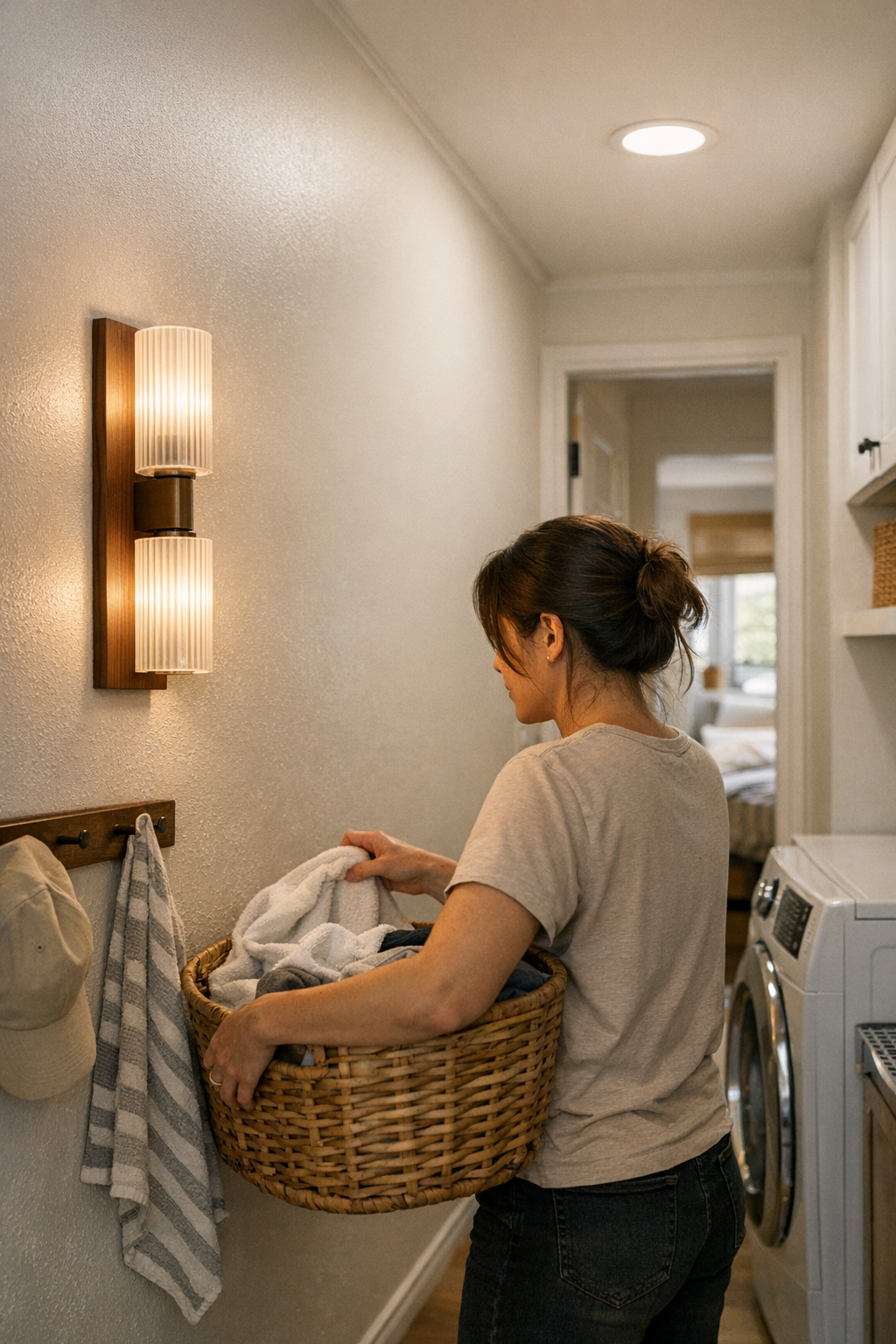
    Picture a narrow pathway to the laundry closet. A new flush-mount ceiling light makes it look finished, but under the elbow bend at a vent, shadows linger. Installing a slim wall sconce, placed at turn level and halfway down, resets the feel. Now, grabbing a basket or picking up stray clothing, you find nothing left behind at floor level. The change isn’t dramatic in the doorway, but during actual use, it immediately removes mishaps and second-guessing.

    Mirror and Vanity: Lighting Where You Look

    For grooming, ceiling-only lighting always cheats you out of balanced visibility. Putting a hardwired wall fixture or vanity sconce at face height erases the split-shadow look, letting you work in true clarity—no more awkward posture or missed details. You see your features as they are, not in two-tone halves.

    How to Spot Trouble Spots in Your Own Space

    Solving lighting friction doesn’t require a renovation. Take a slow walk through your rooms at night, with only the installed fixtures on—ditch the phone flashlight, ignore boost from windows. As you move:

    • Pause when you instinctively squint, lean, or stall—those are immediate cues for where light is failing your routine.
    • Check dim bands along wall edges, at stair landings, near floor vents, or under cabinets—any area you instinctively skirt or avoid during chores.
    • Watch your face at the mirror. If shifting your stance is the only way to see both sides evenly, it’s a sign a true task or vanity light is missing at eye level.

    Details missed repeatedly are never just a bulb problem. Light that feels bright in the air but leaves dark, awkward corners needs aim, not extra output. A compact wall light or fixture at the edge does more than any ceiling upgrade alone.

    Why Real Lighting Satisfaction Comes from Repeated Use

    Many rooms trick the eye into “looking” bright, but comfort and clarity only build up over weeks of routine. The test isn’t an empty room—it’s every repeated step or chore: late-night walks through a corridor, side sweeps in the utility nook, daily checks in the mirror. Each exposes the central light’s blind spots, making clear why relying on one fixture turns into recurring friction.

    Step back: how often are you squinting, shifting or slowing down for a patch left dim by the ceiling setup? The more often it happens, the more value there is in adding a wall sconce, task light, or vanity fixture at real working height. Most rooms never need a lighting overhaul—they need light that tracks the messes, movements, and mirrors that actually matter. Once you see the pattern, options open: a better-lit hallway, a mirror that shows your whole face, a laundry corner that stops swallowing socks.

    See what real-world lighting can do for your hallway, utility, bathroom, or mirror zone at LightHelper.

  • Linking Car Interior Resets to Refueling Cuts Daily Driving Friction

    “Clean” doesn’t always mean usable—especially when you’re behind the wheel, not just looking at the dash. Glance inside and you see neat floor mats, phone cables tucked away, organizers clipped just so. But as soon as you re-enter in a rush—late for school drop-off, hot coffee in hand—the underlying friction surfaces fast. The mat edge nudges your foot, a cable snakes back into gearshift territory, or a charger takes up your best cupholder spot. It’s not the stray mess you spot—it’s the repeated little resets, the fumbles, the seconds lost, that separate an easy car from one that just “looks together.” And when a setup feels off every time you come back, you’re dealing with more than clutter; you’re feeling setup drag—the difference between tidy and truly functional, exposed by real-life driving rhythms.

    The Real Trouble: How Small Shifts Stack Up

    No one intends to drive in a mess. But actual use guarantees small misalignments creep in: a floormat edges forward with every in-and-out, wires drift just far enough to snag a water bottle, and little loose items start orbiting in the footwell. None of it seems urgent—until a typical week unfolds. School rides, grocery stops, quick coffee runs, and each time you’re nudging, tugging, readjusting, or searching for something that slipped. It’s not a big “before-and-after” moment—it’s the steady erosion of convenience, visible only when you’re forced to repeat the same fix twice a day.

    The small disruptions pile up: a single shifted cable now blocks fast charging or cleanly docking your phone, that creeping floor mat starts sliding under your heel or, worse, bunching toward the pedals. Organizers that started aligned end up tilted, swallowing up items or letting them roll out. After several outings, your car still looks fine—but just getting rolling requires more effort every time.

    Why “Clean” Setups Often Boomerang Back

    Surface order is fragile under real use. Most organizers and mounts promise calm by hiding or containing the clutter. But in cars used daily, minor misalignments return quickly. That out-of-sight cable pushes its way around the shifter. A pocket organizer eats up wipes exactly when you need them within reach. A mat chosen for simple “protection” still migrates as you slide in over and over. Each small drift means you’re pausing—resetting wire routes, chasing floating objects, or wrestling the mat back into place—right when you want drive-and-go simplicity the most.

    If you regularly think, “Everything looks fine, but something’s still slowing me down,” it’s usually this invisible friction: a setup that’s tidy only when still, not when used. Real-world driving demands more than a static solution. Interruptions—un-jamming objects, re-routing cables, resetting mats—steal seconds, distract you during busy parking lot maneuvers, and add stress to every high-pressure commute or errand.

    Real-Use Scenes: Where Setup Friction Sneaks In

    The Morning Re-Entry Fumble

    You slide into the seat, hands full, and—again—the charging cable is tangled in the cupholder. The mat edge has crept just enough to snag your heel. Instead of shifting into gear, you’re untangling cords and readjusting before you even start, burning up the little buffer of time you thought you had.

    The Quick Errand, Complicated Return

    The trunk organizer seems sturdy in the driveway but after a few stops, groceries slide out, a loose can rolls out of sight, and you’re forced to reload on the fly. Order vanishes when the car is actually used for three back-to-back errands—the setup that looked perfect on a quiet morning now feels like it’s working against you.

    The Surprise After a Normal Driving Week

    Midweek, you realize: charger cables have crept back into reach zones, wipes are buried beneath a tangle, and the floor mat threatens to crowd your pedals. None of this stands out after a single drive—but the build-up is unmistakable when you need clean, predictable reaches in a hurry.

    Anchor Resets to What You Already Do

    Short of re-organizing after every ride, what actually keeps friction low? Link resets to something you already never skip—like refueling. Each fill-up or recharge window gives you a minute; that’s your opportunity to knock the mat back in line, reroute the main cable, shove loose organizers flush to seat or trunk edge. In less than two minutes, you restore function, not just form—without creating a new chore.

    This habit pays off: pedals stay clear, charger cables stop invading gearshift space, and organizers don’t wander. You’re not aiming for a photo-op—just a setup that’s ready every time you dive in for the real routines, not the once-a-week deep clean.

    Tools That Keep Structure—And When They Fall Short

    Anti-slip mats, cable clips, cargo bins—these help, but none are foolproof if resets drift. Mats will still slide under real feet, cable clips can’t stop wires from returning to snag-zones once other people borrow the car or you swap devices. Even the best organizer turns into clutter if you never empty or align it after several trips. Real gains come when decent hardware meets a predictable reset—anchored to a fuel stop, a car wash, or another unavoidable pause.

    Use structure, but expect to maintain it. That’s not a product pitch—it’s just reality for anyone driving errands, commuting, hauling gear, or corralling dogs and kids in and out day after day.

    Function Over Finish: Making Driving Smoother, Not Just Neater

    After a week of real use, cars that “look organized” but aren’t maintained start to trip you up. True test: are you moving without little adjustments every single entry, or does every errand trip require a correction before you can get rolling? A genuinely functional setup protects pedals, keeps cables reachable but out of the way, and lets trunk organizers speed up—not slow down—every loading and unloading. Showroom order fades fast; what matters is repeat-use flow.

    If your interior starts the week feeling clear but needs daily help by Friday, shift your resets to match your routine stops. A few seconds spent on each fill-up or when you unload groceries does more to reduce driving friction than the best “one-time” setup ever will.

    For car-use tools that actually suit how you drive, shop at DriveWellSupply.

  • Choosing Backyard Storage Solutions That Maximize Small Yard Space and Access

    Every backyard looks organized on day one. The bins are lined up, hooks are empty, and the side yard finally feels open. But fast-forward three weeks, and you’re undoing your own setup just to get through another Saturday. A rake blocks the gate. The “overflow” bin is always full. What started as extra space quickly becomes an obstacle course—especially when daily routines chew up every shortcut. Photos capture the order, but routines reveal the real test: can you move, reset, and stash everything without the path closing in again?

    The Disappearing Order: When Outdoor Setups Start to Drift

    The trouble doesn’t announce itself. A pruner slides behind sports balls, a folding chair “temporarily” blocks the gate, the side strip narrows as shoes, hoses, and garden gloves pile up. Soon, every reset means squeezing past gear or making room for something else—sometimes just to get the recycling out. If you’re playing musical chairs with bins or wincing at the thought of another full reset, the setup isn’t pulling its weight.

    It’s not just how much you can store, but how quickly you can return, grab, and move without a chain reaction. The right system never forces you to clear three things to put one back, or to shuffle gear just to keep the routine moving forward.

    Wall-Mounted Storage: The Difference Between Open Paths and Clogged Ground

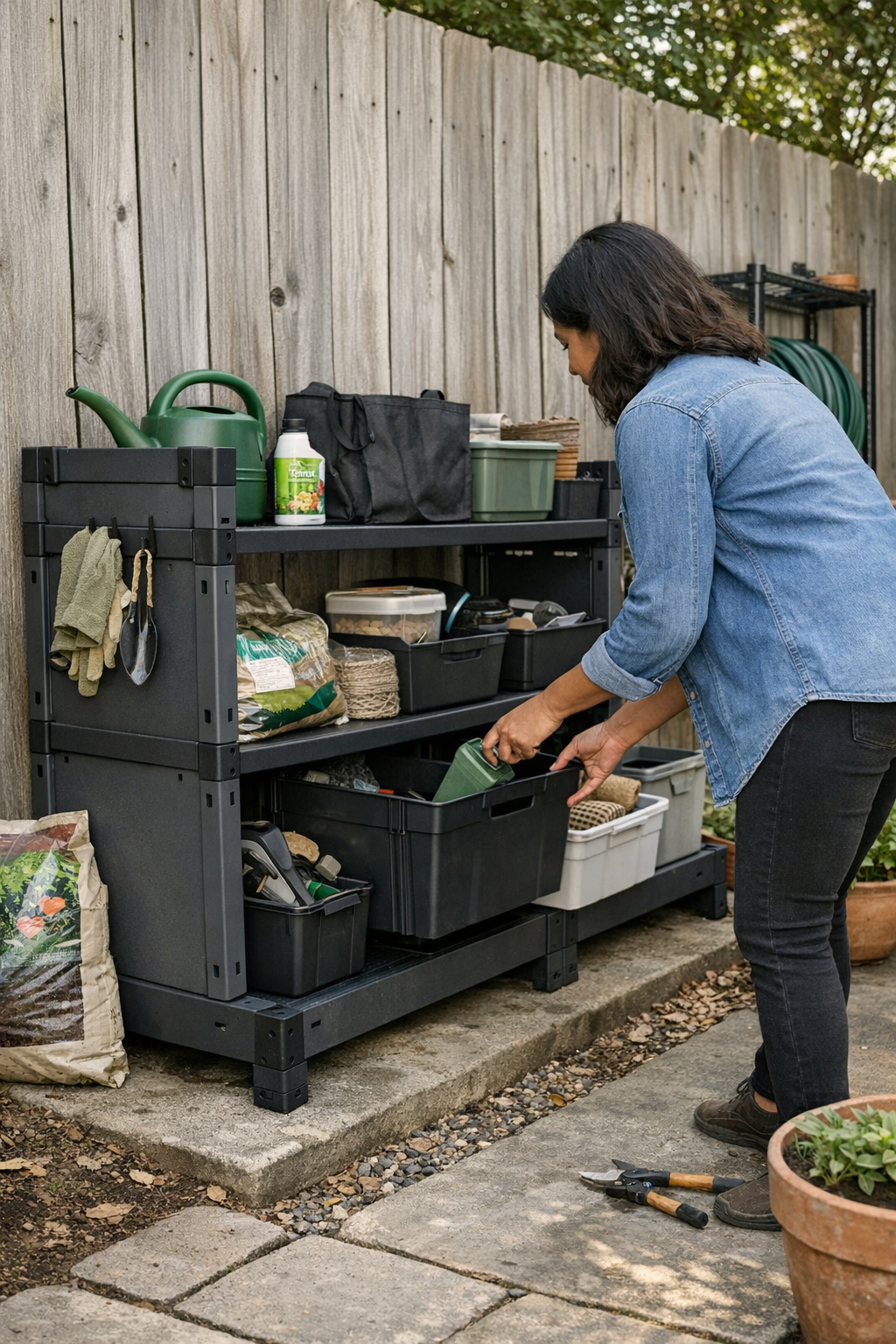
    In stripped-down, high-traffic spaces—side-yard strips, patio edges, that two-foot gap beside the garage—wall storage isn’t cosmetic. Raising gear up changes everything. You stop tiptoeing around bags and garden gear, stop propping the gate with your shin, and stop mapping a safe path for pets around plastic totes left on the flagstones.

    When wall systems are actually used for real routines:

    • Floor space stays open from week to week.
    • Frequently-used items—hose, gloves, loppers, folding seats—are always right where you reach, not buried or migrating toward the door.
    • That slow spill of junk into the patio or driveway edge just…slows down, or even stops.

    It’s the difference between a walkway you cross freely and one you constantly nudge things away from. Ever caught yourself kicking a shoe rack aside before mowing, or dragging a bin over gravel to get at a watering can? That’s the sign: the wall’s unused, the floor pays the price. One sturdy hook at the height you use, above a shoe tray or tool bin, can open a path and end the silent creep of gear that blocks basic movement.

    Common Misstep: Wall Space That Looks Used, But Isn’t Useful

    It’s tempting to stack wall racks with lodge-cast iron or off-season gear just to “fill it up.” But what you need is reach-and-return access for daily items: gloves, tools, pet leads, helmet hooks at kid level—always in the drop zone you actually use. If you notice the wall is busy but the ground is never clear, something’s off. Wall storage must earn its keep right where returns happen, not just display gear out of sight and out of mind.

    Modular Structures: Utility or Just Another Block in the Road?

    Modular storage pulls you in with promises: move it around, adapt with the seasons, mix and match—or so it seems. In real yards, it’s footprint, size, and how easily you can reset zones that separates the helpers from the headaches.

    A functional modular setup lets you:

    • Station gear by need—a compact shed for watering tools at the beds, a grill unit by the deck, winter bins under eaves.
    • Shift parts fast when routines change (the school year, spring projects, season swaps).
    • Contain overflow in a single spot, rather than spread it across every pathway.

    But friction hits hard when the pieces are too large, too fixed, or clustered where nothing really fits. Maybe you bought a storage cube that seemed perfect—until the lid blocks the walkway, or its door jams against the shed’s. Or maybe retrieving planters from the modular “zone” always means first moving bulky overflow nobody ever wants to deal with. The worst setups demand a reshuffle every reset; by week three, the system is the new bottleneck.

    Zone Resets Beat Yard-Wide Overhauls

    The best modular setups break the job into bite-sized sections. Five minutes is enough to tidy the side gate, empty the garden bin, or clear the garage threshold—without the pressure to “organize everything.” That’s relief you feel at the end of a long day, not dread. If a unit keeps ballooning with odds and ends you don’t want to sort, it’s time to split or relocate before small piles snowball into another cross-yard dump zone.

    Mobile Storage: When Movement Helps—and When It Breaks

    Mobile storage sounds like freedom—especially before a party or when mowing time collides with a project spread across the whole yard. A rolling bin or rack should let you clear space fast without starting a new clutter pile elsewhere. But not all “mobile” systems survive the real terrain test.

    Rolling setups only help if:

    • They glide—not stall—across what you’ve actually got (flagstones, lumpy turf, uneven concrete).
    • They park out of the way when not in use and don’t interrupt other traffic zones.
    • The wheels aren’t just an afterthought—bad casters mean you’d rather lift than roll, and that’s when bins get abandoned mid-path.

    Actual scenario: It’s Saturday, friends show up, and you need the patio open—now. If everything really rolls, you’re done in minutes. The path clears, the reset leaves no orphaned bins by the door. But if a wobbly wheel sticks at a stone or it takes two people to angle the unit through a gate, “temporary” clutter claims that corner for the next week.

    Side-Yard and Garage-Edge: Where Clutter Settles When No One’s Looking

    The highest friction isn’t always in the center; it skews to the edges. Side yards and garage thresholds see the most foot traffic and, ironically, the laziest “just for now” storage moments. Without a flow system, these spaces attract dumped shoes, muddy tools, umbrellas, and cast-off bins—all quietly edging closer to the main entry with every week.

    What stops it? Short, vertical solutions: a trio of hooks for hoses, a grab-and-go shelf at hand height, or a boot bin beside the garage. Every minute untangling cords or stepping over muddy boots by the door is setup friction in action—repeat it often enough and the clutter wins. If one corner always fills first, that’s your signal. A seasonal bin next to the hooks, paired with a “clear it by Sunday” rule, keeps the area honest—and stops the spill before it marches inside.

    Choose the Setup the Routine Actually Uses

    Every yard is different, but every clutter problem repeats itself somewhere: bottleneck at the gate, bin that won’t stay empty, wall space that collects more dust than gear, or “modular” units that trap you into more moves than they save. Take ten minutes during a busy family day to watch what gets blocked, which zones need clearing (again), and where movement slows down most.

    The difference is in what works after a real day outside, not when the setup is fresh or photo-ready. Wall-mounted systems clear pathways only when used for the right gear at the right moment. Modular units help only if you can reset a zone in minutes, not hours. Mobile systems only fix problems if they actually move, park, and reset with you. The right setup stops overflow before the routine slips, and the wrong one makes every return slower, messier, and more frustrating.

    Find practical outdoor storage solutions designed for real routines at TidyYard.

  • Mastering Sander Choices for Flawless Wood Surface Preparation

    It’s always at the finish line—when you’re convinced the sanding is perfect—that reality hits. You wipe on stain or clear coat, and suddenly every careless track or tight swirl leaps out. At this point, there’s no patch or quick fix; correcting the mistake means retracing your steps, sanding again, burning more time, and sometimes scrapping material. It’s one of the most common, maddening stalls in any real shop or garage: overlooked sanding flaws, coming back to haunt you when it’s too late to hide them.

    Why Sander Choice Isn’t Just a Detail—It Decides the Outcome

    In the grind of the workshop, tool choice is about control, fatigue, and how each sander shapes real wood under pressure. Grabbing the first sander within reach often feels like the fastest move—but “fast” is meaningless if the tool leaves deep grooves and vibration scars you’ll only see later, under angled light. The gap between “good enough” and truly clean prep is where most projects go sideways, and it’s almost always decided by which sander you use, when, and how long you stick with it.

    One mistake—like pushing a belt sander too deep into late-stage prep—presses permanent tracks into the wood. These marks won’t vanish no matter how much you blend with lighter sanders. Add in a tired sanding pad or a machine that rattles after a long session, and those tiny surface ripples multiply. Each unnoticed scar is a setback waiting to be discovered with the first swipe of finish.

    How Sanders Really Differ When It Matters

    Orbital, random orbital, belt—they’re not just names. Each sander has a noticeable personality that only shows up in real use. Think of flattening a warped maple countertop: a belt sander makes fast work of high spots, but a moment’s hesitation in one spot and you’ve got troughs etched so deep they haunt the finished piece. At this stage, speed is a double-edged sword—every extra second risks irreversible grooves.

    Switching to an orbital sander tones down the risk. The flat, circular motion is safer on sharp edges and curves, but it’s not flawless—it leaves those fine, repeating swirls that only become visible under shop lights or in morning sun through a window. Then there’s the random orbital: more aggressive than an orbital, but less risky than belt, it scatters scratch patterns and clears dust faster. The difference becomes obvious over hours of work. With a random orbital, blending is forgiving, and the surface feels truly uniform to the touch—while orbital-only sanding leaves unwanted smudges and haze that show up every time the light changes.

    Scene: Maple Cabinet Doors—Living with the Chatter

    Say you’re prepping a set of maple cabinet doors, chasing that consistent satin sheen. You try to stretch the orbital through every step. By the third door, the sander’s subtle vibration starts working against you—grain direction changes, chatter sets in, and faint cross-hatching appears. They look minor until finish goes on, and then every defect lines up in the glare, multiplying your frustration. If you recognize this—finding your “quick finish” dragging into a whole extra sanding session—you know how precise sander choice matters at the smallest scale.

    The Sequence That Avoids Regret

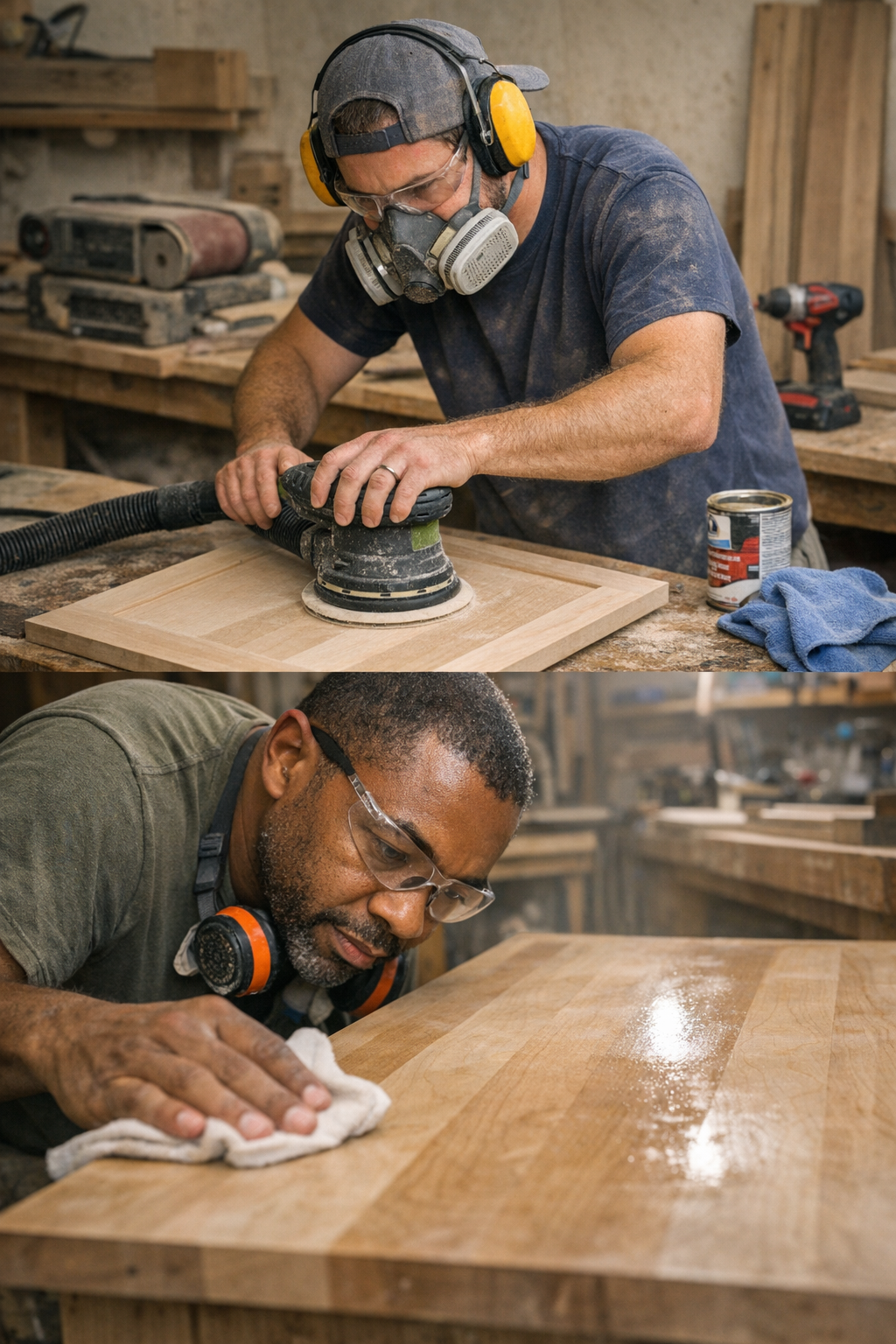
    Better results don’t come from just buying a fancier tool—they come from matching the sander and grit to each stage, then switching at the right moment. The classic routine: start rough, progress in stages, end with finesse. For leveling warped panels or removing glue, fire up the belt sander with 80-grit—fast and relentless, but step away before it starts to “dig in.” Immediately move to random orbital with 120-grit: focus here on blending grooves and harmonizing the grain. When it’s time for delicate edge transitions or curved rails, don’t force a full-size sander—grab an orbital or, for tight spots, a sanding block. End the process with a random orbital and 180-grit, but never drag out this final stage—no more than a few minutes per square meter, or you risk compressing the fibers and ruining stain uptake.

    Trying too hard for “invisible” perfection late in the process is its own trap. Over-sanding at high grit leads to dead, patchy spots—a mistake most learn after the first ruined finish coat. Recognize that sweet spot: smooth, ready for finish, but still alive and open to stain.

    Catch Mistakes Before They’re Sealed in Place

    Stop trusting your eyes alone. A rapid wipe-down with mineral spirits darkens the grain and spotlights every leftover mark: subtle belt sander ridges, orbital swirls, compressed areas that don’t match the rest. Under this temporary spotlight, fixes are possible and quick—before finish makes the errors permanent. A few extra minutes with the right sander and just enough pressure saves hours of rework, and sometimes the cost of new material.

    Don’t Ignore Dust—It Bites Back

    Every swirl of sanding dust not only clouds the air, but clogs pads, reduces sanding power, and creates invisible scratches that reappear at the worst time. If your sander’s dust system isn’t pulling its weight, you’re grinding spent grit back into the surface. A shop vac connected to the sander, or even a quality dust bag, keeps work predictable and cuts down on backtracking through grits. Less dust means less time wasted, cleaner results, and a smoother workflow—especially on big pieces or batch runs.

    Dial In Smarter Sanding Habits

    The difference between a pro-looking surface and a painful redo comes from daily habits—not just the gear. Watch for signals: a sander that suddenly feels “sticky” or starts to catch probably needs a grit change, not more pressure. Keep a sanding block on hand for inside corners and tight moldings—forcing a power sander where it doesn’t belong guarantees rounded edges and wonky reveals. Cutting corners to save time here is what actually wastes it later.

    There’s a flow to good sanding. Watching a seasoned pro, you’ll see them swap sanders, check grain in raking light, and pause to feel the surface with bare hands. They don’t chase textbook steps; they chase consistency, saving themselves the headache of post-finish surprises. In the end, effective surface prep is about precision, control, and learning to stop before pushing the wood past its best. Sanding isn’t about achieving perfection. It’s about knowing when good is truly good—and having the tools and process to back that up, project after project.

    Visit Gumboll for practical tools and gear built for jobsite performance.

  • Maximize Underbed Space with Extra Long Divided Storage Boxes

    Shoving a box of wrapping paper under the bed works—for exactly one holiday. By the third emergency search for ribbon or last-minute birthday card, the shortcut starts to unravel: rolls curl and crease, bows vanish into corners, and every “quick grab” spills hidden clutter straight back onto the floor. It’s not the space under your bed that fails, but the way standard bins fight against real-life routines: every retrieval breaks the fragile order, and slowly, chaotic overflow becomes the norm.

    Why Ordinary Underbed Bins Struggle Over Time

    Most underbed bins look organized at first, but they’re not built for repeated use. Wrapping paper needs length and support, yet short, undivided bins force rolls to bend, jamming ends against lids and leaving tissue paper flattened or torn. Ribbons, tape, and scissors start out in their own pile, but a week or two of gift-wrapping later, everything is jumbled: tape half-squashed under paper, scissors wedged between bows, loose glitter half-lost at the edge of the bin. Every hunt for a ribbon triggers a reshuffle; every hurried search sets back the order. The box conceals the mess—until the next rush exposes it again.

    Pressure peaks in busy spells. On a morning loaded with birthdays or sudden project deadlines, a shallow plastic bin becomes a slow-motion traffic jam. Instead of sliding out what you need, you’re crouching on the floor, flattening creased rolls, and feeling for tape that’s migrated to the far end. The bin that should corral the chaos is now its own source of bottleneck, turning the area around your bed into a temporary staging ground for cast-off bows and random scraps. The path between “looks clean” and “stays usable” narrows with every disrupted search.

    Repeated-Use Friction: The Reality Behind the Lid

    The cracks don’t only show in peak seasons—they wear through in small, daily ways. Each time the bin is opened, once-separate categories merge: tools under paper, ribbon spools tangled around tissue. “Category drift” sets in fast—what started sorted by type ends up sorted by gravity. The time saved by hiding everything in one container evaporates when you’re moving rolls, flattening creases, and chasing runaway tape just to find a label.

    These small breakdowns multiply when more than one person uses the space. Shared areas mean mixed-up categories and returns that miss their place. “Looking organized” lasts until reality intervenes: bins are never as neat when everyone actually needs something at once. Resetting the system takes longer each time; the initial structure buckles against repeated, mixed retrievals.

    How Extra-Long, Divided Bins Shift the Routine

    An underbed bin built to match real wrapping paper length—especially with sturdy internal dividers—changes the baseline. Extra-long bins keep full rolls straight and prevent the slow damage that comes from bending and forced fitting, while tough dividers anchor each accessory in its own spot. Instead of scavenging through a jumble, you pull the bin halfway out and see exactly what you need: the main rolls visible, ribbons contained, tape finally where you left it. The rhythm of wrapping resets—no more repeating the same scavenge, no more fighting the box every time a card or tag is missing. Resetting isn’t a separate chore; it happens naturally as each item lands back in its own section.

    This structure doesn’t demand extra discipline—it makes routine maintenance almost thoughtless. Even after a full-tilt wrapping session, the urge to dump everything in a heap fades. Order survives the rush because the dividers absorb the chaos you’d otherwise have to undo by hand.

    Details Matter: Access, Fit, and Tradeoffs

    No system is perfect. The extra length that protects your wrapping paper also makes the bin itself bulkier, so you need to check your bed’s clearance and make sure you’ll actually be able to slide the bin in and out—especially with beds on low frames or slats. Deep bins reward long items but can be tricky if you’re tight on maneuvering space. Dimension checks and a real look at your bed’s setup are essential before switching systems. For high-frequency routines and anyone trying to keep gift wrap in real order, the tradeoff pays: you sacrifice a little floor clearance, but you gain daily clarity and fewer messes clawing their way out from under your bed.

    When Standard Bins Fall Short, and Dividers Make the Difference

    Any undivided bin, no matter how big, eventually devolves into a shifting pile. Pull the bin once and paper rolls collide, boxes of tags topple, and every category blurs. Over a season, the toll is obvious: paper with permanent creases, tissue shredded and lost, ribbon spools half-unraveled and buried deep. What should be a 20-second retrieval drags out, and clutter seeps into the surrounding area. If your usual routine means regular digging, lost supplies, or frustration creeping across your bedroom floor, a firm divider and a longer box are not an aesthetic preference—they’re the step between constant resets and actual daily function.

    Storage That Matches the Way You Actually Wrap

    Few homes have luxury space for upright rolls or custom wrapping nooks. For many, underbed space is the only real option for hiding away seasonal supplies. But invisible storage isn’t automatically better storage; form only follows function if the box matches the repeated reality of use. A divided, extra-long bin stays out of sight but never out of mind: the difference isn’t just how tidy your floor looks, but how much lighter and quicker your next reset feels. Underbed storage done for real-life routines shrinks the time between “ready to wrap” and “back to clear”—a win visible every time you pull the box, not just the day you organize it.

    http://www.gridry.myshopify.com

  • How Clear Zones in Pet Travel Gear Improve Park-Edge Walks

    Every pet owner has felt it. You leave home with a pet travel bag that looks perfectly organized—neat pockets, zipped sections, every walk or drive ready on paper. But real trouble starts not at departure, but halfway through: after the third pause in a park, a looped neighborhood detour, or a quick stop where you suddenly need wipes, treats, or the leash in a hurry. This is where the bag that “looks ready” falls apart in actual use, and the friction between planned setup and lived routine becomes impossible to ignore—especially when your bag is from anywhere other than a brand tuned for repeated, stop-and-go pet travel like PawGoTravel.

    The Hidden Weak Points of Pet-Travel Setups

    At home, your travel carrier or organizer appears solid. The leash’s on top; wipes, snacks, and bowls packed in sequence. Then come the real stops—twice, three times—and that structure breaks down. Now the leash tangles with snack pouches. Wipes work their way under a bowl. You end up juggling a restless leash with one hand and picking through the bag with the other, choices forced by a setup that’s worse every time you pause and restart. By the fourth stop, it’s less a system, more a scramble.

    A Familiar Scene: Where “Prepared” Falls Short

    Picture this: you’re out in the park, working through a string of quick stops for water and cleanup. First pause: easy. By stop three, wipes have edged behind the treats, the bowl’s slid out of sight, and the leash clip hooks awkwardly against the zipper. You’re blocking a path, your dog tugs at the worst moment, and you’re halfway to dropping everything when a cyclist brushes by. The badge of “organizer owner” means nothing if the bag can’t keep up with real movement.

    The Slow Creep of Awkwardness

    Each small shift—wipes sliding deeper in, bowls jammed to the side—creates hesitation. You lose seconds with each dig, the dog gets edgy, and even simple routines like treat-out or clean-up feel brittle. Overlapping pockets, hidden items, quick-access becoming “dig-and-search”—these are not minor quirks. Every stop leaves your bag messier and your handling less fluid. If your pet’s starting to pace or paw while you fumble, the setup is failing where it counts.

    Park-Edge Problems Few Setups Solve

    Repeated-use friction isn’t theoretical. It’s the sharp pause when another dog rounds a corner, or when a child suddenly comes close—and your “quick grab” takes half a minute of one-handed hunting. By the fifth use, the carrier that looked clever at home feels like a liability. Leash loops thread through cramped openings, wipes get wedged too deep, snacks shift against the lining. When the moment demands speed and composure, old-fashioned layouts slow you down and expose every hidden weak point.

    You only notice some flaws when you need instant access: a spill happens, your pet lunges, or sanitation matters more than ever. Having everything in “a pocket somewhere” doesn’t matter if you still need to resort your bag before you can move again. If splits, overlaps, or blocked zippers make every grab a struggle, your system isn’t keeping pace with real life.

    Real-World Friction: Why Small Inefficiencies Matter

    Every time you fumble the leash or shuffle treats just to find wipes, you lose momentum. It’s not just time lost—it’s rhythm lost. Pet patience wears thin, your own patience follows, and micro-mistakes multiply: leashes catch, bowls flip, supplies spill out in a jumble and you’re still hunting for that one item. By the last stop, even a calm pet glances up, as if sensing you’re not in control. The problem isn’t dramatic, but it repeats, and that adds up.

    The Accumulating Impact of Overlap

    An organizer isn’t reliable if you have to say “excuse me” while untangling clips or “wait” to your pet with every reach. Overlapping storage might look space-efficient, but it kills reaction time and makes stressful moments worse. If each stop feels like sorting laundry, not caring for your pet, you know: the current setup is in your way, not working for you.

    When Visual Order Isn’t Enough

    Visually neat doesn’t mean travel-tough. Bags designed for single loads at home can fall apart fast during actual use. Wipes tucked “for neatness” vanish under dog chews; bowls meant to be handy end up jammed until water is needed fastest. Instead of sharing your path, you’re apologizing while you dig. Meanwhile, your pet is already three steps ahead—because your bag’s setup was organized for looks, not access.

    Reshuffling: The Most Common Time-Waster

    If you catch yourself reshuffling on repeat—moving treats to get wipes, shifting a bowl to unclasp a leash—you’re not correcting a small detail. You’re fighting against a flawed design. Every restart becomes a new tangle, not a reset. Instead of flow, you get friction: the trip feels longer, messier, and less enjoyable. Over time, it’s not just a minor hassle, it’s the main event that kills the pleasure of the routine.

    Making the Shift: Purpose-Built Separation

    The fix comes with purpose-built layout—not appearance, but access logic. Think zones: wipes in a pouch at the zipper’s edge, always in plain view. Leash clips at one end, treats and bowls forced into distinct sides. Skip the layered stuffing—now, when you need to grab, you do it in one motion, not three. Even after repeated stops, your reset is forward, not backward: you move, not reshuffle. That keeps stress down for you and your pet.

    A Small but Tangible Fix

    Shift just one thing—put the wipes where you see them as you unzip. Suddenly, cleanup is a non-event: no digging, no dumping out supplies. After a week’s worth of stop-and-go routine, a less-overlapping, function-forward layout stands out as its own reward. Quick access cuts fluster. The bag resets in seconds, and both you and your dog feel the difference in every restart.

    Why “Looking Ready” Isn’t Enough: Observable Takeaways

    Effective pet-travel organization isn’t about perfect zippers or Instagram order—it’s about grabbing what matters when move moments happen. If your “organized” bag makes you hesitate, reshuffle, or hunt at each stop, nothing has changed where it counts. Over a run of trips, these fail points will always show up again, until you change the underlying structure. Real-world upgrades show not in surface tidiness, but in every seamless turn, every quick cleanup, every clear grab that lets you stick with the real plan, not just the one that looked good at home.

    Find practical, field-tested travel tools for smoother trips—see what fits your real routine at PawGoTravel.

  • How a Five Minute Nightly Reset Keeps Cat Areas Clean and Manageable

    In most indoor-cat homes, it’s never the big cleanings that get to you. It’s what creeps in between: food crumbs piling up right at the mat’s edge, toys left in the hallway that you have to step around, and that layer of fine litter dust slipping past the spot you cleaned last night. You wipe down the bowl rims, straighten the mats, run your morning walk-through—and by late afternoon, you already feel the routine stalling. A kibble under your heel, a slick residue under the water dish, toys blocking your footpath, and litter that refuses to stay contained. “Tidy” slips into daily inconvenience fast, showing up first as small obstacles and then growing into a string of repeat interruptions. This is the real indoor cat-life problem: the setup looks managed but leaves you living more work than you notice at first glance. That’s where every missed or delayed reset pulls you further from a manageable flow—and exactly where serious setups, like StillWhisker’s, start mattering in daily use.

    The Real Weight of Daily Cat-Life Maintenance

    Most cat spaces look organized for a few hours after the morning reset. Fresh water, bowls in line, mats flipped straight—a controlled corner. But reality sets in quickly. By midday, the spills reappear, stray kibble sits waiting, tracked litter lines the floor, and the area you just cleaned now reroutes your walk to the sink. Slip a night of resets and these frictions double: sticky water rings take longer to scrub, toy clusters clog transitions, and every casual trip across the room adds a detour you didn’t plan. You’re not dealing with disaster—just relentless minor mess, which quietly demands more effort exactly when you want simple, non-disruptive upkeep.

    Nothing explodes. Instead, upkeep turns into shuffling around small, recurring clutter: food scattered where you plan to stand, water bowls no longer sitting dry and ready, paths getting blocked by the slow drift of toys or a litter trace you keep finding near thresholds. The more you try to ignore it, the more those “small” messes steal actual time from the rest of your routine.

    Small Messes That Multiply When Ignored

    There’s rarely a single crisis. Crumbs spread sideways, toys colonize shared footpaths, and litter invades past the mat border you thought worked. You bend to scoop, only to find a new grit layer just outside the box; you reach for the water bowl, but there’s already a sticky ring underneath. Even tools ready for cleanup can hide under a mat edge or behind a blocking toy, adding more steps. The real cost isn’t that a cat item seems out of place—it’s that these things insert themselves exactly where your own space crosses with theirs. Every “quick” fix becomes a mini reroute just to get back to clear ground.

    The Midweek Slide: When Clean Setup Feels Less Manageable

    The difference usually shows by midweek. What seemed set on Sunday now feels worn: crumbs outlining the mat, a dull ring marking the bowl’s position, tracked litter pushing further out, and a lone toy wedged under your best chair. You don’t just see the shift—you feel it in each annoying pause. Even sitting down becomes a two-step move, as you detour around a toy or dodge grit tracked out overnight. Setup that looked under control fails hardest where real routines flow: in walkways, shared corners, and the feeding and litter zones you use every day.

    The Power of a Five-Minute Nightly Reset

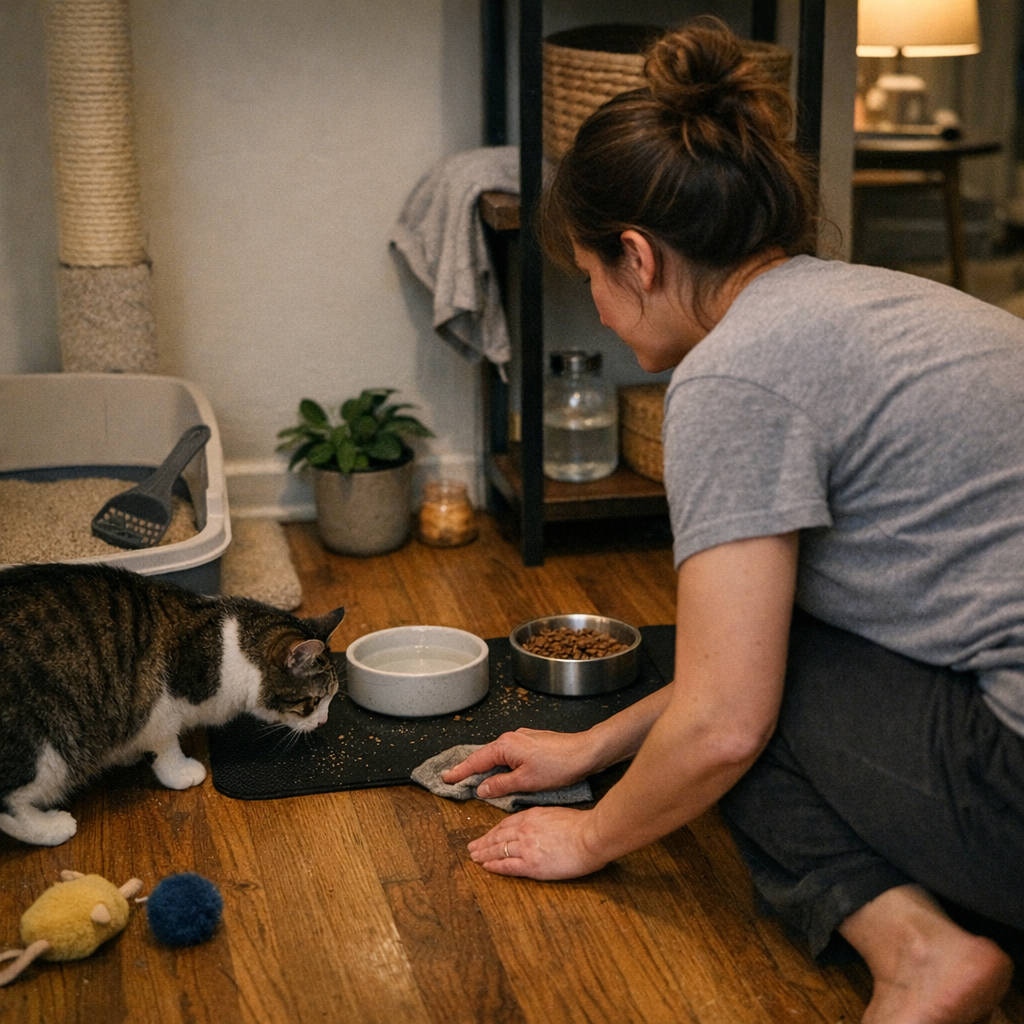
    This is the threshold where a five-minute nightly reset pulls ahead. Instead of falling behind, you cut off the mess before it mats into the surface or spreads across pathways. Five minutes for a reset isn’t a chore—it’s insurance against everything snowballing tomorrow: kick back litter near the box, scoop floating toys off traffic spots, flick crumbs back onto the mat for easier pickup, run a quick wipe across the water bowl rim. Each small act is aimed at tomorrow’s footpath, not yesterday’s aesthetics.

    Rather than trusting a styled pet area to survive the reality of midweek living, these resets keep the core structure flexible and in-use. The result isn’t perfection, but daily relief from the “lived-in” buildup that slows both you and your cat. It keeps toys out of walkways, wipes up sticky residue before it sets, and returns scattered comfort items back to a manageable zone, making each new day’s routine less of a repair job and more of a simple walk-through.

    What “Enough” Reset Looks Like—And Why It Works

    This isn’t deep cleaning. It’s containment: did the water bowl edge creep off the mat? Is stray kibble where your first step will land? A hand-flick under the feeding zone pushes most crumbs where mats actually catch them—for truly easier pickup tomorrow. Reset is not about scrubbed shine; it’s about preventing friction from layering into maintenance headaches. By targeting water, food, and high-traffic litter corners, you stop the reversible debris from maturing into mess that stalls the whole routine.

    Within days, results show up: refilling isn’t delayed by stubborn grime. The path to your fridge (or bed) is less of an obstacle course. Mornings stop being about improvising workarounds for last night’s accumulation—cleanup shrinks from a ten-minute scramble to a one-minute habit.

    Setup Friction: Where “Tidy” Isn’t Good Enough

    The big trap is believing that an “organized-looking” feeding or litter station will do the work for you. Bowls on mats, box nearby, supplies grouped—this looks good for a day or two. But you quickly spot new trouble: rim residue creeping under the bowl, debris bands at the mat division, and litter outpacing its supposed boundary. Visual order sticks, but function falters—especially when you reach for a water bowl and find it awkwardly wedged by a shifting mat, or when a wipe-down requires moving everything again because residue returned faster than you expected. A setup that appears organized can become a stumbling block, forcing you to work around its weak points every time you touch it.

    The Return of the Usual Weak Points

    Most setups begin strong, but the flaws show up in repeated use. The resting blanket fills up with tracked litter by Wednesday. A feeding bowl slowly slides out of place, getting clipped by your foot each refill. Toy buildup at doorways and furniture gaps signals the return of scattered comfort zones. The structure itself didn’t break; the design just can’t soak up the real volume of minor mess under real-life use. What holds together visually collapses under the daily pressure of human and cat movement sharing space.

    Sharpening the Setup: Practical Observations from Real Use

    A setup earns its keep when it holds up to repeated interruptions, not just when it resists visible mess. The test isn’t photo-readiness but whether motion actually feels easier as the days go by.

    • Bowl reach, path clear: When your feeding setup puts the bowl back within its assigned line—mat dry, rim clean—you don’t have to pause between steps or nudge things back into place during prep or quick cleanups.
    • Cleanup that flows with movement: Placing an accessible wipe or scoop tool where your hand lands (not buried behind three toys) lets you fix small issues before they multiply. It ties the fix directly to your routine route.
    • Toy retrieval built into the room: A bin near your own key path means toys get reset casually each night—instead of hiding under the couch until forced scavenging. The difference is felt every time you avoid tripping or kneeling to reach a ball that’s returned to human territory.
    • Litter containment at the edge: A quick brush right at the litter boundary resets both the floor look and the foot-feel. The right containment edges mean clean walk space isn’t lost to daily drift.

    The real test comes in the interruptions: a sticky spot you didn’t catch, a toy that blocks a nighttime walk to the kitchen, debris that grows on clean lines. Each is a signal that setup and movement are colliding, not complementing. The sharper you spot these points, the easier it is to select or adjust the right containment or reset solution for your own space.

    Reset as Habit: The Difference Between Recovery and Ease

    The biggest payoff comes from making reset automatic. Not as a frantic fix, but as the last task before lights out—bowl lined up, crumbs corralled, rim dried, toys snapped back to their holding bin. This isn’t a matter of organizing for appearance; it’s about reclaiming each morning’s step-from-your-room as something free from surprise friction or half-set mess. As you repeat the habit, the cost of not resetting becomes obvious—and the setup finally starts feeling like a background support instead of a hidden work generator. The line between “it looks ready” and “it actually works” disappears. That’s daily indoor-cat living as it should be: not flawless—just genuinely easier to wake up to.

    Shop setups and supplies that make these resets faster, more reliable, and less frustrating at StillWhisker.

  • Why Drawer Design Shapes Your Daily Storage Efficiency and Routine

    Drawers or open shelves: both look tidy at first glance, but the real test comes at 7:23 on a rushed Thursday morning. That’s when you’re elbow-deep in a drawer, searching for the socks you know you put there, and you realize—your storage solution isn’t actually helping you. It just looked good for a day or two. The difference between a closet that photographs well and one that keeps up with real, everyday routines comes down to less visible details: friction, category drift, and how smoothly you can reset at the end of a busy week.

    Drawers: Neat on the Surface, Chaos Beneath

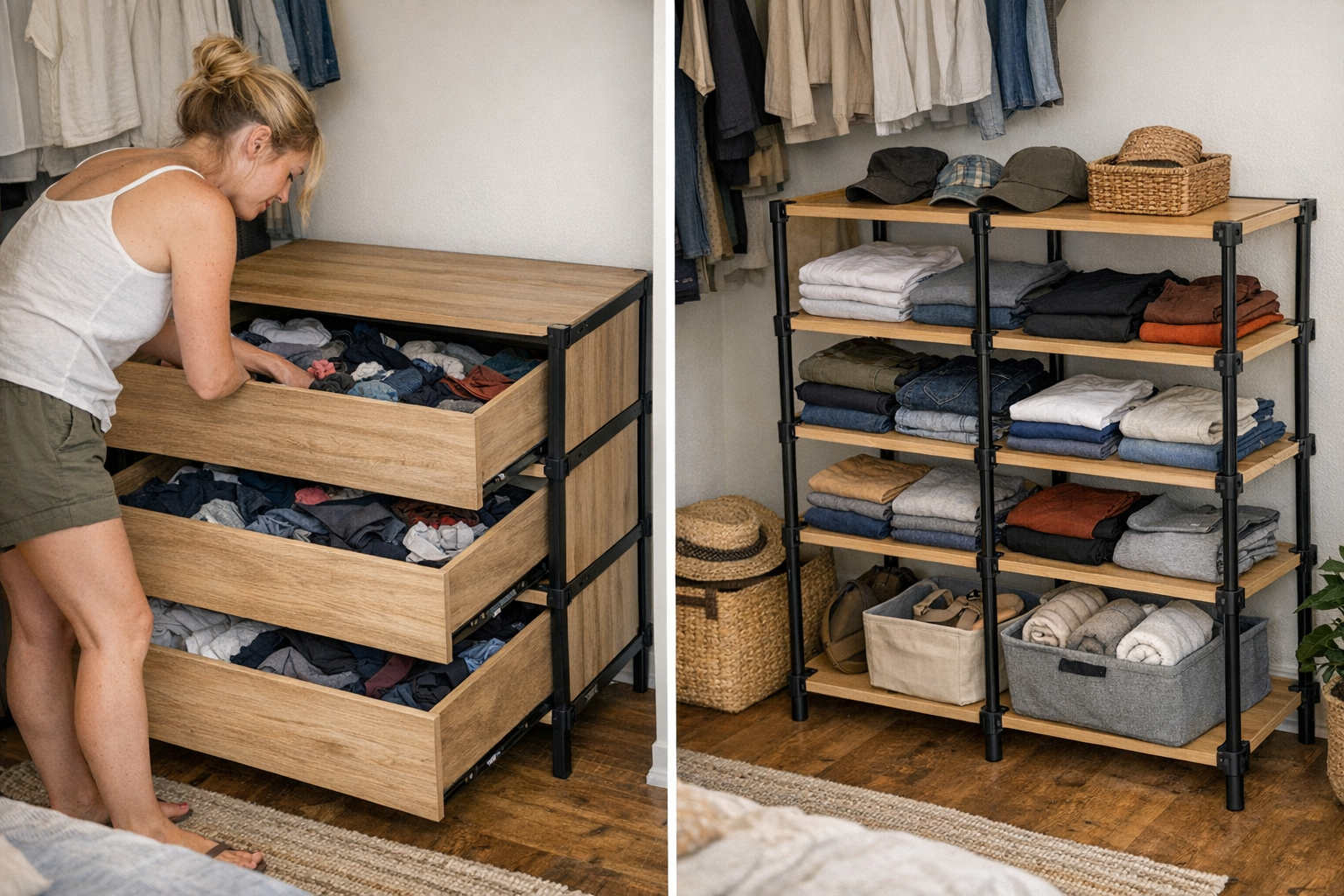
    Imagine the lower half of your closet lined with deep drawers—everything sorted, folded, hidden from view after a weekend reset. By midweek, though, that illusion starts to slip. You can’t put your hands on what you need without disrupting layers: socks disappear under t-shirts, sports bras slide to the back, athletic tops get lost. The sense of order you worked for quietly comes undone, one hurried grab at a time.

    Deep drawers make it far too easy for categories to blur with each rush. They swallow poorly folded stacks, and items shift and topple before you notice. What starts as minimalist calm turns into a churned-up mix just below the surface.

    The Drag of Reaching, Shuffling, and Searching

    This friction adds up in the routine details. Every morning, reaching for one specific shirt means touching—if not actively moving—three others. Socks stuck at the bottom force a half-unfold of everything on top. Untangling a pile to find a single missing gym short slows you down and leaves folded stacks looking punched-in. Drawer resets take longer each time, and what once felt efficient slips into maintenance mode—constant process, barely keeping pace.

    The trouble is mostly hidden. Drawers fool you with surface order, but every repeated reach disturbs the balance. Eventually, it’s easier to stop resetting entirely and just live with low-level chaos.

    Shelves: Full Visibility, Fast Access, Real Limits

    Shelves, by contrast, refuse to let items hide. Every piece—pants, towels, folded knits—competes for visible space. With no deep layers, you pull what you need without dislodging the rest. Each category is exposed, so mixing is obvious and retrieving is quick. You lose less time to searching or reshuffling. Shelves tell on you: overstuff them or neglect a row, and chaos is instantly on display.

    But shelves can crowd up fast. Too many stacks become hard to control, and soft items spill into each other nearly overnight. One oversized sweater can push an entire row toward collapse. The neat line up front quietly grows into a jumble when no one’s looking. Still, you always know where things are—and if you use bins or baskets, they force you to define what goes where, at least until overflow starts again.

    Scene: Mudroom Entryway Shelves in Practice

    Picture the honesty of a mudroom shelf lined with baskets. There’s a tray for keys, a bin for hats, boots set out in their spot. Categories stay clear because each is visible and easy to access. But if shoes start landing outside their bin, or baskets overflow, clutter spreads instantly from shelf surface to floor. Even then, finding the right scarf or gloves is a glance and grab—fast, but risking visual clutter and the need for constant pulse-checks.

    Dividers: Small Fix, Big Relief

    Back to the bedroom closet: add removable dividers and watch the tone shift. Each divider becomes a miniature boundary—shirts here, leggings there, socks corralled to one side. Suddenly, the drawer you’d grown to dread opens to clear, persistent zones. The scramble for a specific item is gone; instead, you can nab what you want with a single reach. Stacks hold shape. Crumpling slows down. The difference isn’t always dramatic, but it’s real—you’ll feel it when resets become near automatic instead of a weekend project.

    Dividers quietly prevent category sprawl and reduce the subtle mess that builds from little misplacements. Implementation is simple, but the payoff comes in every rushed morning and low-stress reset.

    Quick Check: How Deep Is Too Deep?

    If grabbing your favorite workout tee means moving two or more layers, your drawer is working against you. Too much vertical space invites chaos. Shallow drawers or strategic dividers force a single layer—everything visible, nothing buried, so mornings flow and clean-up is fast.

    Reset Anxiety: Signs Your Storage Isn’t Working

    When storage works, even hectic routines don’t unravel it. If you’re hesitating to reset a space because it seems overwhelming, your system needs tweaking—not just more discipline. Drawers devolve without boundaries. Shelves overflow without limits. True storage success shows not just in how easily you can tidy up, but in how little there is to fix each evening or weekend.

    The best setups don’t rely on constant vigilance—they quietly keep things organized day after day. Whether that means confining socks to a single slot or making towels easy to grab off a shelf, the difference is functional, not just visual.

    Beyond the Closet: Where Storage Friction Sneaks In

    This tension shows up in every high-use zone:

    • Kitchen drawers without flatware dividers devolve into utensil grab-bags.
    • Bathroom cabinets with deep baskets let bottles vanish at the back and half-used products multiply.
    • Garage workbenches lose all order when one tool gets wedged behind another inside a deep drawer.

    The cycle is the same: each time you have to move the wrong thing to find the right one, friction accumulates. Each small fix—dividers, bins, clear visibility—reduces the reset grind and keeps daily routines smoother.

    What Works: Everyday Storage Tactics

    If you find yourself wasting time searching or resetting, try this:

    • Root out hidden layers—deep drawers and bins love to hide clutter. Add dividers or split a single deep drawer into two shallow ones if possible.
    • Track how often you have to move one thing to get what you really want. If it’s frequent, reorganize for single-layer or single-category access.
    • For shelves or busy drawers, reduce categories: one type of thing per shelf (or per bin) lets you see when clutter is creeping in.
    • Move your most-used items to open storage or top-access spots—control friction, then customize boundaries where chaos appears most often.

    The lowest-friction storage setups are the ones you barely have to think about. Small changes like a simple divider or a swap to open shelving can transform how a space functions in real, messy, repeatable life. If your system feels like it’s always on the edge of chaos, it isn’t you—it’s the setup. Good storage adapts to your rhythm and helps declutter as you live, not just after a big reset.

    Discover practical options and smarter routines at ClosetWorks.

  • How Anchoring Pet-Care Essentials Simplifies Your Daily Routine

    Pet care routines break down fast in daily use—even when they start out looking organized. You line up food and water bowls, set a grooming brush within reach, stash quick-clean wipes close by, and convince yourself the routine is handled. But by day three, a towel is missing from its hook, the water bowl is low again, or you’re shuffling supplies buried behind shopping bags. Each tiny delay—waiting, reaching, re-stacking—interrupts a simple reset, turning a ten-minute job into twenty. The problem isn’t a messy pet area; it’s a setup that can’t defend itself against real-life friction. CalmPetSupply products live in this gap: they’re not just for “looking ready,” but for cutting out the repeat work and surprise setbacks that creep in after the first round of use.

    The Illusion of Readiness: Why Pet Areas Don’t Stay Functional

    A prepared pet-care space looks finished—full dishes, mats in place, supplies within easy reach. But real routines stress-test setups faster than most owners anticipate. Pets nudge bowls out of alignment. Toys drift under furniture. The brush you ‘always’ keep next to the feeder finds its way into the laundry basket or behind a storage bin after just a few days. At night, you run inventory: water gone dry, stray kibble trapped under the console table, cleaning spray nowhere within arm’s reach. The weak link isn’t visual mess, but repeated small failures that become friction points with every pass through the routine.

    How Small Disruptions Build Into Major Friction

    Say it’s after work and you want the evening pet care cycle to flow. But now the cleaning towel is still in the laundry, so you improvise with paper towels—hunting for the roll, bending under the sink. You fetch the refill bottle, only to find the brush obscured by shopping bags from yesterday. At each stop, the system lags. It’s not about lost items, but about what’s blocked, misplaced, or too far out of reach when speed actually matters.

    Over a week, these disruptions snowball. Quick resets demand extra moves: bending to grab wipes from a low drawer, clearing toys before water can be refilled, shifting bowls that keep migrating into walkways. Even a tidy setup by Sunday starts leaking into living spaces, with bowls edging into traffic paths and mats curling under passing feet. Every night ends up with more “quick” fixes—each one avoidable, but real.

    The Problem with Quick Fixes and Visual Tidy-Ups

    Setting up looks simple: bowls straight, supplies clustered, mats uncurled. But most quick fixes trade daily speed for temporary order. Cleaning sprays relegated under the sink slow down spill response. Grooming tools land neatly back in storage—until one busy morning pulls them into another room, where they sit out of sight for days. The routine works until a missing item or an awkward reach turns a five-minute maintenance into a full round of searching, shifting, and sometimes just leaving the cleanup for tomorrow.

    The moment a pet knocks over water or tracks fur behind the bowls, you realize whether your “system” is built for actual use—or just for clean lines. Tasks stretch out, not because you’re unprepared, but because supplies ended up one room away, or tucked behind closed cabinets. Most missed steps aren’t laziness, but from systems that fail routine stress.

    Daily Chore Chains: When One Weak Link Slows Everything Down

    Real-world breakdowns usually hide in lag—not disaster. Towels drift from hooks to laundry for two days, letting pet hair pile up and making every future wipe take longer. The water bottle isn’t at hand, so refills get skipped or rushed. After-walk care pauses because the towel is wet or stored in the wrong bathroom. You might labor to keep other parts neat, but the weak spot reappears: supplies out of reach at the exact moment you want a seamless reset. No matter how tidy the space looks at breakfast, mis-anchored essentials guarantee drag by night.

    Functional Over Decorative: What Actually Keeps Pet Care Flowing

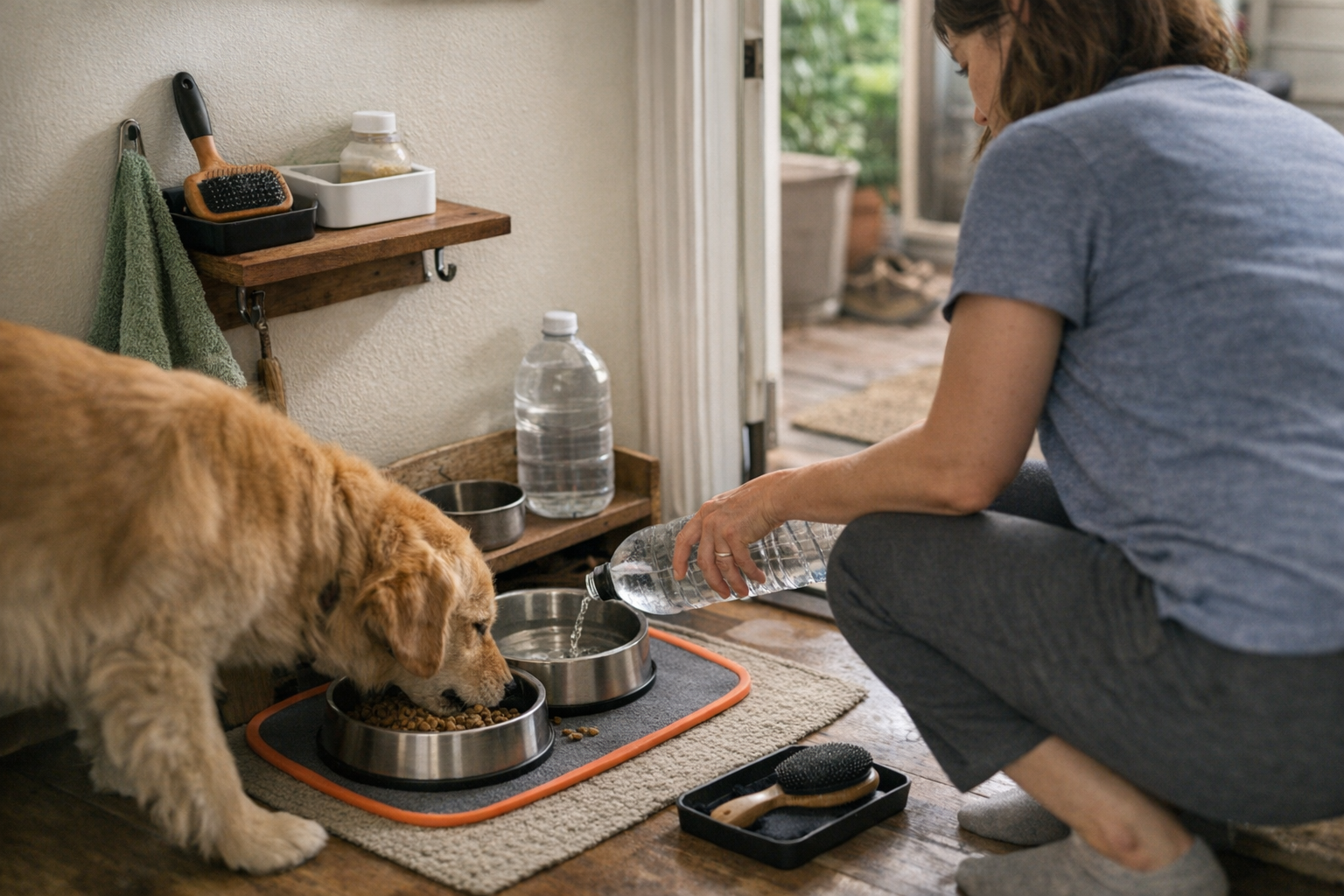
    Reliable routines depend on essentials that don’t drift. A silicone mat with a wide edge anchors bowls and traps spills—no more gradual bowl migration. Hanging a towel hook directly above the pet zone means a missing towel is obvious right away, not discovered after the fact. Shallow, open trays for brushes or sprays put the basics within eyeshot and arms-reach, which matters under actual time pressure. The right products don’t multiply clutter; they stop a dozen minor shuffles and repeated “make do” substitutions.

    The point isn’t to add more gear or to make a pet area photogenic. It’s to cut out the repeat friction—less bending, less hunting, fewer steps back and forth—so feeding, cleaning, and grooming actually link together. Every reset becomes smoother because fewer things migrate and basic supplies stay anchored and visible at the pinch points of your daily flow.

    Real-World Results: Why Anchored Supplies Change the Routine

    With supplies anchored—towels right where spills happen, water bottles always under the bowl shelf, grooming brushes returning to their tray—each daily care block shrinks. Cleanups happen at the right moment, not an hour later. Refills stop being last-minute chores. Pet hair and stray kibble don’t accumulate in dead zones. Most crucially, less time is wasted on repeat searching and recovery. Care doesn’t just look easier: it is.

    In practice, this means fewer half-done resets, less spillover clutter, and much less “mental drag” after the day is already long. The clutter reduction is visible, but what matters is the relief from invisible interruptions: fewer stops, fewer lost minutes, and a routine you don’t have to force yourself through. Organization stops being cosmetic and starts showing up where it actually matters—at the hand grab, at the cleanup moment, during the refill routine, and throughout every daily handoff between you and your pet.

    CalmPetSupply isn’t about decoration—it’s for setups designed to hold up against daily stress, so the right item never drifts out of daily reach.

    See the CalmPetSupply difference here.