Author: jaesoon_admin

  • Why Your Carry-On Setup Slows You Down During Travel Routines

    Most travelers realize too late that an organized-looking carry-on can still drag you down once you hit real airport movement. That tidy setup—pouches lined up, color-matched pockets, every charger wound and zipped—holds just long enough for one round of security or boarding. As soon as you’re juggling trays at TSA, digging for a passport while someone breathes down your neck, or trying to find a card at the gate, the initial order starts to break. A pocket that seemed “perfect” at home turns into a two-handed puzzle. Instead of quick retrieval, you get tangled charger cables hiding your boarding pass, critical documents stuck below snack bags, or a comfort item blocked by low-priority gear you thought you packed smart. You don’t just lose time—you lose momentum right when airport movement pushes for speed and access.

    A Bag That Looks Ready, But Moves Slowly

    Neat packing tricks rarely survive repeat-use pressure. At home, your layout looks under control; in motion—checkpoint panic, boarding squeeze, tray transfer—it exposes friction. Grab for your passport and a stray cable blocks the way. Your receipts, tickets, and boarding document share a slim pocket, but now they tangle every time you reach for one. The pain isn’t just a few seconds lost—it’s hesitation, blocked flow, and the slow realization that “visual order” isn’t cutting it.

    Recognizing the Early Warning Signs

    The first trip through security rarely shows the problem. But by the next gate, you’re still fumbling for ID while your section boards. Each access becomes messier: zippered pockets pulling double-duty, overlapping pouches forcing awkward two-hand digs, smooth routines derailed by the pocket you now avoid opening. Movement uncovers what home-packing hides—order that resists, rather than supports, real airport flow.

    The Hidden Cost of “Order”

    Order works until you actually need quick access. Bags that look versatile demand a full reshuffle for one document. Travel passes slip under mesh meant for tech, headphones migrate beneath snacks, and dividers intended to “help” create more layers to clear. With every extra compartment, structured neatness becomes physical friction—especially in the rush or when space closes in. It’s not chaos; it’s the wrong kind of control working against you at every movement checkpoint.

    Common Patterns That Disrupt Real Travel Flow

    • Re-grabbing the same passport multiple times—always shuffling past cords and bottles to reach it
    • Returning from security only to find your phone charger now blocks wallet access in the same pocket
    • Boarding hold-ups: awkward one-handed searches for a ticket now trapped under snacks and tissues
    • Fatigue that stacks—not just from carrying weight, but from the drain of repeating the same avoidable friction every time you need something fast

    When Repeated Use Highlights Real Weak Points

    Flaws rarely appear with a first packed bag—they build over three, four, five moments of gate movement. “Packed well” and “moves smoothly” become two different problems. That bedroom-perfect pouch configuration clears floor space, but can’t handle the rhythm of ongoing checks, tray dumps, and seat-side pivots. Every transfer magnifies the same design blind spot: digging for a document under slower-use items, or repacking half the bag to reach the one thing you need twice an hour.

    Real Moments That Expose Carry-On Weakness

    Imagine: At security, you go to pull your laptop but find it anchored by your liquid pouch. On boarding, your tech organizer traps the pass you need “right now” because it shares space with rarely used adapters. It’s not dramatic—it’s repeated micro-failure, where the cost isn’t a lost item but a lost beat, again and again. By hotel check-in, you realize every interruption today came from layout, not lack of preparation.

    Practical Fixes That Change the Experience (But Not Perfectly)

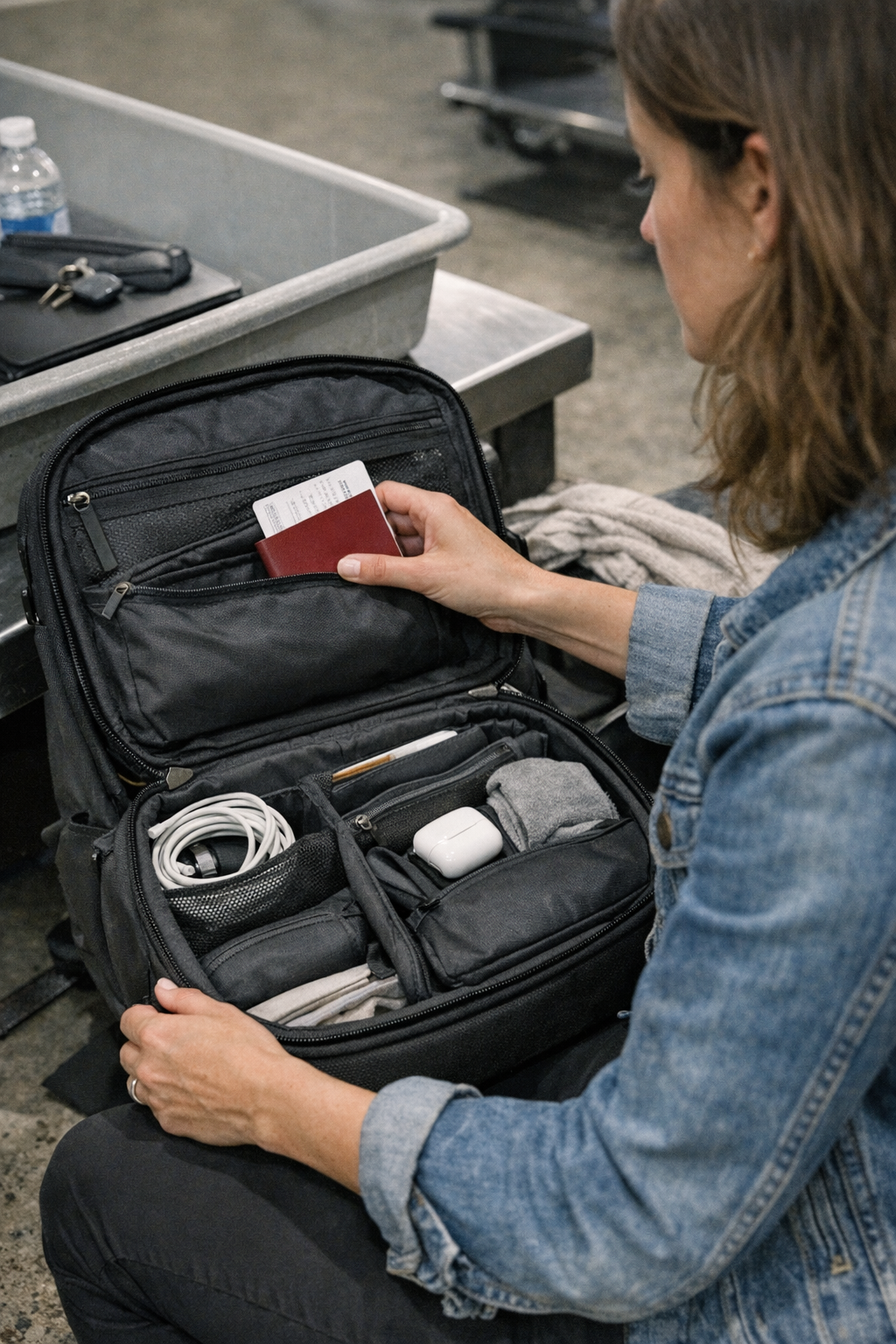
    Solutions don’t mean perfection—they mean fewer slowdowns and less rework, in the right places. The simplest fix: dedicate a single top-access pouch for high-frequency items—passport, cards, boarding pass—with no overlap. Cables and small gear live somewhere else. Leave deliberate “lanes” unfilled so nothing blocks the fast path. It’s counterintuitive, but empty space beats over-organized pockets when you’re moving between checkpoints back to back.

    Example: The Power of a Dedicated Access Lane

    Sail through security when key items sit alone at the top, not mixed with infrequent-use cords or toiletries. Instead of double-zipping around shifting pouches, you open one section, grab, and go. This small design pivot is only obvious after you run out of patience mid-transit and realize one friction-free grab is worth more than an alphabetized packing grid. Mid-journey, a quick-access lane feels like breathing room—less refolding, fewer retrieval errors, and noticeably less mental drag when every second counts between trays, gates, or narrow aisles.

    What Really Makes a Carry-On Setup Work

    The best layouts aren’t the ones that impress at the check-in counter—they’re the ones that rebuild themselves in seconds after the fifth interruption. Real structure minimizes friction, keeps you reset-ready, and quiets the urge to reorganize after every minor delay. Fast access turns delays into manageable blips instead of recurring headaches, so you spend less time recovering from your own system and more time moving forward through gates, connections, and hotel arrivals.

    Structured access always beats just looking tidy: fewer blocked grabs, less confusion about where things went, smoother resets from tray to seat, and a quieter, more controlled motion through unavoidable airport obstacles. The test isn’t what the bag looks like on the bed—it’s how little drag it creates in the middle of real travel.

    For more practical travel structure and easier carry-on access, visit: http://www.carryonsupply.myshopify.com

  • Balancing Wall Sconces and Ceiling Lights for Comfortable Spaces

    The most aggravating indoor lighting problems don’t show up until you actually start living with them. The desk that looked “finished” now casts a sharp shadow where you set your coffee mug. A reading corner with its sleek sconces feels oddly unsettled. Overhead glare swallows up the effect of wall lights, and the cable you thought you’d hidden becomes the first thing you notice when you sit down to use the space. What appears clean and resolved on setup becomes distracting and awkward in daily use, especially in small rooms or mixed-use corners where every lighting choice exposes its limitations again and again.

    Why Ceiling and Wall Lights Clash More Than You Think

    It’s easy to install a bright ceiling fixture and feel the job is done—until you notice it overpowering your wall sconces and flattening the room. Most setups start this way: one strong overhead panel, secondary sconces or desk lamps for “comfort.” But instead of layering smoothly, the ceiling throws blunt, uncontrolled light everywhere, killing off the subtle work wall fixtures are meant to do. Sconce beams become washed-out smudges. The space feels visually crowded by glare, and surfaces look uniform yet hard to use.

    This isn’t about general brightness. The problem is ceiling light that bullies everything below it: its glare coats worktops and walls, erasing contrast and exposing every cable, bracket, or seam you hoped to keep hidden. Suddenly, hardware and wire runs become a distraction, and the whole layout feels constantly unsettled, as if nothing quite “sticks” in the visual structure—even after careful installation.

    Looks Clean, Feels Awkward: When a Setup Fails Under Routine Use

    From a distance, the room checks every technical box: modern LED panel, slim sconces at the right height, every cable tucked with care. But actually working or relaxing in the room exposes the flaws immediately:

    • The front edge of your desk is swallowed in shadow, while the main surface is overexposed and tiring to scan.
    • The supposed reading corner forces you to shift your seat, adjusting the lamp angle just to see a page clearly.
    • Cables and brackets—painstakingly routed—become visible again, highlighted by cold ceiling spill or clashing lighting tones.
    • Everyday actions—unpacking a bag, finding a document—somehow become more awkward, because your eyes keep tracking the lighting weaknesses, not the task.

    This friction isn’t cosmetic. Broken cooperation between ceiling and wall lighting leads to practical slowdowns, cluttered surfaces, harsh edges, and the sense that something small is always getting in your way, no matter how organized it should feel.

    Real Scene: The Lounge Desk That Never Quite Worked

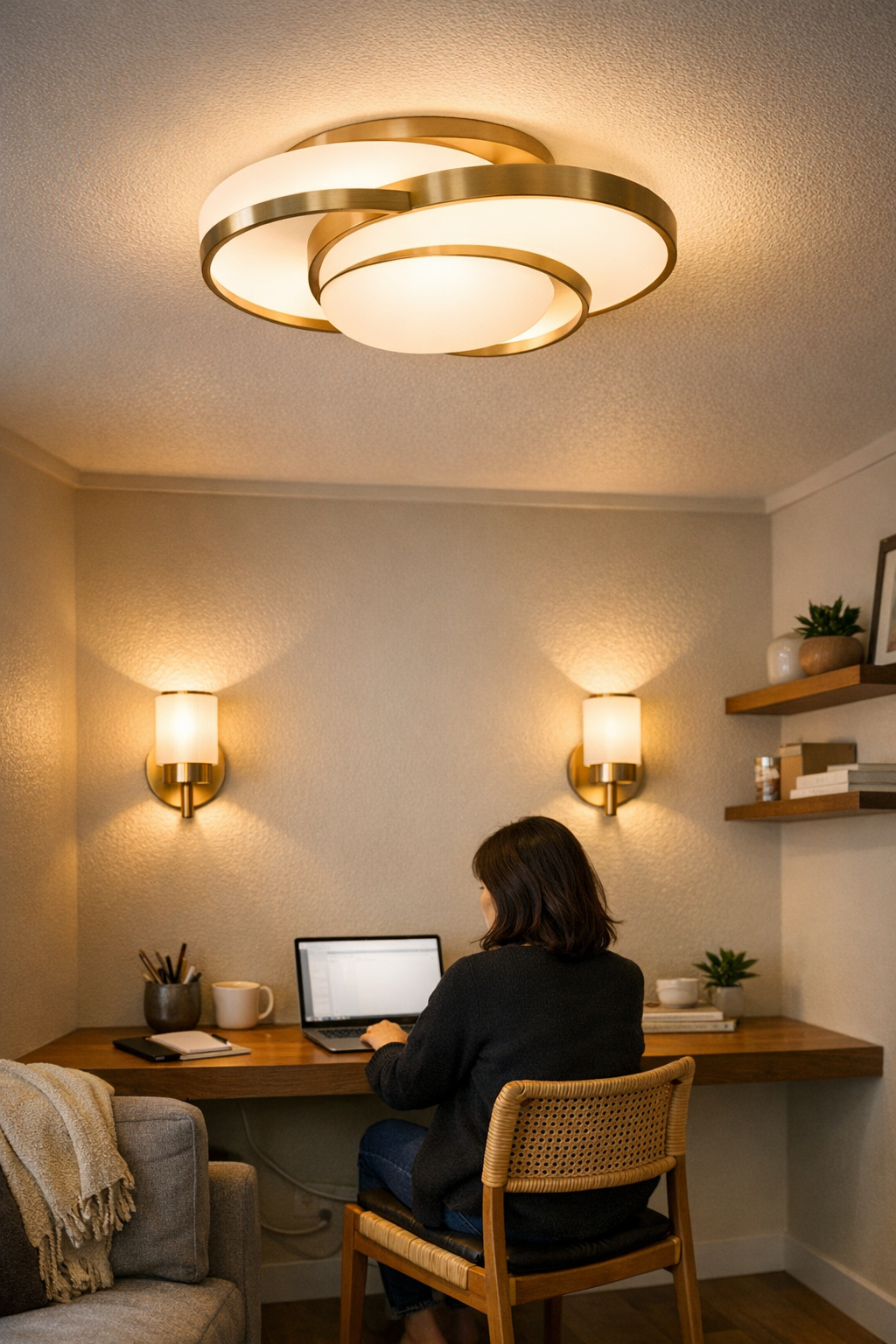
    Consider a narrow lounge with a floating desk: centered ceiling panel, matching wall sconces. Visually, it’s clean. But then the routine returns—a laptop open at the far end, a coffee mug at the corner, a quick evening call. The overhead panel drops a flat sheet of light that shoves hard-edged shadow across half the desk, killing sconce definition. Cables, run tight and flush, now catch every catch of light, turning minor supports into constant visual noise. And every task—a quick search, a note, grabbing your phone—stretches longer, simply because you can’t settle into the space comfortably.

    This discomfort isn’t just a quirk of taste. It means you miss small items at the desk’s edge, fumble with cables that glare out against the wall, and find that “quick, low-effort” work always takes more attention than it should—purely due to unresolved lighting and support behavior.

    Small Shifts, Big Relief: Breaking Out of Ceiling Light Dominance

    Most flawed setups don’t need a total overhaul. In this lounge scene, two specific changes cut through the friction:

    1. The ceiling panel was reduced to roughly a third of its output and switched to a warmer tone. Instantly, harsh lines faded and wall sconces actually began to define their areas without glare interference.
    2. Sconce brackets, previously set at head height, were nudged above eye level—letting cable runs blend into the wall edge instead of spotlighting messy loops beneath.

    The difference was immediate: Glare melted away from work edges, surfaces became calmer, and the view stopped jumping to cable clutter. The setup became quietly usable—no new hardware, just smarter interaction between the lights and their supports.

    Often subtle tweaks—dimming the ceiling, narrowing a panel’s spread, re-mounting a bracket, or bundling cables into a wall’s shadow—have a dramatic impact on how a space works in practice. It’s the daily routines, not the first impressions, that feel lighter, easier, and less visually distracting.

    How to Spot the Tell-Tale Signs of an Unbalanced Setup

    Most rooms with clashing lighting and awkward cable exposure share the same signals:

    • Desk and counter edges stay dim or shadowed, even if the overall space feels bright.
    • Cable runs or bracket mounts are fresher in your eyesight than the work to be done, because glare or uneven color actually highlights them.
    • You find yourself moving the lamp, your chair, or your work items just to “chase” decent visibility—even after you thought the room was finished.
    • Support hardware—meant to blend in—stands out sharply, often thanks to a clash in shadow or color temperature.

    If these hiccups repeat, resist the urge to just add another lamp. Instead, dial back or warm up the ceiling fixture, shift mounting heights, or contain cables tighter to their supports, and see whether your sconces or task light finally do what they’re supposed to: make the space work for you, not against you.

    Temperature Clashes Make Everything Worse

    The friction nobody plans for: mismatched color temperature. When overhead panels pour cool white onto walls meant for warmer sconce light, every cable run, bracket, and support detail is thrown into relief—not smoothed out. Even expensive fixtures can’t hide the chopped-up visual field this creates. The quick test? Flip off the ceiling, and see if your wall lighting alone keeps the area useable and visually steady. If yes, layer the ceiling back in gently; its job is coverage, not dominance.

    Lighting and Support Routines That Actually Work

    Perfect cable routing and designer fixtures don’t matter if the lighting fails every time you actually use the room. Watch for these tells:

    • Your worktop is easy on the eyes in the evening but not in the morning—because ceiling and sconce temperatures are out of sync.
    • The layout looks straight in photos but always requires you to swivel the lamp or slide your chair so your routine isn’t interrupted by glare or awkward shadows.
    • Support pieces or cables vanish at first glance but crowd your focus in real use, lit up or outlined by harsh spillover.

    More hardware rarely fixes these. Often, pulling glare back, shifting a bracket, or narrowing a light’s beam makes the space feel settled at last. Day-to-day comfort won’t ever come from a space that only looks organized—only from repeated use feeling truly easy, natural, and visually quiet. If you’re still wrestling with the setup—even a little—there are still gains to make.

    http://www.lightsupport.myshopify.com

  • How Small Sound Changes Can Improve Your Dog’s Rest and Routine

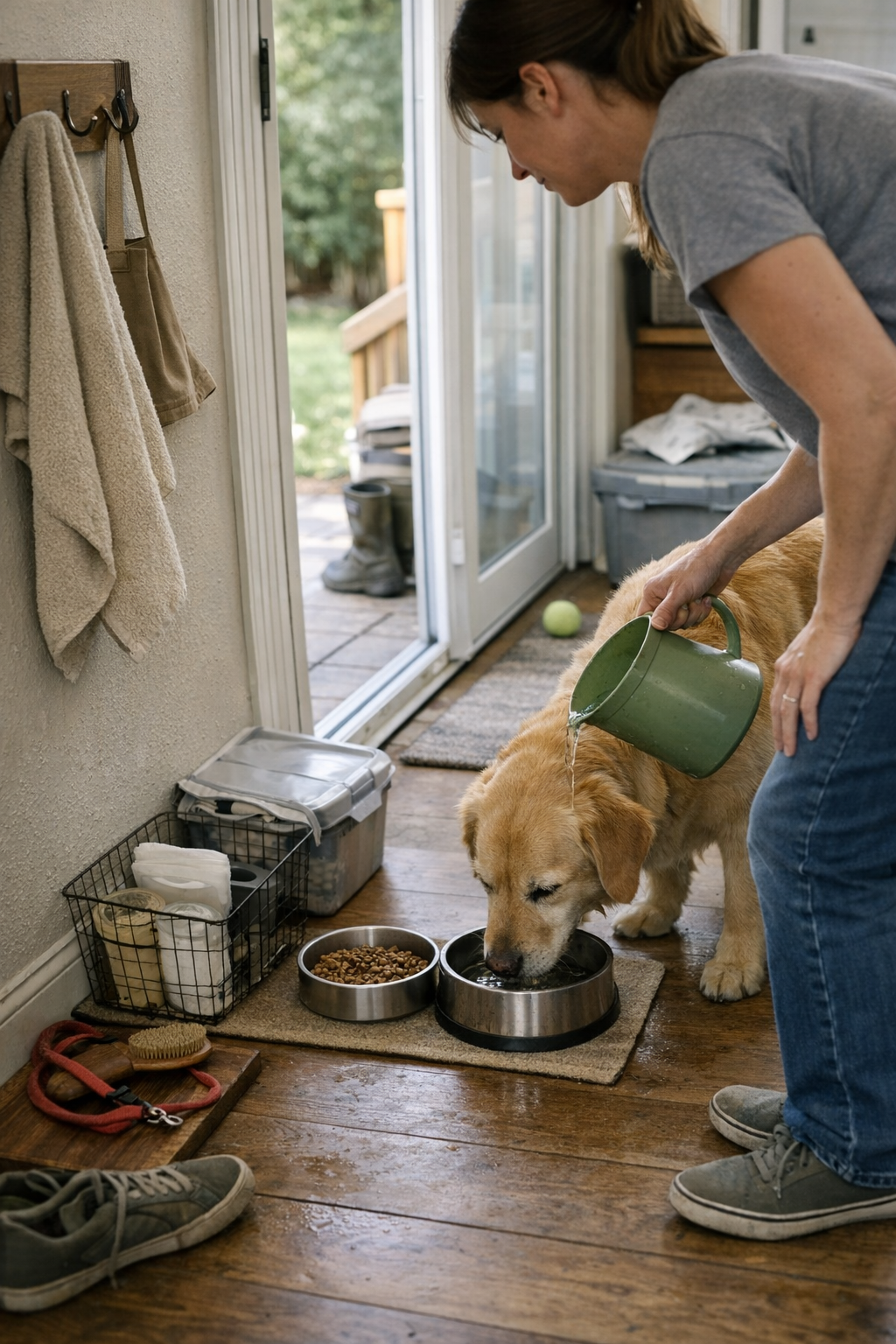
    If your dog can never quite settle—gets up halfway through a nap, paces the hallway after a walk, or jolts awake as you refill a bowl—it might not be bad luck or just high energy. For a lot of homes, the real reason is buried in setup friction: the daily rhythm keeps snapping, not from one dramatic noise but from a scatter of small, repeated interruptions. Bowls clatter when refilled, tags scrape tile when the leash tangles, a towel for muddy paws is always just out of reach, and the “tidy corner” for supplies blocks fast movement during cleanup. Each mini-interruption chips at your dog’s comfort, making rest shallow and transitions drag out. This isn’t about chasing silence—it’s about removing the routine friction that keeps breaking the flow of everyday dog life. That’s the premise behind DogPile: setups that cut down on the noise and awkwardness that block real calm, not just visual order.

    The Soundscape Behind the Restless Dog

    Most owners tune out the routine soundtrack: bowl scrape, chair leg drag, tags rattling when you reach for the leash. Dogs don’t. Watch closely during any ordinary hour—your dog hears a bowl touch tile and instantly lifts her head, tenses at the closet hinge before a walk, or freezes as you slide out a stool. None of these noises are catastrophic. But together, they become a string of micro-interruptions: tiny resets that keep your dog on edge long after the initial sound fades. Settling after a walk takes longer. Naps break up into short stints. Rest becomes effort instead of default.

    The build is slow but constant: Not one noise, but the unpredictability. A loud clang here, a jumbled pile of toys there. Instead of your home smoothing the rhythm of routines, small friction points jerk the process back to start, over and over.

    What Subtle Interruptions Look Like in Real Routines

    Take any busy evening. Your dog curls up beside the kitchen, hoping to rest, but jumps at the bowl being emptied in the next room. She moves to the hallway; a chair legs scrapes, and she’s up again. Another spot, but now a door latch snaps and her shoulders tense. Most owners see:

    • A head-turn every time someone passes through a doorway—never fully at rest
    • Ears bracing for the next sudden movement near the food or water area
    • Pause on the walk—tags banging the vent, leash twisting underfoot—interrupting smooth movement
    • Shoulders just off relaxed, like she’s in standby waiting for the next clatter

    It’s easy to read this as being alert or restless “by nature,” but most of these signals trace to setups that keep resetting calm: sounds and obstacles that force your dog to shuffle, hesitate, or give up resting spots that never stay peaceful for long.

    Small Frictions, Larger Patterns: When Flow Keeps Breaking

    It’s rarely one big mistake. It’s the everyday offenders:

    • An ultra-soft bed placed in the main footpath—great comfort, but your dog has to move every time someone crosses the room. The dog never sinks in; he’s up and down, watching feet.
    • Cleanup wipes on the counter: looks organized, but after muddy walks, the leash hand can’t reach without letting go—so paw prints streak through the hall before you can act.
    • Bowls lined up, tidy but metal-on-tile. Every refill or cleanup clang resets the nap zone.
    • Toys stored together, but the bin blocks morning traffic from the back door to the kitchen. Quick access is now a clumsy obstacle course.

    Each of these setups solves one problem but injects new friction. Calm is replaced by a routine cycle: partial reset, interrupted rest, a new trail of dropped toys or muddy tracks, and both dog and owner slightly more tense than before. When a system only looks organized but doesn’t lower repeated-use friction, it doesn’t actually help.

    The Real Cost: Interrupted Routines and Hidden Tension

    Why does it matter? Day by day, the stacking effect shows:

    • Your dog goes rigid and alert at every bowl move or wipe grab—instead of letting down between activities, she’s primed for the next interruption
    • Even the quietest hour doesn’t deliver full rest, because every meal prep or quick cleanup breaks the streak again
    • At night, shallow naps feed into restlessness all the way through bedtime. A smooth routine never comes together—reset and drag repeat every evening

    Left unchecked, these “small” frictions make the whole day more fragmented. You both lose out on the smoother, lower-pressure flow that should anchor routines post-walk, after feeding, or during quiet time.

    Recognizing the Early Signals: What to Watch For

    Rarely obvious. Usually small-but-steady: The dog that can’t quite settle often leaves a pattern:

    • Head snaps up with every clink or rattle—then lingers, waiting for calm that doesn’t last
    • Pacing or hovering, moving beds or changing corners when sounds spike or movement cuts across their space
    • Paused in doorways, torn between moving forward and waiting out another interruption
    • Shoulder tension or quick glances at ordinary noises, even in otherwise quiet rooms

    If you’re seeing these clusters—especially around high-traffic moments, after walks, or during feeding and cleanup—the culprit is often setup, not temperament. Clutter, blocked access, and noisy gear silently ramp up friction.

    Subtle Friction Points to Audit in Your Routine

    • Bowl material and spot: Metal bowls on tile near busy paths cause unnecessary clatter exactly when your dog needs calm. Opting for silicone or rubber-bottomed bowls in the right corner drops noise during refills by more than you’d expect.
    • Tags and collars: Loose tags or heavy dangles turn every leash grab into noise. Tighten up, use a silicone cover, or choose lighter hardware if your dog reacts to every shake.
    • Thresholds and hardware: Door latches, catches, sticky doorstops—these add up. A smoother hinge or quieter stop fixes more routine friction than most owners realize.
    • Furniture feet: Chairs moved during meals, stools near the rest area—sudden scraping snaps dogs out of pre-nap calm. Pads help, but so does choosing spots outside heavy traffic lanes.

    No fix needs to be perfect. The aim is to lower the impact of every repeat-offender zone—enough to stop the routine from always snapping back to tension.

    Shifting the Setup: Real Changes for Smoother Days

    For most homes, building a calmer routine doesn’t require silence. It means pinpointing and cutting the worst friction—so the day doesn’t keep resetting for the wrong reasons. What works isn’t more storage or stricter tidying, but changes that actually show up in how routines flow:

    Simple Switches That Actually Stick

    If your metal bowl is the main source of dog-and-owner agitation, try a silicone or rubber-bottom version. The difference isn’t about “being fancier”—it means meal preps, water top-ups, and fast cleanups happen without a jolt. In use, you get:

    • Dogs less likely to jolt awake as bowls move—head stays down after you finish in the corner
    • More stability in waiting routines—no repeated circling when you wipe paws or refill water in the same spot
    • Shorter hallway loitering: when background clatter drops, dogs follow the routine instead of waiting out the next sharp interruption

    Same principle: keep collar tags still, cover with a buffer, or streamline gear; slide pads under chair and stool legs that live near nap areas. If your door always triggers commotion, a quieter latch is often all it takes for your dog to treat thresholds as neutral instead of on alert. The point isn’t perfection, but a low-friction default—the kind that doesn’t feel remarkable, because routines don’t keep breaking down.

    The Pace of Real Improvement

    Visible change is never instant—the first day, everything feels the same. By the third or fourth, a new routine forms: your dog doesn’t jump up at every clink, nap stretches longer, cleanup and feeding stack without extra rounds of hallway resets. The measure isn’t how pretty the setup looks, but whether transitions make your day smoother and your dog’s rest deeper.

    Daily Routine, Less Drag: What a Smoother Soundscape Produces

    Rest isn’t just the absence of noise; it’s the absence of forced resets. A calmer home routine lets your dog move from walks to feeding to rest without tension at thresholds, blocked

  • Why Perfect Pet Care Setups Often Slow Down Your Daily Routine

    Why “Perfect” Pet-Care Stations Slow You Down

    The everyday reality of feeding your pet isn’t as simple as it looks online. A row of matching bowls, wipes hidden, perfectly stacked bins—this kind of setup feels organized until you start using it every day. A care area designed to “look right” quickly reveals hidden friction: bowls you can’t grab without emptying a cabinet, scoops buried out of reach, towels never where you need them, and extra steps added to almost every routine. The more pristine the station, the more you chase order instead of ease—until pet care means hunting for basics instead of a quick, calm reset.

    The Hidden Cost of Organized Appearances

    Setting up with labeled bins, bowls in neat lines, and wipes stashed away seems straightforward. But real routines break this facade fast. Each morning, the “put away” scoop means digging through a drawer or fending off a stuck cabinet door while your hungry dog or cat waits impatiently. Sparkling bowls? Only until that dried food edge blindsides you and sends you back to the sink, just as your pet’s paws start shifting closer.

    Hooks by the laundry room look tidy on day one, but the towel is rarely where muddy paws cross the threshold after a walk. You hang it up once, but end up grabbing paper towels—knowing you’ll wipe the floor again later. Storage bins stack high, but the favorite toy always seems buried, making you empty the entire container just as playtime’s supposed to start. “Neat” setups work against you when the items you most need are always a step, hook, or lid away from where routines actually happen.

    When Everyday Routines Get Stuck

    Take a breakfast rush. The counters look spotless, but getting food down means sliding bowls out from under the countertop clutter, locating a scoop behind pantry cans, and spot-cleaning a crusty bowl rim on the fly. Your dog returns wet from a morning walk—the towel’s on the other side of the house, so you trail water across clean floors, improvise with napkins, and add one more thing to reset before work. The routine looks controlled, but every day, something is misplaced, blocked, or slow, and you’re left reshuffling just to keep pace.

    Hide pet mats to clear the living room, and they keep sliding back into high-traffic spaces—or the feeding area is missing its mat when spills hit. Bins meant to corral toys transform into obstacles, forcing the same evening cycle: dig out, scatter, re-stash, repeat. Every “orderly” move ends up adding steps nobody wants.

    Real-World Friction: When Looks Outweigh Function

    If you’re constantly doubling back for a scoop or skipping a cleanup because the wipes are never where messes happen, the setup is working against you. Rows of feeding bowls shine on the counter, but every refill stalls because the water pitcher is always somewhere else. Litter scoops tucked away mean frantic searching the one time you really need a quick clean. Neatness becomes a trap—prioritizing how things look over whether you can handle the next mess without losing momentum.

    The slowdowns don’t shout—they creep in. Over a week, those extra trips and missed wipes steal minutes you can’t get back. Chores drag, parts of the routine get skipped, and you start hesitating before each simple task. The mess wasn’t the problem; the “perfection” was.

    The Small Change That Transforms Routine

    Fixing it isn’t about buying more storage—it’s about shifting what’s already there. Hang the towel not in the laundry room, but by the main hallway, right at the spot where muddy paws and messy mouths land. Suddenly, wiping down water or mud takes one reach instead of three rooms. One simple move—putting care tools near the actual action—cuts out detours and repeated resets. That rough-looking towel next to the bowls wins the day; hidden storage never did.

    The takeaway: let the routine dictate where each tool belongs, not the appearance. Bowls stacked by the sink, a scoop left beside the kibble, wipes on the counter—none of it looks “finished,” but every piece is in play when you need it. Function beats photo-ready order every single feeding, clean up, and night check.

    Spotting the Weak Points in Your Routine

    Notice repeated stalls: are water bowls always empty later than you meant? Are wipes only handy after the mess dries? Does the scoop ever stay out, or do you dig for it every time? If one item always forces you to stop or retrace your steps, the setup is slowing you down, no matter how it looks. When “tidy” means constant resetting, you’re managing appearances, not routines.

    Choosing Daily Ease Over Perfect Order

    In pet care, saving steps is the difference between routine drag and actual calm. Move even one tool closer to where it’s needed, and feeding or cleanup speeds up with zero show. Trust a setup you can move through without thinking about what’s buried, what’s missing, or what gets in the way—from morning meals to late-night walk returns.

    An area that looks organized isn’t always easier to run. Choose routines that work at real speed, with tools within reach and cleanup that doesn’t wait. Bowls placed for the quickest grab, towels ready for actual paws, and wipes visible when the mess is fresh—these are the changes that show up in every daily round, not just in a photo.

    For more practical ways to support your daily pet-care flow, visit calmpetsupply.myshopify.com.

  • Why Tightening Your Clamp Lamp’s Second Joint Improves Desk Lighting Stability

    A desk that looks spotless is not always a desk that’s actually ready for work. The difference shows up fast when you rely on a clamp lamp: tightening the base clamp makes everything seem secure, but real use exposes what the tidy setup misses. As you switch between typing, grabbing notepads, sliding a drawer open, or shifting your screen, the lamp’s head quietly drifts off-target—unless you’ve remembered to lock down that second joint. The lamp that seemed “set” turns tricky, pulling your focus with every bump, reach, or adjustment.

    How an “Almost Secure” Lamp Interrupts the Routine

    Most clamp lamps use a two-joint system: a base clamp plus an elbow or neck joint holding the lamp’s angle. Tighten just the base and the whole lamp looks finished—until you move. A glance won’t reveal anything wrong, but the next time your elbow brushes past, or your notebook creeps too close, the lamp head tilts away or slips an inch, scattering either shadow or glare exactly where you don’t want it. It’s not a big slip, but by the end of the day, the light never matches where you expect it. Those small mismatches force you to pause, reposition, and reset—especially noticeable when you work quickly or change tasks often.

    You don’t register the disruption until it starts adding up. By midweek, you stop trusting that the lamp will be right when you reach for it. Each time your chair grazes the desk, or you slide open an under-desk drawer unit, the angle shifts and the old annoyance returns. The friction goes from invisible to everywhere—a lamp meant to help actually slowing you down.

    When Visual Tidiness Masks Real Instability

    A base-clamped lamp fits a desk aesthetic: cables vanished, monitor lined up, nothing loose. But it can be deceptive. Outward order hides functional drift. On a compact work surface where bins and organizers tuck under the top and stacks sit within arm’s reach, even a slight looseness at the joint means a routine reach—pulling a storage tray, grabbing a reference book, brushing away a charger cable—gently dislodges the lamp every time. The misalignment is subtle at first, but eventually you’re dodging glare on your screen, chasing shadows along your documents, or annoyed by needing to re-aim lighting after each desk adjustment. The desk “looks organized” but never actually works smoother.

    Daily Patterns: How Subtle Drift Adds Up

    These shifts show up most when you’re moving between tools. Slide out a notepad beside your keyboard, the lamp slides; adjust the monitor, the lamp leans; reach for a drawer, the lamp sags a notch. If the joint isn’t locked tight, each nudge drifts the beam off the critical zone. What you notice is:

    • Shadows landing on your keyboard just when you need clarity for notes
    • Reflections creeping across your main screen mid-task
    • The right lighting never quite where you last left it, breaking focus after each small reset

    These aren’t dramatic, but they slow your pace and distract from the actual work. The true cost isn’t in big mistakes—it’s in a desk that never quite disappears as a tool, always demanding attention you meant to give to your tasks instead.

    What Changes When the Second Joint Is Locked In

    Locking down that second joint, right after you’ve aimed the beam the way you want it, moves your desk from looking organized to actually behaving organized. From then on, even as you adjust the monitor, shift your chair, or use under-desk storage, the lamp holds its aim—no tilt, no sag, no need for constant readjustment. You swing it aside to clear space, bring it back, and the light picks up exactly where you left off. The friction is gone. The space adjusts to you, not the other way around.

    It’s not about chasing some perfect, showroom-ready desk. It’s about cutting the minor headaches that build up in every desk session. You go for the reference book below the surface; the lamp holds position. You come back from a long call; the light’s right where your hands expect it. Instead of fighting your tools, you actually work—fewer slowdowns, fewer mental resets, fewer moments lost to a lamp that won’t stay put.

    Not Just for Flexible Desks: Stability Matters Daily

    Even a fixed workstation—one where you almost never move the lamp on purpose—reveals the problem over time. With every small vibration, cable drag, or adjustment to other gear, gravity works the loose joint. Week after week, bending the lamp back into place becomes a recurring part of your routine. No layout is immune. Clamping both joints from the start removes this constant slow leak of time and patience, whether you’re in a creative studio, project workspace, or a home office that doubles as storage and charging station.

    Real Answers to Recurring Lamp Friction

    Why does my clamp lamp keep slipping out of position?
    Ninety percent of the time, the culprit is the second joint at the neck or elbow—it’s rarely fully tightened when setting up. The base clamp alone can’t hold the head against daily nudges, cable movement, or the effect of drawer access under the desktop. Repeated drift is the signal the joint isn’t secure.

    How can I keep my lamp rock-steady during a busy day?
    Set the lamp for how you actually work—illuminating notes by the keyboard, reaching into under-desk storage, lining up with your monitor. Then, lock the joint at your chosen angle. If slipping returns, check for worn internal threads or a washer issue. Only a tight, stable joint keeps the lamp focused through real tasks, not just at setup.

    Is this a problem in every kind of workstation?
    The instability stands out most in active or shared spaces—creative desks, technical review setups, hybrid home offices—where gear and layout shift often. But even in static arrangements, a lamp that resists drift cuts down mental drag and prevents the subtle but constant reset-churn that can accumulate day after day.

    A Simple Habit That Pays Off Every Week

    Locking the second joint of your clamp lamp isn’t about a cosmetic win—it’s a tiny, practical fix that changes the flow of your work. Tidy isn’t enough when light and reach fall out of line at every turn. This upgrade pays for itself not in visual order, but in the way your desk actually feels: steady, responsive, and finally invisible. You don’t see the stability—but you notice the difference every time you don’t have to reset it.

    Explore the full WorkBasic collection

  • How Standardized Modular Bins Transform Garage Organization and Efficiency

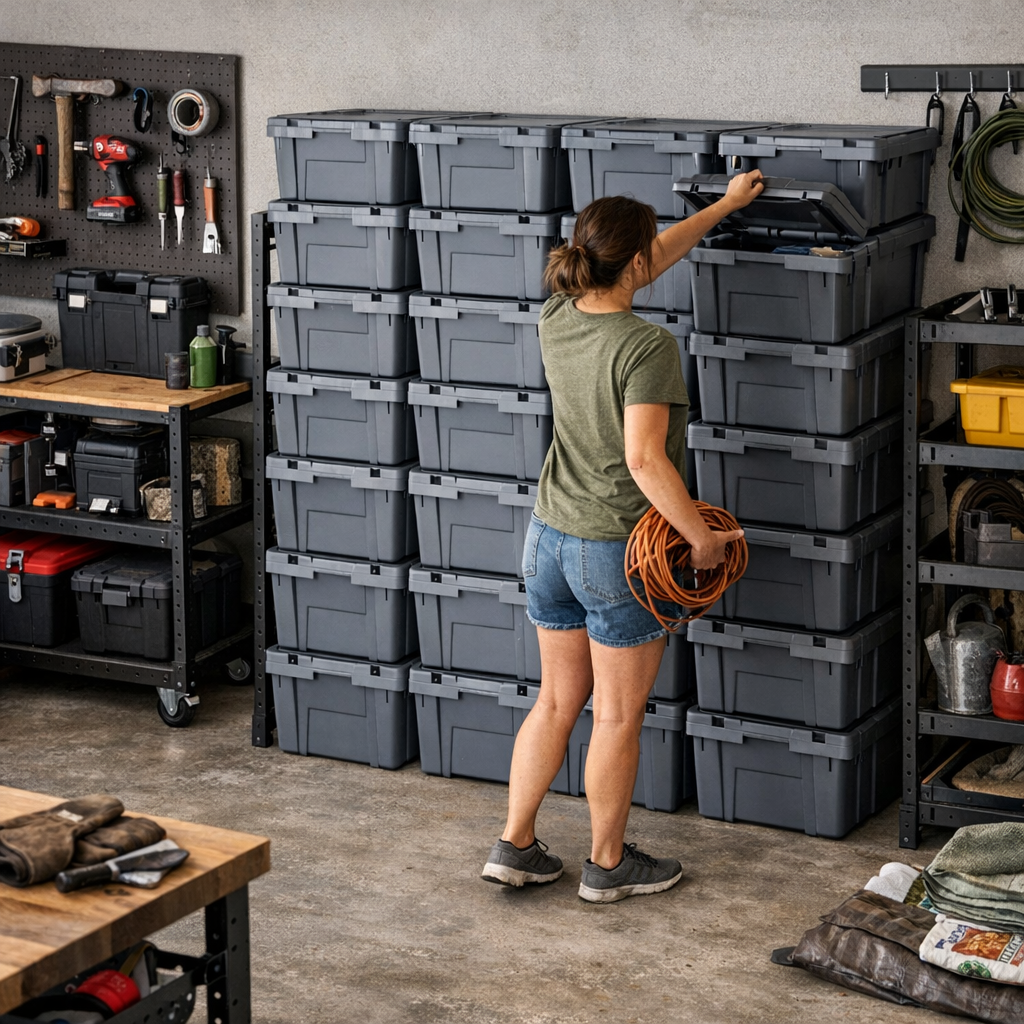
    The truth about “organized” garages is that most never quite work as planned. You haul out every dusty bin, stack them with care, wedge a rolling cart into a corner, and line up shelves like dominoes—sure, it looks tidy on Sunday afternoon. But by Thursday? The cracks show. The ladder is blocked again. Retrieving garden shears means shifting two containers and balancing one lid against your knee so it doesn’t slam shut. Every “grab and go” turns into a cautious shuffle, detouring around a cart that never stays put. The feeling isn’t disaster, but it’s not seamless either. The order you created takes daily hits—adding slow friction that multiplies the more you use the space.

    When tidy falls apart: Where routine meets real-life

    You stand back, see everything “put away,” and call it a win. But a garage that looks organized isn’t the same as one that lets you move freely. The first frustration usually comes fast—a shelf blocks half of the only real walkway, forcing you to squeeze sideways, shoulder to the wall. Bins of different heights don’t nest, so you wind up building awkward stacks in random spots. Every time you need the extension cord from the bottom of the pile, there’s that old routine: stoop, unstack, pull, restack, curse. Feel familiar?

    The daily setup becomes a game of avoidance. That rolling rack you originally parked inside the door now migrates, wedge-like, near the workbench, scraping over uneven concrete. One move always triggers three more: slide the cart, nudge the shelf, shift the scattered bin—just to clear a path. The supposed system starts to feel like a slow-moving obstacle course.

    The slow breakdown of mixed storage

    The rookie move: set up bins, a couple different shelves, a cart for heavy tools, and call it organized. At first, each type of storage promises a purpose—the hardware bin here, painting gear there. But the seams don’t hold. Bins won’t tuck flush against shelves, casters hit cracks and refuse to budge, deep containers hide behind others. Soon, every edge—the dead zone by the back wall, the strip under the window—catches oddball overflow that won’t quite fit anywhere else.

    Every time you return something, you size up the mess. Does this bin fit in the gap beside the rolling rack, or do you wedge it by the freezer, half-blocking the path? Each decision means a little shuffle, a nudge, a small compromise. The “one-time setup” turns into a hundred micro-adjustments that bog you down and blur your original zones into chaos.

    Weekend reality: The garage after real use

    Picture Saturday after a rushed repair or dig in the garden. You’ve pulled out the bin of hand tools, spilled a box of screws on the counter, hauled the rolling cart out to reach your favorite shovel. Now—time to tidy up:

    • The extra-large bin slides just far enough to block an outlet and jams small containers into the margin. Plugging anything in requires a foot-long reach-around.
    • The cart only fits back in its spot if you turn it diagonally, eating up a third of your walkway.
    • You’re sidestepping around tight corners, hip-checking a shelf, steadying your armful of tools, all to make it through without a spill.

    Each “reset” takes longer than last time. Storage creeps into every usable strip of floor, but with each cleanup, things settle just a little further from where they belong. By week’s end, it’s hard to tell where one zone stops and the next begins.

    Uniform bins rewrite the routine

    The shift isn’t about owning less—it’s about bins that fit together, every time. Move to a single size of modular, stackable container and the space starts to cooperate. Bins line up neatly, lids don’t hang up or require unstacking, and there’s finally a straight edge along the wall, not a series of jutting corners inhaling all the floor space. That six-inch strip by the door? It becomes usable: slide a bin in—done.

    Uniformity creates a kind of muscle memory. Need the drill? You know exactly which bin, exactly how to lift the lid—no guessing, no creative rearranging just to get under one box. The wall stays clear, walkways go back to actual walking, and the dreaded “reshuffling” disappears. You see instantly when something’s out of place, instead of wondering if you left it somewhere in the back corner last week.

    Giving up variety? Or gaining usable space?

    This isn’t about stuffing the awkwardly sized garden rake into a bin that’s too small—it’s about choosing a set of containers whose footprint matches your gear and your patterns. Oversized bins eat corners and block walkways, so get real about your most-used pathways. The reward for matching your system to your routines? Clear floor paths that stay clear. Resetting after a project actually feels as quick as it should, and zones don’t spill out of bounds with every use.

    The price of ignoring the mismatch

    Stick with a piecemeal setup, and the penalties add up. Walkways narrow as bins slide crooked; corners collect random overflow; wall edges fill, but never usefully. A quick reset grows into a mini-move—track down the right lid, realign the cart, squeeze the toolbox in wherever it fits. It’s never catastrophic, but it’s always slow. Each little hurdle chips away at the space’s promise of effortless use, turning routines that should take seconds into small projects of their own.

    Keeping the flow: Habits that stop the slide

    Even uniform bins aren’t magic unless you work with them. Take a few minutes every couple weeks to scan for spots where loose gear is gathering (high shelves, back corners, wherever the system feels “fuzzy”). Tweak the layout before a dead zone grows. If your routines change—a new tool, a new hobby—adapt where needed. When the system follows the way you actually use the space, resets go back to simple. Tidying up after a project doesn’t feel like a negotiation, just another part of the rhythm.

    And you notice the difference fast. Gear goes back without detours. You spend less time hunting or shifting and more time actually working. The garage finally moves at your pace—not the other way around.

    The real test of organization isn’t the first impression after a deep clean—it’s how smoothly the space handles your fourth, tenth, or fiftieth project. A unified storage system isn’t about perfection; it’s about supporting your routines without interruptions. The right containers become less about storage, more about removing the friction between you and the work you want to do.

    Visit StackNest for systems that stay in line with real use.

  • Why Dividers Outperform Larger Cabinets in Entryway Organization

    Most entryway clutter doesn’t announce itself as chaos—it arrives as small, daily friction. Set up your bench and cabinet on Saturday, and by Tuesday the system’s falling apart: shoes angle out of line, bags block the walkway, keys vanish under the growing pile. It’s not about having too little space. It’s how fast shared routines and rushed drop-offs break down boundaries, letting items blend, pile, and interrupt the flow through your threshold. The deeper problem? Any structure built only for storage, not for flow, fails under real, repeated use. Entryway storage from Betweenry isn’t about capacity—it’s about handling pressure, overlap, and fast resets in transition spaces where ‘organized’ collapses by midweek.

    When Plenty of Space Isn’t the Solution

    The lure of a bigger cabinet or bench is strong: for a few days, every shoe and backpack has a place, and the entry looks under control. Yet by Wednesday, boots have drifted under bags, gloves are buried, and someone’s keys are jammed unseen behind the last grocery return. The problem isn’t storage size. It’s how quickly mixed items invade each other’s zones. With catch-all storage, every end-of-day reset becomes a project—tugging at pileups, sorting jumbled categories, and re-hiding the clutter until it reappears the next morning. The pain point: each new mess slows you down right when you’re least able to tolerate it.

    When bags, shoes, and essentials mix freely, you don’t just lose order. You lose time and patience, right at your home’s bottleneck. A big cabinet with no boundaries lets the same small pileups become routine obstacles. Searching for keys under a backpack isn’t just an inconvenience—it’s tension at the threshold, delaying everyone behind you, and making a two-minute departure slip toward ten.

    Dividers: Small Barriers, Big Impact

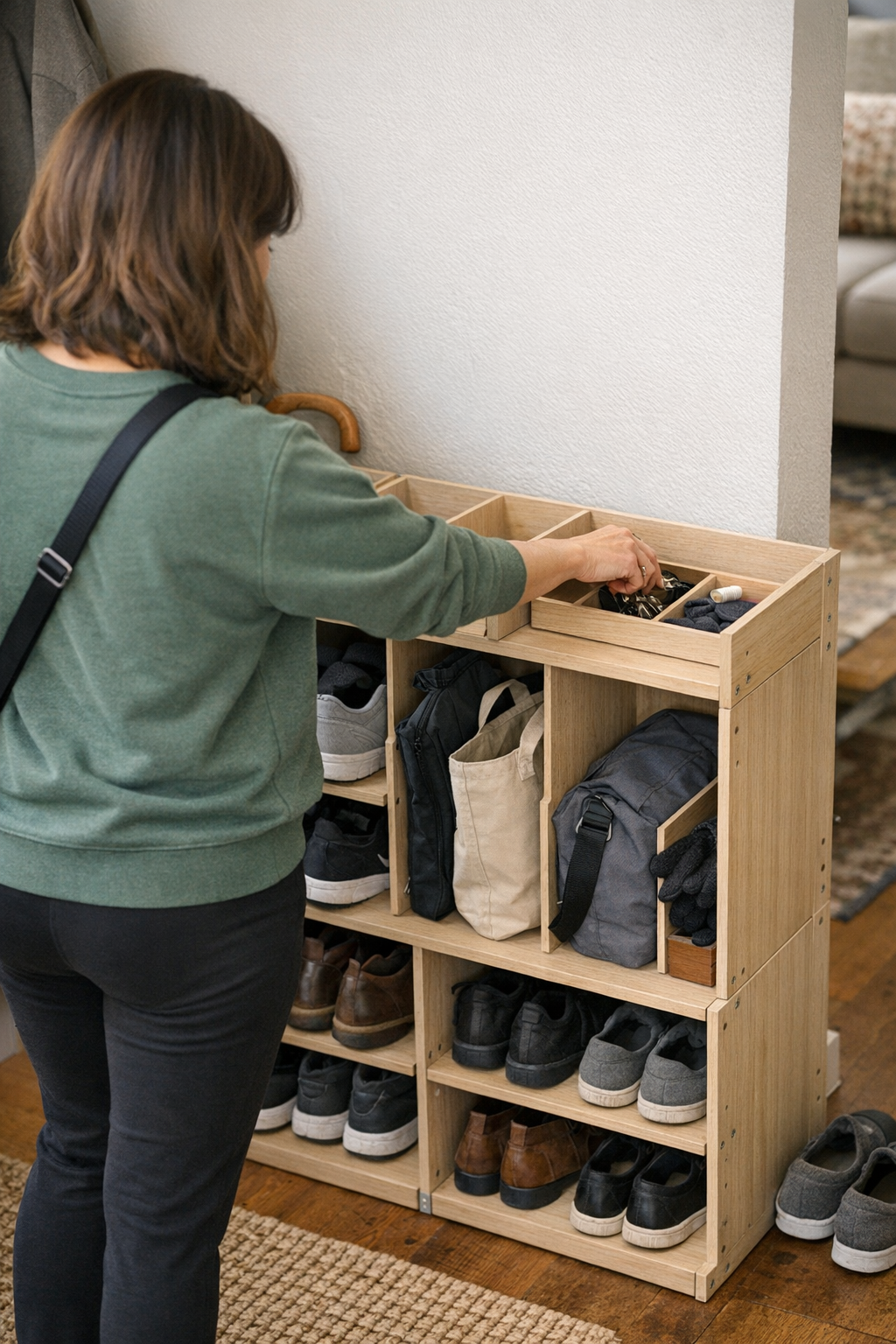
    Insert dividers or trays in your main storage, and the effect is immediate. Shoes slide into lanes—so the row you start with on Monday still stands by Friday. Bags stack upright instead of drifting sideways. A shallow tray collects keys and gloves before they vanish into the churn. Now, when two people come home at once, each can open the cabinet, drop their gear, and move on—without shoving someone else’s pile aside or blocking the path.

    The change isn’t just neater rows; it’s less collision, less searching, and a real drop in return friction. In the rush of morning exits and after school re-entries, dividers keep one pair of shoes from smothering another, shields essentials from bag spillover, and makes anything out of place instantly obvious. “Category creep” slows. Resetting takes seconds, not minutes—or worse, silent frustration as you step around the pile waiting for ‘later’ that never comes.

    Reset Speed and Routine Pressure

    Here’s how you know when open storage is failing: Sunday setup looks great, but by Thursday, you’re fishing for gloves under coats, and the last clean shoe slot has filled with odds and ends. Rushed mornings expose every weakness. A bench without clear lanes becomes a catch-basin. The overflow migrates to the walkway, crowding whoever arrives next. If one reset turns into heavy shuffling and awkward pass-throughs, the cost is bigger than clutter—it’s one more source of daily stress at the threshold where your routine is most fragile.

    Dividers quietly block that breakdown. As volume rises, separation holds: shoes stay paired, bags don’t topple, and a low tray means keys are actually visible before you bolt. Instead of repeating the same ten-minute hunt, you see exactly what’s missing, move what you need, and get out. In transition zones, speed and clarity aren’t luxuries—they’re the line between flowing through and tripping up.

    What Setup Drift Feels Like in Real Life

    Most real entryways are narrow—sometimes just a small bench or low wall cabinet forced to absorb gear for the whole household. That’s where “drift” happens: drop a bag, and shoes scatter sideways; sit to tie laces, and the bench picks up a bottle or errant mail; any new arrival tips the nearest item into the main route through. Overflow isn’t a surprise—it’s inevitable when the only structure is a big, blank container.

    • The bag placed too close to the edge now blocks half the pass-through the next day.
    • Shoes that started lined up against the cabinet end up twisted or shoved into a tangle by midweek.
    • An umbrella wedged in once becomes a permanent obstacle, chewing up foot space and cramping the threshold every morning.

    Visual “order” is a false comfort. More space gives room to hide drift, but the routine keeps breaking: too many things stacked, too few boundaries, too much silent buildup until the zone clogs and movement stalls. That’s the real-world cost—flow interrupted, not just clutter visible.

    Structural Boundaries Over Storage Size

    Equating more storage with smoother routines is a classic mistake. In practice, the bigger the cabinet without structure, the more effort it takes to reach what you need. By Thursday, what looked like generous capacity is now a hard-to-manage obstacle course. When every use demands pulling items out to find what’s buried, the “extra space” just adds steps to your reset burden.

    Divided storage flips this logic. A three-lane divider or segmented tray uses less total volume, but delivers more order: shoes stay paired and visible, bags stand up rather than drift, essentials stay corralled. Instead of guessing what’s behind the pile, you get a predictable routine: put away, retrieve, move through. For shared entryways, the clarity matters—no silent resentment, no repeated moves to reach your own stuff, no more morning pileups because someone else “reset” the space to fit their bags, not yours.

    Keeping Order with Tight Entryways and Mixed Routines

    Entryway setups aren’t static: guests show up, new sports or school gear arrives, and the lineup of must-haves keeps shifting by season. If you keep stepping into a bottleneck—standing on one foot in a tight entry, elbow-deep in a pile that’s drifted across the zone—it’s not just clutter. You’re missing friction-fighting boundaries that reset themselves, even when real life pushes the layout off-script.

    Dividers and tray inserts adapt to almost any structure—wall-mounted cabinets, low benches, narrow shelves. In these tight spots, they block pileup drift: shoes can’t sprawl, bags find a set lane, and small essentials are less likely to feel “lost in the big zone.” Even on a slim shelf, a divided tray keeps keys and passes from sliding under the day’s outerwear or landing at the back where nobody looks until next week.

    One Small Real-World Tip

    Designate a divider slot or tray as a “re-entry” zone—a pocket that always catches quick returns, mail, or essential keys as soon as you walk in. This one small habit keeps return flow smoother, making resets less of a chore and reducing that silent spread where temporary placement becomes tomorrow’s new pile.

    The Real Win: A Transition Zone That Works, Not Just Stores

    Choosing dividers over wide-open storage isn’t about capacity—it’s about building invisible boundaries that match actual routines, so daily mess doesn’t quietly rebuild right after every reset. A slim bench or structured cabinet keeps categories in-check and mistakes visible, not buried. In homes where paths are tight and overlap is constant, structure makes the difference: less blocked movement, faster resets, a launchpad entryway rather than an obstacle zone. The real transformation is visible not in how things look once, but in how quickly the zone comes back to order with every return and departure.

    Betweenry: http://www.betweenry.myshopify.com

  • When Cat Clutter Is More About Routine Than Storage Solutions

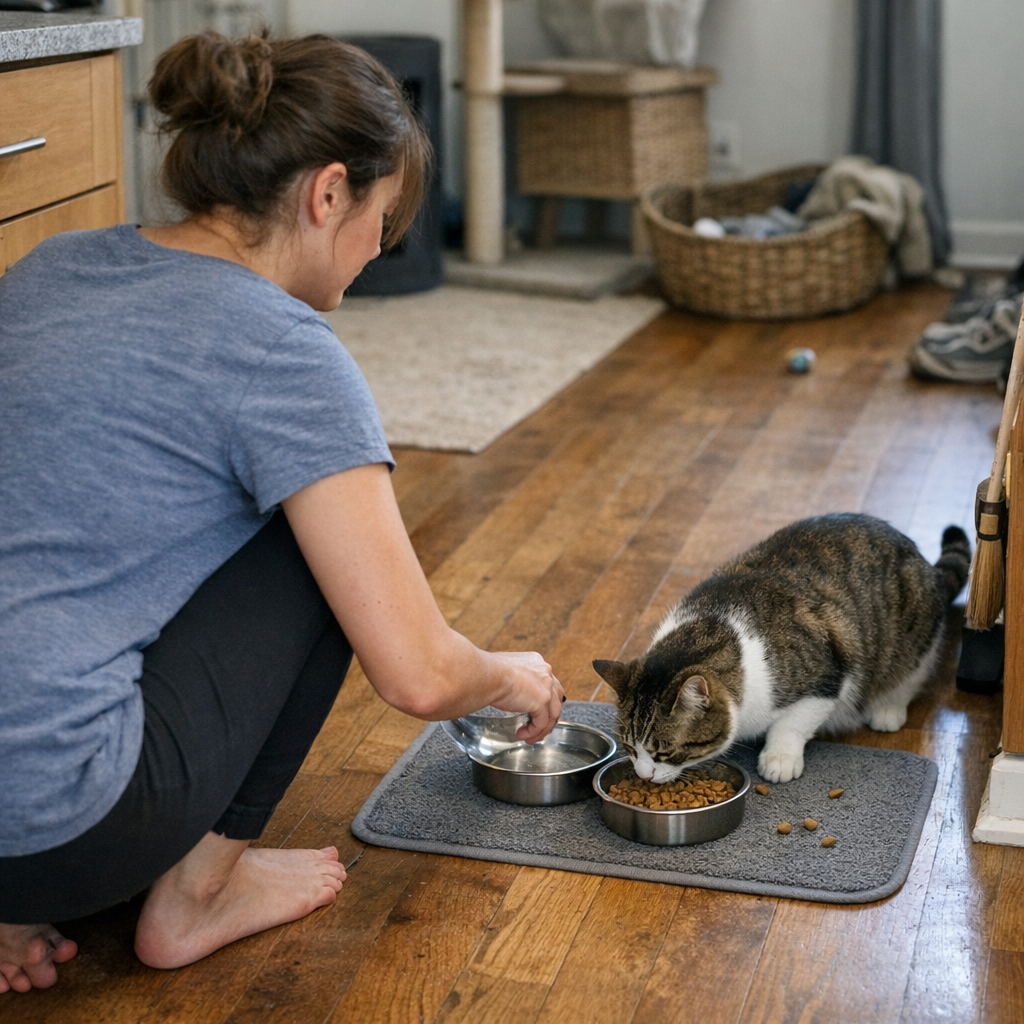
    It always starts as something you can ignore—a bowl just out of reach, a mat “safely” out of the path, a corner for litter that looks invisible—until the friction piles up. Then one morning, you’re dodging a chunk of kibble with your foot again, brushing aside crumbs that reappear by lunch, and realizing what’s really off: the setup isn’t failing because it’s messy, but because it quietly fights your real daily routine. In most indoor-cat homes, the hidden cost isn’t chaos. It’s those seconds you lose, the unexpected pauses, and the energy spent resetting the same area over and over, all because the space isn’t made for how you actually live beside your cat. Welcome to the practical reality that StillWhisker was built for—where ordinary routines, not just containers or color schemes, determine what actually works.

    The Real Roots of Cat-Related Clutter: Not a Storage Problem

    The cycle is almost universal: bowls are brought back, litter trails appear again, and yesterday’s pile of toys works loose from the “tidy” bin before breakfast. If you feel like you’re constantly organizing, but the mess just slides back, here’s why: the hardest-to-fix chaos isn’t about storage or neatness—it’s about setups that break down as soon as real routines begin.

    When cleanup becomes a repeat loop—retrieving bowls stuck behind stools, squeezing past a too-close mat, wrestling wipes out from behind where you actually need them—you’re not seeing failure so much as the signs of a setup that’s physically in your way. It doesn’t look like a mess until the tenth time you stoop down for the same toy wedged under the couch. What looked organized on day one now needs constant micro-fixes just to keep pace with your day.

    When the Setup Looks Settled but Still Slows You Down

    Tidy, yes—but functional? That “hidden” litter box in the corner, the curated toy basket, the feeding dish aligned with the backsplash… these all promise visible calm. But open the door during a normal week and the illusion cracks. You spot the unspoken swap: the area photographs well, but you’re now fighting slippage—wiping a mat that drifts every time someone walks past, crouching for toys that sneak behind radiator fins, breaking stride to dig behind stacked supplies that once “decluttered” the room.

    The Daily Reset That’s Never Quite Done

    Picture this: Every night, you drop all toys in a deep bin. By noon, your cat’s chosen two are back in the middle of the floor. One has already found its way into the shadow gap beside the fridge. Now you’re down on your knees again, and that clean floor you admired last night is a memory—while the “storage” isn’t helping any ordinary routine. It’s a loop. Soon, you’re straightening the mat or nudging the bowl back into place and hearing yourself think, “Didn’t I fix this already?” The room looks fine in snapshots. The burden only shows up on repeat.

    This is why photo-ready order doesn’t always equal liveable ease. Sooner or later, constant resets start to feel like chores you shouldn’t have to do—but can’t quite skip without the system breaking down again.

    Invisible Interruptions: How Misaligned Setups Cause Everyday Delays

    It’s not always the sprawling mess; sometimes, it’s the tiny detour hiding in plain sight. Maybe the water bowl sits in a decorative alcove, but you have to break your morning flow to reach it—a few extra seconds each time, easy to dismiss, until a rushed morning means the refill gets skipped. Soon, there’s buildup or stray fur inside and that’s when the small inconvenience shows its teeth. Let enough minor frictions line up, and missed maintenance stops being rare—it becomes part of the week.

    Comfort vs. Convenience: When One Fix Creates Another Issue

    “Upgrades” sell the promise of improvement, but every change has a tradeoff. That stylized mat—now located “out of view”—keeps shifting, leaving a trail of crumbs extending past the spot you’re supposed to stand. Maybe you pick a soft cat bed that matches the room, but the cover refuses easy cleaning, so the comfy spot turns into another routine you grudgingly maintain. Design for cat comfort adds unseen labor for you, multiplying each time an easy solution means more crouching, more shaking out, even more hair to sweep up.

    Shared Spaces: Cat Gear That Keeps Sneaking Into Your Life

    Cats don’t respect defined zones; the nuisance is slow enough to ignore, until it builds up. Feeding mats edge closer to pathways, toys roll into hallways and under seats, even containers you picked to “hide the mess” begin to pile clutter just behind your reach. Need the broom? Now you’re moving a scatter of supplies stacked in your traffic lane. Carrying a cup of coffee? The kicker toy appears underfoot again. These are the micro-interruptions that erode convenience—unplanned, but felt just the same.

    The real sign a setup is off? Annoyance you can’t quite get rid of, no matter how much you tidy.

    Frequent Reset Points: Where the Routine Keeps Breaking Down

    The classic offender: the feeding zone that looks unobtrusive, but gets crumbs nudged with your foot every visit. Or a litter mat that never sits square, drifting until cleanup is an extra step just to access the essentials. Then there are caddies or wipes tucked “logically” out of sight, only to be out of reach in the one moment you’re managing a spill. Setup friction isn’t always a big mess. Sometimes, it’s surfaces needing wiping later than you meant, accidents that happen just out of your prep zone, and trays that remind you the system’s built for looks, not for repeat use.

    Spotting and Fixing Routine Friction in Real Cat Homes

    When small resets start to feel like real work, it’s not about getting lazier—it’s the setup missing your life’s tempo. Let a few minor misalignments persist and items fall behind: wipes never where you need them, food areas that slide out of “easy,” hair clustered in spots you never check until errands are underway. The promise of an organized space weakens; your routines slow under the extra handling the tidy look demands.

    Read the Repeats: When One Weak Point Keeps Returning

    Watch where your own frustration pools. If you’re always bending for the same toy, nudging the same bowl, or missing wipes by two steps, it’s not a discipline problem—it’s a warning about the structure. The solution isn’t prettier storage or another basket; it’s a reset that reflects actual use: what you reach for, where you pause, and whether you can grab essentials with a minimum of bending or searching. Real fixes mean aligning the setup’s rhythm with yours, not just your cat’s.

    Small Shifts, Big Results: A Feeding Zone That Actually Works

    Change doesn’t have to be major to be felt. After months of crumbs working loose under the kitchen rug and half-resets that didn’t stick, moving the main feeding bowl from its “out of the way” niche directly onto our morning walk-path reshaped the routine. Suddenly, the cleanup wasn’t a side task—it was natural, done while passing, no added step. Refilling the bowl stopped being a minor detour. The mat didn’t shift; the bowl didn’t wander. What changed wasn’t the look, but the fit: the setup began to live where daily life actually happens, making invisible effort visible—and then, lessened.

    No big re-design. Just one strategic move that cut down the repeat mess and stole back lost seconds. The setup didn’t only look more at home. It interrupted less, because it worked on the same loop as everything else.

    Testing Your Own Routine: Signs It’s Time to Rethink the Setup

    • Cleanup routines force you to detour, squat, or pause outside your normal path.
    • Wipes, scoops, or bags exist—but you always reach for them a few steps too late.
    • Surfaces stay dirty longer simply because essentials are slightly out of reach.
    • The same trouble spots demand your attention over and over, stealing your focus from anything else.
    • Resets start to feel heavier or leave you with minor regrets—even if everything looks organized.

    All point to one core problem: a setup chosen for how it looks or what’s familiar, not for the way you and your cat move, play, and reset inside your actual space. The solution rarely involves buying bigger storage. More often, it’s relocating or reflowing what’s already there to get ahead of what keeps breaking down.

    Practical Moves That Make Daily Resets Simpler

    Want a setup that works in real life, not just in photos? Start here:

    • Place feeding stations where your normal path brings you, not in a decorative or hidden spot. If you pass it
  • Why Drawers Outperform Baskets in Everyday Noise and Clutter Control

    The tell: baskets versus drawers isn’t a months-down-the-line difference—it starts showing up within days of real use. Scan a hallway nook or a bedroom wall stacked with matching open baskets, and you’ll see clean lines and clear intentions. But wait until the weekday routine sets in, and that new order crumbles faster than you expect. Each rush-hour grab sends a basket scraping, tilting, or shifting; contents spill or mix; and shelf space that looked organized last weekend now breeds small, constant interruptions. Retrieval isn’t grab-and-go—it’s reach, knock, jostle, and then a reshuffle. In contrast, closed drawers—often overlooked in favor of “easy access”—stand up to repeated friction, containing chaos and absorbing movement you barely notice until you’ve switched over.

    When Organized Looks Don’t Hold Up in Real Use

    Open baskets seem to offer clarity: you can spot what you need in an instant, with no barriers to reach. But easy visibility doesn’t survive real-life habits. Grab your charger or a towel; cables tangle, bottles tip, and items shift out of place. The shelf amplifies every nudge, and pretty soon you’re re-lining baskets as the system falls apart. In shared or high-traffic zones—a family entry, hallway drop-spot, or linen closet—these breakdowns repeat with every interruption. What started as a sorted, open setup now demands daily adjustment just to keep up with basics.

    The central pain isn’t just noise. It’s the constant drag on your routine. Baskets drift or wedge, and small items sneak behind them or migrate between zones. Each pass means a micro-reset: pause to move a basket, dig for a missing item, or re-sort categories merging at the edges. After just a few days, the reset work isn’t background tidying—it’s a friction that compounds until you start questioning the system’s usefulness.

    The Work of Living with Baskets: Small Frictions Add Up

    After three or four regular uses, baskets stop pretending to be effortless. Hunting for keys, you accidentally shove a bottle into the next bin. Folded washcloths topple over. Category drift sets in: hair ties and coins leak into the cracks, chargers slip behind the row, and soft-sided bins lose any real containment. The area morphs into an overflow zone that looks better in theory than it works under pressure.

    The shelf structure exaggerates this effect. Each set-down creates noise or piles. If children are moving through, or if it’s a tight hallway, stray items build up at the edges and regular overflow forms—new piles inch along the shelves, rarely returning to their original spot unless someone does a full reset. Baskets’ open forms become porous, encouraging new disorder each time the space is touched.

    Overflow Zones: When One Area Keeps Collecting Too Much

    One bin inevitably morphs into a dumping ground: scarves, chargers, “just for now” tools that never leave. Instead of basket flexibility making life easier, it creates the risk of accidental avalanches every time you reach for something else. The lack of a firm closure or limit means each use generates a little more mess, and the basket edge becomes a magnet for whatever doesn’t fit elsewhere.

    Drawers in Practice: Quieter, Contained, Less Reset Needed

    Drawers change the daily rhythm. Closed sides and smooth runners turn “grab and go” into “slide in, done.” The whole structure absorbs motion. No rattle. No contents leaking into the next zone. Shared areas suddenly hold their order—not because people try harder, but because the system blocks category drift by design. The items you need—chargers, wipes, remotes—get pulled out and thrown back in with minimal disruption. On a rushed morning, you aren’t fixing a pile every five minutes. And the overlooked value: drawers hide visual clutter, stopping a mess from soaking into the rest of the room or hallway. Return flow improves. The surface stays visually calm even if the drawer contents are only roughly squared off.

    Reset becomes nearly invisible: open, use, close. For families or shared apartments, this difference can be the line between a weekly “reckoning” and a setup that just works. You notice it because you don’t notice the system anymore—it simply fades into the background and stops demanding attention.

    Getting Drawer Sizing and Loading Right

    Drawers don’t solve everything if sized badly. Overlarge drawers cause lost-in-the-depths syndrome: small things migrate where you can’t reach them. Drawers that are too shallow jam and can’t take awkward shapes. Balance matters. Fill drawers so contents are visible at a glance— not stacked to the brim, but not so empty you waste space. Use trays or dividers for micro-items that might get lost (cables, toiletries, adapters). Even at half capacity, a properly loaded drawer stays stable and neat, sparing you the daily work baskets make inevitable.

    Scenes from Real Life: Hearing—and Seeing—the Difference

    Visualize a bathroom corner setup: baskets above for spare towels, drawers below for the daily-use odds and ends. Morning rush: someone tugs a basket; you hear the scrape and watch as a conditioner bottle rolls to the back. Later, the drawer opens—its motion almost silent—everything still in place, and nothing has slipped out of zone. Try moving your most-used items into a drawer for a week. You’ll see fewer things sliding out of position, and the routine “hunt for the missing charger” vanishes. Returning things becomes automatic—even for others in the house—because the contained space signals where things belong, not just where they looked tidy at first setup.

    Why Baskets Keep Falling Short Once Routines Kick In

    The openness of baskets—the very thing that sells them on day one—works against you after repeat use. Each careless grab, quick drop, or side swipe multiplies disorder: baskets slide back, wedge themselves off-center, and even the best-labeled rows collect stray belongings in the cracks and corners. Instead of maintaining their “system,” baskets quietly increase the daily maintenance load.

    The proof is in your patterns: if you’re straightening up most days, shifting bins forward, rebuilding lines that collapsed, or re-sorting what should have been self-explanatory zones, the initial gain has failed the ongoing test. Nothing dramatic—just a slow drain on your time and routine, especially when more than one person uses the same spot and nobody wants to be the reset hero.

    Practical Tips for Smoother Storage Flow

    • If using baskets: Add non-slip liners or felt to kill the scrape, keep categories tight with simple dividers, and fight the urge to overstuff. Anything spilling over the edge is a future reset task in waiting.
    • For drawer setup: Match drawer size to real daily items—not backup extras. Shallow trays help for small, loose essentials. Resist turning deep drawers into black holes: subdivide if needed and keep the most-used things accessible, not buried.
    • Keep the footprint clear: In narrow spaces where every inch counts, replacing wide shelves and floor-standing baskets with slim drawer units or a tall, stackable cabinet can open up the path and block spillover zones forming at ground level. Watch for how much the area actually holds up between resets, not just what fits inside on day one.

    The Bottom Line: Look Past First Impressions

    The basket-versus-drawer decision is less about the fresh-sorted surface and more about what stays functional through repeated use. Drawers don’t just store, they stabilize. They make organization less dependent on your attention, cut noise, tame overflow, and leave shared or high-traffic spaces with less friction day after day. Baskets sell their flexibility, but the price is constant micro-maintenance. When real life returns to the storage zone for the third, fifth, or tenth time, drawers show their steady advantage—calmer routines, clearer return flow, and less clutter pretending to be order.

    Explore Gridry’s solutions for calmer, more usable inside storage.

  • Streamlining Pet Travel Gear for Faster After-Meal Walks

    Rest stops don’t reveal weak setups—they multiply them. Pull in after an hour’s drive, dog already pulling to explore, and you know the routine demands speed: leash, waste bag, wipes, maybe a quick water break. But the “organized” travel bag slows you down at the very first stop. Leash tangled behind a bowl, waste bags swallowed under comfort blankets, wipes slipped into a zip pocket that now needs a two-handed dig—what looked neat at packing becomes a scramble under pressure. One hand holds back a restless dog, the other tries to free essentials that should never have gotten buried. The real pain isn’t a missing item—it’s the repeated drag: fumble, reshuffle, restart, every stop, every time.

    When “Looks Organized” Doesn’t Mean “Works Fast”

    Real-world pet travel is a test of access, not just order. The familiar letdown hits when there’s a pocket or pouch for everything—yet nothing is instantly grabbable when movement counts. Unzipping just to find items blocking each other, wipes nested beneath a double-stacked bowl, leash clasped behind treats—at rest, the kit looks tight. In use, it’s layered frustration:

    • One zipper opens…but the bowl’s in the way of waste bags.
    • The wipes you need must be fished out, leash-hand cramping from a dog’s pull.
    • Mid-trip, you’re repacking because you never found a way to avoid bottom-of-the-bag delays.

    The more stops you make, the clearer it gets: “organized” can just mean “stacked behind each other.” For multi-stop days, every slow retrieval becomes its own mini roadblock—especially when you’re juggling leash, carrier, and keys in one lopsided motion.

    The Multi-Stop, Multi-Interruption Trap

    Efficiency drops fastest on trips with repeated short stops. At the first break, you tolerate a slow search. By the third, you’re low on patience, reshuffling to keep up any sense of order. Small bags are no protection; if items overlap, even the best dispenser or folded blanket adds to the tangle. You grab for wipes and hook a finger on the dog’s ball instead. The mess isn’t just clutter—it’s lost flow, every single outing.

    Real-World Access: The Difference One Clip Makes

    The split between “looks good” and “works fast” is the access structure—what’s reachable at a seat edge or carrier door versus what’s swallowed inside. The first upgrade isn’t storage; it’s separation.

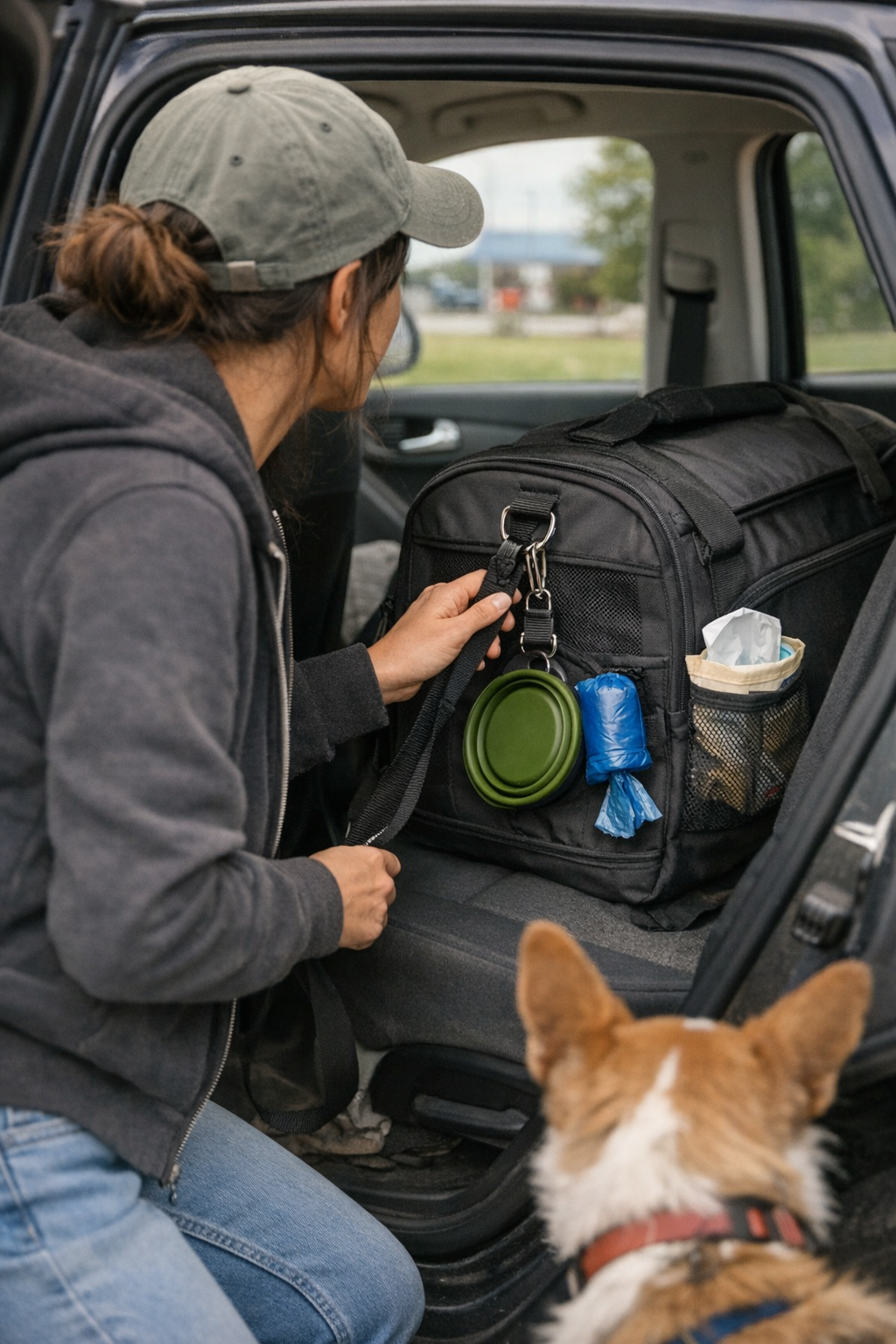
    Picture the high-friction rest stop: you’re pressed for time, dog ready to lunge, keys half out. Instead of scanning pockets or repacking on the car hood, you reach straight to a clipped waste bag at the seat’s edge—done. The leash is ready, clipped just outside the bag, no digging or double-hand fumble. Movement barely breaks stride; the restart is smooth, pet energy stays focused, and you skip the classic bag-juggle that frays nerves over a long day.

    Travel Friction You Only Notice When It’s Gone

    Repeated stops make weaknesses loud. Even a bag that impressed on day one will turn against you if daily use means constant reacharounds and forgettable pockets. True upgrades shove recurring items—leash, waste bags, wipes—into direct-access, not shared pouches or deep zips. Yes, the kit looks busier, less tidy. But efficiency overrules show: you transition from curb to car and back with nothing stuck, nothing overlapping.

    Common Setup Friction Points

    • One-hand fails: Needing a cleanup bag while both hands are full, forced into a risky unzip-and-search that risks dropping something or losing grip on your pet.
    • Stacked gear drift: Every item stacked just right at first—but by the third stop, wipes and bags have sunken out of instant reach, slowing movement every single time.
    • Owner/pet mixups: When a wallet, phone, or charger shares a space with pet gear, even a quick grab for treats turns into a full routine interruption.

    What’s barely tolerable at stop one gets old fast by stop four. Unless you fix the access logic, you’re dragging the same friction and delay through every leg of your trip.

    The Single-Reach Upgrade: Small Fixes, Big Flow Improvement

    Practical fixes aren’t about more pockets—they’re about smarter reach. Move your highest-use items to clips, visible loops, or outer pouches placed at the seat edge or carrier opening: waste bags clipped to the door, leash swinging from a carabiner, wipes visible in an open side slot. Each item split, never stacked, so nothing gets buried at the worst possible moment.

    This shift pays off in momentum:

    • Stops go smoother; less rummaging every time you park.
    • No tangled hands, no forced two-handed acrobatics with an impatient dog.
    • Cleanup and leash transitions run faster—movement feels reset, not stopped.
    • Pet stays engaged, less rattled by pointless pauses and owner-side scrambling.

    After a trip, you’ll find repacking is easier too—since nothing important disappeared into the bottom layer of the bag in the first place.

    Why “Prepared” Isn’t Always Practical

    The expected promise: more tidiness, more readiness. But tidy setups, especially fresh from packing, only feel effective if you ignore what real use exposes. “Prepared” matters less than “usable in motion”—especially when tired, distracted, or managing a high-energy pet under pressure.

    On long travel days or back-to-back stops, a system with true single-reach flow makes the difference between preserved patience and a day of friction. It only takes a missed waste bag or blocked leash to turn a simple stop into a hassle. The strongest upgrade can’t be photographed—it’s the flow that actually survives real travel. You only notice what works when, for once, nothing interrupts the pace, nothing saps your energy, and your pet isn’t left waiting while you hunt for what you already packed.

    Find pet-travel solutions and seat-side upgrades designed for real, repeated use at PawGoTravel.