Author: jaesoon_admin

  • How Linear and Panel Ceiling Lights Improve Workspace Comfort and Efficiency

    The real cost of poor lighting isn’t the first thing you see—it’s the friction that nags at you hour after hour: a bright desk with a blind spot at your dominant hand, cables jutting out along the floor but disappearing into shadow just when you need them, and surfaces that look clear at first but always seem to hide a stray pen or connector in low, unusable light. The problem isn’t just how the room looks. It’s how your routine keeps stalling: glare catches your screen at the wrong angle, corners swallow objects while you hunt for them, and every shift in your workday exposes another spot your lighting just doesn’t reach. That sense of a “finished” room? It fades fast when you’re still squinting, dodging shadows, and tracing cable runs that felt tidy until you actually needed to use them. If light doesn’t land where you need it—at the working edge, under the shelf, next to the cables—not just how the space looks, but how it actually works, gets interrupted again and again.

    When Overhead Lights Leave You Dodging Shadows

    Most standard ceiling lights—centered fixtures, general-purpose pendants, or single-source flush mounts—create presentable symmetry. But as soon as you sit down with your laptop, stack up files along a shared table, or reach for a wall outlet, the setup shows its limits. Shadows snake out along the far side of your desk, the edges of a shelf blur into half-dark, and any device cable left plugged in seems designed to vanish at exactly the worst moment. You end up shifting your chair, tipping screens to dodge a burst of glare, or brushing your hand blindly along the floor for something you dropped—again. Even with visually “clean” cable runs and organized surfaces, too many spaces end up half-lit, constantly forcing micro-adjustments and workarounds: nudging a lamp, shifting your working position, and unconsciously planning your movements to avoid the worst lighting patches.

    Linear and Panel Lights: Flattening Out the “Dead Spots”

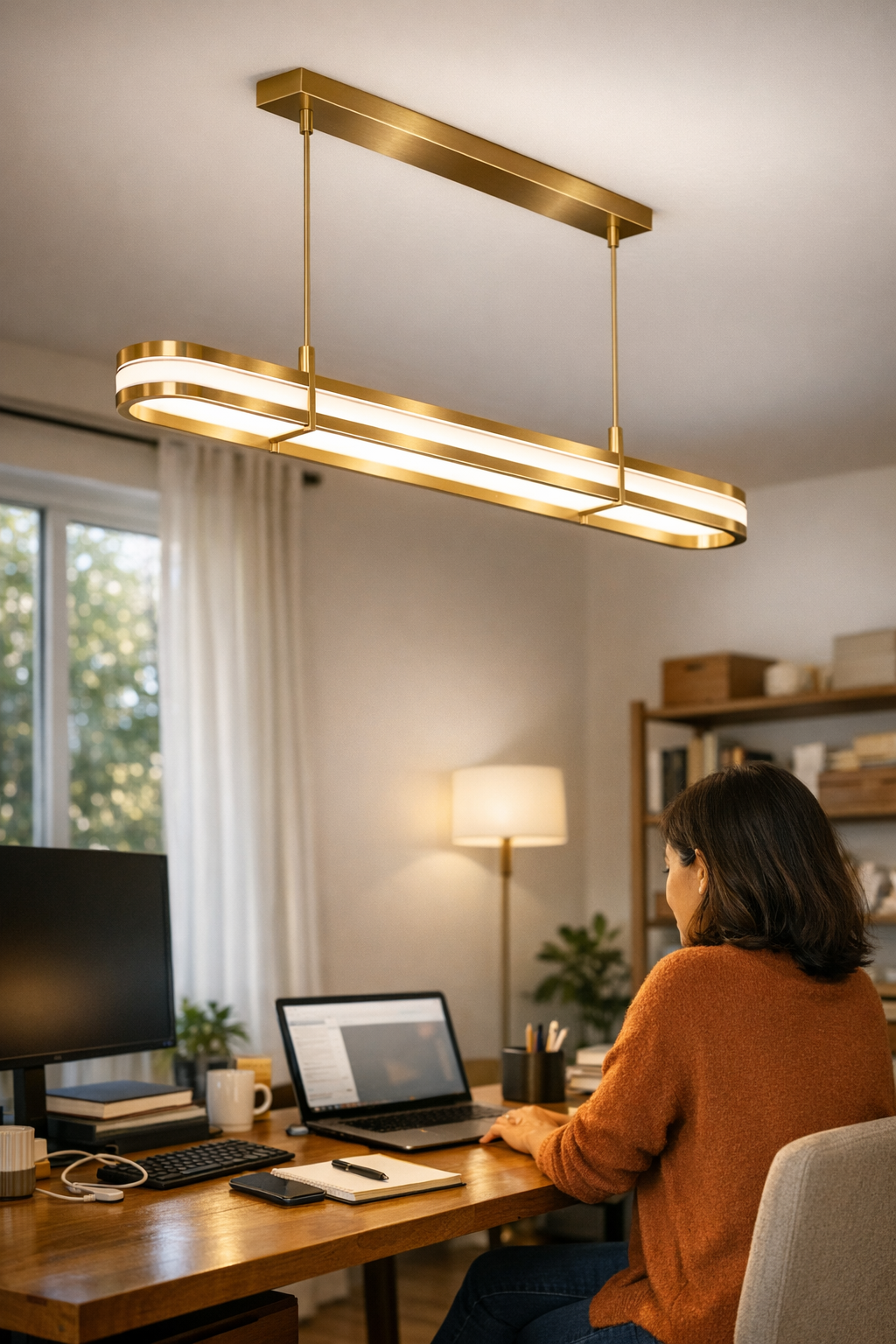
    The difference with a linear or panel light is rarely dramatic at first glance, but impossible to ignore over time. Instead of pouring most of the brightness into the center and leaving work edges and room margins to dim, linear and panel fixtures run parallel to the actual surface zones you use. When aligned with your main working run—across a long desk, along a wall-mounted shelf, or tracing the edge of a conference table—they deliver steady, even coverage that matches real movement paths, not just architectural designs. You stop having to tilt or pivot for clean visibility. Paperwork doesn’t slip into patchy shadow. Cables, pens, and devices stay fully visible, without “pockets” of gloom or repetitive glare striking your screen.

    The shift is practical: less searching for missing objects, fewer mental interruptions to adapt your posture, and a drop in the low-grade tension that builds up with mismatched lighting. This clarity isn’t just about brighter bulbs or smoother panels—it’s about fit. The right fixture shape and alignment chase away the need for constant small corrections, cutting down wasted movements in your everyday routine.

    Setup Matters: Matching Lighting to Your Real Routine

    No fixture is one-size-fits-all—especially with linear or panel lights. Their coverage power depends on your actual surfaces, ceiling height, room shape, and how you set up desk or shelving runs. Miss the alignment, or mismatch the fixture’s line to the way your furniture breaks up the space, and the old issues stay: a dead strip along the wall, bands of shadow along your main work zone, or a persistent glare spot just outside your direct view. Choose for the room on paper, and you risk trading one inconvenience for another. Look at how you move, reach, and use each zone—then orient your lighting so every key surface lands in the target coverage, not the leftover dark.

    Everyday Scene: A Shared Workspace Transformed

    Picture a group table that parallels a window, chairs drifting from end to end. Centered ceiling lights cast the classic cycle: move to the far chair, and your own shadow falls across your notes; screens sparkle with glare that follows every seat change; cables disappear at the perimeter beneath the usual dim drop-off. Swap in a panel or linear fixture running the long axis of the desk, and the difference comes into focus as you use the room: no sudden brightness shifts from one seat to another, every surface and cable path clear regardless of angle, and no drawn-out search for a charger in a murky corner. Instead of constant posture tweaks and workarounds, the room settles into the background—letting the day run on its own momentum. Most people can’t name exactly what changed; what’s clear is the absence of interruption. The room stops reminding you of its blind spots, and you spend less time compensating for the setup.

    Small Adjustments, Big Results

    The change is often one move: replace that single central flush mount with a slim linear panel, lining it up above the real working zone. The difference shows up where it counts—no more invisible cable tangle at the edge, no more pens vanishing off the desk, and no more awkward seat-tweaking just to kill a screen glare or chase comfortable light. The quick, repeated frictions—seeking a better angle, retracing the floor twice to pick up a dropped adapter—fade out first. You feel less worn-out at the end of the day not because the room got brighter, but because you stopped fighting against it with every small adjustment.

    Limitations: When Even Coverage Isn’t Automatic

    No setup solves everything by itself. Even the best panel or linear arrangement will leave gaps in rooms crammed with divides, deep shelves, or odd-angled walls. A linear run that lights the desk can’t reach behind a blocking bookshelf. A corner gets lost when part of the room is separated by a door or bulky partition. These are the signals to bring in targeted help—a plug-in under-cabinet bar for shelves, a small task lamp for a persistent dark spot, or cable management that keeps connections visible, not buried in shadow. Evenness is strategy, not just fixture shape: look at the awkward zones your hands, eyes, and devices reach most, then supplement just enough to keep those edges from sabotaging the flow.

    Real Improvements: The Difference Between Looking Done and Feeling Right

    On paper, a space can be impressively neat—flush panels, pristine shelves, cables clipped just so—but if you keep shifting to see your notes, or repeat the same annoying cable search at the edge, the setup failed the one test that matters: is it easier now, or just prettier? Linear and panel fixtures win not because they decorate, but because they reduce interruption in the movements you make every hour—less cable hunting, fewer surface blind spots, fewer jolts of glare or uneven shadow as you shift from task to task. The work rhythm smooths out. Tasks blur from one to the next, not because you try harder, but because you’re no longer disrupted by the structure of the room itself. The real test is quiet and clear: the old urge to reach for a lamp, scoot a chair, or hunt through the dark vanishes—and the space finally starts to feel finished where it matters most.

    For more practical solutions to lighting and support friction, visit LightSupport.
  • Transform Your Workspace by Hiding Power Bricks for Better Flow

    Under-desk power brick chaos rarely grabs your attention—until it shapes your entire workflow. That familiar tangle of adapters and cords, shoved by the wall or hidden behind chair legs, looks like background noise on day one. But in daily use, it quickly flips from “handled” to headache: wheels catch on cords, feet search for open floor, and every simple swap—charging your phone, adding a notebook—becomes a ripple of small standoffs with plastic shapes and stubborn cables. What you thought was a fixed problem quietly returns: that half-second pause before reaching under the desk, the slow creep of friction that makes even routine resets feel heavier than they should be. In a week of fast switches and scattered focus, these invisible obstacles pile up, making the workstation feel less like a tool and more like a puzzle you solve, over and over.

    When cable management hides clutter but traps your workflow

    On the surface, most desks look orderly after a round of cable discipline. Cable boxes, cord sleeves, modesty panels—each hides the nest, leaving the top clean and clear. The effect works… right up until you need to reset in real time. Especially on shallow or shared desks, hiding cables often means crowding them into the same stretch or cinching them just out of easy reach. The “fixed” setup starts unraveling the moment you actually work at speed:

    • Legs collide with new under-desk barriers. As boxes drift forward or bricks slip loose, even pulling in your chair feels off.
    • Every device swap slows. Disconnecting a laptop means tracing a cable path, undoing ties, or contorting around fixed points—far from frictionless.
    • The tidy look tricks you into thinking nothing’s changed—while small hesitations now line every action underneath.

    Visually, the upgrade is there. But inside a week of real use, the difference becomes painfully clear: looking sorted isn’t the same as working smooth. That space between “neat” and “functioning” becomes an everyday detour.

    Where friction creeps in during the workweek

    Across five days of real work, the problems keep resurfacing:

    • Device swaps stack up: Headphones, external drives, extra monitors—every plug change is a chore if bricks and wires are trapped behind boxes or bundled into corners. What should be a fast move becomes an awkward shuffle.
    • Rolling back becomes a negotiation: Each push of the chair grinds against cords or bumps a plastic box, slowly nudging obstacles where your legs should go. Before long, you’ve lost key knee space to the “cleaned up” cluster.
    • Cleaning is never simple: The best-hidden boxes also gather the most dust. Sweeping means dragging the whole thing out and trying to rebuild the layout each time. Unless cables are anchored aggressively, they start sneaking back out onto the desktop.
    • Quick resets stall out: Need to switch chargers before a call or round up the right cable mid-sprint? If you have to untangle—every single time—the “streamlined” system collapses where you need it most.

    The pattern reveals itself: most cable-hiding tricks survive until you ask for flexibility. As soon as you need repeated resets, or if your setup shifts even slightly, the initial benefit reverses course. Instead of flow, you get a series of routine interruptions—just subtle enough to sap your energy, just consistent enough that you adapt instead of fixing them.

    Why hiding spots matter—floor vs wall vs under-desk

    The standard solutions—floor cable boxes, under-desk trays, wall-attached sleeves—aren’t equal. The impact depends less on “cable management” as a category, and more on where friction builds up in your real setup.

    Floor-level cable boxes

    They stash adapters out of sight, but sooner or later, dust settles in, and the box starts drifting as you sweep or roll. Small desks lose usable depth fast; even the narrowest box can edge out your natural foot placement, so every desk entry becomes a cagey step around a plastic barrier.

    Modesty panels and tight routing

    Threading everything tightly behind a front panel makes for a blank, clean view—but corners get crowded, cables bend sharply, and rapid device switches demand patience you never meant to spend. Over time, the panel becomes a makeshift shelf for odds, ends, and the cables that couldn’t quite be contained.

    Under-desk mounting

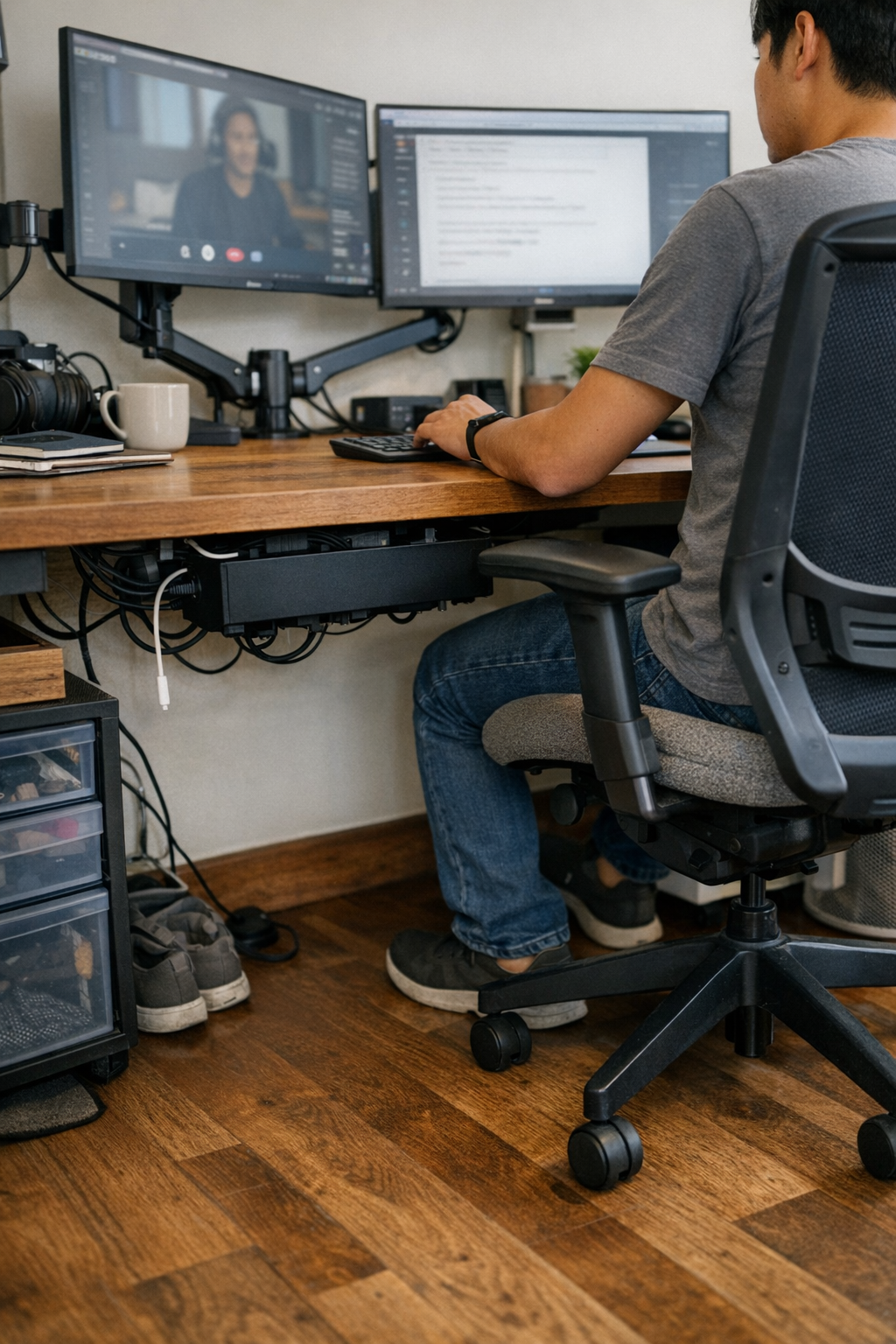
    Mounting a power brick organizer under your desk—done well—keeps adapters off the floor and away from your legs. The key: strategic placement, sturdy velcro or mounts, and leaving a margin for cable slack and airflow. Rush this job, and you get the same set of problems: too-tight fits that strain plugs, awkward rear access, or mounts that peel off as soon as the chair clips the edge.

    The fix that survived real use

    What actually held up? Mounting a power brick organizer to the underside—but not pressed up against the wall. Leaving a 10cm margin from the rear desk edge created a buffer: the center foot well stayed clear, and cables dropped gently rather than kinking or tugging. No connectors forced against the wall, no cords tensioned to the breaking point.

    Weeks later, the results held up even as routines changed:

    • Chair pushed in, feet extended—never a cable catch or brick slip into leg space.
    • No more gradual pileup: the organizer stayed fixed, and nothing worked loose or overspilled onto the floor.
    • Cleaning meant a single motion, not a full teardown and rebuild of a tangled nest.
    • Device swaps moved at the speed of thought—one reach and the plug was free, no half-minute hunt through loops or ties.

    This wasn’t perfection, just a match between hardware, routine, and real-life mess. The main win: a setup that stopped breaking stride after every reset, even when the room needed to look organized for someone else.

    Choosing a cable-hiding strategy: what matters most?

    Is a cable box on the floor ever worth it?

    If you have acres of open floor and never clean beneath your desk, maybe. But most users get the opposite: a dust magnet that drifts out of its lane, blocks the spot where feet should park, and complicates life as soon as you add one extra device or change outlets under pressure.

    Why do hidden power bricks still cause trouble?

    Because bricks and strips migrate, pulled by cord tension, jolted by chair wheels, and nudged by cleaning. Unless anchored hard—velcro, mounts, or adhesive—they drift. An unanchored floor box will never behave for more than a few days of real use.

    How does cable-hiding backfire?

    Over-tight routing—short sleeves, sharp bends, aggressive bundling—kills flexibility first. Plugs start wiggling out, insulation gets scuffed, and every device change builds irritation you don’t notice until you’re avoiding the reset altogether. Always budget more slack than you think you’ll need. Easy now means easier much later.

    The workstation that works—not just photographs well

    The best cable and brick approach doesn’t just hide power for a tidy photo. It keeps access reliable, foot space open, cleaning fast, and device swaps nearly automatic. Plenty of desks look flawless right after a cleanup; but their real value shows in the middle of a crowded workday—when a new charger needs to fit, when you slide a notebook beside your keyboard, when the chair glides all the way in, and nothing snags beneath. That’s the point: function that quietly outlasts appearances.

    If every work session ends with a little more annoyance and a little less flow, it’s time to reevaluate: your cable solution is performing for the wrong criteria. Start with foot space, stable mounts, and a bit of forgiveness for cable movement. The right fix works not because nobody sees the mess, but because you finally stop feeling it every time you move.

    Explore the full WorkBasic collection

  • Why Your Garage Storage Fails After a Few Uses and How to Fix It

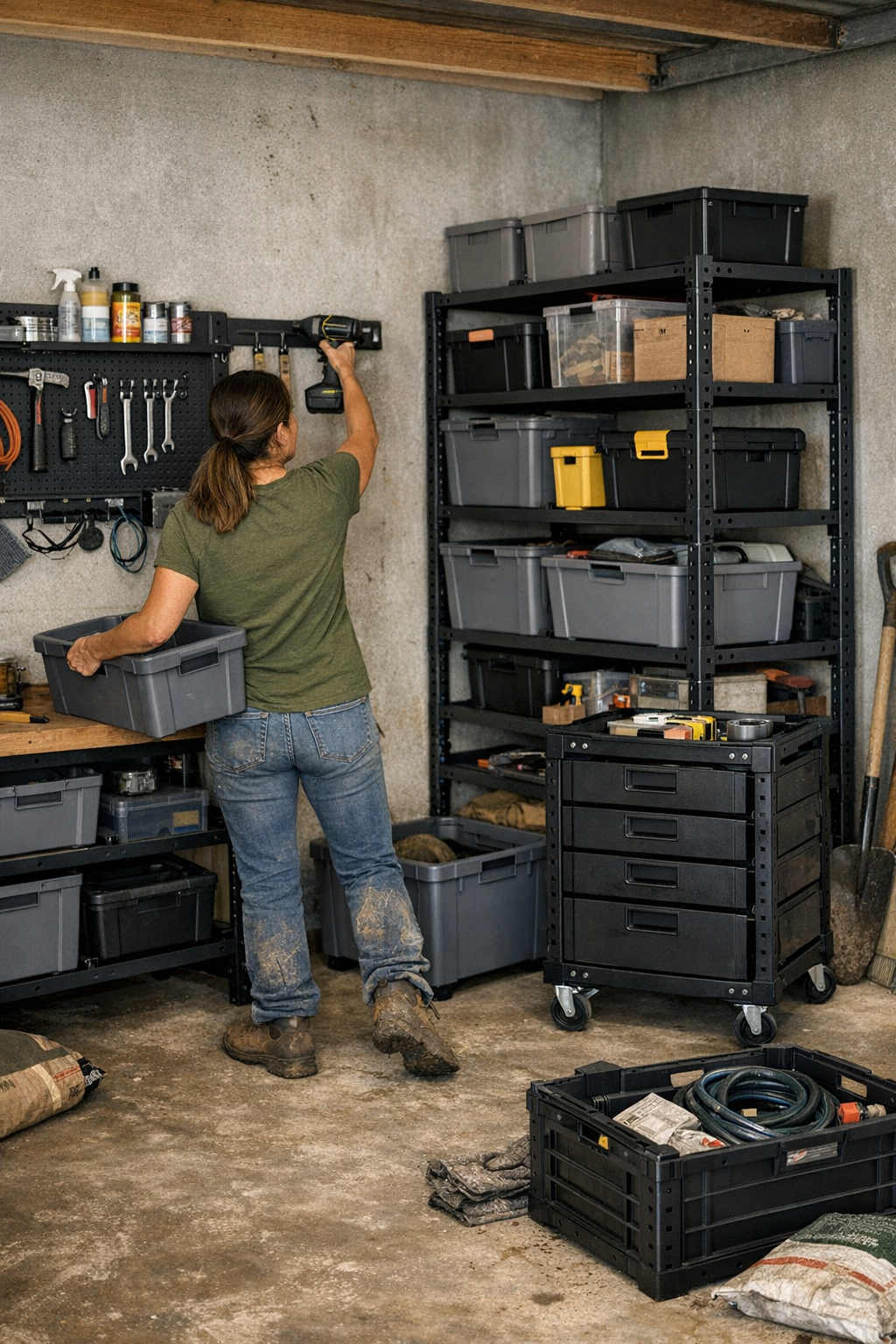
    The difference between a space that “looks organized” and one that truly works for you is exposed at the exact moment you’re in a hurry—reaching for a tool, trying to reset the bench between jobs, or hunting for that one item you know you put “somewhere obvious.” In the world of garages, workshops, and utility rooms, the setup isn’t tested by photos on day one—it’s tested by the repeat friction that creeps in day after day.

    Where Friction Lurks: The Subtle Enemies of Flow

    Most setups start out promising. You spend a weekend lining up shelving, add a fresh cart, maybe even label every bin. At first, there’s relief: everything feels in control. But fast-forward a few weekends of real projects, and the cracks show.

    Do you find yourself nudging a cart aside—again—just to swing open a cabinet door? Unstacking two lighter bins to get that heavier one you always use? If grabbing a screwdriver means weaving through an awkward footprint or shuffling an overflow pile for the third time this week, your storage is silently slowing you down. What looked efficient becomes a daily source of tiny interruptions.

    When “Organized” Turns Into Obstacles

    An area that appears uncluttered on day one can quickly sabotage itself under stress. Return a tool after a long project and discover there’s no clear place—so it gets tossed in the nearest open bin. Then you block a shelf with leftover gear. Soon, small delays become predictable: sidestepping, pushing aside, rummaging. Every extra step and blocked route reinforces the same truth: the system fits the stuff, but not the way you actually use the space.

    Reality Check: The Shuffle Trap in Action

    You finish yard work with tools caked in dirt. You bring a shovel back to the garage, but can’t return it to its intended spot—maybe a camping cooler is blocking the shelf, or a folding chair wedged in from the last “reset.” Out of time, you lean the shovel against a wall or wedge it into a bin. By next weekend, it’s buried, and the quick return becomes another drawn-out hunt. Over time, what should be “grab-and-go” turns into constant reshuffling. The system doesn’t fall apart all at once—it wears you down through accumulated friction.

    Overflow Zones and Corners Gone Stale

    Every setup develops trouble spots: one shelf that absorbs anything that doesn’t fit elsewhere, the back corner that becomes a graveyard for half-finished projects, a stretch of wall that’s labeled but never truly used. When those overflow areas swell with stray items—when you keep parking a cart in the only clear floor path, or junk spreads into the same awkward corner—the layout has stopped supporting you and started resisting your flow.

    Overflow signals lost ground. It eats up valuable floor space, clogs walkways, and bogs down even the quickest reset. The mobile cart meant to increase flexibility becomes immobile—parked in front of standing space, collecting whatever you can’t put away quickly. Instead of relieving chaos, your “solution” reshuffles it into places that interrupt real work.

    Pretending to Be Organized—Until Use Proves Otherwise

    Beneath the surface order—stacked bins, neat labels, fresh lines on the floor—old problems often persist. If putting anything away regularly means shifting something else or inventing new categories on the fly, your routines suffer. What starts as organization slips into a free-for-all: categories blur, clear paths vanish, and the time spent “maintaining” only increases.

    Unlocking Flow: One Upgrade Can Change Everything

    True improvement rarely means a full overhaul. Often, one smart tweak unlocks your whole routine. Swap a deep, double-stacked shelf for a shallow wall rail above the bench: suddenly, you’re not reaching over three bins for pliers—they’re just there, in sight, at hand. No more stacking and restacking. The setup isn’t perfect, but every grab-and-return is smoother, faster, less likely to snowball into chaos.

    These changes don’t erase mess forever—but they create a system that stays functional even as tools shift in and out. Over time, that’s the real difference: a workspace that adapts to use instead of collapsing under it.

    Try These Two Real-World Tests

    • Map your return moves: The next time you’re done with a chore, notice exactly how you put back the five things you touched most. Are there extra steps? Do you have to detour or move something else first? Small annoyances repeat and multiply fast.
    • Spot your quiet spill zones: Pay attention to which areas gather items “just for now.” Are those shelves or floor areas attracting overflow because there’s no real home for those objects? This is the setup’s pressure test—where it breaks, revise with clarity or fresh storage before clutter becomes the default.

    Making the Setup Last: Build for Use, Not Photos

    The best setups aren’t the most visually impressive; they’re the ones that let you move without second-guessing, reset without dragging bins around, and adapt quickly as needs change. In practice, that often looks like:

    • Mounting your high-turnover tools right where you actually use them—even if it “breaks” the symmetry.
    • Creating designated cart paths free from blockage, not just empty floor on setup day.
    • Picking storage shallow enough that nothing gets buried, so you see it, grab it, and put it back—no buried layers waiting for next season.
    • Tweaking the system regularly when new overflow or dead zones appear; don’t wait until frustration sets in.

    Setup is a living pattern—never finished, always adapting. A system that fits your real routine makes daily movement simpler, not more complicated. If you constantly find yourself blocked, overloaded, or reshuffling despite best efforts, it’s not disorganization—it’s your current setup holding you back. The right, practical adjustment can shift your workspace from a struggle back to a tool that actually helps.

    http://stacknest.myshopify.com

  • How a Small Trash Bin Transforms Entryway Clutter Management

    The overlooked clutter always starts small: a wrapper tucked behind shoe baskets, a crumpled snack bag abandoned on the bench edge, packaging stranded near the shelf. The first day, no one notices. By the third, wrappers start making the rules. Each time someone rips open the mail or empties a bag in the entryway—then walks off without a bin in reach—the drop zone absorbs another fragment. The mess doesn’t just collect; it migrates, slips between shoes, hides under benches, and returns to the surface with every shuffle. Suddenly, “resetting” the entry no longer means restoring order, but launching another lap through concealed traps of trash the system was never designed to catch. And the longer this gap stays unaddressed, the more it blocks flow—turning the threshold into a place you rush through, not use with intent.

    How Trash Finds Its Way Into Every Transitional Gap

    Every real entryway gets hit with shoes, bags, packages, mail, groceries—over and over, day after day. One rushed afternoon, a snack wrapper lands on a shoe rack while bags are unloaded and left in a hurry. Parcel packaging parks on the bench, blending in until it becomes background clutter. Junk mail scraps settle in with keys, “just for a second,” and hang around for days. No built-in disposal means that trash never exits in a single pass: wrappers drift from one surface to the next, bouncing from shelf to shoe to bench.

    • Wrappers that start by the drop zone end up jammed beneath shoes after a week of comings and goings.
    • Mail shreds, package tabs, and snack remnants fill the small “dead zones” no one intends to use.
    • Even wall-mounted storage and open shelves turn into accidental collection spots when there’s no clear-out channel.

    In the absence of a bin right where unpacking happens, every storage feature becomes a fallback trash shelf. The cycle repeats: nothing gets out cleanly, and each quick tidy is just a partial reset that lets the same debris sneak back in.

    Why a Designated Bin Changes the Entire Entryway Routine

    Introduce a properly sized trash bin directly into the routine—under the bench at shoe-removal height, beside the main door, or pressed against the main drop spot—and wrapper migration collapses. Suddenly, when mail is opened or a snack is finished, trash has nowhere to spread. Wrappers and packaging are discarded instantly, right where clutter begins, not shuffled to the next surface “for later.”

    This isn’t just about surface appearance—it shifts the entry’s entire rhythm. Debris never makes it behind shoe racks, never hides out in baskets. Resetting the entry turns from a slow, multi-stage hunt (sweeping every corner for hidden trash) into a single, clear routine. The system removes friction: clutter gets absorbed and exits without delay, so the area stays functional day after day.

    Not Every Bin Works: Size, Placement, and the Backfire Effect

    Drop the wrong type of bin into the entry—too large, awkwardly shaped, or tucked away—and the problem just shifts. Oversized bins become a final depot for general trash: weeks pass between empties, and the zone gains a new sense of unresolved mess. Awkward bins, parked out of reach or poorly aligned with movement, are skipped entirely or overflow in the wrong spot. Instead of solving wrapper drift, these bins become their own stationary clutter, demanding manual resets or getting ignored. When the disposal channel is incorrect, trash doesn’t exit—it just detours, and the reset burden falls back on you.

    Scenes That Spotlight the Entryway’s Real Storage Weak Spot

    Regular routines push systems to their edge. Picture Sunday night: several people, multiple bags, groceries, parcels, and backpacks squeeze through the same threshold. There’s nowhere to toss packaging except the nearest flat surface, so wrappers fan out over the bench and nestle under shoes. Midweek comes; passing through means dodging mini-piles that now block shelves and bench seats. Every shoe line is pushed wider. The bench becomes more landfill than seating, and by the next round of resets, you’re not clearing shoes—you’re dragging out all the trash that’s floated into every gap.

    • Shoe storage gets jammed with transient debris, and rows start slipping past their assigned lines.
    • Drop zone shelves and key trays quietly fill with wrappers that never made it past “just for now.”
    • Quick in-and-out moments slow down, pressured by stray packaging at every touchpoint.

    This isn’t neglect—it’s a system missing a critical step. The trash never exits on the first pass, so low-level congestion seeps into every part of the flow. Resetting gets slower, passing through the entry grows tighter, and clutter takes up mental as well as physical space. That’s how wrappers turn from temporary inconvenience to semi-permanent congestion—because no alternative exists at the exact friction point.

    The Power of Precise Placement: Making the Bin Disappear Into the Routine

    Tested in actual busy entryways, a compact, lidded bin placed right under the bench—exactly where bags and shoes land—is nearly invisible by the second week. It opens easily with a foot nudge. Wrappers get dropped as soon as they appear—no detours, no “I’ll handle this after.” The zone stays clear not from discipline or extra effort, but because disposal becomes a reflex, not a chore. The difference isn’t just neatness—it’s daily movement that’s smoother, reset cycles that shrink, and no more strays lurking behind walls or inside baskets.

    For real use, size is not a small detail. A capacity of 2–4 liters handles the typical pile-up—snack wrappers, package debris, mail fragments—without becoming the next trash can for the whole house. It fills on cue with routine debris, empties out on schedule, and never gives wrapper drift a second home. Too big, and the entry inherits a new mess; too small, and wrappers overflow, restarting the cycle. The right size and spot mean trash disappears on arrival—and the entry stays open for every round of shoes, coats, and bags moving through.

    Practical Tips for Entryway Bin Setup

    • Place it where unpacking happens: Under the entry bench, close to the primary door, or right at shoe-drop height. The shorter the path, the fewer wrappers wander.
    • Choose a compact volume (2–4 liters): Enough for daily debris, not so much that it morphs into a permanent garbage stash. Predictable to empty, impossible to ignore.
    • Use a lidded bin: Keeps contents contained and avoids accidental spills, especially with pets, kids, or a tight passage between outdoors and in.

    The Real Difference: Containment vs. Camouflage

    Most entryways can look organized after a heavy tidy—but without dedicated disposal, wrappers aren’t gone; they’re just hidden until the next reset. A bin doesn’t simply store trash—it gives it an exit ramp the system never had. Baskets and wall shelves are designed to contain, but without a real trash channel, they camouflage the problem, letting debris resurface in cycles. The real improvement isn’t cosmetic: it’s spending less time chasing loose wrappers and more time moving freely through an entry that self-clears every time you walk in the door.

    From Drop Zone Congestion To Smoother Daily Flow

    A small, well-placed trash bin doesn’t just clean up appearances—it clears the underlying cause of recurring entryway congestion. No more collecting wrappers for the next trip to the kitchen. No more using a recycling basket as a stand-in. Packaging and debris leave the entry the moment they arrive. The drop zone stops falling back into disorder between resets. You can cross the threshold without sidestepping yesterday’s clutter, and the routine speeds up without backtracking for strays. The result: a transition space that finally matches the way you use it—open, resettable, and ready for whatever walks through the door next.

    Find transition-space entryway solutions designed for real daily use at Betweenry.

  • Why Choosing a Larger Litter Mat Transforms Home Cleanliness and Maintenance

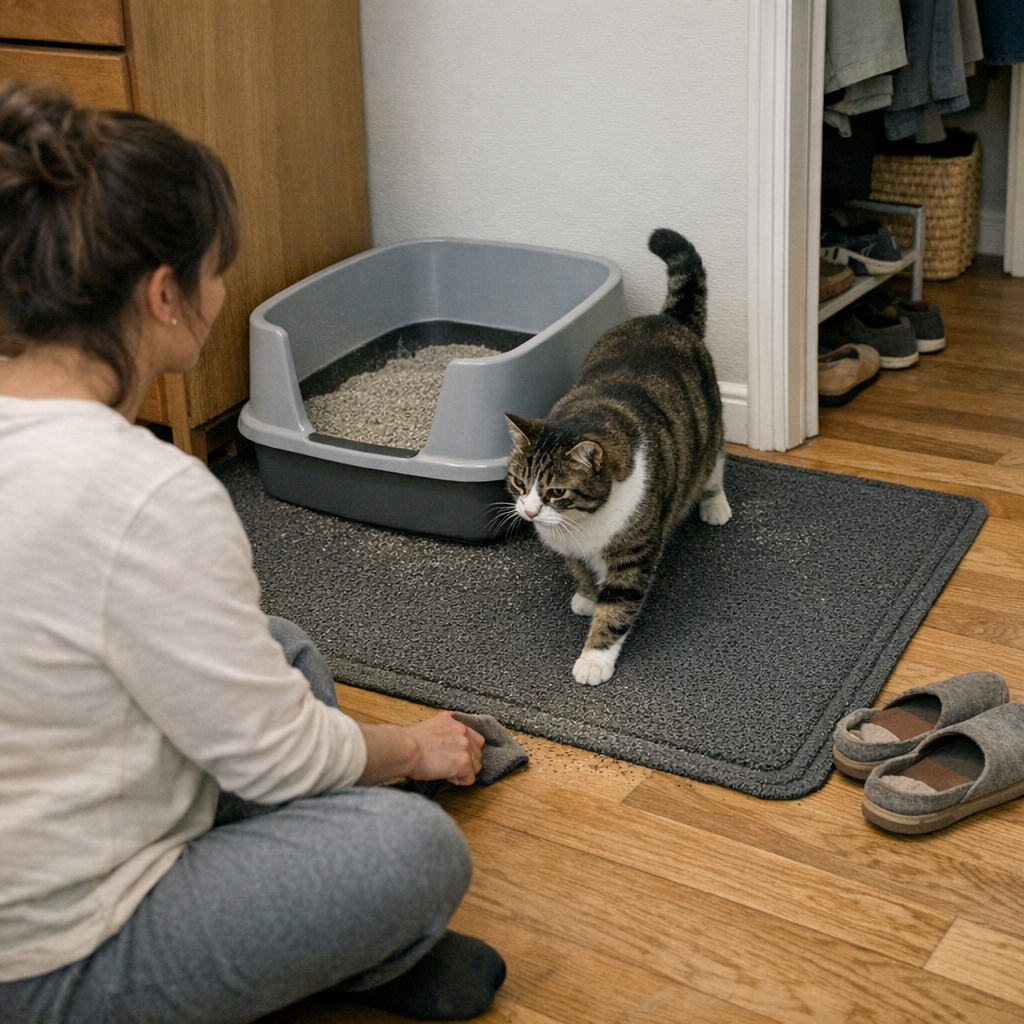
    Every indoor cat owner knows the pattern: a fresh litter mat goes down, the floor gets a careful sweep, and for a day or two, it looks as if the litter zone might actually hold together. But by midweek, gritty granules crawl past the mat’s edge and wedge themselves everywhere you walk—into seams between floorboards, under the kitchen table, across the walkway where you top up water bowls or sweep out stray toys. What looked like “contained” order quickly crumbles, and routine resets become a constant, silent battle against slow leaks of mess that never seem to stop at the mat’s promised boundary. The real-life StillWhisker setup starts with recognizing this cycle, not glossing over it.

    The Small Litter Mat Problem: Looks Can Be Deceiving

    A standard litter mat gives a first impression of control—a landing zone that hints at less mess and a line your cat’s paws won’t cross. For the first couple of days, this seems to work: the edges line up, the walkway beside the box passes an eye test, and maybe you even vacuum with a sense of closure. But in reality, one look underfoot or a midday sweep tells you the boundary broke hours ago.

    Repeated use is where the flaw opens up. Each trip to the box sends grains arcing just beyond the protective edge. The instant the mat fills up, stray litter launches directly onto tile, carpet, or wood. By Wednesday, you track a faint, gritty line right into the kitchen or the refilling spot for the water bowl. Even when a small mat “looks” full, the escape continues, creeping silently under doors and into daily footpaths you can’t avoid.

    Where Setup Friction Shows: Beyond the Box

    Indoor-cat life means the litter box zone isn’t isolated—food dishes, storage bins, feeding mats, and the occasional dash underfoot all crowd the same corner. Place the box near laundry, a closet, or a busy hallway, and it’s only a matter of hours before the supposed boundary erodes. Real friction shows up when:

    • Reach Gets Interrupted: Topping up water means stepping over a scatter of litter pebbles—one misplaced mat edge, and suddenly each refill trip gets slowed by a surprise crunch or awkward sidestep.
    • Surface Stays Gritty: Entryway and kitchen floors start harboring hidden granules. Go to wipe behind a table or check under a chair, and what should have been a 10-second reset turns into dragging out the mop.
    • Cleanup Splits Locations: Instead of a contained spot, you end up wiping two, sometimes three different zones: by the litter box for the main dump, and wherever those persistent granules roll or hitch a ride.
    • Resets Stack Up: Instead of one quick routine after breakfast or a food refill, you’re retracing your route, scooping and shaking down crumbs from every mat and walkway the litter crosses.

    When the Mat Is Too Small: Tidy Looks, Messy Reality

    The first warning sign isn’t a messy-looking space—it’s the sensation of grit under your heel when you least expect it. The mat might trick the eye with a clean border, but as soon as the cat takes a single stride outside the coverage zone, the boundary flops. Cats that exit sideways, sprint out, or pick a favorite off-center route guarantee those edges won’t hold. Each day, the line of debris creeps further from the setup, and what started as a focused space now seeps into laundry corners and high-traffic hallways, making each sweep or quick reset slower and less satisfying.

    For anyone in a tight apartment or a home that pulls feeding, litter, and rest areas closer together than desired, the cost stacks up fast. Suddenly, you’re not just sweeping; you’re managing ongoing clutter in places meant to stay clear—across bare floors, under feeding stands, and in the very spots you hoped would be easiest to wipe down at the end of the day.

    Shared Spaces, Shared Headaches

    A mat that’s too small for the job doesn’t hide its failures; it just moves them around. You find clusters of litter in water splash zones, under the edge of a resting mat, or at the pivot point for stashed cleaning gear. Where cat space overlaps with daily life, narrow mats open up more places for debris to accumulate—and more moments where a quick task is derailed by unexpected mess or blocked access to a supply bin.

    Re-Thinking Litter Mat Size: Why Wider Is Different

    Choosing a larger mat isn’t just about adding width for looks—it’s about real, structural change to daily containment. Lay down a mat that extends 18–24 inches or more past the litter box exit, and you notice right away: gritty trails fade, the time until your next full sweep actually stretches, and the majority of kicked litter now lands in grooves, not on the open floor. This isn’t a small tweak. It’s a containment upgrade that stops the spread before it becomes a room-wide hunt for stray grains.

    The difference is sharpest where routines overlap: The margin between the litter zone and where food or water is prepped, the line you walk to put away supplies, the visible boundary between pet setup and shared home space. Suddenly, cleanup shrinks from endless spot-checks to a couple of planned resets. You feel it when refilling bowls no longer means tiptoeing around scattered bits, and when “quick wipe down” no longer stirs up a hidden mess from under the mat’s edge.

    Real-World Adjustment: Following the Cat’s Path

    Cats aren’t precision machines; few exit directly out the front every time. If your cat favors a diagonal jump, a sideways stride, or the occasional burst of speed, a mat centered only at the box’s front becomes meaningless—grit carves its own escape lane. Watch the weak side after three days. Where the first trail appears is where the mat coverage is failing. Shifting or swapping in a wider mat cuts down the spots where litter slips past, shaving off those creeping “surprise” cleanup needs from your daily routines.

    Compact Room, Large Mat: Fitting Without Overshadowing

    It may feel awkward to drop a big mat into a snug laundry nook or entryway, but the trade-off is visible in fewer patrols and less scattered mess bleeding into living space. Instead of policing every odd corner or resetting the floor after each visit, you gain a boundary that contains, not just masks, the recurring friction between “cat zone” and the rest of the home. It’s a swap: slightly less open floor for far less day-to-day interruption.

    Choosing the Right Mat: Details That Make a Difference

    Grabbing an average mat off the shelf is rarely enough. Surface and depth matter as much as size. Flat or glossy mats let grains skid off, especially if a cat’s paws are caked or the exit is energetic. Look for deep grooves or mesh overlays—designs that actually grip, not just display, the fallout from repeated passes. These details show up in daily results, not just product tags:

    • Size: Minimum 18–24 inches from main exit; wider if your cat has non-center habits.
    • Texture: Deep grooves or mesh layers stop the skip-and-slide routine, holding microscopic litter that smooth mats leave behind.
    • Reset Ease: Pick something you can shake out or vacuum in seconds, not a design that forces awkward flexing or constant wrestling. Plan to sweep or shake every few days, but upgrade to weekly resets, not daily fire drills.

    What Happens When the Mat Finally Fits

    A mat that matches your cat’s exit path doesn’t chase perfection—it creates repeatable containment. By Thursday, if the border still holds and the walkways feel smooth underfoot, that’s the test passed. The big relief isn’t eliminating every stray grain, but in reducing the number of times a “quick clean” stretches into a whole-home sweep. Fewer interruptions, walk zones stay comfortable, and the “reset” pressure falls back into line with actual living, not endless maintenance. The difference won’t always be obvious in photos, but you’ll feel it walking from room to room without the underfoot crunch returning on day three.

    Routine Tweaks for Easier Litter Zone Maintenance

    A well-fitted mat helps, but a few small habits make life easier:

    • Shake out or vacuum the mat every 2–3 days—or daily for multi-cat or high-traffic spaces.
    • Relocate water and food bowls if you spot litter working its way in—distance helps isolate the problem and shortens cleanup cycles.
    • Keep a brush or hand-vac within arm’s reach, not buried behind a storage tote—if it’s easy to grab, it actually gets used when quick messes appear.
    • Avoid letting supply bins or storage crowd reset routes. If access slows you down, relocation is overdue—storage should help the flow, not block it.

    Containment that actually holds up through the week means less time spent correcting the same old weak points and more space that works for both you and your cat. Litter management

  • How Proper Placement Keeps Bathroom Linen Cabinets Moisture-Free and Organized

    The difference between “organized” and actually easy-to-use storage shows up fast when it comes to towels. That sharp-lined bathroom linen tower looks calm at first—but five days in, the flaws start appearing. Towels pulled from lower shelves feel limp or stale, the tower’s closed doors trap steam from daily showers, and what once seemed handled quietly becomes another source of small, repeated disruption: slow-drying linens, musty corners, extra shuffling every time you reach for a fresh towel. Hidden inside most linen cabinets is a cycle where visual order doesn’t equal practical reliability—even when the setup looks perfect immediately after install.

    The Hidden Effect of Placement—Why Moisture Finds a Way

    The real tipping point isn’t dramatic. On busy mornings, you grab a towel from the “good” middle shelf, but it’s not crisp—just faintly damp, not quite right. It’s rarely a visible leak. Instead, it’s the slow, invisible humidity that blankets the cabinet after every shower. Where you place a storage tower matters: wedge it too close to a shower door or under a window prone to condensation, and even the tightest cabinet seals are no match for gradual moisture buildup.

    This becomes a repeating feedback loop. Each stack absorbs a bit of dampness, so freshness fades unevenly. Over several days, you’re not just grabbing a towel—you’re testing for the driest one, re-stacking leftovers, and hesitating before shutting the cabinet again. Over time, retrieval turns from routine to mild shuffle: rotate, sniff, refold, repeat. The system quietly loses its edge, and the difference becomes annoying, not just inconvenient.

    Towers That Look Organized vs. Towers That Stay Functional

    Closed tower cabinets promise dust-free stability, but they routinely trade airflow for appearance. Behind some tidy door, lower shelves take the brunt of the moisture—especially when the tower is pressed up to splash zones or cheap vent windows. What looks sorted quickly slides into the old cycle: most-used towels get shuffled to the top, forgotten ones stagnate below, and musty surprises multiply midweek.

    Open shelving flips this problem—air circulates, you can check towel condition instantly, but now everything is exposed. Lint, visual clutter, and a sense of unfinished business move in. Worse, in tiny bathrooms, either setup used without considering the true flow of steam just makes bad positioning harder to ignore. Stack a closed tower near the steam source, and you’re back to rotation games and, eventually, hidden mildew creeping in from below.

    Repeated Use Reveals Subtle Pressure Points

    Picture a real outcome: a tower placed two feet from the shower, with no exhaust fan. The first couple of days, storage seems ideal—towels stacked, quick to grab. By Thursday, the bottom shelf is loaded with slightly heavy towels, while the few on the upper racks get all the action. You fall into a loop of:

    • Pulling towels, then quickly shuffling lower stacks to air them out
    • Second-guessing the “safe” spot, fishing around after several back-to-back showers
    • Half-empty shelves as you constantly rotate older towels upward, losing track of which set is still good—organization becomes a moving target

    This ongoing, low-key uncertainty doesn’t just erode your storage—it chips at every attempt to streamline the morning routine.

    A Small Shift That Changes Everything: Moving Away from the Steam

    Most fixable problems don’t need a new cabinet, just a rethink of placement and shelf loading. Shifting a tower 50 centimeters out of the wettest zone—further from blast lines or that perpetually fogged window—immediately reduces trapped moisture. Another often-missed trick: leave one shelf free between stacks. This empty space lets air move and towels breathe, even in a cramped setup. It costs a bit of storage, but the payoff is real: fewer towels going limp, less reshuffling midweek, easier resets on laundry day.

    Within days, towels stay lighter and more consistent. That background mustiness fades, and the usual “air out and hope for the best” ritual quietly disappears. Instead of digging for a dry set, every shelf becomes more reliable with less fuss. Sometimes, the hardest-working storage tweaks come down to one adjustment—distance from the damp, and resisting the urge to cram every inch at capacity.

    Practical Tip: Mind the Shelf Gap

    Don’t pack every shelf just because you can. Skipping a row or alternating where stacks land creates small air channels that keep towels fresh much longer. Rotate which shelf holds empties and which gets restocked, and watch the reset cycle smooth out. That minor “waste” of shelf space prevents the bigger drain: endless midweek reorganizing and rotating, all to keep up a system that should have made the routine easier, not harder.

    Tower Height, Airflow, and the Role of Routine

    Adding more shelves might seem like progress, but it often creates new problems. When towers get too tall, bottom layers become dead zones—forgotten towels hiding out of reach and slowly collecting humidity. Realistically, three shelf levels is the high-water mark for most home bathrooms. Anything more, and you get category drift: last year’s towels living at the base, out of use, while a rotating handful cycle through the top. The best layout keeps shelves above splash lines and along clear wall space—away from heat pipes or plumbing, so movement and airflow stay simple and predictable, not blocked or hidden.

    Closed vs. Open: Choosing for Your Actual Space

    Closed cabinets defend against dust if you’re disciplined about regular airing out and don’t overload every shelf. In drier corners, they work smoothly. But shut too tight or filled too deep, they turn into slow-reset chambers, trading sleek appearance for hidden maintenance headaches. Open shelving has a different rhythm: it forces rotation, avoids forgotten stacks, and keeps even the bottom towels in active use. Hybrid options—closed for reserves, open for everyday—often make sense, so long as the tower stays clear of the steamiest walls and you’re willing to prioritize ease of circulation over absolute capacity.

    What Looks Sorted Isn’t Always Easier to Use

    The proof of a bathroom storage system isn’t in perfectly folded stacks—it’s in how many times you grab, pause, and reshuffle before getting what you want. If you’re opening one door to reach for another, running overflow onto a random chair, or leaving drawers half-closed to let air in, your setup isn’t really working for daily life. Storage should match the actual rhythms of your routine, not just hit a visual benchmark.

    Keep questioning: does this layout give you what you need in one smooth step? Reducing shuffling, doubling back, and hesitating over stacks makes all the difference—far more than extra shelves or decorative order ever could. Placement, airflow, and space for circulation are what make towel storage part of a reliable routine, not just a once-a-week reset challenge.

    For more practical storage systems and ideas, visit Gridry.

  • Preventing Route Overload in Pet Travel: Maintaining Easy Access After Every Stop

    Every pet owner with a “ready” travel bag knows the letdown: by the second or third stop, what looked organized becomes a tangle of unreachable essentials and awkward searching. Even the best-packed setup breaks down mid-route—leash buried, wipes hiding under toppled bottles, bowl compacted under comfort gear. Each quick stop magnifies the gap between the look of preparedness and the reality of grabbing what you need. Struggling at the wrong moment means a restless pet, lost time in parking lots, and a nagging sense your so-called system is working against you—especially when pressure hits during a spill, sudden cleanup, or frantic leash grab.

    When “Organized” Isn’t Usable: The First Signs of Setup Slowdown

    The failure isn’t dramatic. It’s small but immediate: the leash, once in plain sight, sinks behind a backup collar. Wipes—folded for neatness—now buried beneath a lap blanket or pressed behind a bulky bowl. That clean, central compartment makes sense until your first roadside walk or messy water spill, when the high-frequency items are anything but quick to access. It starts with fumbling around at the next pit stop and ends with you abandoning the idea of tidy repacking entirely, leaving wipes tossed on the seat and leash hooked wherever it fits. When each restart means another round of digging, you know the setup’s not holding up in the real world.

    Real-World Route Friction

    Take a week’s worth of errands: early dog park detour, pharmacy run, vet waiting room. On paper, your system holds all the right pieces, but try grabbing the leash with your dog squirming after a pit stop—it’s wedged under a spare sweater. Next time, wipes you swore were handy end up pinned beneath a bottle. Before long, every attempt to exit means another shuffle: bowl and harness trade spots, treats spill out, leash tangles in a zipper, and cleanup gets slower every time. The repeated friction isn’t a failure of organization—it’s proof your bag doesn’t match the stop-and-go rhythm of real travel.

    Why Structure Breaks Down in Repeated Movement

    Most pet bags are engineered for picture-perfect packing, not seat-side reality. The flaw is structural: items needed often—leash, wipes, travel bowl—drop under less-used gear, hidden by the very neatness you started with. Each reset after a stop adds seconds—then minutes—as you rearrange, repack, and repeat the cycle. By mid-week, it’s the same routine: you fix the bag, but the next interruption buries the essentials all over again.

    A Setup That Looks Ready But Stalls the Routine

    The pain point never appears in staged photos—it hits when your dog whines and you’re rooting for wipes under a water bottle rolling across the seat. Suddenly, “well-organized” feels like a trap: every layer and pocket built for show, not for the moments you’re in motion and pressure is up. In that gap between ideal and actual use, tiny delays multiply, agitation builds, and the line between “organized” and “usable” gets sharp and visible—right when you can’t afford distraction.

    Overlapping Organization: Order That Slows You Down

    More compartments rarely solve this. Instead, they create a shuffle: collapsible bowl pressed flat (and invisible), leash coiled around the wrong pouch, wipes lost at the intersection of two zippered sections. Owners end up reaching into the wrong place half the time or interrupting their route to sort items yet again. By the third or fourth stop, quick fixes—wipes tossed in the cupholder, leash knotted on the headrest—start to clutter the entire car, not just the bag.

    The Real Cost: Cumulative Delay and Agitation

    Every shortcut—leaving bags unzipped, tossing items loose—signals that your gear is failing the real test of repeated movement. The cost isn’t only visual mess, it’s every extra minute spent searching and every restart hampered by slow access. It’s the cycle of things getting messier, faster, every time you stop, start, and need something on cue.

    Practical Fix: Rethink Item Access, Not Just Item Placement

    Appearance isn’t the target—flow is. Redesign your setup for mid-trip resets by anchoring the highest-use items (leash, wipes, bowl) to one side-mounted section—something accessible from your seat or as you step out. No more upending the main compartment or tracing through three zippers. Every return to the car becomes a true reset—less stress, less delay, less mental drag gathering up your pet’s travel basics when patience is already thin.

    Reducing “Bag Lag” With Accessible Paths

    Direct access wins over “neat” packing every single stop. When leash and wipes live in a purpose-built quick-reach pocket or side anchor, you stop losing rhythm. Clipped travel bowls or dedicated hydration slots mean nothing gets hunted, nothing rolls or vanishes. With each routine loop, seconds are saved, clutter is minimized, and your energy isn’t wasted resetting the same mess.

    Recognizing the Early Warning Signs of Overload

    Most only notice the slow unravel after shortcuts become habits: essentials left on the dashboard, cleanup skipped, leash looped wherever it lands. By then, the bag that solved one problem is causing another—repeated friction at every stop, mounting tension as resets fail. Setup overload creeps in not as a dramatic collapse but as a series of missed beats that drag down every pet travel outing you attempt.

    The Look of Readiness vs. Usable Rhythm

    It’s easy to be fooled by a post-staged bag, but actual routine exposes which setups survive repeated, real use. After a few stops, the system that recovers instantly—from seat to sidewalk and back again—feels vastly different than one that looks untouched but needs constant rearrangement. In practice, order that works under pressure always beats perfection that collapses on the go.

    Building a Setup That Survives Real Repeated Use

    If your travel days include multiple quick stops, cargo shuffling, or seat-side handling with a pet waiting, structure matters more than photo-ready order. Prioritize side pockets, snap loops, or add-ons for the basics you reach for every time—saving the main compartment for backup items that only get touched once or twice. When you start thinking “maybe I’ll just toss the leash in the front,” you’ve waited too long to switch. A setup that can be reset in seconds—no matter how often—means less drag, more control, and a travel flow that survives the full cycle, not just the first leg.

    The difference is clear at every return to your seat: calm restarts, instant access, minimal reshuffling. That’s the real sign your pet travel bag fits real travel life—not the photo, but the restart-after-restart reality. For practical pet-travel gear that works the way you move, not just the way you pack, find practical pet-travel solutions at PawGoTravel.

  • Balancing Style and Function in Everyday Storage Solutions

    The glossy promise of “organized” storage is everywhere—matching baskets, rows of bins, that dream of everything in its place. But real-life pressure points surface fast: not on day one, but during the third rushed morning, the fourth laundry load, the fifteenth time you dig for headphones you swore were in “the basket.” Instantly neat-looking spaces are easy to create, especially in active zones like entryways, closets, or at the base of the stairs. But as the week unfolds, it’s the usability—not the look—that matters. That’s where so many setups quietly break down.

    Photo-Ready or Practical? The Tradeoff You Feel Every Day

    Uniform bins and pretty baskets deliver instant transformation: shelves go from chaos to a glossy catalog page. The illusion usually unravels by breakfast. With nearly identical baskets, the search begins: all the lids look the same, but today you need the field trip form, a left glove, the earbuds for the bus ride. Closed storage turns morning access into a guessing game—lifting lids, peeking under folded scarves, hoping you don’t have to upend a stack to check the next bin down.

    This whack-a-mole hunt doesn’t limit itself to one spot. Bins migrate to bedroom bookcases, hallway shelves, laundry nooks, and suddenly every quick grab becomes a mini excavation. The daily buildup is subtle: things quietly drift out of the “system” onto open surfaces—a hat on the banister, shoes abandoned by the sofa—because retrieving them from “organized” storage now takes three extra steps nobody wants to repeat.

    When Hidden Storage Creates New Problems

    Closed bins aren’t inherently flawed—they’re just mismatched with everyday, high-touch items. For backup extension cords, extra mittens, or holiday decorations, hiding stuff away makes sense. For everything you—and everyone else—actually touches on a daily basis, it just gets in the way. With phones dying, mail needing sorting, and a child late for practice, the last thing you want is to fumble through the wrong basket—again.

    Categories That Don’t Stick

    Every storage system starts with hope: one bin for hats, one for pet stuff, another labeled for “chargers.” By Thursday, the charger bin holds crayons, goggles, and a single slipper. Life’s pace tramples categories. After enough mishaps—gloves tossed in “mail,” receipts hopelessly crumpled under scarves—the whole family stops bothering, because the work of sorting outweighs the payoff. Overflow builds up, and the original boundaries dissolve.

    The Chain Reaction of Extra Steps

    Scenes repeat: the dog leash hides in the third bin down, so two bins come out, slumping the tidy line of containers. Grab one thing, reshuffle them all. Or worse, you open, dig, and realize—wrong one. Stack, unstack, restack: these slowdowns add up and pile on irritation. By Friday, the shelves look less peaceful, more like an obstacle course. The “easy” routine is suddenly a test of patience.

    High-Traffic Zones: Where Order Collapses First

    Busy entryways expose the weakness immediately. Everyone coming in or rushing out wants surface-level speed, not lid-lifting or mystery bins. What begins as organized—backpacks in a bin, shoes stacked away—ends with sneakers clustered by the door and bags draped over chairs. The system quietly fails under the pressure of life in motion.

    Closet shelves tell a similar story. Folded shirts start upright in a deep basket, but as outfits are yanked during frantic mornings, the pile tips, shirts slouch, and soon everything’s toppled at the bottom. Instead of maintaining order, the storage container becomes just another mess to sort through, not a system that keeps its own shape.

    Real-life storage only works if it keeps pace with habits. If putting things away takes too many steps, or if seeing what you have requires constant uncovering, clutter will always find new homes—usually on the nearest horizontal surface. By Thursday night, open counters and spare chairs fill with everything crowded out of neat-looking bins.

    Open Storage: The Real Shortcut to Staying Organized

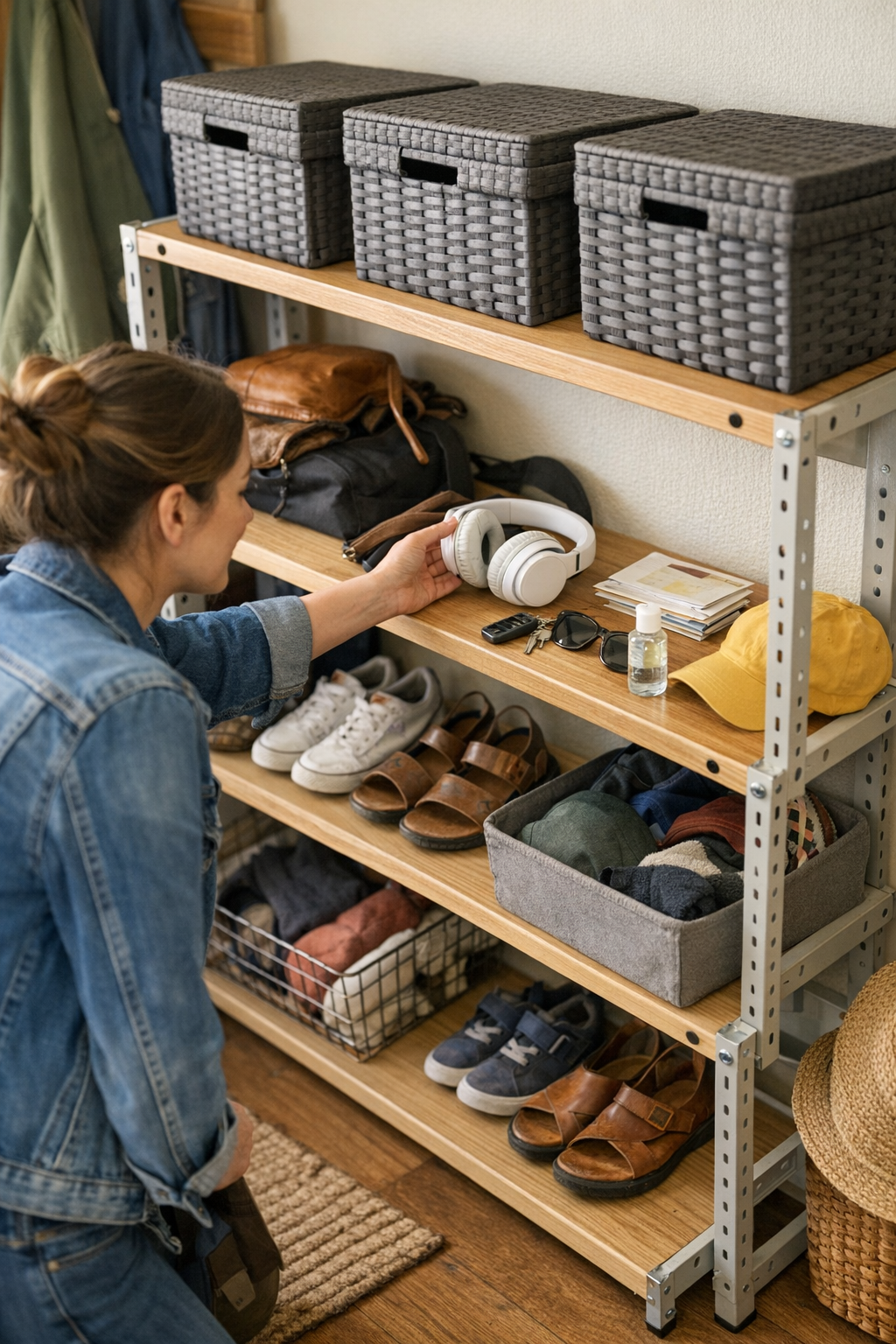
    Here’s where small changes make a visible difference: open bins, shallow trays, and clear shelves change the whole dynamic. With daily-use essentials in full view, you skip the rituals of sorting and hunting. Suddenly, “grab and go” routines work as intended. The result isn’t just speed, but better boundaries and less reshuffling overall. What actually happens day to day:

    • Immediate access: Water bottles, keys, headphones—one move, not five, and you’re out the door.
    • Easier resets: When you see the shelf crowding, you can purge or rehome items in seconds—no more “out of sight, forgotten ‘til spring cleaning.”
    • Role clarity restored: It’s obvious what goes where, so hats stay with hats, tech stays together, and the dog leash doesn’t wander into snack storage.
    • Fewer lost items: Visibility cuts down on double-buys and last-minute panics—if you see something’s missing, you notice right away.

    Set a Visual Limit—the “Tray Is Full” Trigger

    Open storage comes with a built-in signal: when the tray fills or the bin overflows, it’s time to purge. No more mystery stockpiles hiding behind closed lids. Use a shallow tray as a parking space for daily items—when you can’t fit more, it’s an obvious cue to reset. The shelf stays steady and your system regulates itself, not just on day one, but over months of use.

    Know When It’s Time to Rethink Your Setup

    You’ll feel it first in your own daily beat—if you can put things away and find them again without pausing, your system works. But when you catch yourself:

    • Repeating the same hunt for the basics
    • Noticing bins morph into mixed heaps that lose their roles
    • Watching “just for now” items multiply on counters
    • Feeling hesitation or annoyance every time you need to return something

    —that’s your gut telling you it’s broken. Usually, you don’t need a total overhaul; one open shelf at “grab height,” or a few see-through bins in the busiest spots, is enough to take the pressure off and win back function. You don’t need perfect categories—just visible, one-move homes within reach.

    Where Style Meets Reality (and Actually Lasts)

    There’s still a place for lidded boxes and matching baskets. For guest blankets, off-season decor, or craft supplies you reach for once a month, the benefits of hidden storage—dust control, visual calm—make sense. But for your “in and out” stuff, visibility wins every time. Durable, livable order isn’t about glossy calm; it’s about being able to function, fast, every day—even after a tornado of a week.

    If shelving still feels crowded, bins fill up fast, or the “organized” look falls apart by midweek, consider: a move toward open, obvious storage isn’t just style—it’s relief. And relief tends to last longer than any label.

    Find practical solutions for every routine and room at ClosetWorks.

  • Why Car Organization Fails Over Time and How to Fix It

    Most cars only look organized until the third or fourth time you have to get in and out in a single day. That’s when the small breakdowns start—right as you’re juggling your phone, charger cable, a bag, and whatever’s rolled into the footwell since yesterday’s drive. The problem isn’t obvious the first time. It’s obvious when you reach for your phone as you settle in, only to twist awkwardly around a seat edge or fish under a mat for a charger line that’s suddenly out of sight. The neat appearance slips the moment routine use collides with your car’s real layout.

    Where Daily Routines Uncover Hidden Friction

    That new organizer, dash pocket, or console tray looked like a fix—until you actually started using it day-to-day. Neatness can fake reliability, giving you just enough satisfaction to ignore the coming slowdowns: blocked cables at the seat rail, loose bottles trapped under mats, or your phone wedged deep in a pocket you can’t reach without twisting. These aren’t chaos. They’re the small, recurring frictions that quietly waste seconds, unsettle your motion, and make you think twice about even keeping things tidy.

    Repeated Reach, Same Snag

    If you drive daily, you know the script. Every time you return from errands, you aim for quick re-entry, hoping your phone and charger will be in reach. Instead, you find the cable knotted around a floor anchor, or your phone hidden so deep in a compartment you have to dig and twist—just to grab what you use most. It barely slows you down the first time. But after several stop-start cycles, the frustration isn’t minor; it’s the main reason clutter creeps back and “organization” starts to mean extra hassle.

    Visual Organization vs. Everyday Flow

    A car that looks organized isn’t always easier to live with. Even purpose-built organizers and low-profile bins can create new points of friction where you least expect them:

    • Cables routed “out of sight” now snag under moving seat tracks every time you reset your position.
    • Floor mats catch bottles or wrappers under their edges, shifting debris with every brake and turn until cleanup feels endless.
    • You tuck your phone away for neatness, then have to reach blindly across a gear shift—sometimes dragging the charging cord into a new tangle at every stoplight.

    These aren’t dramatic failures, just a pattern of subtle slowdowns—from unloading groceries to answering calls—caused by setups that value appearance over repeated-use flow. Visual neatness, on its own, hides friction lines that real routines keep finding and exposing.

    Why Clutter Creeps Back

    The setups that demand reshuffling to touch the basics—phone, charger, sunglasses—become self-defeating. Instead of unblocking your path, they bury what you need under what you’re trying to keep hidden. Within a few days, your high-use items migrate to “temporary” surfaces and door pockets, turning even the most organized car into a patchwork of quick fixes and repeated trade-offs.

    The Cost of Overlapping Paths

    Notice how everything compounds on a busy Saturday: back-to-back errands, someone else adjusting your seat, and every zone competing for reach. The charger cable ends up wedged under a newly moved seat; your cleanup wipes now block the only free charging port; containers drift into footwells, demanding a shuffle before you can even get in. This is when the difference between a thought-out setup and a surface “fix” gets brutally clear. Overlap between storage, charging, and loading zones turns each retrieval into another tangle, doubling the time you lose in routine motions.

    When Every Attempt Slows Down

    The hidden friction isn’t the initial mess—it’s every extra second spent untangling or shifting things mid-flow. A phone mount inches loose after each drive, a bin slides into foot space, or a cable vanishes behind a seat bracket—none of it seems big alone, but layer them together and you’re less likely to bother keeping anything tidy.

    What Actually Improves Daily Car Use?

    The difference comes down to setups built around use, not just appearance. Changing a cable-trapping side pocket for a wide charging tray alongside your main seat makes repeated entry startlingly easier:

    • Your most-used items—phone and charger—live in plain reach, right beside you, never buried or grabbable only at a stretch.
    • Cable routes stay intentionally clear of footwells and seat rails, so loading a bag or sliding into the seat doesn’t drag a cord into a new knot.
    • The return path for high-use items is obvious and repeatable—no guesswork, no hunting.

    This is how real friction stays out and your car stays usable. The magic isn’t in having more bins; it’s in having the right paths and placements that hold up through actual, repeated motion. The best setups shrink the cleanup loop and stop clutter from sneaking back in by giving each item an uncontested home that doesn’t block what you do next.

    Recognizing When Your Setup Needs a Rethink

    Signals that your structure is failing are rarely visible from the driver’s seat alone. Notice the moments you’re untangling a cable for the fifth time in one day, shifting a container with your knee every entry, or hunting for your phone at the end of every loop. If these cycles repeat, it’s not a “clutter” problem—it’s a layout problem. Neatness hides friction, but real function always finds a way to reveal itself through repeat annoyance.

    Out of Sight, Out of Reach?

    Pockets and cubbies that keep things hidden often slow you down when it counts: essentials mix with junk, and each reach gets just a bit clumsier. If grabbing your charger or wipes feels like an ordeal, or if you find yourself dreading the process of stowing the same “regular” items, you’re working against your own car—regardless of how tidy things look right after a reset.

    Building a Structure That Lasts

    The most reliable setups aren’t minimalist or flashy—they’re structured around what you truly reach for, and they stay stable after dozens of routines, seat changes, and weather shifts. When must-have items always land in a visible, unblocked spot with a repeatable path back, clutter doesn’t get to creep in. Place those high-use objects just outside busy “travel” corridors; route cables so they can’t snag or disappear; give up on perfect concealment if it means repeated slowdowns later.

    Adaptability Over Perfection

    No single organizer, mount, or cover solves everything, and most setups fail not from lack of tools but from mismatched structure. Focus on alignment: charging, loading, dropping off, everyday cleanup—each needs an unblocked lane. That’s what keeps your car genuinely easier to live with, even after five errands, one passenger, or another round of forgotten water bottles under the seat.

    For more practical solutions and car-use improvements, visit DriveWellSupply.

  • Why Re-Checking Lighting After Power Restores Ensures Safer, Clearer Spaces

    Most indoor lighting problems wait until routine kicks in. A hallway looks bright at a glance—but one step in, your heel slows at a shadowed stair edge or faded landing. In the bathroom, overhead bulbs promise “full illumination,” but the moment you reach the mirror, glare hits your eyes or your reflection slips into shadow, making basic grooming awkward rather than effortless. These aren’t rare annoyances—they’re clear signs that lighting comfort doesn’t come from wattage or first impressions, but from how a fixture lines up with actual, everyday use.

    Why Lighting Problems Hide in Plain Sight

    Rooms fool you at installation. The day a new fixture goes up, the lounge, corridor, or stairway reads as “complete.” But routines expose misses: a semi-flush hallway light shines straight down, casting the center bright but leaving corners dim and alcoves in shadow. A bathroom sconce looks gentle from afar but suddenly throws unwanted glare right into your morning routine. These misses don’t announce themselves on day one—they trip you when you’re moving fast or relying on habit, not when you’re standing still admiring the upgrade.

    The problem isn’t brightness—it’s coverage and direction. The wrong fixture leaves part of the room underlit, shadows in high-use corners, or glare where your eyes need comfort. You spot it only when you resume real patterns: walking the hall at midnight, using the kitchen counter, or leaning in close at the bathroom mirror.

    Hallway and Stair Lighting: Looks Bright, Moves Slow

    Hallways and stairs are classic for this. Stand at the entrance and the area looks flooded with light. Start walking, and you slow down at the landing or stair turn, feeling the edge blur into shadow or the wall go dim. The trouble isn’t how much light—the trouble is where it falls. Ceiling fixtures often create a bright central spot but miss the critical path around corners or onto each stair’s edge. Subtle shadow bands make people hesitate or miscalculate footing.

    If you want safety, don’t just assess standing still. Walk the actual route in real lighting—notice where you slow, hesitate, or feel a step less visible. Often the fix is not buying another fixture, but tweaking placement—a broader flush mount over the bend or repositioned ceiling light to hit the stair wall directly, softening those trouble spots and keeping pace steady.

    Vanity and Mirror Zones: Where Glare and Shadows Sneak In

    Bathroom lighting reveals its real character the first morning you use it. Over-mirror bars and ceiling globes often leave cheeks and eyes blanched while jawlines vanish into shadow. Glare jumps back from the glass right at eye level. The mirror appears well-lit from a distance, but up close, details drown or shift into awkward shadows. Daily tasks, from shaving to makeup, become a small battle against the light instead of a seamless step in the morning.

    The solution isn’t just dialing up bulb wattage. The gain comes from structural change—lensing that smooths the throw of a fixture, or a wall-mounted vanity light long enough to balance horizontal and vertical shadows. When the right light softens and broadens at the right height, grooming stops feeling like guesswork in a spotlight.

    Shadowed Work Surfaces: When “Bright Enough” Isn’t Useful

    Kitchens and laundry rooms often fail the real test: task surfaces end up shadowed by your own body, even in “bright” rooms with modern panels. You stand at the counter, hands in the path of a ceiling beam, and the chopping board falls half in gloom. Reach for detergent, and the shelf edge is lost in murk. People slide sideways or settle for “good enough” visibility—until the next time a task slows down or a knife hesitates mid-chop.

    True fix? Don’t flood the room—target the actual working line. Under-cabinet or fixed task lighting makes the countertop, sink, or laundry shelf not just visible but easy to use from any angle, at any time. Problems vanish not with more light, but with better-placed, purpose-driven light.

    Real Patterns, Real Friction: The Cost of Everyday Interruptions

    Lighting failures aren’t always dramatic—they chip away gradually: a hallway walk that’s “almost fine” until one section feels risky at night; the daily workaround to dodge glare at the sink; hands casting their own shadows over a workspace that only seemed bright enough. These repeats have a cost: minor hesitation, eye strain, and a steady undercurrent of inconvenience that becomes background irritation.

    If your routine feels interrupted or awkward where the room “should” be covered, you’re witnessing the weak spots in real time. Most homes are left at “good enough” once the room registers as generally bright. But the difference between “lit” and “fits your life” is noticed only when routines expose the same shadow lines and glare points, again and again.

    Practical Fixes: Focusing on Placement and Structure

    Patching these gaps doesn’t mean adding endless fixtures. Improvement comes from noticing real-use patterns and refining coverage: swapping a narrow spot for a broad flush mount in a corridor, choosing a damp-rated sconce for horizontal light in the bathroom, or adding strip lighting beneath cabinets instead of hoping overhead bulbs will reach. Payoff is practical: smoother hallway crossings, safer stairs, no more dodging the mirror, and work surfaces that stay clear without awkward maneuvering.

    Tip: Test setups with real routines. Walk the hallway at night. Lean in at the mirror. Prep food or fold laundry as you normally do. Where you squint, pause, or sidestep, that’s your structural clue—not just a sign for brighter bulbs, but for smarter placement or fixture shift.

    Lighting That Adapts to Real Use—Not Just the Paper Plan

    Good lighting isn’t measured by empty-room brightness, but by what stops being awkward in daily use. The first days after power returns, or after new installs, are prime for catching the spots where the plan falls short—before those hidden shadows and glare patches settle into your norm. An adjusted fixture, a new zone of coverage, can change the story of how a space is used—making light feel less like a static backdrop and more like a responsive tool for actual living.

    For practical, repeat-use focused indoor lighting—covering hallways, stairs, vanities, work zones, and all the lived-in corners where light needs to pull its weight—visit LightHelper.