
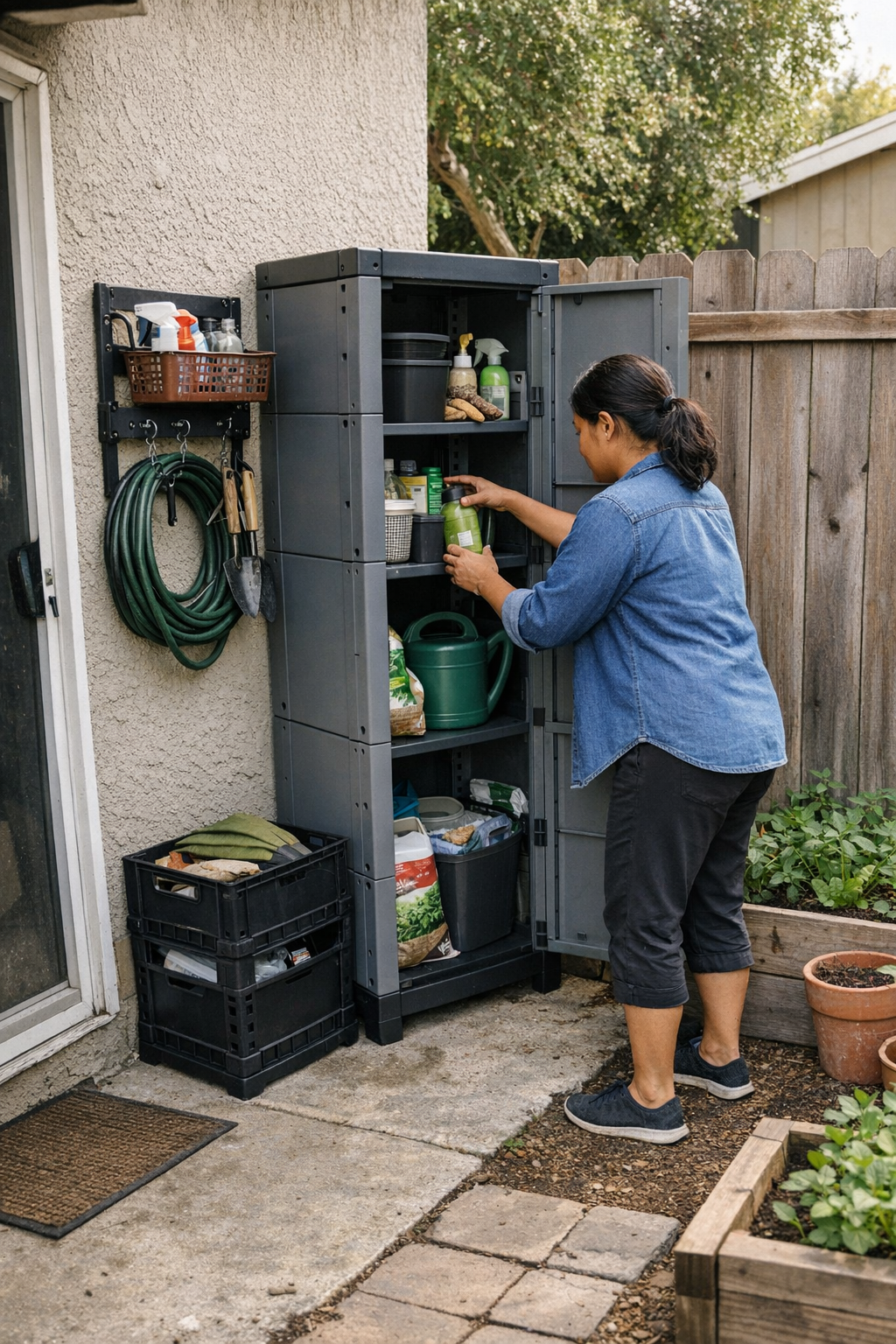
It’s always the outdoor dead zone—the side strip, the fence run, the garage threshold—where storage setups quietly decide how broken or frictionless your routine feels. On move-in day, any storage unit looks like progress. But once real life sets in, the wrong setup—especially a too-wide bin or an open rack—leaks into the path, tangles the shoes, and makes you reset the same four trouble spots over and over. At first the bin looks generous. By week six, you’re kicking gear out of the way or wading through a cluster that never leaves the “not quite put away” phase. The frustration is never about the volume of stuff; it’s about the repeated, clumsy ballet of returns and resets, and how quickly “looks organized” unravels under actual use.
The Repeated Return Problem: Where Clutter Sneaks In
The outdoor storage trap always shows up at the return: when real people, on their own schedule, toss something back. An early gardener slips pruning shears in before work. Someone else dumps cleats after dark. Kids wedge soccer balls right by the bin, hoping it counts. Even with good intentions, the comfortable layout on paper can go sideways midweek: handles spill out over the walkway, gloves topple off the edge, stray boots block the gate latch. Overflow isn’t a one-time event—the layout turns repeated returns into a slow-motion spill that creeps into every movement path.
Most outdoor storage fails not by running out of space, but by making it too easy to return things badly, stacking and drifting mess back into circulation almost overnight.
Open Racks, Deep Bins: The Trap of Easy Access
A deep bin or open rack seduces you with the quick drop: faster to toss in boots, easier to shove a rake, “good enough” when hands are full. But access comes at a cost—stuff never truly gets put away. The first item blocks the next. A broom never really fits; its handle juts into the path, forcing a detour. Someone hangs a shovel horizontally rather than lifting everything else out. After three days of normal use, the bin is just a messy pile with a sun-hardened web of small tools inching closer to the path every time someone walks by.
Unlike closed storage, open systems have no off switch for accumulation. Movement paths that seemed wide enough suddenly shrink as the gear forms a permanent barricade. What looked like “flexible storage” now makes you side-step carrying the trash, or inch sideways just to find the hose nozzle. The setup visually says “organized,” but in reality, it keeps tripping routines and bottlenecking daily flow.
The Case for a Simple Outdoor Cabinet
A basic cabinet does what open bins can’t: it kills the slow spill-over before it ever invades your walking zone. Doors force a decision. If something isn’t all the way inside, the door simply won’t close—and you (or the next frustrated person) has to reset before the mess leaks outward. This tiny friction point stops the cycle. Handles, stray gloves, or muddy boots can’t linger half-in, half-out. Visual clutter stays shut away from every passerby. The path regains its full width; you don’t have to shift anything just to get through.
- No more shovel handles stiff-arming every leg passing by
- No boots tipping into the gate track
- Loose gear lands inside or gets noticed, not ignored
- Resets become short and obvious—open the door, see the job, close it, done
I swapped an open bin for a shallow, vertical cabinet along a 24-inch backyard run. Within the first week, the awkward sidesteps were gone. Returns became binary: the door shut or it didn’t. No amount of rushing could stack stuff in the path or let items dangle halfway in. The difference wasn’t how tidy everything looked after a fresh reset—it was how little effort it took to keep the zone clear during the chaos of normal use, even when that meant wet gear at the end of a rainy day.
Everyday Scenes: How the Setup Shifts Daily Life
Morning Rushes and Evening Returns
Early mornings, a clammy shovel is snagged; late night, someone carelessly drops cones and soccer gear after practice. The old open rack would choke with half-sorted piles, the next person through forced to tiptoe or haphazardly shove more gear aside just to enter the yard. The pile migrates, then multiplies.
With a cabinet, pile-ups stall at the door. If the cabinet gets full, it’s immediately, unmistakably visible. There’s nowhere to drop new gear except all the way inside—or not at all. Suddenly, the zone keeps its shape, even under heavy back-and-forth. The path stops feeling like a gauntlet of stray tools. The simple limit of a door keeps everything else from turning into a multi-step cleanup at the worst time.
Searching, Shifting, Resetting
Old routine: plan a garden task, then pull three bins, excavate a lost trowel, unearth a moldy glove under yard bags, waste ten minutes before ever starting. With the right cabinet, the sequence is different—a set of shelves (even makeshift or labeled with tape) and a vertical footprint mean you can see what’s there on first glance. “Tools” means tools, “supplies” means supplies; returns are automatic, and you spot what’s missing before you go hunting in frustration. The weekend reset drops from a 40-minute wallow in the mud to a three-minute check-in.
Choosing the Right Cabinet—And Avoiding Common Pitfalls
Not every cabinet solves the problem. Match it to the real-life rhythm, not the showroom ideal. Cabinets that are too deep simply eat gear in their dark corners, turning into a new wilderness. Too shallow, and nothing fits—instant overflow zones pop up outside. Look for a fit just big enough to stand up your longest shovel but slim enough to leave your walkway free. Shelves (even add-on ones) keep things from stacking horizontally and clogging the bottom. A strip of tape labeling zones means less arguing, less guessing—more things just end up where they should because it’s easy to remember and impossible to ignore.
Why a Cabinet Holds Its Line—And Why Others Fail
What makes the cabinet work isn’t just hidden storage—it’s the hard border. Unlike open racks or bins that hemorrhage mess at the edges, a cabinet draws a strict line: either it fits inside, or it’s time to rethink what gets stored here. Routines will get sloppy, and people will still forget, but it stays easy to see when the zone needs help. You’re no longer policing random piles; you’re just closing a door. Even after a rough week, it only takes one person a couple minutes to bring the area back to neutral.
That’s the difference between chasing clutter around every outdoor space and having a setup that pulls things back to order—on its own, most of the time. For outdoor storage that works at the edge of real use—not just in a staged photo—see what TidyYard makes possible.