
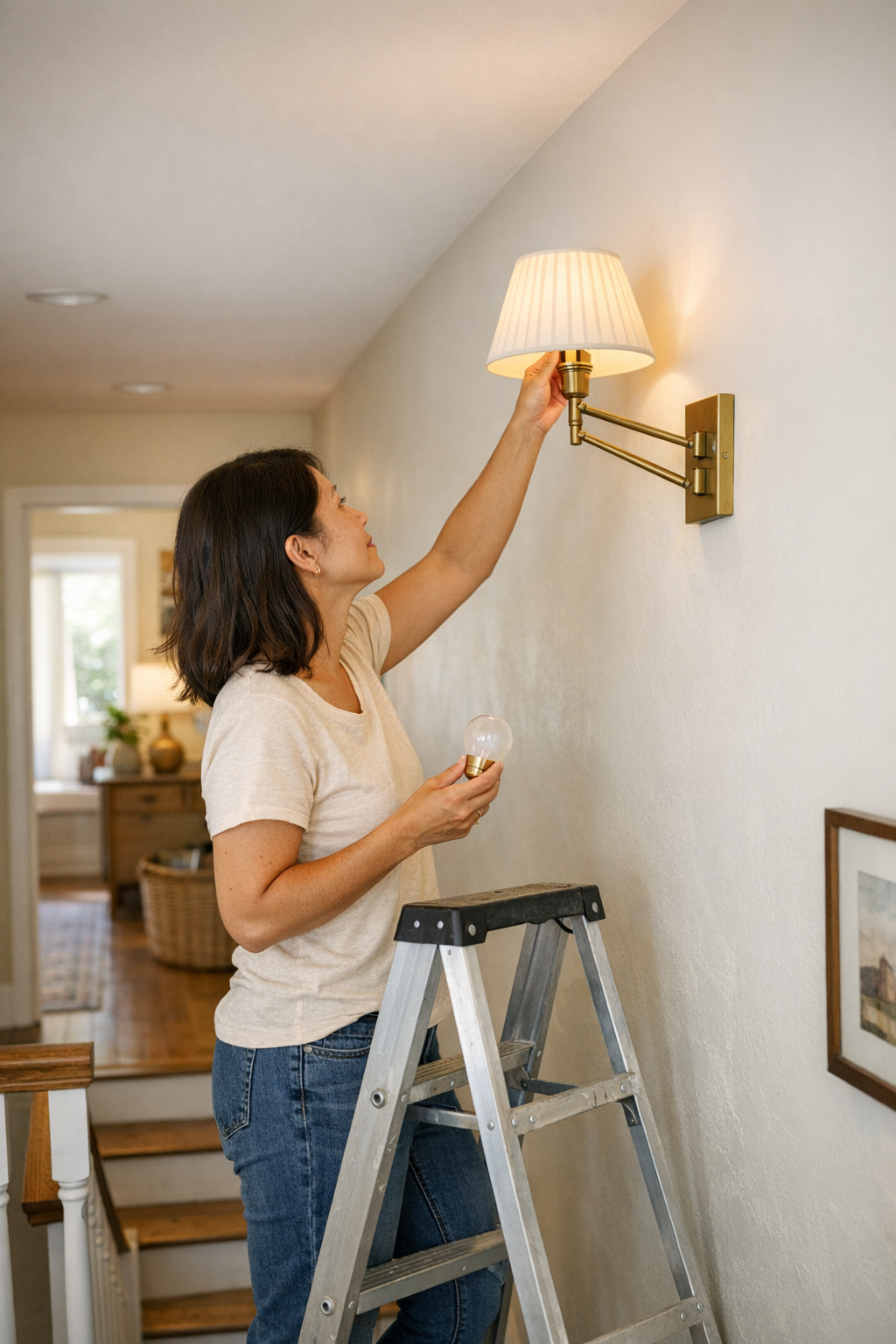
The real test of indoor lighting isn’t how a fixture looks on installation day—it’s what happens every time you need to access it. If you’ve ever stood halfway up a stairwell, shifting your weight with one foot angled on a step, hand stretched for a flush mount ceiling fixture that always seems just out of reach, you’ve felt how access failures turn convenience into a hassle. The wrong location doesn’t just create a maintenance headache; it can be a silent safety risk, and a steady drag on how you use your own space. These are the decisions that don’t show up in showrooms—and they’re exactly where the payoff or penalty of your lighting choice reveals itself, one awkward reach or ignored dust patch at a time.
When Good Light Meets Bad Access
Standing below a stair landing, squinting upwards, you might notice the lighting feels balanced on paper—or in a listing photo. But routine use tells another story. Every time you stand on tiptoe, ladder wobbling, just to replace one stubborn bulb, spatial design clashes with daily reality. Fixture placement that forces you into weak footing or awkward stances is a structural inconvenience baked into your routine.
You see this disconnect in nearly every room: a wall sconce over a laundry counter that glows perfectly until you need to reach over the washer—straining each time just to clean the glass—or a snug vanity light that serves the sink’s edge, but leaves your hand brushing a mirror when it’s time for upkeep. These aren’t dramatic flaws, but they quietly push routine tasks off your list or make you delay them until the shadow and dust become impossible to ignore. The problem is rarely brightness or coverage. It’s the subtle misfit between where the light is, and where your hands can safely reach.
Structural Choices Shape Daily Movement
Ceiling lights, wall sconces, and task fixtures all shape how you move through—and maintain—your space. Their mounting points aren’t just about balance or symmetry, but how your body interacts with the room, again and again. Centered flush mounts above a stair void or behind a door might look “right,” but demand awkward ladder setups or unsafe reaches. A semi-flush pendant meant to anchor a small hallway lands directly above a traffic pinch point—now every bulb change means dragging furniture or contorting around it. Repeated, these micro-mismatches chip away at any sense of lighting as support for actual living.
Stairways: Where Access Meets Hesitation
In staircases, visual balance often demands ceiling fixtures up high or at mid-landing turns. But when the first burnt-out bulb forces you up a ladder, torso twisted over the handrail, it’s clear the architect never hung the light themselves. That minor misplacement doesn’t just add five extra minutes—it turns a simple swap into an avoidable risk. Soon, overdue maintenance becomes routine, not the exception.
Utility Spaces: The Illusion of Completion
Try loading laundry at dusk, only to find the wall sconces create tidy brightness on top of appliances—but veer just far enough from the edge of the counter that wiping down or swapping bulbs means stretching or moving an entire washer. Utility room “completion” is a mirage when access isn’t planned against real obstacles like low ceilings, stacked machines, or narrow zones. Getting the light working isn’t the same as making it work for you.
Public Paths: Corridors and Hallways
A flush ceiling light in the hall may look architecturally perfect, but if it hovers above a sideboard, or the only solid spot for a ladder is behind a traffic knot, the day you need to service that fixture, friction multiplies. Instead of a quick job, you’re pivoting furniture or risking a slip. The room “reads” as well-lit but never really fits how you move and maintain it. That gap gets larger with every missed cleaning or delayed repair.
The Real Cost of Awkward Lighting Placement
Ignore the subtle toll, and maintenance becomes the chore you plan to avoid. Dust layers build into glare that alters the character of a flush mount’s light. A bulb burns out in a stair turn, and you find yourself navigating darkness until the hassle feels justified. The system slowly becomes less reliable—and your willingness to interact with it fades, one unresolved issue at a time.
- Unreached fixture glass collects dust, spreading glare and undercutting clarity—especially in task or stairway zones.
- Delayed bulb swap-outs mean key surfaces—laundry counters, hallway turns, vanity mirrors—can fade into shadow.
- Small, persistent access barriers breed unsafe workarounds—too-short ladders, unstable stepping—quietly upping daily risk.
Practical Improvement: Shifting to Safer, Smoother Routines
Improvement starts with honest fixture placement—small adjustments that transform every future maintenance step. For example: moving a stair fixture by eighteen inches so it lands directly above a landing with stable footing. Suddenly, changing a bulb is as simple as standing upright—not dangling over the rail. The lighting outcome is identical; the routine effort is not.
The same goes for laundry alcoves: shift a linear wall light closer to the edge of the work zone, not above the hardest-to-reach spot. In hallways, avoid centering flush mounts directly over immovable obstacles—place them above the safest, accessible stretch of floor. When day-to-day cleaning and repairs no longer feel like a gamble, you reclaim both time and safety. The room isn’t just finished—it’s functional by design.
Is It Time to Rethink an Awkward Fixture?
If any of these ring true—
- You’re dragging the ladder back and forth to the same corner every few weeks;
- Appliances or mirrors must be shifted just to change a bulb;
- Certain routine fixes keep getting skipped because the light is always just out of true reach—
—your setup isn’t supporting you. No special tool compensates for a fixture installed beyond practical access. The best location is the one where you can stand safely, reach with both hands, and finish the job without improvising safety or delaying maintenance.
Small Tweaks, Lasting Improvements
Lighting that lasts isn’t just bright—it’s placed for real hands and real movements. Swapping perfect symmetry for accessible placement is a quiet but powerful upgrade, noticed every time you finish maintenance in moments instead of dragging it out. Less risk, less hassle, fewer unaddressed flaws. Lighting should serve the routines you repeat—not just the appearance you admire once.
Quick Tip for Next Time
When planning a new light or repositioning an existing one, stand exactly where you’d go to clean or change it. Is there stable floor beneath? Can you safely reach the fixture? If not, shift location before installing—function trumps forced symmetry every time, especially when access affects everyday safety.
Lighting is only as good as its real-world fit. If your setup lines up with your own daily movement and maintenance—over the right stair tread, along the reachable counter, away from congested corners—staying safe and keeping your lighting at its best becomes automatic. Fix the practical mismatch, and every room proves its worth over time.