
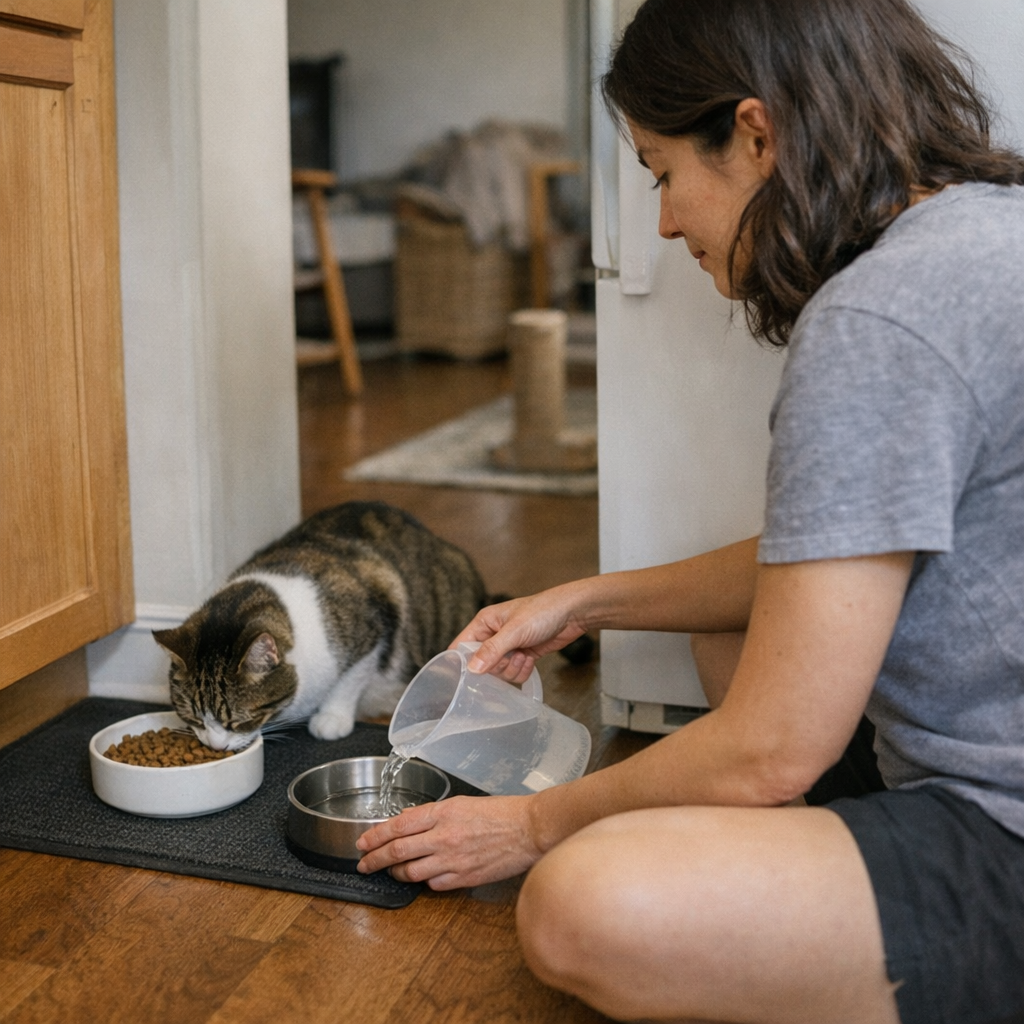
Nothing exposes the cracks in an indoor cat’s feeding setup like using it day after day. That corner looks clean at 7 a.m.—bowls lined up, mat uncurled, water topped off—but that surface order unravels fast. By the end of the first week, the truth arrives quietly: you’re nudging the bowl out of your morning path for the third time, straightening a mat you “fixed” yesterday, or following a gritty trail of kibble past the threshold. The problem isn’t disaster—it’s a setup that turns one quick task into five small, invisible chores. You’re not dealing with chaos, but you are picking up the pieces in the background, and the pattern is hard to escape. This is the StillWhisker world: not a catalog of cat decor, but the daily pressure test for where setups genuinely fail or quietly hold up.
Where Feeding Setups Go Wrong—Even After Careful Planning
Most cat owners start with a simple fix: bowls and a mat in a quiet-looking corner. For two days, it works. Then the commute from fridge to coffee pot becomes a sidestep routine because a bowl is against your ankle or the mat creeps under the cabinet door. Maybe that “no-slip” mat turns out to slip anyway, or the bowls sit just close enough to the fridge that bumping them is nearly guaranteed during any refill. The logic felt solid, but the lived-in routine exposes every small miss.
As the days go on, what started as “tucked out of the way” turns into one more obstacle in the household race. Morning means: skip a puddle, correct the bowl angle, pause for stray kibble, and listen as your cat waits impatiently for the setup to return to working order. Every step is a quiet feedback loop you didn’t sign up for.
The Small Signals That Routine Isn’t as Smooth as It Seems
Spot these in your own mornings?
- Refilling the bowl requires smoothing out a mat edge that buckles under the bowl or your hand—nearly every time.
- The water dish appears in place until droplets show up where your sock lands on first pass.
- Your cat vocalizes, not because of an empty bowl, but as if to say, “this station still isn’t ready.”
- Kibble escapes to the hallway—a narrow, visible stream—despite your quick after-breakfast sweep.
- Even a so-called quick tidy-up means you’re realigning the setup instead of just cleaning.
This is not a problem of laziness or neglect—it’s a mostly-organized area that never crosses into truly usable. Each “minor” fix tugs at your routine with new, hard-to-ignore friction.
Repeated Friction Sets In—And Keeps Returning
The pattern isn’t stopped by a single improvement. It’s what happens when you think you’ve solved the issue—only to spot the mat sliding again, or realize moving everything closer to the wall makes cleanup more cramped. Every adjustment triggers its own compromise. The real line appears after several cycles—not in a dramatic mess, but in steady, quiet demand for correction.
The crucial difference: some setups invite new work, while others get out of your way. Over time, the better arrangement doesn’t need daily rescue; the weaker one piles up micro-corrections, stretching a one-minute process into a sluggish, sidestep-heavy hassle. You don’t notice it in the first hour, but by day seven, it’s shaping how you move.
When “Calm” Feels Like More Work Than Cleanup
Chasing a tidy look often backfires. You end up compensating:
- Dragging a dish from under a cabinet, then guessing how it should “sit right” for the next meal.
- Sweeping up crumb trails that keep extending past the linoleum onto shared carpet areas.
- Flattening a mat that rebounds after every touch, turning small spills into wipe-first, reset-later rhythms.
- Your cat waits, watching for the moment the area stops shifting and actually opens for breakfast.
The pain point isn’t mess—it’s friction and the pressure to intervene over and over. A feeding area that only looks calm teaches your household a reality of short-term fixes, not reliable routine.
Better Structure Means Fewer Hidden Corrections
A feeding or water corner that stays functional isn’t just “organized”—it works with you. Key factors:
- Pick a genuinely quiet location, not just a visually hidden one, so daily traffic (both yours and your cat’s) doesn’t collide with the setup.
- Choose mats with real grip or enough weight to stay put after a paw scrapes or a spill—not just matching the floor for aesthetics.
- Place bowls where you never have to squeeze past cabinet doors, stand on one foot to reach, or backtrack when cleaning up. Refill should never involve obstacle negotiation.
The mark of real improvement: by week two, intervention is rare. The setup needs less, not more, of your attention. Practical changes appear across daily details:
- Calmer cats—because the area is always “ready,” not mid-reset or on pause for a fix.
- No more crumbs or water tracks bleeding into main traffic areas.
- The mat and bowls don’t roam, so you stop spending mornings setting things straight.
Scene: Breakfast in Three Movements—With and Without Friction
Mornings with friction: You enter, immediately angle your path: the mat has drifted again and must be reset before you can even start. As you refill, two kibbles scatter away—one toward the fridge, one under the counter. Reset, again. Overnight, the water bowl has slid into the walkway; now you’re pushing it back and mopping up a thin splash with a napkin you have to fetch from the next room. Your cat circles, waiting for the routine to finally work.
With a setup that holds: The bowl remains in place, dead-center in a clear zone. The mat’s edges stay pressed to the floor, not curled, not creeping past its boundary. There’s no waiting—refill is direct, cleanup is just that, and nothing requires shuffling or do-over. Your cat settles in; you move on.
Why Visible Doesn’t Always Mean Messy
Concealing the feeding area behind a door or squeezing it beside the utility bins might spare your décor, but function usually suffers. Hidden spots become the new hassle:
- Every closed door creates one more step or prompt for your cat to scratch or stall.
- “Out of the way” rarely matches how your household actually moves—you or your cat end up blocked at the worst time.
- Reaching past brooms, boxes, or storage just to refill water turns a two-second job into a repeat delay.
Contrary to instinct, a clearly visible—but structurally smart—feeding zone saves you work. You instantly spot escaped food bits, can wipe or adjust in real time, and miss the slow buildup of hidden messes that attack the area after days out of sight. Reliable setups aren’t invisible—they’re stable, easy to check, and impossible to miss when maintenance is needed.
Placement Details That Save Time—Or Add Work
Accessories matter less than placement and structure. Inches count:
- Moving the station even six inches out of the primary footpath can end daily bump-and-reset routines.
- Give a tiny buffer between bowls and swinging cabinet doors; a one-inch gap can stop weekly spills and creeping mat curl.
- Pick mats that don’t twist or rise after contact. Soft-edged mats may blend visually, but turn maintenance into two-step jobs—straighten, then clean—every time.
The proof that it works: Your setup stays still. Location needs one correction, not constant nudging. No mystery kibble in the hallway, no unexpected puddles at the coffee machine, and your cat simply waits to eat instead of waiting for a fix.
The Ripple Effect: How Setup Friction Spills Into the Whole Day
Setup friction does not end at the feeding zone. Crumbs migrate to living room rugs; displaced bowls mean morning detours and stray puddles mean more frequent sock changes. Even tiny delays add up: when cleaning spray is one cabinet away, or towels are out of reach, you delay wiping up until stickiness sets in. Toy scatter and feeding mess can intersect, compounding the clutter. The setup that “contains” the mess often just displaces the problem—making every reset slower than it should be.
How Changes Actually Show Up in Daily Life
After adjusting feeding and watering