
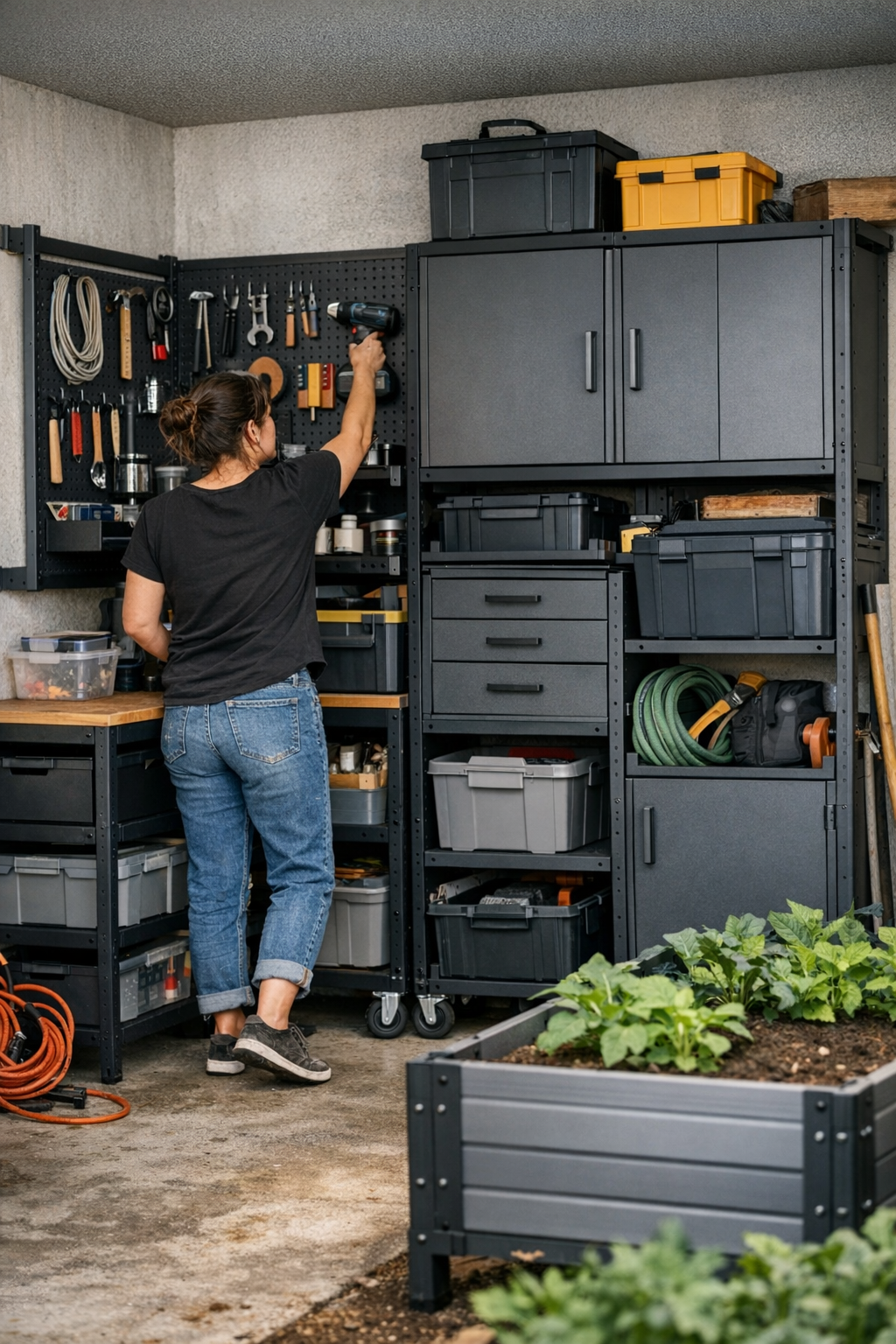
Visible storage looks like the answer: Line the walls with hooks and shelves until every tool, accessory, and fastener sits in plain sight. On day one, it feels like rocket fuel for productivity—no more searching, no more forgotten gear, just quick grabs and fast starts. The space “looks” ready: racks are full, every slot has a resident, and you can actually see what’s missing at a glance.
The Creep of Clutter No One Plans For
But after the first round of real work, the shine fades. The logic of “keep it all visible” gets jammed up by the routines of a real garage or workshop. Projects drift from one weekend to the next; gear moves but doesn’t quite return; and the glimmer of quick efficiency is replaced by a cycle of subtle, daily friction.
Paths shrink, steps double. Bins and buckets land on the floor “for now” and stay there. That open rack you added for convenience wedges against a cabinet, so now every time you swing the door, you have to nudge the rack out of the way—or, worse, just accept bruised knuckles. A hose loops where your foot wants to go. A cart you thought you could roll around for flexibility ends up stuck as a semi-permanent obstacle, blocking an easy path to your workbench. The more you try to keep everything out in the open, the more you’re forced to maneuver, adjust, and sidestep just to do simple tasks.
When Clarity Becomes Chaos
Visibility promises order, but real use guarantees overlap. Tools in heavy rotation migrate to the front of hooks, stacking in front of the gear you only use monthly. What started as a simple row—one tool per hook—becomes a tangle of screwdrivers, pliers, the odd extension cord, and something borrowed that never found its spot. Overflow boxes supposedly in “temporary” exile dig in right where movement matters most—at the edge of the shelf, underfoot by the entry, or in the last bit of open floor.
Each grab turns awkward: reaching for a drill means moving two other items, or stretching behind a garden trimmer just to snag the only tape measure. Bags of fertilizer take over the floor next to the mower, while your planter supplies squat in whatever corner remains. The wall’s no longer a launchpad—it’s a shifting sea where seeing everything means nothing is actually easy to reach without a mini reshuffle.
Overflow Corners and Ever-Expanding Dead Zones
The mess isn’t just visual—it’s functional. Those empty shelf ends take in all the returns that never quite make it home. A bin you swore you’d empty “right after the project” becomes a semi-permanent junk drawer on the floor. Instead of dropping a tool back in its slot, you end up hunting for open space, dodging stacked containers as you work.
Give it a couple of weekends and it’s obvious: a packed pegboard just means your everyday driver gets buried behind tools you only use twice a year, and stashing a box under the table puts it right in the way of wherever you need to stand. The promise of flexibility is so often undercut by small obstacles—resetting takes twice as long, and the space that should make every job easier instead throws up fresh barriers to getting started.
The Real Price of Blocked Flow
Movement is always the first sacrifice of “see it all” storage. Walk in with your hands full and you’re immediately stopped by yesterday’s stack of bins—or a cart that started mobile and ended up a squat, heavy checkpoint. You put these aside just to make a path, but eventually every trip means shifting the same stuff again and again. Handles from wall racks catch doors; corners become dead zones you circle around but never use.
This isn’t a rare mess; it’s the default when visibility trumps actual workflow. Modular wall units fill every available edge, but leave nowhere reliable to return a spare box or project caddy. Each “put-away” starts to feel like a puzzle: do you pile it onto the stack, start a new catch-all, or just wedge it in wherever there’s an inch to spare? The zone sprawls—until nearly every job starts with a clean-up instead of actual work. Built-in flexibility ends up being a myth: your setup holds more, but supports less.
Pushing Back: What Balance Actually Looks Like
The real fix comes when you decide not everything has to be visible. After enough cycles of shuffling equipment, you realize only your true dailies deserve prime wall space. That old box of specialty fasteners? It goes in a labeled bin on a low shelf, out of your way. The trimmer that’s hardly touched this month migrates behind the cabinet door, not at hip height on the main rack. You’re not hiding things—you’re picking what actually earns easy reach, so fast access gear isn’t blocked by once-a-year tools or accidental piles.
Sometimes a minor shift rewrites your entire reset routine. Drop a crowded shelf down one notch: now screws, gloves, and most-used micro-tools live at a natural, see-and-grab height. Overflow—batteries, specialty bits, out-of-season gloves—shift higher or lower, freeing the middle for the moves you make most. Suddenly, you’re not guessing where anything belongs or clawing through overflow to put things back. Your floor stays mostly clear, and dead zones shrink instead of multiplying.
Real Habits That Actually Help
- Cull or rotate gear each cycle: After every major project, take a few minutes to scan what you’re really using. If something’s been untouched for weeks, it doesn’t need prime wall space—it belongs off to the side or out of sight.
- Adjust shelves so your daily tools aren’t buried: One notch, up or down, can change your whole flow. Give breathing room to the supplies that get grabbed over and over, not the gear that just adds weight to the system.
- Leave open slots for returns—not just display. When a wall or rack is overfull, that’s a red flag. Don’t cram extras in—shift out the lesser-used, and let essentials breathe. Let cabinets or totes do the work of holding overflow, so only the best-used pieces fill your line of sight.
Spaces That Actually Support Your Routine
The shift is subtle, but unmistakable. Instead of tripping through the same tangled path, you’re clearing projects without a reset each time. Wall storage stops being a visual checklist and starts acting as real workflow support: permanent residents—your go-to hand tools—are always ready, while less frequent items stay tucked out of your way until you need them. The floor is for your feet, not for overflow.
You feel the payoff every time you walk out: returns are easy, resets are barely a thought, and storage works with your habits instead of slowing you down. The space no longer punishes you for getting busy—it flexes, adapts, and holds its organization even through hectic weekends. Your shop doesn’t just look more usable; it actually is.
See practical storage setups and find modular options that support real use at StackNest.