
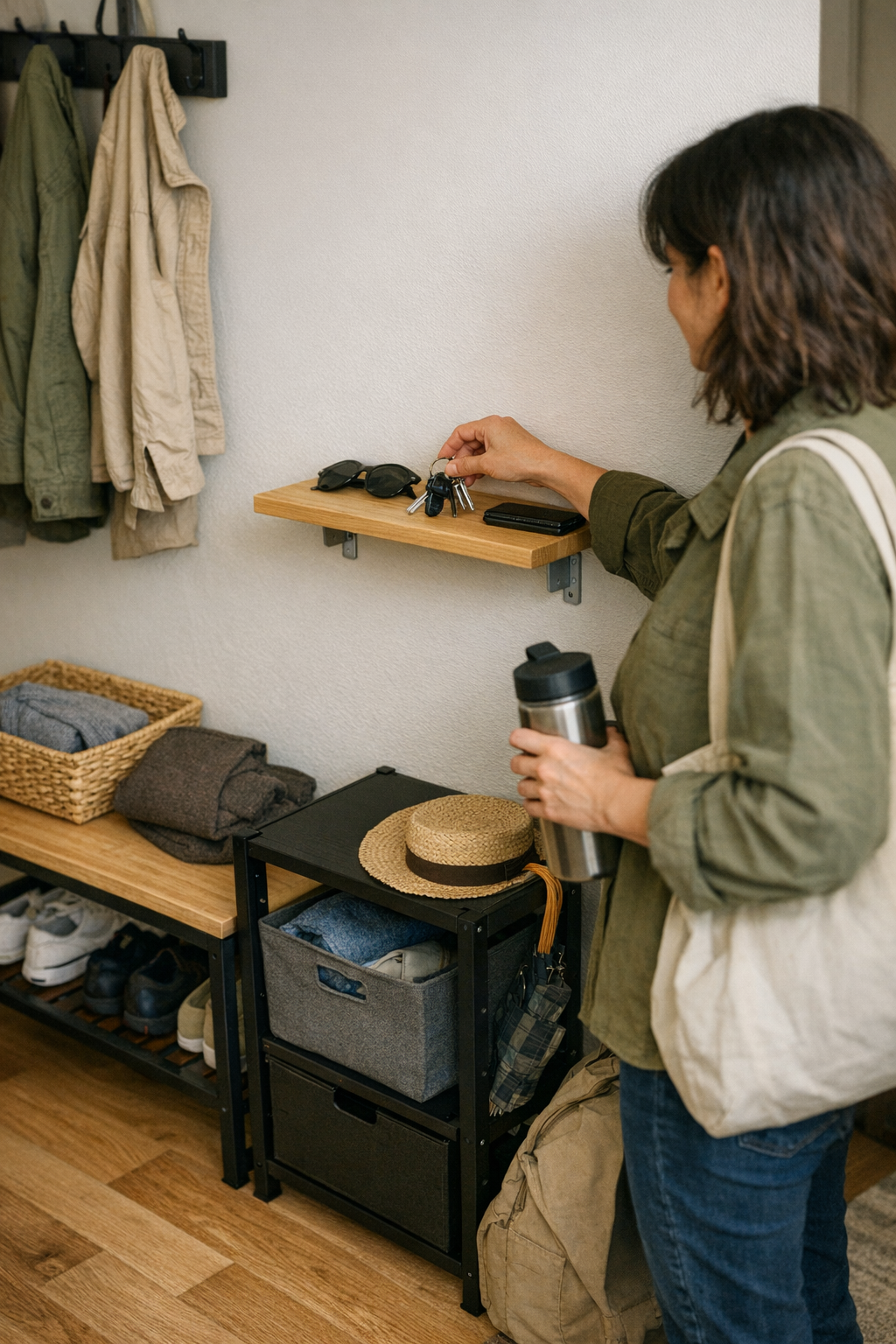
The entryway is a pressure zone, not neutral ground. Each time you step inside, hands full or arms loaded, whatever you’re carrying lands on the first available surface. One day it’s the bench corner, next day it’s a shoe rack edge, or the sliver of space left on a crowded side table. The setup you trust to “catch the drop” quickly turns uncertain: miss the right drop zone, and by midweek you’re wading through scattered keys, stray mail, and half-sorted gear. What felt controlled on Sunday is already slipping—resetting turns into a repeat search, and walking through the threshold feels more like dodging obstacles than coming home. One misplaced item grows into a pile that blocks the way and slows your return to order.
When Every Surface Is a Landing Zone, Clutter Follows
The logic is almost automatic: drop whatever you’re holding, keep moving. But when any free spot becomes the default landing pad, you don’t just drop your keys—you set off a chain reaction. By midweek, keys share space with pocket change and sunglasses, while the bench hosts yesterday’s bag and today’s mail. The path narrows as every “just for now” item lingers, and resetting the entry feels like tipping over a slow domino run of misplaced and multiplying things.
The shoe row tells the whole story: heels drift, boots fan outward, and in a few days what was a slim walkway becomes a maze. Your mail-and-key console transforms into a catchall tower: coasters, stray masks, folded bills all staking claim until the original purpose—the quick grab, the clear reset—gets buried with each new loop. The time lost and the small irritations add up, not just for you, but for anyone sharing the threshold.
The Floating Shelf: Designated Drop, Not Decorative Display
The floating shelf isn’t about looking tidy—it’s about breaking the cycle of diffuse landing and semi-permanent mess. Visually, it fades in; functionally, it stands out by forcing a new habit. Placed above bench chaos and below shoulder reach, the shelf becomes a target: every key, card, or daily essential finds its place before it disappears into clutter’s sprawl.
That separation is what makes the difference in real pressure zones—narrow hallways, tight corners, busy doors where two people and three bags barely squeeze through together. Overflow—snow-damp jackets, extra shoes, or unclaimed parcels—spreads along the floor, piling up fast. The floating shelf escapes that crush: it doesn’t get buried by coats or swamped by bag drop drift. Instead of becoming another cluttered horizontal, it creates a “no-mix” zone where essentials resist the gravitational pull of daily buildup.
Not All Shelves Work in Real Use
This isn’t about putting up any shelf and calling it a win. A poorly placed shelf—up too high above an already crowded cabinet, or tucked outside the main pass-through—answers the wrong problem. If it’s outside the default re-entry path, it gets ignored. If it’s too wide, it turns into a mail mountain; too stingy, it’s useless after the second item. The honest test: at week’s end, is the shelf still cleanly holding the essentials, or has it disappeared under piles, fading back into the background noise of entryway clutter?
Entry Benches, Overflow, and the Downward Slide
The “catchall” is never just theory—most homes try it. Maybe it starts with a tidy bowl or tray on the console, and for a day or two, surfaces look clear. But then real patterns reassert:
- The collection bin quietly overflows
- Bench seats become lost to gloves, grocery bags, and half-remembered mail
- The bench’s entire top turns into a stacked buffer zone—where you’re supposed to sit is now another surface you have to clear just to use
Floating shelves sidestep this ground-level crowding. By pulling keys and main essentials up and away, they reassign benches and racks back to their real jobs: shoes, gear staging, loading for the door. You spend less time shifting loose items just to find somewhere to sit or set down a bag, and the bench survives as useful seating rather than overflow storage.
The shelf’s benefit appears subtly at first, but becomes obvious as the week cycles: where trays and bowls become indistinguishable from their contents, the floating shelf interrupts this slow-slide before it gains momentum. The clear drop point disrupts the pileup, sparing you from the endless shuffle of clearing, re-clearing, and crowding out your own entry.
Real Use: Threshold Pressure and Easy Resets
The advantage sharpens in the messiest moments: a grocery haul lands, or muddy shoes plus umbrellas eat up all the bench space in seconds. The usual reflex—to toss keys onto any open patch—leads right back to chaotic spread, and before long, tracking a single item means reshuffling half the entry.
Add a floating shelf, and the process splits:
- Keys, lanyards, and cards ride above the churn, untouched by bags, jackets, or boot clusters
- Mail, packages, and shoes may still amass below—but what you need to leave stays reliably in reach, unmixed and unburied
- Every reset gets easier: lifting a pile to grab keys stops being a daily routine
After a few weeks of use, the friction falls away. The shelf remains steady—one spot you never have to dig for, even when the rest of the space is pulled into overflow and reset loops by rushed mornings or high-traffic evenings.
Placement Details That Matter
Exactly where you install the shelf reshapes how long its benefits stick. Shift it just above the usual bag drop zone—and still within arms’ reach on your direct path—and the routine transforms. In one everyday fix, this single adjustment stopped morning key hunts. The shelf stayed visible and open, never hidden behind coats or half-sat bags, and reset friction dropped because the entry’s main access path stayed clear. The shelf wasn’t just present; it stayed functional, holding the line even when the threshold was tested at its busiest.
Threshold Storage That Works With You, Not Against You
There’s no magic trick—no floating shelf resets a cluttered room by itself. But it does collapse the micro-delays and daily reshuffles that frustrate entryway routines. Instead of multiplying flat spots that only collect more clutter, the shelf sharpens the transition: one purposeful drop, one easy reset, one predictable flow in and out.
For homes that want transition spaces to back up their routines—not get in the way—a floating shelf brings a visible advantage. It turns the regular return from “looks organized” to “stays usable,” showing where structure decisions really pay off after repeated, imperfect days. Every time you cross the threshold, you get one moment of function that doesn’t vanish the first time life gets chaotic again.