
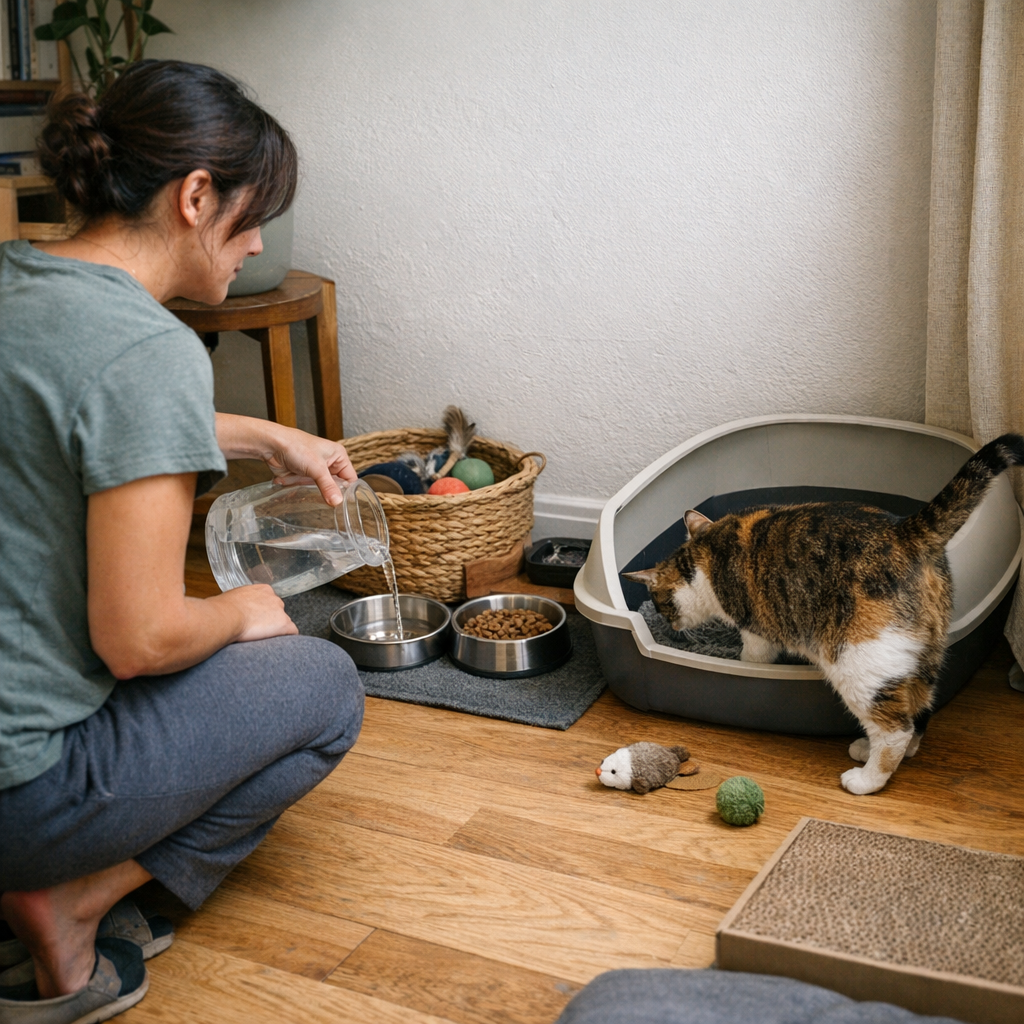
The moment a “tidy” indoor cat setup turns into extra work isn’t dramatic—it just shows up during another loop through the house. That feeding corner you labeled as settled suddenly means sidestepping a backpack or shifting a stool to reach the water bowl. The litter box “out of sight” becomes an out-of-mind cleanup, pushing you to cross rooms again when grains turn up under your socks in places you swore were cat-free. With every pass, what once seemed organized reveals friction points: the cleaning tools that are never where you are, forgotten toy clusters under the couch, and surfaces that stay messy longer just because the reset zone was split too far. The difference between a setup that simply looks under control and one that stays easy to live with becomes obvious when small annoyances stack up—fast. StillWhisker’s world starts where these points of friction show: the actual flow, not the initial look.
Where Good Looks Start to Strain: The Visual Calm Versus the Living Flow
Arranging your cat’s world by spreading food, water, litter, and toys across different corners can make your living space seem more open. A dish in the kitchen avoids crowding the hall; toys slide under the edge of the couch; the litter sits behind a laundry door. You get two days of feeling tidy—until you’re refilling before work and must weave around a chair just to deliver water, only to realize the scoop or wipes you need are nowhere near the action.
Soon you’re not just cleaning up cat mess; you’re repeating laps for left-behind supplies while bits of kibble and tracked litter collect outside their supposed “zones.” Instead of one maintenance sweep, every reset spreads out: longer detours, more steps, less completion. Day by day, the smooth, compartmentalized look forces scattered effort in ways you can feel every morning.
Spotlight on Invisible Costs: Ordinary Moments That Add Up
One missed cleanup doesn’t wreck a routine—but cat care runs on reruns, and every small lag multiplies over a week. When the only litter scoop lives across the hall, tracked grains get nudged further each time you wait. Wipes stored with cleaning products two doors down turn a spilled water puddle into a sticky spot you ignore “until later,” which quickly becomes tomorrow. Each roadblock is minor alone, yet together they quietly inflate the work—so what looked like separation for neatness means more repeat hassle, not less.
A midpoint most people hit: you bend for runaway toys after breakfast, notice a line of litter trailing past the mat, then have to cross to the laundry or under-bathroom cabinet for supplies—by the time you’ve circled back, another round of mess has started somewhere else. This “one quick fix” grows into a five-minute loop, especially if you’re pressed for time or if guests are coming and the pressure for visible order ticks up. Layout starts to matter less than how fast you can actually get through the routine.
Centralization: Shrinking the Loop, Saving the Routine
Pet blogs love the idea of clean separation: bowls here, water far off, and the litter box banished to its own corner. But real daily use rewards a different approach—centralizing everything you need within arm’s reach. Instead of pristine minimalism, you lock feeding, water, litter, wipes, and toy storage into a single functional zone, tucked but unbroken. A washable mat can hold both food and water side by side; a short divider puts the litter nearby without inviting a cross-room trek. Supplies stay in a shallow caddy close enough that picking up, wiping down, and returning all happen in a single round, not a scavenger hunt.
Now, when dishes need a refill, you lift both in a single movement. When kibble scatters or a water splash hits the mat, the cleaning tool is already there—no detour, no accumulating mess for later. Even the toys that want to roam end up dropped into a bin you can reach without walking away. Suddenly, resets aren’t slow—they’re what happens in the same space, in real time, without thinking about it twice.
The Mess Behind the Mask: When “Tidy” Isn’t Actually Easier
A setup that seems calm because every category has its siloed corner can backfire as soon as life gets busy. You walk into a room that looks spare, but there’s a sticky bowl edge you keep ignoring because the cleaner is across the house. The extra step between water drop and available towel means puddles linger longer. Restoring order after play turns into another cross-room journey for scattered toys and the bin you’re wishing wasn’t always out of the way.
This isn’t uncommon: a laundry-room litter setup designed for “order” can mean twice the cleaning area, as tracked litter stretches away from its source, never fully under control. Each visually clean separation reveals new work not because you’re lazy, but because the routine simply isn’t built for fast correction in the main zone. The room’s tidiness is no match for daily movement—and you feel the gap every time you’re delayed by one supply that never seems close enough when needed.
Tradeoffs That Don’t Disappear: Crowding, Cleanup, and the Line Between Order and Ease
Of course, bringing cat life into a central zone tests your comfort with “fuller” corners. Grouping food, water, and litter tighter can turn that area into the busiest visual spot in the home. And a real zone, if it drifts toward piling up, can start to feel cluttered if you don’t maintain clear boundaries—a washable mat, divider, or supply tray that holds the line between contained and chaotic.
Even when boundaries are set, there’s no perfect neutrality; the core zone will look denser. But now, everything you need to restore order is right there. Toys cycle back with zero detour. Messes created and messes cleaned live in one place. Litter scatter is corralled, not tracked through living spaces. Under time pressure, the whole zone resets in minutes instead of spiking into a major chore when every category plays out in different rooms. The tradeoff: a busier core for way less friction everywhere else.
How Real Use Shows the Weak Link—And Where Improvement Pays Off
The weak point of any setup isn’t obvious on day one—it’s what breaks down in real use after a week. A misplaced towel, a drawer that sticks, a scoop that drifts too far from the core zone: these hiccups slow resets, forcing half-done loops and extra chores. Catalog images show ideal lines and pure surfaces, but cats (and people) nudge, move, and unsettle anything not anchored to the daily routine. Improvements show up not in permanent neatness, but in how much less you have to think about cleanup, how little retracing you do for a single mess, and how fast you return to “done” status—even when interruptions hit.
No setup erases friction completely. Cat routines change, preferences shift, supplies migrate, and even the tidiest arrangement becomes imperfect over time. But the leap from an area that simply appears orderly, to one you don’t mind resetting again and again, is often what saves your patience. The best arrangements survive housemate interference, crowded mornings, and a cat’s habit of rewiring the whole scene—while keeping your effort low, even on the busiest day of the week.
Key Habits That Make the Core Zone Work
Limit Toy Rotation to Avoid Clutter Creep
Keep just a few toys in the main bin, directly in the core zone. This avoids spread-under-furniture scavenger hunts and makes quick returns realistic. Swap toys bi-weekly or monthly—not daily—so your cat gets novelty and your floor stays navigable.
Keep Refill and Cleanup Supplies on Hand—Not Across the Room
Stash scoops, wipes, or sprays within the same area as food and litter. A lightweight caddy or shallow drawer by the core zone eliminates the excuse to “do it later”—meaning scatters, spills, or stray food get handled on the spot, not hours after they appear.
Revisit the Layout After a Week of Real Use
The first setup never survives a week as-is. Recheck: Is the mat wide enough? Does the divider work, or does it get in the way? Has someone in the house “tidied up” by removing supplies you rely on? Reshape the layout after honest use—it’s not a snapshot; it’s an ongoing circuit for both you and your cat.
When Calm Looks Different: Accepting That “Neat” Isn’t Always the Goal
Some setups never look perfectly guest-ready—and that’s fine. What matters in StillWhisker’s world is not surface neatness, but how much less work you face in repeated routines. Each friction point solved in the zone means spills stay contained, toys are easier to tuck away, and resets get short enough that daily life with a cat stays both liveable and clean enough to enjoy.
Explore practical setups and accessories for real, routine-tested indoor cat life at StillWhisker