
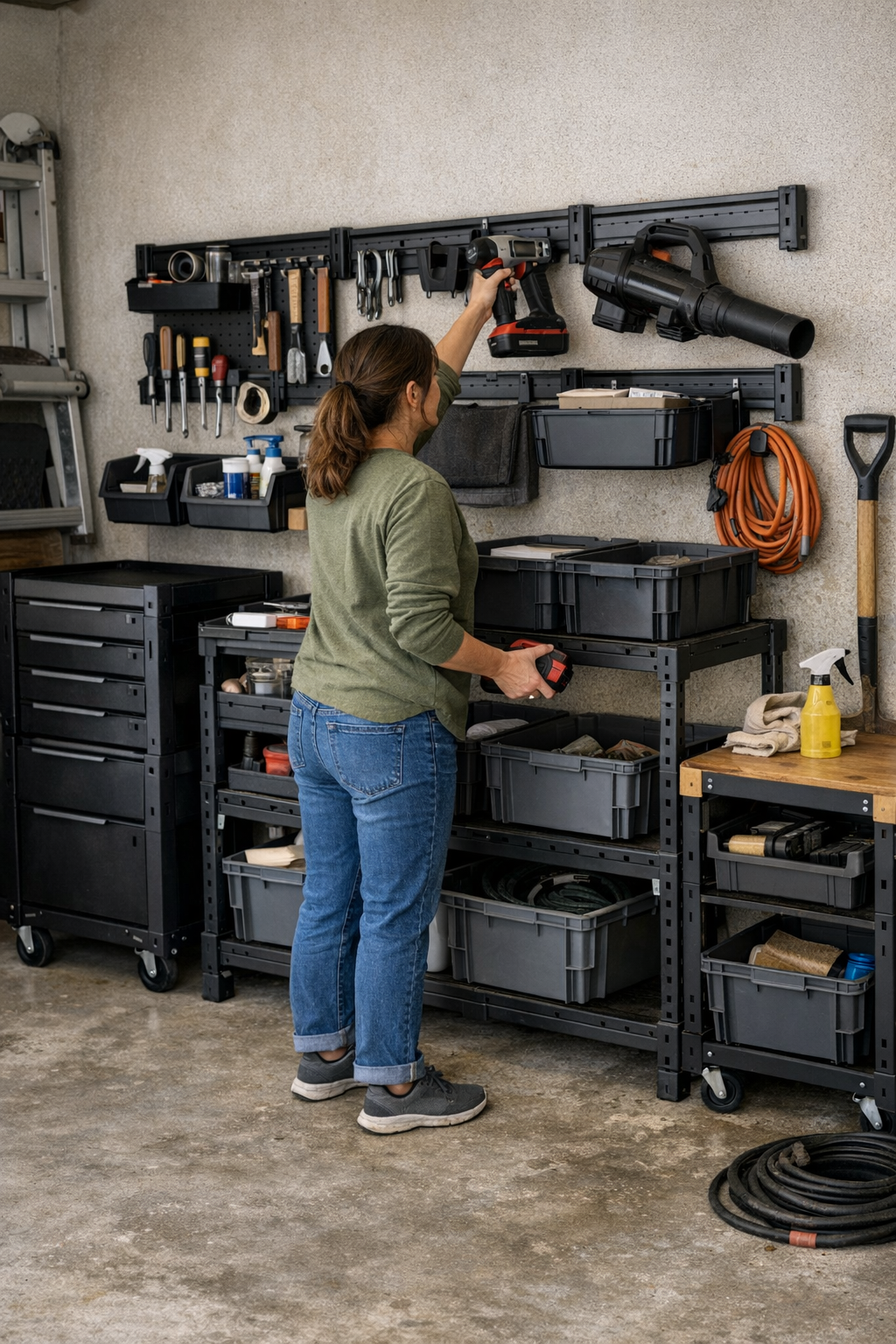
We all buy into the modular wall storage promise: take back the floor, keep your go-to tools visible, and make cleanups as quick as they should be. But here’s what sneaks up on you: it’s shockingly easy to build a wall that looks perfectly sorted—until the next job. Suddenly, you’re squeezing past a rolling cart again, reaching blindly behind a storage bin, or retracing the same clumsy steps just to put a wrench away. Most wall systems are built for appearance, not for the grind of real, repeated setups—and that’s where so many “organized” spaces fall apart.
When Tidiness Masks Everyday Hang-Ups
That first setup always feels satisfying. Hooks line the wall, bins pop into place, and every hammer, cable, and measuring tape stands ready for action. But by week three, the visual order slips: the wall that should save time becomes a barrier course. That screwdriver you grab twice a week? Wedged behind a snow shovel, blocked by a pail. Need to open a cabinet by the wall? Not without shifting a rolling chest—again. The difference between what looks organized and what actually works is revealed every time you’re juggling three things to get the one you need.
Resets that should be automatic get slower: bins start to overflow, hooks pile up with backup gear, and narrow corners gather everything that doesn’t have a real home. Sliding aside the same storage crate for the fourth time, you realize—visual tidiness alone can’t keep up with real work. Every supposed time-saver adds another shuffle, another reach, another minute lost to routine friction.
Overflow: The Cost of “Just Hang It Anywhere”
The empty wall invites you to fill it. Anything with a hook, anything with a handle, anything that will balance for now—it’s all fair game. Off-season hoses, bags of potting soil, backup coolant, the rake you use once a month: up they go. It feels efficient, until you’re digging under last spring’s cleanup supplies just to reach your pliers. Slowly, the wall morphs into an “overflow zone” where the things you count on most are always blocked by things you rarely touch.
What should speed you up now just stands in the way: hooks meant to clear the floor become buried, pathways between benches get narrower, and the “temporary” jumble of seldom-used gear becomes a permanent half-obstacle. It’s always one extra step, one re-stack, one more bump with your knee just to get a routine task done.
Organization Isn’t About Capacity—It’s About Flow
The real test: how quickly can you put your essential tools away, with no second-guessing, no moving a bin “just for a second”? If the answer is always, “well, after I clear this out of the way,” the wall isn’t organizing anything—it’s just making the shuffle look neater. The wall should be your shortcut, not your new bottleneck. Every time you lift, slide, or dodge one item to get to another, you’re trading visual order for everyday awkwardness—especially when you’re tired, rushed, or trying to squeeze a project into borrowed time.
How One Overloaded Zone Slows Down the Entire Setup
Things don’t break down all at once. It starts in one corner: maybe the step ladder pushed into the only open stretch, or a pile of gloves accumulating where the rotohammer is supposed to live. There’s always a tipping point. For me, it was needing the leaf blower before dark—and discovering it jammed behind winter gear, pinned against two boxes, and tangled in an old bike lock. Instead of a ten-second grab, it turned into a five-minute scramble. Gloves hit the floor, boxes got shifted, and the urge to just leave the mess “for tomorrow” nearly won.
That’s how wall zones go from helpful to headache. What was a fast-reset area transforms into a dumping ground for every “I’ll just stash this here for now.” Quickly, the system you trusted to keep clutter off the floor just rearranges the clutter at eye level—and the struggle repeats, day after day.
Who Really Deserves Space? Resetting the Standard
The fix wasn’t another organizer, but a hard boundary: only tools used weekly or more gained prime wall space. Anything else (seasonal, “might need it later,” or lost in last month’s project) got reassigned—to drawers, basement shelves, or low-profile bins tucked under the bench. The results were dramatic in real use:
- Essential hooks stayed open, every time.
- Bulkier items stopped clogging grab-and-go lanes.
- Cleanup after even a long day felt automatic—no more zoning out, dreading resets.
Now, the routine changed: finishing a job doesn’t mean recalibrating the wall. Tools find their places in seconds without mid-reset detours. The space isn’t just tidy—it finally matches the patterns of real work, where speed and simplicity matter more than a fully occupied rack.
Let Habit—and Friction—Point to What Needs Clearing
The wall either helps you move or it makes you slow down. Does the layout let you reach, return, and reset with a single motion? Or are you caught sidestepping bins, wrestling with stacked gear, or having to open a cabinet around yet another stray cart? Even the perfect modular system won’t fix what’s overloaded or mismatched to your routines. What you really need is a zone that can absorb repeated use—without becoming an obstacle course three weeks later.
Action step: Next time you hesitate at the wall—if you feel yourself mentally pushing back (“there’s nowhere clear for this drill,” or “I’ll just leave this for now”)—pause and strip the zone down to the true essentials. Clear the rest, even if it means a pile on the floor for five minutes. The difference is immediate: fewer blocked hooks, smoother movement, resets that don’t drag. You’ll actually use the wall, not just stare at it.
Don’t wait for one more frustrating morning or an overflowing bin to trigger a big fix. Small, honest resets—driven by what you actually touch every week—tend to last, and the wall finally begins to work for you instead of the other way around.
For more storage solutions that hold up to real routines, visit StackNest.