
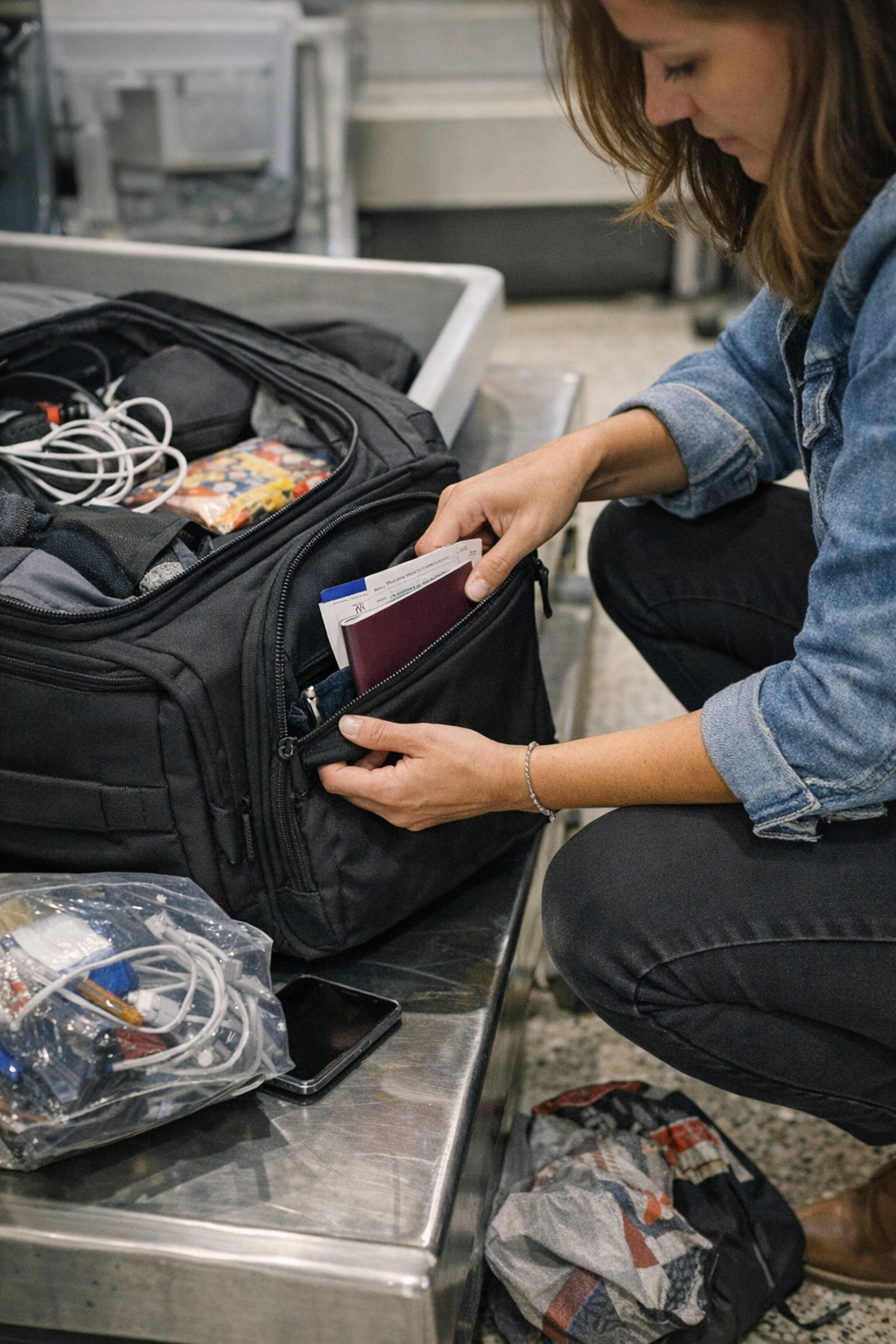
The hidden friction of your return flight isn’t chaos—it’s the slow breakdown of carry-on order, revealed through real, repeated movement. What seemed perfectly sorted when you left home starts to betray you by the time you’re threading through airport security or inching down the boarding aisle. You notice it in tiny stalling moments: the charger that’s migrated deep into a snack pouch, the passport that now clings to receipts, the “quick-access” pocket that suddenly requires two zips and a blind hunt.
This isn’t a dramatic collapse. It’s the incremental drag of a system that deteriorates silently—one awkward document retrieval, one tangled cable, one tray transfer at a time. Outbound, your structure held. On the return, the cost shows up with every small interruption. The more you dig, the clearer it gets: a bag can look tidy but feel unworkable when the flow of actual travel starts testing each pocket, pouch, and packing routine.
When Organized Isn’t Enough: Where Friction Takes Hold
Every seasoned traveler knows the feeling: the trip begins with chargers, snacks, and travel documents each in their mapped spot, and outer pockets prepped for quick grabs. But delay creeps in once you’re back in the churn—security queues, check-in counters, crowded gates. What started as order fades as charger cables drift into snack kits, boarding passes get sandwiched with crumpled receipts, and fast-access pouches turn into catch-alls.
The bag still looks structured, but your motions stall. You reach for a passport, hesitate. The right item means tracing multiple zippers instead of one. At security, you fumble to separate tech from snacks, losing tempo as the line moves on. There’s no mess—only a slow, compounding loss of speed in moments that once felt automatic.
Specific Travel Points Where Carry-On Structure Breaks
Check-In: The Disappearing “Safe” Pocket
It’s never at the hotel where things go wrong; it’s at the check-in counter, people on all sides, hands full, trying not to hold up the queue. You go to grab your passport, but it’s wedged against postcards or snack wrappers, no longer in easy reach. What should be a swift handoff becomes a hand-deep search and that awkward moment shuffling items while staff and other travelers watch. Not lost, not scattered—just resistant, just slow.
Security: Scramble at the Tray
Security unpacks the problem. Your laptop is in one pocket, but the charger—you discover—is tucked with travel snacks, “just for now.” Headphones, pen, cables: each piece clings to something it shouldn’t. Items cross over, pockets lose discipline, and you’re pausing to untangle the intended from the extras as bins fill up. When it’s time to reload, the neat pack resists reassembly—it’s become looser, less reliable, and you feel exposed, not prepared.
Boarding & Bins: Order Becomes a Puzzle
You reach the boarding tunnel and face the overhead bin. That slim, compartmentalized bag you were proud of now demands multiple unzips to reach a boarding pass or headphones. You edge down the aisle, aware of people waiting behind you, as you work through a tangle that was never meant to be this tangled. Each attempted shortcut—outer pocket, side zip—reveals another small barrier.
Gate Lines: The Repeat-Check Rut
In the final queue before boarding, you start double-checking essentials—again. Instead of a confident “here it is,” you’re fishing through three pockets, feeling for familiar shapes, scanning for documents. Every extra second matters in the slow-moving crush, and a bag that should follow your rhythm instead demands attention, making retrieval a minor hassle every single time.
Why “Good Packing” Cracks Under Real Repeated Use
This isn’t just about overstuffing or laziness. The real culprit is the slow breakdown of your access logic as repeated transitions force items into “just for now” slots. What began as compartmentalization erodes as pouches overlap roles. A tech organizer ends up swallowing old stubs. The bathroom kit swallows loose travel snacks. Even a well-planned layout gives way under pressure from security, gate changes, and last-minute adds. The decline is easy to ignore until it makes itself felt at the worst time—when movement and speed matter.
So, if your efficient outbound setup is losing shape by the return, you’re not alone. Packing isn’t a one-time mastery; it needs to hold against the drag of real movement and real repetition.
Real Signs Your Carry-On System is Slipping
- You now dig through two or more pockets to get a travel document you used to reach in one
- Chargers, snacks, and cables end up in the same compartment, slowing retrieval at every checkpoint
- Security “quick-access” zips are stuffed with extras, turning a 2-second check into a drawn-out fumble
- Repacking after each checkpoint requires placing your bag down for a mini-sort, not just a quick slide
- The feeling of “control” is replaced by low-grade tension each time you need something on the fly
You don’t need mess for a failed system—a bag that hesitates, delays, or stalls on demand is already costing you.
How to Restore True Order: Single-Purpose Quick-Access Zones
Packing again at the hotel won’t save you. Resorting to endless re-zipping rarely helps once the structure’s gone soft. Instead: assign a single pocket for mission-critical items only—passport, boarding pass, pen. Set this zone aside before travel, not improvising mid-route. Don’t let snacks, tech, or last-minute extras invade this space. Delegate each type of item—tech, snacks, receipts—to its own pocket or pouch, even at the cost of visual neatness. When a single-use pocket is preserved, stress drops: retrievals become automatic, motion stays smooth, and the rest of the bag—however jostled—never blocks what matters most.
This reset pays off at every checkpoint: you move without searching, you board without pausing, you sidestep the classic pile-up at tray returns. Not every inch of your bag stays pristine, but your flow does.
How to Keep Your Carry-On Functional Through Every Transition
Give Each Pocket a Non-Negotiable Role
Don’t compromise: If a pocket is for documents, only documents go there—always. If it’s for tech, keep it hands-off for snacks or souvenirs, no matter how tempting. Structure that survives friction needs fewer zones, but sharper boundaries. The outside can be a little messy if the core logic never softens.
Stop Tucking “For Now”—It Never Stays Temporary
Last-minute receipts, wrappers, or pens will tempt you to just tuck them where there’s space. Don’t. Each “harmless” add-in fills the retrieval path you’ll need later. Instead, stop after major checkpoints: restore each compartment to its role, reassign floaters, and clear out catch-alls before the next move. Letting your essentials migrate opens the door to later headaches at exactly the wrong moment.
Test the Setup in Real Sequence, Not Just at Rest
It should take one motion to get a passport, no looking down. You should be able to pull a charger mid-queue with the bag on your shoulder—not with the bag spread out on a chair or floor. If any core retrieval takes more than a few seconds in the real flow—boarding, security, gate—adjust now. Surface neatness never compensates for friction that repeats dozens of times between start and finish.
Real Performance: Built for Movement, Not Just Looks
A carry-on doesn’t prove itself by leaving home organized. You see its real value at the fourth checkpoint, the second gate change, the late-night seat entry when pressure is up and time is short. Set up your structure for the actual grind of travel—repeated access, standing surges, repackings on the fly—not the controlled calm of pre-departure packing.
That’s what keeps a carry-on working for you, not against you: less visual perfection, more access logic that doesn’t crack under pressure. The real advantage isn’t just less mess, but the missing drag, the recovery of rhythm—so you can focus on moving forward, not on searching for what used to be organized.