
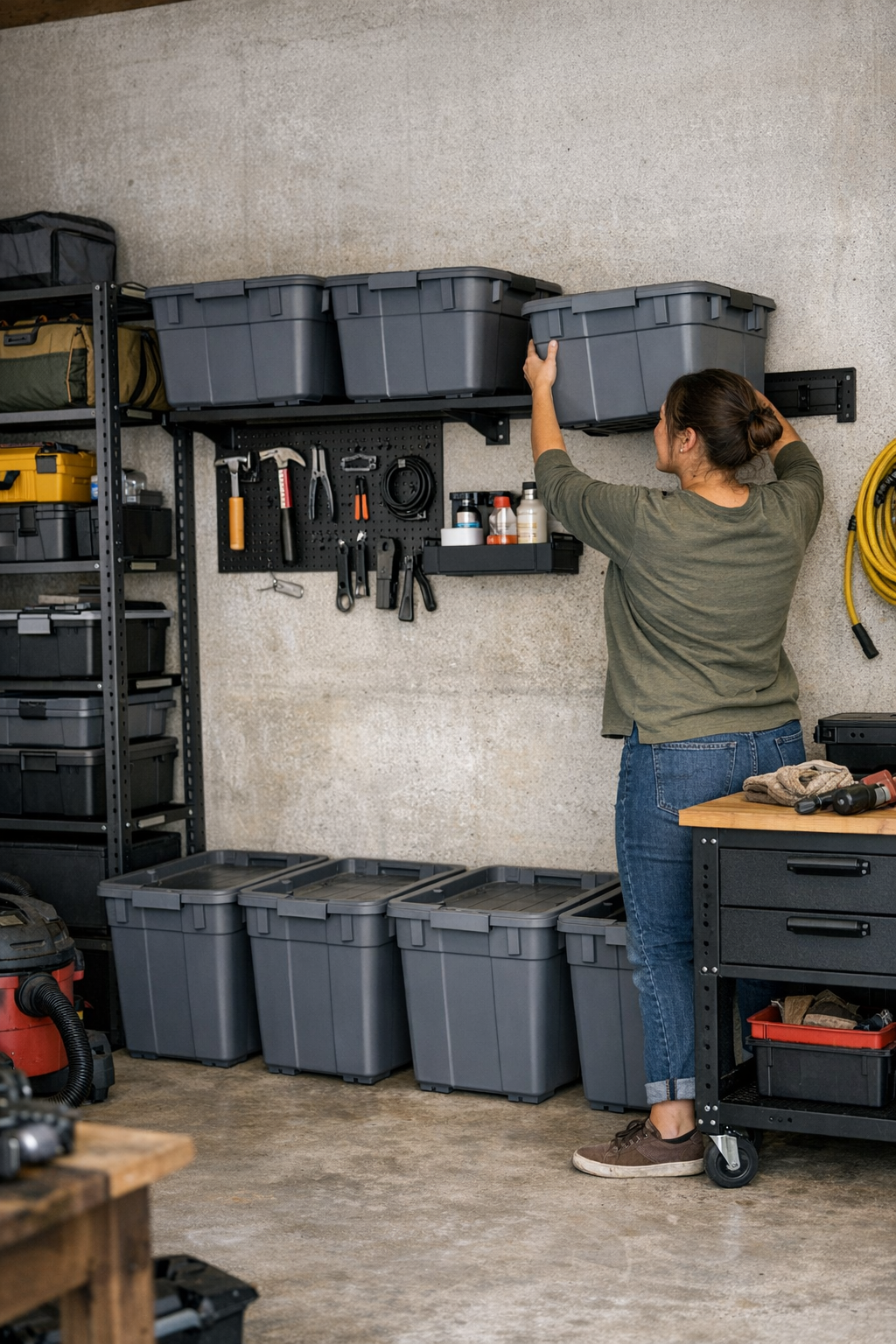
Any garage or workshop can look “organized” for a few hours—rows of matching bins, everything lined up, floors swept. But there’s a familiar moment, usually by the end of a busy week, when you start to realize: it’s not working. You’re nudging a rolling cart for the third time in the same afternoon just to get to the outlet. A hose is pinched behind a bin that wasn’t there yesterday. The corner that should be empty has quietly become a dumping ground for overflow, and every routine involves a few extra, unnecessary steps.
Why More Storage Doesn’t Mean More Usability
The first instinct is to add containers—a new stackable bin, a bigger tote, maybe a taller shelf. On install day, it looks great. A single row of containers along the floor, all perfectly matched, seems like the answer.
But in practice, that order is fragile. You reach for something at the bottom of the pile, and suddenly bins are poking into walkways. The cart that’s supposed to help winds up blocking access to the very tools you use the most. That seasonal box—never quite empty at the right time—wanders further from its zone every time it’s pulled down, eventually occupying the only stretch of wall where you could actually move around.
The real problem: more storage doesn’t solve the constant low-level disruption of a space that can’t keep itself in line. Each extra container delays mess but also spreads it.
Unanchored Containers: The Enemy of Open Flow
Loose bins and gear on the floor don’t know their place. The “tidy” footprint drifts: containers inch into traffic lanes, blocking that one spot you use to turn with a full armload. The empty-for-now tote quietly migrates to the center of the room. What was a clear corner becomes a tangle where nothing is immediately accessible. Floorspace that feels open one day becomes a minefield the next.
The repetition is relentless: three moves just to put back a wrench, every cleanup session a mini Tetris marathon. A mobile chest finds its way into the path every single Saturday—you move it, mutter, and think about doing a real reset… but know it’ll happen again. Unanchored storage never stays put, and the gap between “organized” and “quickly usable” gets wider every week.
Overflow: The Unseen Clog
Overflow isn’t a dramatic avalanche—it’s silent, slow, and steady. An awkward lamp, a leftover bag of potting soil, or a single unfamiliar tool slips into the system and the regular bins start drifting. Suddenly, the path to the back wall takes a detour. The corner under the window feels permanently blocked. Outlet access, once simple, now means awkward reaching or hauling containers aside—not just once, but every single use.
The daily impact is small but cumulative. Every reset takes longer. That little resistance—annoyance here, a few extra seconds there—turns into wasted time and mounting frustration. The space looks “neat enough,” but it can’t keep up with the way you actually work.
Anchoring Order: What Physical Boundaries Actually Do
Boundaries transform storage from cosmetic to functional. Wall rails, anchored shelves, and modular panels force the layout to obey real limits. A boundary isn’t just about keeping bins from sliding; it’s a hard rule for where gear belongs, how much will fit, and—crucially—where routines don’t get blocked by drift. Even with messy use, things can’t wander far from their rightful spot.
Try swapping out a third of your floor bins for truly wall-mounted options. Overnight, the main path stays clear. Returning a power tool stops being a three-step shuffle. You know exactly where the overflow can and can’t go. Seasonal containers can live overhead or inside a defined bay, not wherever gravity lands them. Cabinets stop jutting into walkways, and the area once clogged by “temporarily” parked gear finally stays open.
Reset Speed: The Unseen Value
What’s most striking after creating real boundaries? Reset routines shrink. Instead of shoving rogue bins aside or reverse-engineering your original layout, you put the item back and move on—done. Spotting an out-of-place tool becomes so obvious you fix it without thought. There’s no wrestling the same rolling cart back into line, no detouring around congestion points. On even the busiest days, order survives. Cleanup stops being a project and becomes a single, automatic motion.
With boundaries, overflow can’t quietly colonize new ground. You see clutter instantly. The system stops needed policing, and you start actually using the area the way you intended: more making, less rearranging.
Why “Looking Organized” Still Disrupts Real Routines
Walls of labeled, evenly measured bins look good at a glance, but they fool you. Every week, the same old pattern returns: one cabinet always off the wall by a few inches, one corner with a mystery pile that never moves, and that one spot by the door that collects everything that doesn’t quite fit anywhere else.
If it feels like every project ends with a pile of “to deal with later,” you’re not alone—it’s a sign your storage system can’t withstand real life. The difference shows up in the lost seconds and the low-key annoyance of constantly nudging, shifting, or hunting for what should be two steps away. Weak boundaries are invisible thieves of time and energy, making every return-to-order more tiresome than it needs to be.
Setting Your Own Boundaries: Practical Tweaks That Work
Target your bottlenecks, not your bins. Is the path to your workbench always a zigzag? Does gear constantly pile up near the back door or the outlet wall? That’s where a rail, sturdy panel, or defined shelf should live—not just “more storage,” but something with a clear limit.
Give your setup a reality check: after a regular task, time your reset. How many times do you move something just to put another thing away? Where do you have to reach awkwardly—every time? Those are signals your layout needs a real boundary, not another container.
Try simple tests—assign a slot for each bin using a modular wall, or mark a “home base” spot for a tool chest. Watch whether it holds its ground after several days, or if things drift back into chaos. The right experiment is the one that makes cleaning up as automatic as the mess itself.
The Everyday Test: Will It Work Next Week, Too?
Truly functional garage setups aren’t just about the install—they show up in the way you use the space at actual speed. Are walkways still open, or is access shrinking every week? Do you have to reshuffle four things to get to your main supplies? When the day ends, does reset happen quickly—or does a “quick cleanup” turn into a frustrating rearrangement?
The best boundary-driven setups take a stand: movement stays clear, overflow is contained, and routines stay direct even after heavy use. The proof isn’t in perfect labels or matching colors—it’s whether the space helps you keep moving, hands full, without dreading the return. If your system can survive three messy Saturdays without collapsing, you’ve set up more than storage. You’ve given yourself a workspace that works—today, next week, and far beyond install day.