
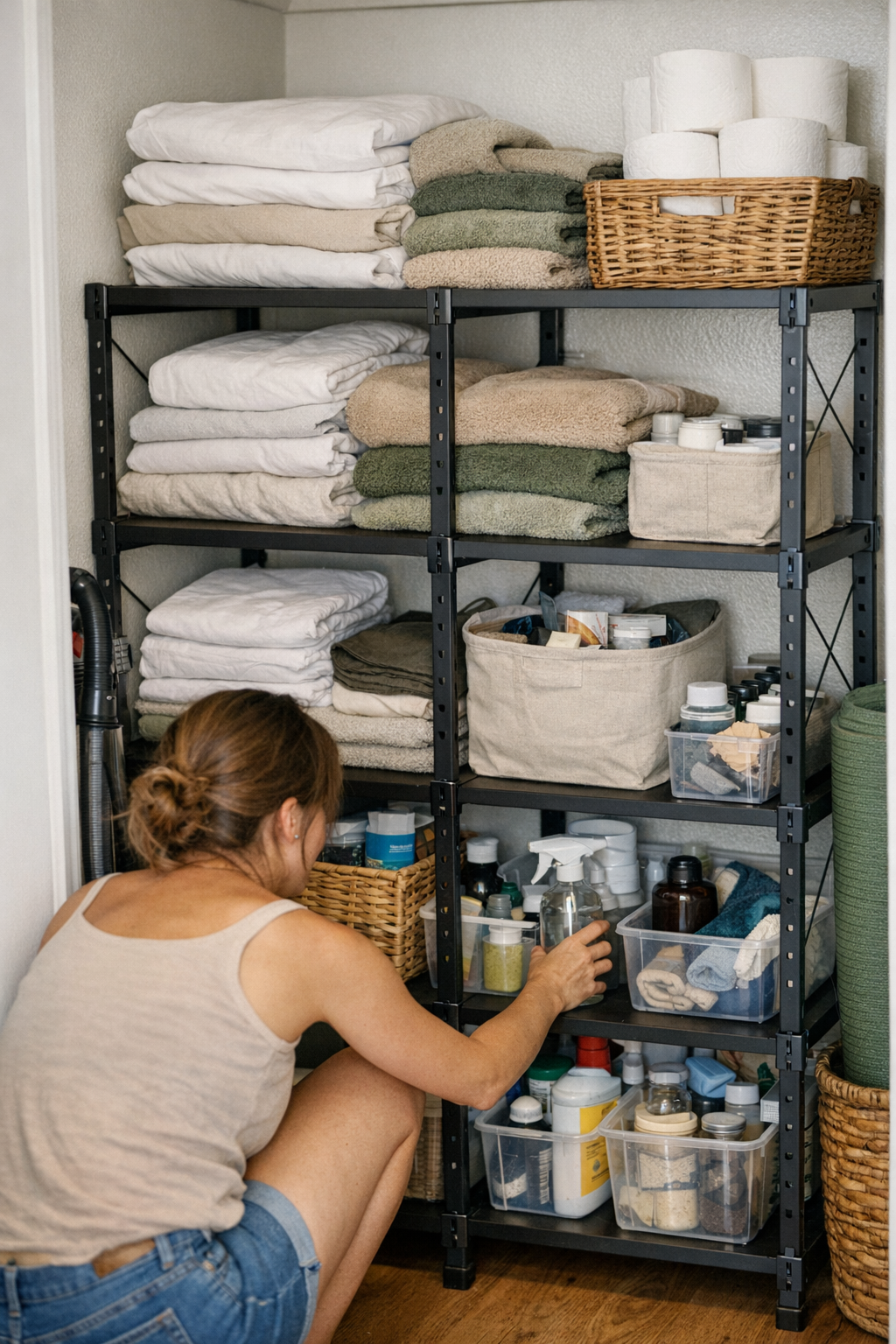
Labels Are Not a Cure—They’re Symptom Management
Walk into nearly any hallway closet, pantry, or bedroom storage wall and you’ll spot them: the ambitious row of sticky-backed labels, the perfect handwriting on baskets, the hopeful arrows pointing to “Towels,” “Snacks,” “Seasonal.” We chase that first satisfying click of order—the sense that if everything is labeled, disorder will finally loosen its grip. Yet by the end of the week, the familiar patterns creep back in. Labels are suddenly wrong, ignored, or so specific they don’t match the real contents. That earlier surge of control? Replaced by the quiet suspicion that you’re no longer keeping organized—you’re just managing a game of label-and-relabel.
When Labels Only Add More Work
The breakdown isn’t theoretical. It’s what you feel in the rush of living. Midweek, you open a bin marked “Sheets” and find a tangle of socks and nightshirts. You lift every basket looking for a missing pillowcase, or stop and squint at a fading “Snacks” label before realizing the bin holds oatmeal and canned beans now. Instead of quick access, you’re in maintenance mode: editing categories, rotating items, peeling off labels to make room for new ones—just to stay afloat.
This frustration spikes in the spaces that see real action. In the hallway closet, everyone dumps towels wherever there’s space. In the pantry, groceries fill and empty unevenly, so the “Breakfast” shelf ends up mixed with crackers or soup. Even the front door cubby, meant to keep shoes and bags apart, descends into a heap by Friday. The problem isn’t that you lack discipline. The problem is a system that demands you work for it, not with it—rigid bins, labels for things that change daily, corners no one can reach without crawling.
The False Promise of Perfect Order
Those first few days, a new labeling scheme looks unbreakable—baskets lined up like a catalog photo, every item in its painted lane. But real life erodes surface order quickly. The “Towels” stack bulges sideways, blocking the next bin. The “Seasonal” basket starts hiding birthday candles with garden gloves. Miscellaneous clutter finds its way into every available gap, regardless of what the label says. Soon, frustration becomes routine—reaching behind crumpled stacks, stacking baskets on the floor, bulldozing through one bin to reach something in another.
Watch what actually happens: the “Snacks” box drifts toward baking supplies after one grocery run; folded towels uncoil past their boundary into another category; the label for “Misc” slides out of reach behind a pile of winter hats. You realize the container isn’t the problem—the daily realities never matched the label’s tidy fantasy.
Shared Spaces Create Label Blindness
Add a second set of hands (or five) and the system degrades even faster. In the bathroom, “Guest” bins fill with everyone’s contact solution and razors. Laundry zones labeled “Delicates” and “Whites” collapse into one after a hurried wash. Labels become hopeful reminders, not actual guides. After a few days, nobody trusts them. Everyone navigates by memory or guesswork, shoving items wherever they’ll fit.
Where Storage Systems Fail—And Why
Picture the reset after laundry day. “Sheets,” “Towels,” and “Cleaning” bins are theoretically separated. But the shelves are just deep enough that extras spill into the nearest bin. Pillowcases land atop towels. Searching for one set, someone pushes other contents forward, unseating the stacks. By week’s end, the categories are shot—a haphazard blend of items requiring a full scan and multiple basket-pulls to find anything.
Half the battle isn’t about tidiness, but about the design itself. Too-deep bins swallow things out of sight. Overly narrow baskets overflow while bulky “storage” bins sit empty. Shelves set at awkward heights mean stacks quickly collapse, sliding into neighboring spaces. Vertical room is wasted above, while horizontal zones self-destruct under pressure. Almost every retrieval turns into a slow-motion excavation.
Reset Speed: The Real Test of Your System
The truest measure? How quickly can you restore order after a normal, hectic day—not a staged cleaning session. If your system only looks organized in photos but becomes a puzzle to reset, you burn time and energy every time you restock. Do you have to drag out half the closet to sweep up stray socks? Are you re-labeling or shuffling bins with every change of season or new bulk buy? If your shoes and hats keep creeping into the entryway—or if the kitchen’s “Overflow” bin is perpetually a mix of everything—chances are, your categories are fighting your habits.
The most livable storage setups aren’t strict—they’re forgiving. They create “good enough” boundaries you can refill in seconds, not with a checklist and a label maker.
Lean Into Flexibility: Improvements that Actually Last
If your resets keep getting slower or more complex, it’s time to look at how your storage set up, not just what the label says. Are your bins the right size for the real amount of stuff—are you always cramming extras on top? Can you reach what you need without moving other baskets? Do your categories reflect how you actually use the space, or how you wish things would work?
Try this: swap out universal labels and mismatched bins for simple, open shelving—just define a visual rule, like “don’t stack above the second shelf.” When items are visible and distances are short, you reset faster. No digging, no guessing, no rearranging every time someone tosses in a backpack or seasonal coat. Clarity improves, and minor everyday clutter never snowballs into a full afternoon of re-sorting.
If you want to keep labels, be ruthless about their purpose. Only label what must truly be separated (“First Aid,” “Holiday Decorations”), and use adjustable tags or wipeable markers. When routines shift, so can your categories—no peeling, no guilt, no system overhaul required.
Storage Should Disappear Into Your Day
By the end of a long Tuesday: the last towel is hung, the backpacks are dropped just inside the door, the weekly groceries are shifted into reach. If your system fades into the background—if you can reset it in under a minute, without a sigh or a scavenger hunt—you’ve found something functional, not just photogenic.
Don’t ditch labeling entirely—just recognize its limits. The best storage fits your actual rhythms, not showroom rules.
Discover storage options built for real life—messy, busy, imperfect—at ClosetWorks.