
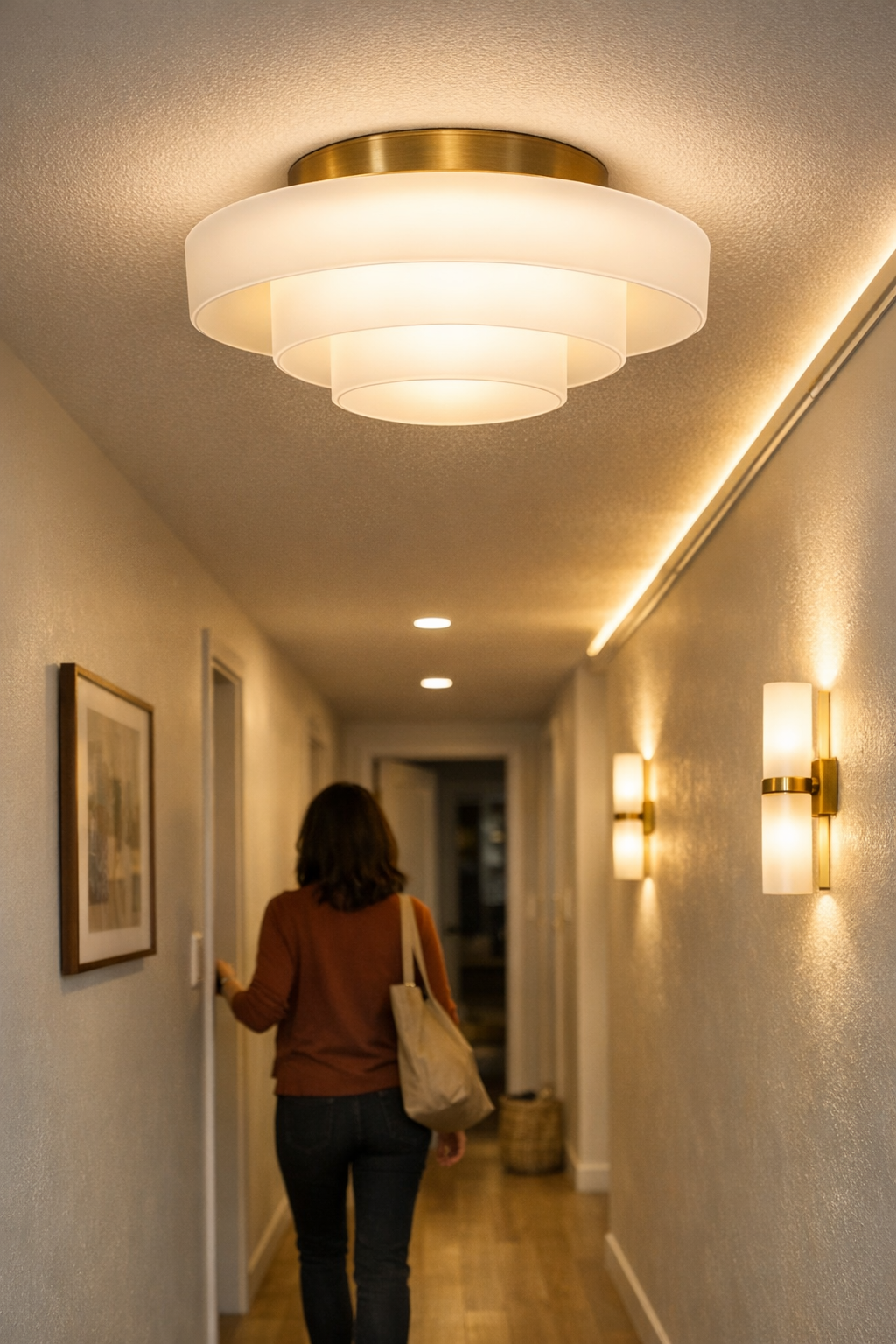
Hallway lighting often works against you where it matters most—during the rush, not on the first look. Flush fixtures and hidden cables give a tidy finish, but the disguise falls apart in daily routines. The moment you scoop up laundry, scramble for keys, or edge around a guest in the evening, the flaws announce themselves: shadows cluster along skirting, glare lands right in your line of sight, and crossings require extra attention to see or avoid what your setup failed to solve. The promise of a “finished” hallway clashes with the reality of repeated movement—the real test is whether the space lets you pass through easily without glancing down for every step or nudging past another misjudged bracket.
When Visual Cleanliness Hides Daily Friction
Choosing flush ceiling lights, tight brackets, and barely-there cable covers can make any hallway look organized for a listing photo. But daily use exposes problems that surface only with repetition. Only after multiple passes will you notice shadow-stripes left by a mispositioned fixture, or that your bag reliably snags on a cable channel just a shade too low. These aren’t cosmetic disappointments—they’re daily speed bumps built into the very idea of “tidy” lighting if the setup isn’t dialed to match how the hallway is actually used.
This friction escalates in the rush of real life. Early-morning shoe hunts, bathroom runs with low light, or a fast trip while holding groceries each magnifies what the original install missed. When the hallway turns from pathway into obstacle course, the neat setup loses its relevance and starts actively getting in the way.
The True Test: Movement and Repetition
If you have to adjust your route, pace, or grip, your hallway lighting isn’t working.
The clearest sign of a weak hallway setup is the repeated need to compensate: slowing down to see into a dull bend, shifting away from a low wall bracket, or shuffling too close to one edge because light coverage doesn’t reach across. This doesn’t just happen once. Every routine—grabbing shoes, walking groceries, or passing with arms full—turns into a reminder of missed coverage or misplaced support.
Even minimalist or visually seamless designs become irrelevant if you find yourself steering around a glare spot or brushing past a protruding bracket every day. In hallways, use patterns matter more than the clean lines seen in static photos. What looks resolved isn’t actually solved if your everyday path keeps forcing small corrections.
Where Clean Lineups Miss: Underlit Runs and Glare Spots
Flush-mount ceiling panels or slim wall fixtures often promise streamlined clarity, but break down after sunset or when real traffic resumes. The central strip of brightness is rarely enough—doorways, corners, and junctions acquire dark bands exactly where you turn or pause. One harsh hotspot near an entrance might impress a visitor but leaves you squinting the rest of the time or stepping into sudden dimness halfway down the run.
Spotlighting fails outright when a hallway isn’t straight or when use concentrates at the ends, not the center. Exposed cables—sometimes left visible for style or fast install—only trade one problem for another: extra visual distraction, more cleaning work, or a persistent signal that function came second to the appearance of neatness.
Hidden Obstacles: Wires, Brackets, and Subtle Annoyances
An install that “cleans up the look” but puts one wire box or bracket in the wrong path guarantees a lifetime of quiet annoyance. In tight hallways—especially with bags, coats, or quick-moving kids—any hard edge, dangling cord, or slightly jutting mount turns into a hazard that slows or snags as often as you pass by.
Recurring tells include always stepping wide of a dim patch, tracing along the wall to feel secure in low light, or seeing guests hesitate at a dark threshold. Subtle in isolation, these are compounding costs when the hallway should simply let you through without thinking. Even cable supports meant to stabilize can project into traffic zones, adding risk instead of reducing it if not sited high and outside the active path.
What Actually Fixes a Subpar Hallway Setup?
Improvement in a hallway means you can walk its length—even half-asleep or carrying bags—without rerouting or scanning your steps. The fix rarely comes from dialing up brightness or loading up decorative trims. What works is overlap and placement: switching from a single centered fixture to a staggered pair of low-glare linear LEDs lit up the entire four-meter stretch in real-world trial, making edges and drop zones clear on every pass. Running cable high along the trim and using evenly spaced, out-of-reach brackets erased both clutter and the recurring need to steer away with your shoulder.
Suddenly, hands stayed free of snags, floors didn’t hide trip-points in shadow, and routine cleaning no longer dragged cables out of position. Not every flaw vanished, but for the first time, the hallway handled actual movement—a visible and felt upgrade, not just a fresh look. Even with full arms or tired eyes, the space simply worked instead of demanding attention.
Practical Tweaks That Genuinely Help
Break Up Uniformity for Consistency
Skip the urge for a matched row of identical fixtures. Layering ceiling and wall mounts, even at irregular heights, helps eliminate both glare and persistent shadow. Staggered, diffused fixtures break up the “dark lane” effect and create a reliable, readable path where motion actually happens, not just where it looks best in photos.
Elevate, Tuck Away, and Repeat
Keep all wires above shoulder level and out of grab zones, held steady by brackets well clear of normal reach. Use channels or covers that match the wall tone to move distraction out of sight. This doesn’t just protect the wiring—it lets you stop thinking about cables completely, restoring the hallway’s usefulness instead of shifting the problem to eye height.
Don’t Shrink the Space With Spotty Light
Concentrated lights not only create glare but can make the passage feel tighter than it is. Spread the light pattern across the footpath, and stagger your support pieces to echo natural use—not arbitrary symmetry. Function wins in a hallway when the coverage runs edge to edge, no matter the fixture lineup, so you aren’t funneled into a narrow, artificially dim channel.
What Adds Up in Real Use
The difference between a hallway that feels clear and one that nags at you is measured in tiny, accumulated interruptions: places you slow down, obstacles that catch, cables that break the line of sight. Over a month, what’s “minor” becomes unmissable friction. Ignoring these compounding weak points means living with a setup that looks settled but works against you, over and over.
Upgrades that focus only on aesthetics or simple swaps disappoint as soon as practical movement resumes. The most reliable fixes blend intentional overlap, clean support placement, and deliberate cable management—letting you treat the hallway as a functional, not decorative, part of your home every time you use it.
View more indoor lighting and support solutions at LightSupport.