
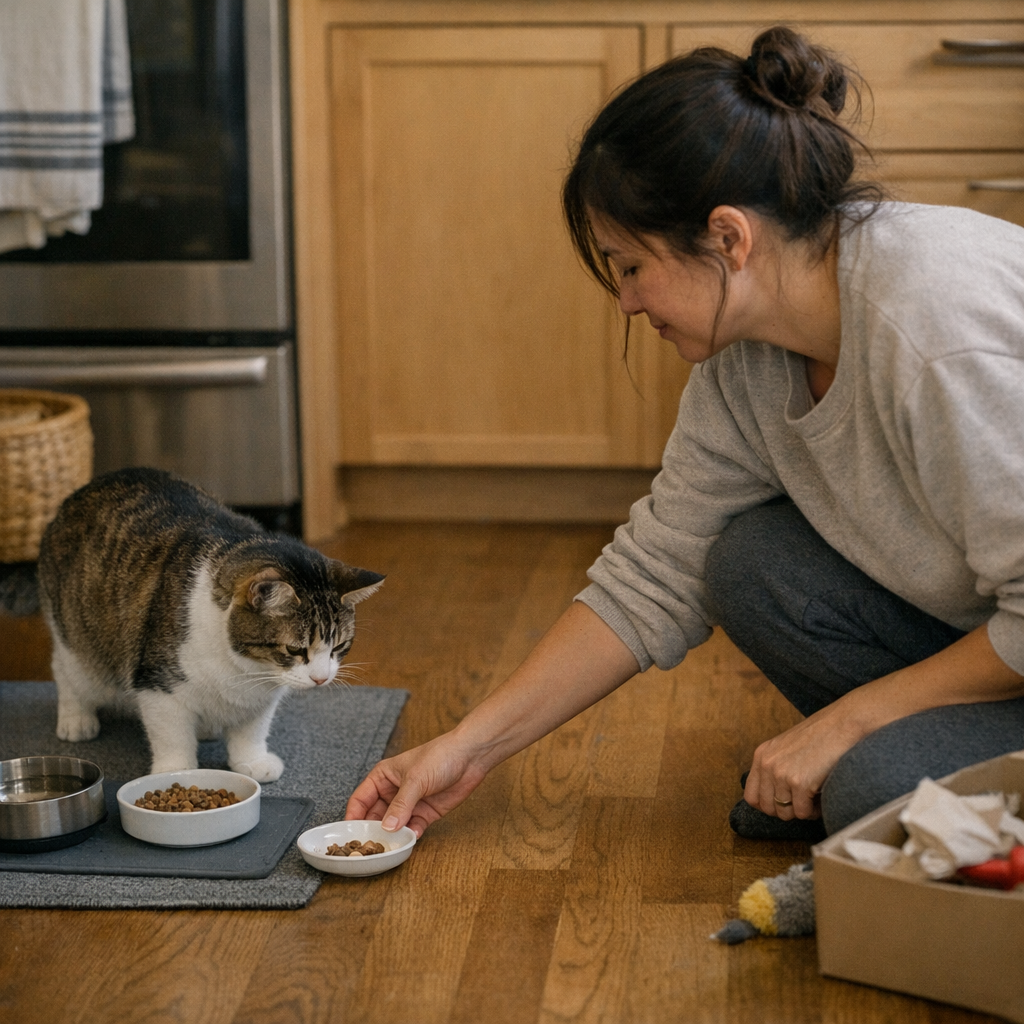
The first problem sneaks in quietly— a quick treat tossed next to the food bowl, a half-open kitchen drawer left as an unspoken invitation, a crumb escaping the edge of the mat. But these small exceptions don’t stay harmless. Before long, your indoor cat isn’t just parking herself at meal times. She’s circling the kitchen, eyeing the treat spot, blocking your reach as you reset the feeding area or fetch a wipe. Every impulse treat resets expectations, and what looked like a manageable feeding setup turns into a loop of distracted pacing and extra cleanup you did not budget for. Suddenly, the cat’s feeding zone doesn’t signal “finished” anymore; it signals constant possibility—a drifting mess of missed boundaries and repeat chores. In the StillWhisker world, where structure is supposed to make each day smoother, even one off-rhythm treat can throw the whole setup off balance.
How Treat Drift Unravels a Manageable Feeding Setup
The hidden cost of scattered, unplanned treats isn’t measured in the price of snacks, but in the repeated disruption of your home’s rhythm. A feeding zone that once felt contained turns into a negotiation stage. At first you barely notice: your cat begins to hover a few extra minutes after meals, then lingers at odd hours, scanning you and the treat drawer for a hint of the next handout.
The patterns escalate quickly:
- Pacing along the food mat at random times instead of settling elsewhere
- Waiting for that sound—the crinkle of a treat bag, the drawer sliding open—and redirecting all focus to that trigger
- Crumbs collecting just past the edge of the mat, requiring extra wipes not counted in your usual cleanup
- Interest in actual meals displaced by the anticipation of treats, making feeding less predictable and more work
The shift from “tidy” to “exhausting” happens in the background. With each unstructured treat, you increase the frequency of small interruptions—loose crumbs, blurred boundaries, and daily feedback loops that quietly erode both your control and your cat’s routine.
When the Line Blurs: Invisible Work and Quiet Friction
Even orderly routines show their limits here. What starts as a quick treat detour creeps into refill pauses, mat resets, and every half-step needed just to reach the water bowl. Instead of a clean feeding cycle, now you find treat residue ground into the mat, the small vac never quite put away, and your cat’s attention glued to the feeding station whether it’s time or not. The old boundary between “done” and “maybe something extra” collapses, and you’re left with invisible friction—an accumulation of side chores that pull attention away from the rest of your setup.
Well-placed storage offers little relief if the treat bag stays too close to other essentials. Resetting after meals looks fine on the surface, until the week stacks up with a series of extra wipes and unscheduled negotiations. Unlike predictable routines—water refills, litter sweeps, toy pickups—treat drift injects ambiguity, exposing the weak seams in your otherwise solid setup.
Practical Scene: The Real Cost of a Shifting Treat Zone
Picture this: feeding goes by the book on Saturday morning. But when you reach down later to straighten the mat, crumbs have already crept beyond its edge. The cat, who used to wait elsewhere, now springs up the instant you move toward the treat drawer—even if all you wanted was a fresh cloth. That tension, thickest at the feeding corner, becomes a low-level background drain: slower resets, more wipe-downs, and a feeding zone that keeps pulling you back for fixes it shouldn’t need.
Setting a Predictable Routine: How a Treat Rule Reclaims Structure
The fix isn’t a new feeder or another storage hack—it’s a repeatable structure for the treats themselves. A clear, predictable rule, enforced daily or weekly, collapses those negotiations. You don’t need to go rigid, just deliberate: treat time links to one reliable event, in one designated spot, with a setup that guides both cat and owner back to baseline. For example, a single treat after brushing or just before a shared rest period. Same place, same time, same sequence.
The shifts are immediate and visible:
- The cat waits for the known moment—no longer pacing, no longer on high alert for random signals
- The mat resets quickly and stays cleaner, as treat debris is confined to a separate cycle
- Your attention stops fracturing—cleanup is folded into a single, predictable routine, not endless spot checks
- The cycle of negotiation evaporates—expectation is clear, behavior normalizes
When the rule becomes visible in the room, the background tension vanishes—and the feeding zone returns to its original, low-friction state.
Making the Rule Visible and Easy to Follow
Simple distinctions make this structural change stick. Never serve treats on the same mat or dish as regular food. Use a specific plate, preferably something shallow and ceramic for faster cleaning, placed just adjacent but always separate from the main feeding station. It comes out for one event, then returns to storage. Avoiding textured mats for treat moments prevents crumbs from embedding, cuts back on debris trails, and lets you reset the area in one step—not ten.
The Repeated-Use Difference: How a Defined Treat Moment Impacts Daily Flow
What looks like a small scheduling detail rewires your whole routine. Now, cleanup is contained in a predictable slot—no more scouting for stray bits or doubling back to the feeding zone with the hand vac. The kitchen corner stops being a cat-powered detour every time you walk past. Instead, it works the way the rest of the StillWhisker setup does: smooth, clear, and not constantly nagging for attention.
Where Setup Meets Reality: Good Intentions vs. Daily Conditions
Appearances mislead—a visually tidy feeding area crumbles if routine fails. Mats and bowls align, but you still find yourself checking the treat bag’s location or scrubbing a sticky plate that should have been reset hours ago. In a truly functional setup, every routine slots into place without overlap: water, litter, toys, rest, treats—each with its own beat, none tripping over the other. Any repeated stumble—knocking the treat container during a refill, retracing a cat who’s moved in on “treat central”—signals a structure gap that looks minor but leeches hours and energy across weeks.
Pulling those pain points out of overlap—through an obvious treat boundary—brings daily reality in line with best intentions. You’re no longer habitually interrupted. Your cat gets clarity. The home feels less reactive, more in sync with the rest of your StillWhisker structure.
Smart Treat Area Practices for Easier Indoor Cat Life
The difference between stress and effortless upkeep lies in a separate treat zone and strict timing. Keep treats on a dedicated dish—never on the main mat. Only bring it out for the routine you’ve fixed in advance, whether that’s end-of-grooming or calm evening time. Put it away just as quickly. Textured mats only invite crumbs and slow you down—skip them for treat service. This isn’t about removing small pleasures; it’s about protecting the rest of your setup from gradual, invisible sabotage. A feeding zone that resets fast and stays free of non-meal interruptions is worth far more in lowered hassle than a feeding zone that simply looks kept up.
Unplanned treats rarely ruin a setup in one go. They degrade it gradually—through shifting boundaries, repeat crumbs, and small negotiations that drag the whole house out of sync. In homes where water, litter, toys, and rest already move on set rhythms, letting treats slip into free-form chaos breaks the pattern and makes every next reset harder than it needs to be.
Watching for Recurring Friction: When to Revisit Your Treat Routine
If you notice any of these signals, it’s time to audit your treat structure, not just your storage:
- Vacuuming or sweeping after treat time becomes a weekly ritual
- Meals are ignored unless a treat is produced first
- The cat appears at the treat station at all hours, regardless of schedule
- Cleanup supplies keep drifting closer to the feeding area—out of necessity, not intention
These clues aren’t solved by better gear alone—they need a singular, predictable treat event to restore order.