
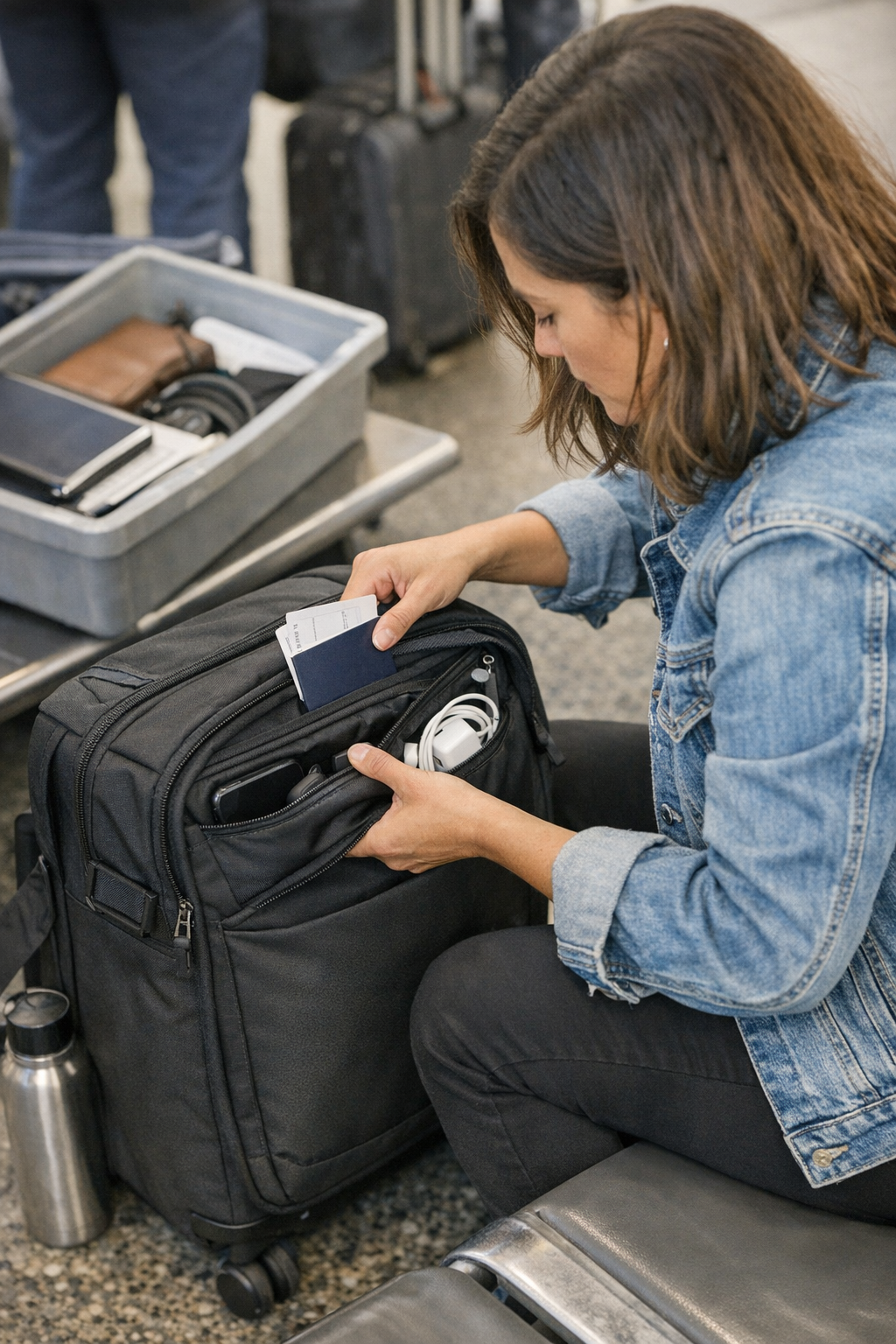
A carry-on bag that looks organized in your bedroom can fall apart the first time you hit a crowded airport checkpoint. The real make-or-break moment for any “smart” setup comes not when you first zip it closed, but when you’re forced to yank out your passport in a moving security line, or reach for a charger while someone elbows past you at your gate. Every second spent unzipping a pouch, fishing through layers, or repacking in the aisle isn’t just lost time—it’s unnecessary friction, visible not just to you but to everyone stuck in line behind you. That’s when a neat-looking system reveals whether it actually works under pressure, or just slows you down in ways you only notice too late—right when it counts.
When “Neat” at Rest Becomes Messy in Motion
What survives airport reality is rarely what looked neat at home. The passport pocket that seemed so accessible becomes a blind spot when facing a boarding agent and four hundred people behind you. Your labeled pouches are still color-coded—but the boarding pass has slipped under a charger, and now every retrieval triggers a full-bag scramble. The difference isn’t subtle: small flaws repeat, drag out, and stack up each time you need a single item in the middle of a rush.
This is where so-called “organized” setups betray you: waiting in line, hand hovering over the right pouch, only to discover documents are stuck two layers down. There’s no smooth landing zone to work out of; your top compartment’s zipper jams against another bag. Suddenly, your well-packed kit isn’t saving you time—it’s making you the holdup.
Repeated Reality Checks: Where Smart Design Collides With Real Use
Perfect order has a short lifespan under airport repetition. These are the slowdowns you’ll notice most:
- Pouch-Within-Pouch Overload: What started as smart separation turns into digging through a matryoshka of pouches just to grab headphones or a passport. Each retrieval means unpacking, then repacking, with no quick reset.
- Snagged Zippers, Delayed Access: An outer pocket that snags at the worst moment—leaving you bent awkwardly over your luggage, while your ID is seconds away but out of reach.
- Two-Handed Fumble: Tech kits designed for neatness require a table or flat lap, but airport reality gives you one hand, no space, and the need to grab a charging cable fast.
- Layer Confusion: Compartments overlap so closely that each zip for your phone means spilling out five unrelated accessories first.
These aren’t rare annoyances—they’re the quiet, repeated missteps that chip away at airport momentum, turning tidy “solutions” into a time tax you pay at every checkpoint and every bottleneck.
Typical Scenes: Friction You Can Feel, Trip After Trip
Security Tray Slip-Ups
You reach for your laptop and liquids at the checkpoint, but your compact packing means your laptop sleeve is behind two zippers and the charger tangled three layers deep. Now you’re unpacking your whole setup onto a gray plastic tray as the line builds. That “clever” separator just became a scramble zone—multiplied by every connection, every airport, every return trip.
Document Retrieval in Tense Moments
All smooth until you need your boarding pass again. It’s under two pouches this time, and your hands are already full. Every repeat access ramps up stress, not just once, but at every gate, every document check—no matter how perfect it looked before you left home.
Overhead Bin, Underwhelming Access
You toss your carry-on above, settle in, then realize your headphones are in a side pocket that’s now completely blocked by armrests and other passengers’ gear. To get them, you have to dig, lift, and repack—risking dropped items and impatient looks from everyone behind you. A second saved on initial packing, lost tenfold in the aisle.
The Invisible Cost: When Looks Override Function
Visual order is a false comfort if your setup can’t handle the test of actual transit. The “clean” arrangement—organized pouches, crisp dividers, triple-bagged toiletries—lasts only until you need the third item in a row and realize that each barrier slows the whole routine. The drive to declutter at home actually invites mid-trip disorder when every layer and gate becomes an extra hurdle. Obsessive tidiness morphs into access-blocking complexity, defeating the real goal: smooth movement through the airport maze, not just a neat look when still.
Where Practical Adjustments Make the Difference
If you’re recognizing any of this, you’re seeing the shift that every frequent flyer eventually makes: ruthless prioritization of speed and simplicity over decorative stacking. The fix isn’t “add another pouch”—it’s clearing layers between you and what you touch most, and designing routes for documents, chargers, or headphones that won’t get blocked mid-trip. The strongest setups share some rules:
- Direct-access for repeat-touch items: Anything handled more than once per leg—boarding pass, phone, charger—goes in top or external pockets, not inside a pouch inside a pouch.
- No deep nesting for essentials: The more items you bury, the more time you’ll waste unpacking at pressure points.
- Instant retrieval trumps photo-tidy: If you can’t grab it standing up, with one hand, that “order” is just a future bottleneck.
Switching all my in-transit essentials to a main top zip pocket didn’t just make security faster; it ended the cycle of mini-unpacking before every gate and every seat. No deep dives, no second-guessing, just a clean motion—making the bag not only look good but finally work in real situations, over and over again.
Signs Your Carry-On Could Move Smarter
Watch for these signals that your setup still privileges appearance over flow:
- Pausing or stalling with each basic retrieval in a line or terminal.
- Full or partial repack after every travel document or device check.
- Multiple zips, pouch dumps, or item shifting just to grab what you need next.
- Bag neatness returns only after you stop—but every real access still adds drag or distraction.
The best structure is the one that stays agile under stress: repeated security, last-seconds boarding, inflight access, terminal transitions, and hotel resets. Reliability isn’t a stack of pouches—it’s flow that stays easy after the sixth checkpoint, not just at departure.
Building a Carry-On That Works in Motion—Not Just at Rest
Forget showroom-perfect packing. Build your carry-on to handle back-to-back access, cramped aisles, and sudden document checks. Organize not for photos, but for the messy, repeated hands-on moments travel always brings—when every extra zip or pouch layer only adds time and stress.
What wins is practical structure: true quick-access pockets, purpose-built document slots, and a minimum of overlapping sections. Order that breaks down less under real use will always beat picture-perfect neatness that can’t survive airport pressure. Accept every small compromise that gives you fewer stops and smoother resets—trip after trip, airport after airport. The difference is immediate: a carry-on that stays in rhythm, not just in order.
Find tools, organizers, and carry-on solutions shaped by real movement at CarryOnSupply.