
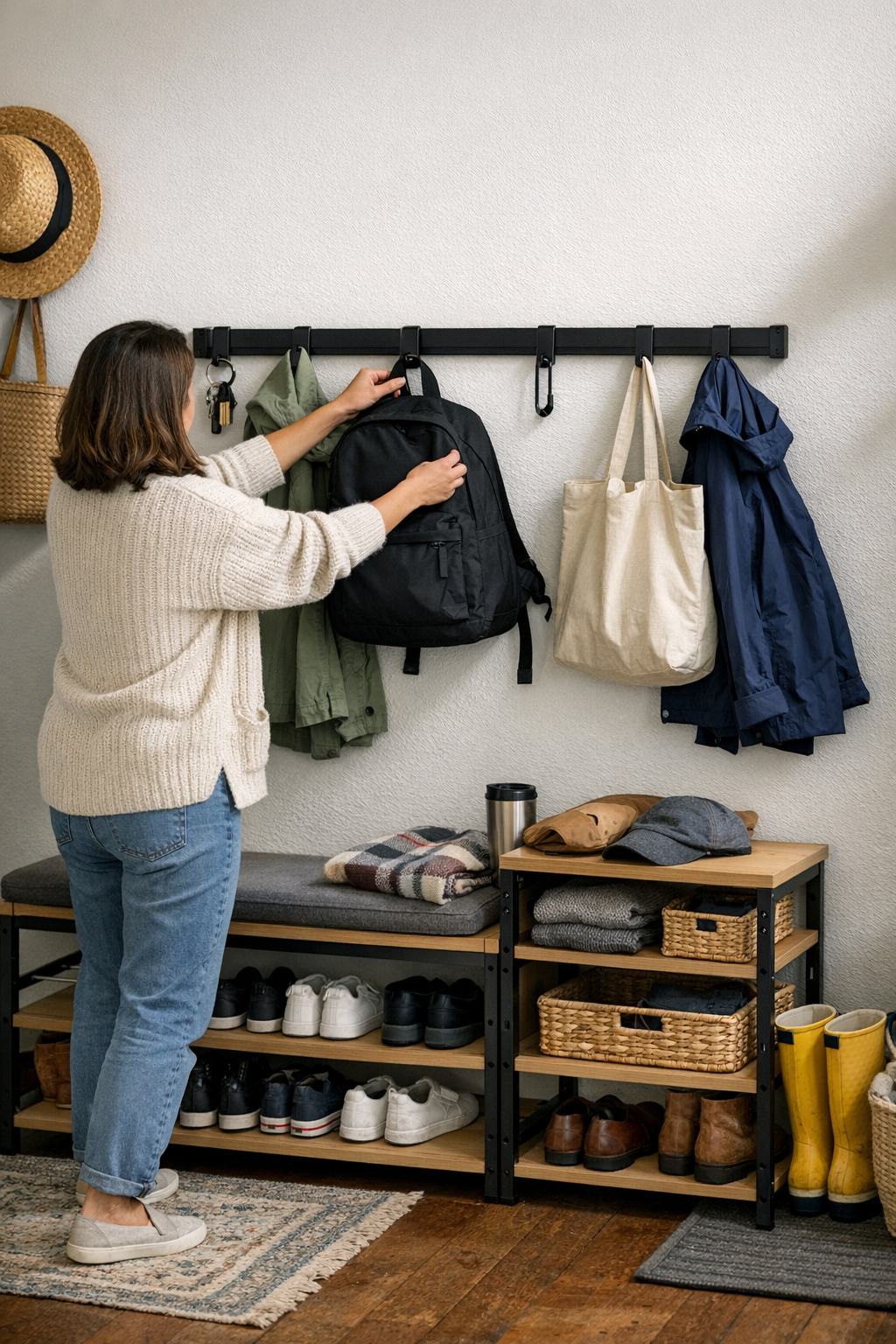
Clutter in the entryway is rarely dramatic, but it’s relentless. The moment two people drop a bag and a damp jacket at the same time, the system breaks: hooks fill, bags spill, shoes creep outside their lane, and a once-clear passage becomes a daily bottleneck. Suddenly, what looked “organized enough” turns into a zone you have to wrestle your way through—nudging shoes, shifting coats, digging for keys—just to get in or out. If you’ve found yourself resetting the same pile five days in a row, the problem isn’t your willpower; it’s a setup that can’t flex as daily routines overlap or weather turns unpredictable.
Why Fixed Hooks Fall Short When Routines Overlap
Fixed hooks seem like they should hold the line—a neat row on the wall, each with its role. Until real routines return. The cracks show instantly when:
- Multiple people pile in together: Three hooks become too few long before you hit the door with two backpacks, a raincoat, and someone’s gym bag.
- Gear gets bulky, damp, or dirty: One jacket drips onto another, bags press together, and what doesn’t fit gets stacked on benches or left on shoe racks.
- Resetting gets awkward and slow: Shifting one thing tugs another, knocking keys down or tangling up bag straps, and a quick “clean up” always turns into an annoyed scramble.
This isn’t just surface clutter. It’s the difference between an entryway you can walk through in one motion and one that stops you to rearrange piles. Over time, overflow spreads—shoes start migrating out from the bench, bags slouch onto the floor, and what’s meant to be “temporary” almost never gets put away. The zone that manages gear turns into the zone that collects it.
Rail Storage Adds Crucial Flexibility in the Entryway
Install a wall-mounted rail with sliding hooks and you’ll see the difference inside a week. A rail isn’t just decorative—it’s an adaptable zone. Need more space for winter coats? Slide a few hooks tight together. Wet jackets after a storm? Move a hook aside so they don’t drip on school bags or pile up on the shoe bench. Rush hour bulk drop? Cluster hooks on one end to catch the day’s overflow, not block the main path.
- Group bulky coats away from the door to keep quick-access hooks clear for keys and daily bags.
- Slide wet items to the end—no more drips on shoes or tangled straps.
- Re-arrange for after-school gear explosions, then reset for evening calm, all without taking the whole wall down.
This isn’t about keeping things “pretty.” It’s about stopping regular rushes—or surprise gear dumps—from turning a threshold into an obstacle. The difference: the entry stays usable, not just tidy for a moment.
Where Fixed Hooks Break Down: An Everyday Scene
Late afternoon—school bags and a heavy parka arrive just as someone settles on the bench to get their boots off. The hooks are already crowded. The first bag fits, the second half-hangs, shoved against a coat. Going for the keys? They tumble off a hook that’s lost all open space. The shoe row becomes backup storage for whatever can’t be hung. Clearing any of it means juggling armfuls while other feet try to squeeze past. Every item added tightens the zone, and every retrieval becomes a reset.
How a Rail Handles the Same Pressure
Rail system: shift a hook. Backpacks move left and clear bench access. The parka slides over—no more drips down on bags. Keys get their own hook, not tangled or dropped. The floor stays visible—shoes don’t vanish under collapse. This time, nobody has to move three things just to reach one. The path is open, even with the usual chaos.
Real Improvements, Not Just Visual Tidy
Rail storage doesn’t erase clutter, but it blocks the cycle where stuff crowds every surface until the only option is a total reset. Over a few weeks, you notice:
- The bench stays clear for sitting—it isn’t just a backup for what can’t hang.
- Shoes stay visible and accessible—no more getting buried by whatever slips off a too-crowded hook.
- Pressure gets relieved as needed—clusters, slides, and isolation give you options instead of forcing ugly reshuffles.
The difference isn’t decor; it’s a daily routine that survives real-life mess. The threshold stays open, resets get faster, and friction drops—even when nothing is perfectly in place.
When a Rail Really Makes the Difference (and When It Doesn’t)
Some households—just one or two people, no shared gear, staggered schedules—can get by with a few fixed hooks. But if your entry is regularly overrun by:
- Morning and afternoon traffic jams
- Mixed-weather chaos piling up gear in waves
- Shared drop zones and guest overflow
—then a wall-mounted rail starts to matter. The detail that counts: you need a minimum of 18–24 inches of wall to let the rail flex. Without that flex, benches and shoe storage will still become overflow zones, no matter how tidy the hooks look. If you’re still stepping over bags and bumping shoes aside, the fixed hook setup is not holding up—it’s just hiding the jam behind better spacing.
Why Setup Flexibility Becomes a Daily Advantage
Rail storage doesn’t banish clutter forever, but it delays—and often avoids—the moment when minor annoyances become deal-breaking clogs. Shifting hooks for the week’s rhythm means less blocked movement, less searching for buried shoes, and faster resets. The system flexes; the routine flows. Entryways only look functional on paper—real function comes when storage can bend to absorb whatever real days drop at the door. For most busy setups and shared drop zones, a rail isn’t a compromise: it’s a defense against repeated frustration, letting the entry hold its purpose without constant workarounds.