
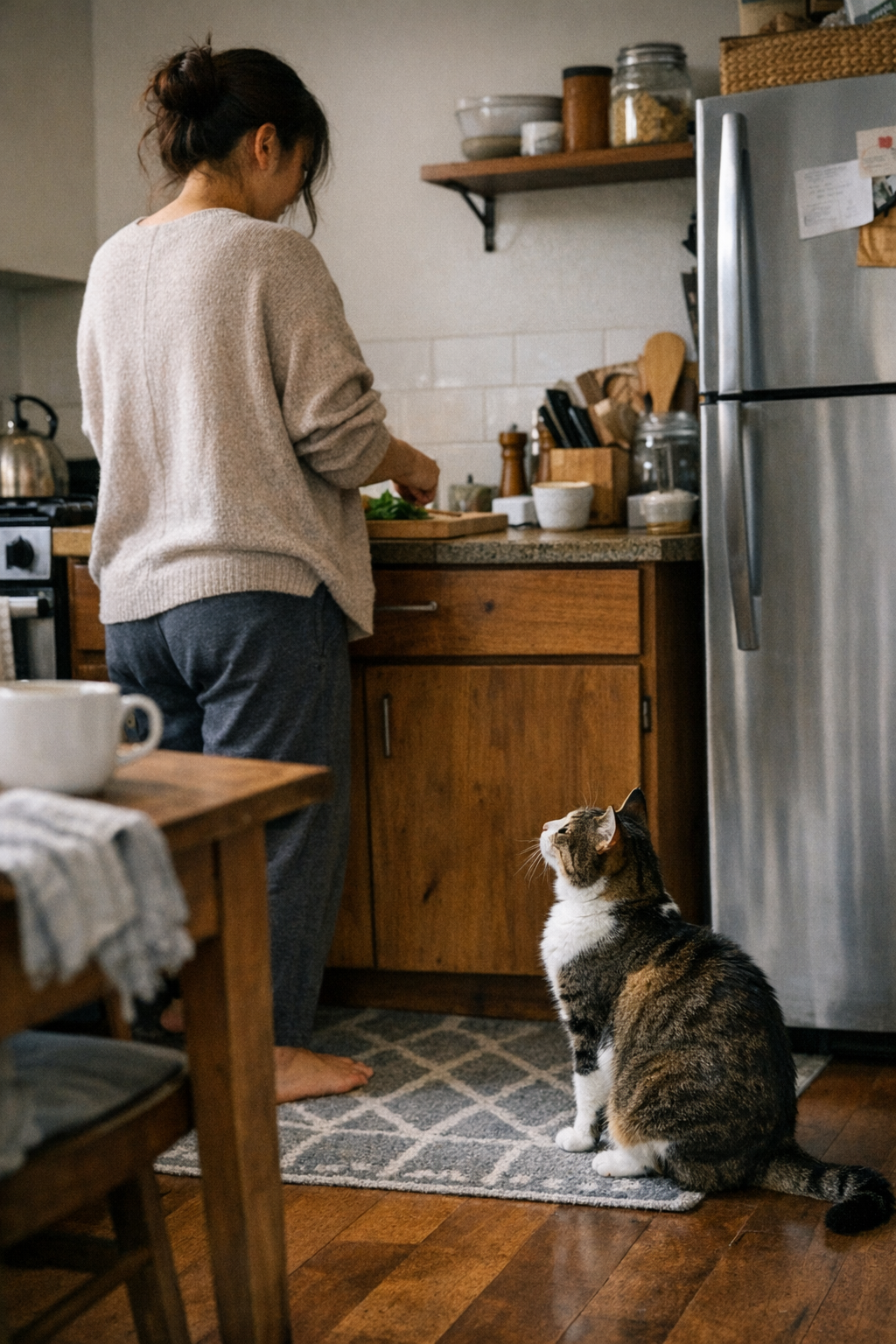
The treat routine that started as a lighthearted “just this once”? By week two, it’s rerouting your every kitchen move. If you often find yourself pausing mid-step, coffee scoop in hand, because your cat has planted herself between you and the counter—blocking the fridge, singing out sharp, expectant meows at every hint of a snack—you’re dealing with more than playful begging. You’re experiencing the repeat disruption of an indoor-cat treat habit gone structural: kitchen crossings now come with feline patrols, every cabinet creak can trigger a sprint or a standoff, and what began as harmless is now reshaping how (and how well) your shared home actually flows. The kitchen doesn’t just look different—it works differently, with StillWhisker-level details suddenly at the center of every refill and reset.
When “Just This Once” Becomes Every Day
Giving a cat a treat sounds simple—until each treat changes the rules of your home. At first, it’s a single bag hidden away, a quick reward, a happy scramble. But to an indoor cat, scattered treats aren’t random. They teach her to read the kitchen as a daily event. Soon, you’re shadowed to the drawer, intercepted at the pantry, slightly off-balance at the sink while your cat blocks your footing—believing you might turn snack run at any moment. Double-bagged treats or closed cabinets don’t erase the circuit: anticipation lingers, turning non-food routines (anything near the treat spot) into daily triggers. Refill, reset, and even a midnight glass of water now come with feline choreography you didn’t sign up for.
From Clutter Control to Cluttered Living
Maybe your setup looks fine: containers lined, a mat by the bowl, clean edges, hidden bags. But functional order breaks down fast once your cat’s new “treat patrol” launches. Head on into a reset and suddenly you’re negotiating with paws in the way, or choosing between prepping food quickly or dragging out the distraction dance. The real friction is the friction that returns with every meal, every cleanup, every movement, never quite leaving—even as the area looks organized. Clutter might be invisible, but daily interruption is not.
How Treat Timing Shapes Shared Space (and Why It Adds Up)
Anticipation is the real mess-maker. A scattered treat schedule glues your smallest actions (open a drawer, rinse a dish) to your cat’s “might be treat time” radar. Your kitchen shifts from food prep zone to hope-and-holdout territory. Walking through becomes slower, movements stall at feline checkpoints, and cleaning—especially quick wipes or resets—takes longer because you’re dodging, redirecting, or working around a hopeful audience.
Every Move Feeds the Cycle
Here’s how this pattern wears on ordinary routines:
- Reach for the coffee scoop—cat darts into the line of fire, blocking your next step as she eyes the treat drawer.
- Late-night water trip? That crinkle means a chorus of meows, hopeful circles, and a cat waiting right in front of the food zone.
- Cleanup stalls as crumbs or bags bring instant feline attention, making it harder to finish resets without detours.
- Wiping the counter happens late, slowed by the need to intercept your cat before she leaps up or noses into the treat cabinet the moment you’re distracted.
The result? Kitchen flow stalls—not because it’s messy, but because your routine is now split between “my task” and “feline management.” Treat anticipation leaks into every refill and reset, splitting your attention and stretching basic tasks into a series of interruptions.
Invisible Wear, Real Friction
This isn’t just an occasional annoyance—it’s visible if you look for it:
- The kitchen mat grows a bald patch right in the waiting zone, showing just how many hours are logged on treat patrol.
- Circling cats shed fur onto prep surfaces, raising cleanup frequency—and making quick wipes feel never quite finished.
- Small tools migrate to new, awkward spots so you can keep them cat-free and reachable mid-interruption.
- You start handling tasks with one hand, always angled to redirect a determined paw without dropping the coffee scoop.
It’s not the appearance of mess—it’s a practical loss of flow. Every reset, every refill, is a little harder than it should be. Organized storage only shields the surface; the underlying pattern is constant friction fighting what should be smooth home movement.
Why Predictable Treat Routines Change Everything
The fix isn’t just a better-looking setup—it’s structure. Treats tied to fixed, predictable moments (after meal prep, or as part of a set evening reset) pull anticipation away from every random kitchen move. Instead of a cat on edge for each creak or step, you get gaps in feline attention: the house settles, the routine clears. You regain the use of your space, with interruptions shrinking and maintenance finally back to planned resets instead of constant detours.
The Shift: Less Hovering, More Usable Space
After just a few days on a fixed-rhythm treat schedule, owners repeatedly see changes like:
- Cat downtime moves out of kitchen high-traffic areas, letting you reach the fridge or prep zone without a barricade of paws.
- Vocal demands decrease—less insistent meowing, fewer “just-in-case” reminders at every kitchen trip.
- The mat recovers as cats spend less time camped in one spot, showing less visible wear.
- Resets happen quicker—fewer quick stops to redirect a cat, easier batch cleaning, less back-and-forth.
The kitchen isn’t transformed into a cat-free zone, but it becomes usable in the way it’s supposed to: one owner, one cat, real space to complete each task without layered delays. Structure beats optics; what matters most is a routine that removes obstacles from repeated daily work.
What “Organized” Looks Like Versus What Actually Works
Closed cabinets and matching bins set a hopeful visual—but if the treat rule is “whenever I pass by,” real friction remains. Storage alone won’t short-circuit expectation. In practice, a cat will abandon even her nap zone to shadow every movement that’s treated as a maybe. The true test is when the cleanup or reset falls apart despite how good the area looks five minutes after a deep clean.
Real Example: The Calm-After-Meal Routine
Notice the kitchen mat: one owner found a worn spot always under feline watch. She shifted treats to after meal prep and a second slot post-cleanup. Days later, the mat’s wear faded, the cat returned to distant napping corners, and kitchen flow—fridge to counter, drawer to sink—became routine again instead of an obstacle course. Cabinets hadn’t changed, but the tempo of paw vs. person reset entirely. Real order wasn’t just visual—each pass through the room felt smoother, resets took less time, and feline interruptions moved out of the way of actual use.
What Works: Linking Treats to Rhythm, Not Randomness
Winning setups don’t hide chaos under storage bins—they assign a rhythm. Treats follow a daily marker (lunch breaks, evening resets, or after returning home), not every stray trip past the food zone. What to try:
- Select one or two routine events per day—lunch reset, post-dinner batch cleanup, or returning from errands.
- Keep treat storage steady, but don’t depend on hiding it; the timing shapes behavior more than the container location.
- Give the new rule a week—less loitering in traffic zones, fewer random meows, and smoother resets typically follow.
This isn’t about strict control—it’s about outgrowing repeat friction and making the space work closer to how it looks: organized and, more importantly, fully usable, even with a cat who’s always part of the action.
Recognizing The Real Setup Win
The improvement isn’t measured just after a deep clean. It’s in quick noon resets, end-of-day meal preps, coffee runs, or those fifteenth trips for grocery bags when the routine either jams up or keeps pace. With a predictable treat rhythm, the difference is clear: kitchen traffic thins, resets slide back toward done-in-one, and you stop negotiating every movement. Every setup—feeding, water, cleanup, or rest—runs closer to its purpose, not just in looks but in daily use, making each interruption rarer and each maintenance task less of a battle, even when the surface is ordinary and the schedule is busy.