
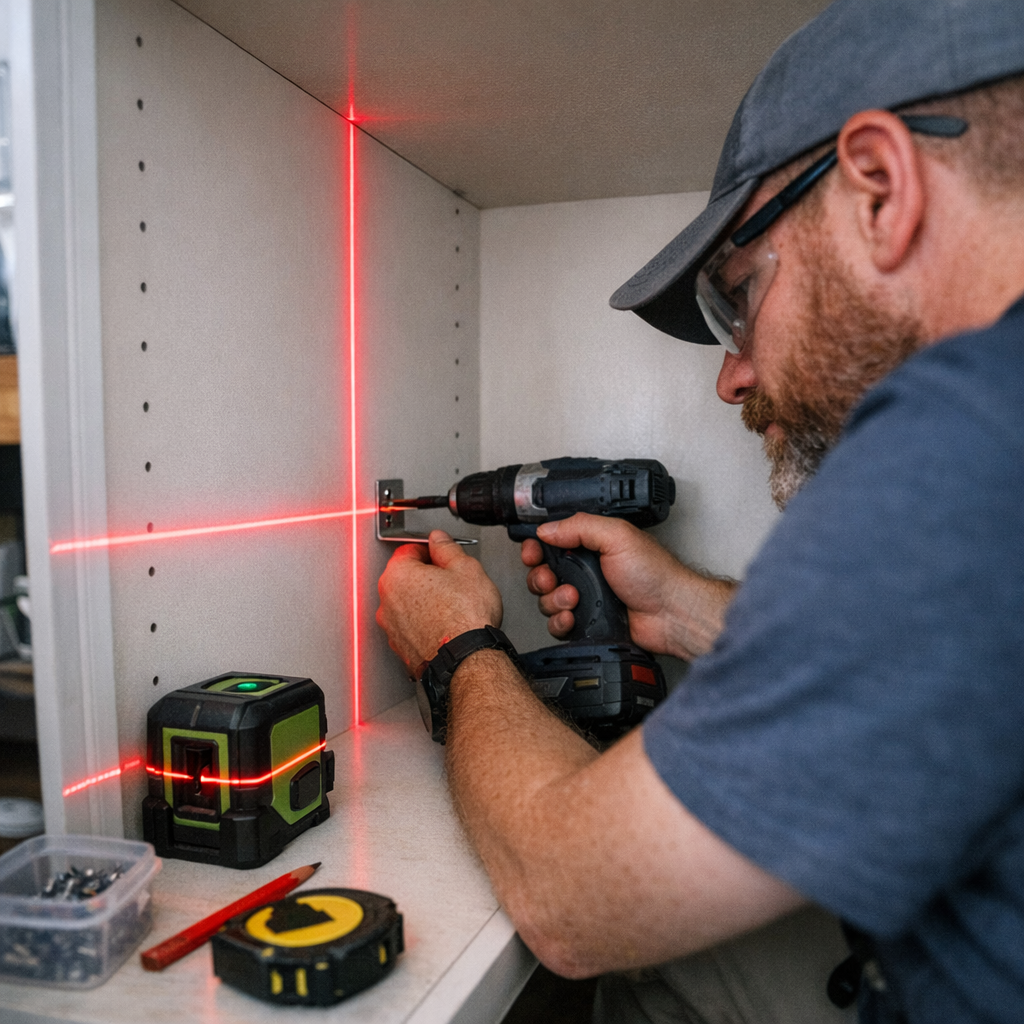
The real pain starts the minute you try to measure inside a cabinet—cramped, awkward, hands wedged between hinges—and your trusty laser suddenly lets you down. What was crisp and reliable across an open wall quickly becomes shaky guesswork when you’re deep in a 75cm-wide base or tight closet. Instead of a sharp guide, you get fat, blurry lines with hazy edges bouncing off melamine or glossy laminate. Every mark is a question: “Is that really level, or just close enough?” You might not see the problem until later, when the hardware’s up—one bracket sitting proud, another sagging off square, uneven gaps you can’t unsee no matter how much filler you pack in. If you’ve ever run a drill or set a bracket inside a narrow carcass and come out with ragged results, you know the mess a basic laser can leave behind in tight spaces.
Why Standard Lasers Struggle Where Space Is Limited
Give most box lasers a clear, open expanse and they look flawless—straight projections, level lines, plenty of working room. But jam that same tool inside a built-in or above a short set of shelves and different rules apply. The beam bounces. Edges double up. The so-called “fine line” washes out across glossy panels. Suddenly you’re nudging the unit, trying to snap lines that don’t drift, or hovering over every measurement. And each 1-2mm misalignment—imperceptible at first—turns serious once the hardware goes up. That’s the moment you realize: what passed for precision on drywall just causes trouble in close quarters, translating into sanding, re-drilling, or wrestling with drawer slides that never quite pull smooth.
A Little Drift, a Lot of Problems
In the guts of a small cabinet, what starts as a barely-there wobble gets amplified at every step. A pencil line drifting off by just a millimeter can leave brackets visibly crooked or drive a shelf install off flush—stuff that looks “okay” until the flashlights and the client’s eyes hit it. Correcting these slips isn’t just cosmetic. An extra round of sanding, plugging faulty drill holes, or carefully trimming a misaligned panel wastes real time, burns patience, and can easily eat an hour you can’t bill.
The Specs That Matter in Close Quarters
Forget the spec-sheet noise—most lasers tout self-leveling, robust casing, or “long-range” projection. But when the working gap is little more than your forearm, you need:
- Minimum throw distance: The shortest space where the line isn’t smeared, doubled, or unusable—just a crisp reference edge, even 25cm from the target.
- Narrow beam width up close: Under 2mm thick, so when you line up the drill or strike-off for the saw, you’re not guessing which edge is real.
- Steadfast short-range accuracy: The alignment doesn’t flutter as you press the tool flush or work near high-gloss paint that might reflect stray light across your reference points.
Most mainstream models can’t keep up here. Beam washout or panel reflections turn quick installs into slow-motion fixes. A proper close-range, sharp-beam laser—though less flashy on paper—simply works where you need every line to count the first time.
What Actually Happens Inside Cabinets and Built-Ins
Imagine sinking four shelf brackets inside a pantry corner. The laser’s propped up awkwardly. You peer in, trying to read a faint, fuzzy line that splits as the beam hits the adjacent side. You sigh, mark your best guess, and move on. After install, two brackets sit flat; the rest drift off, the error glaring only once everything’s in place. You either break out the filler stick, or—worse—drill again, hoping the next marks won’t peek out from underneath the hardware.
Or say you’re marking for a drawer slide where the space is so narrow you can barely angle the drill. Using a basic laser, you see two edges, blurred together. Which one was your real reference? Spend five minutes second-guessing, and fifteen cleaning up after the fastener slips or the slide goes in crooked. One tool quirk and a four-hole job drags into lunch break.
Compound Friction in Tight Spaces
Every mistake inside a small cabinet multiplies. One crooked bracket, one drifted anchor hole, and now every cut or fastener is slightly off. You find yourself sanding shelves down to hide the tilt, or grabbing a putty knife to fill mismatched holes. Soon you’re not installing, you’re fixing—all because the tool didn’t adapt to the space you were actually working in.
The Switch: Using a Close-Range Laser in Confined Jobs
The change is immediate once you swap out the usual model for a laser designed specifically for cramped conditions. It might take a minute to balance it on a stack of shims or clamp it at an awkward orientation inside a base unit—but the line is razor sharp, clean as a scribed pencil, even a few centimeters from the edge. Now you drop in brackets or center-punch anchor points and everything lines up. Smoothing edges or filling gouge marks becomes rare. The job moves forward instead of backtracking after every round of hardware install.
Even better, a true tight-space laser stays dialed after you rotate or flip direction between shelves and dividers. No constant recalibrating or fighting to subdue double-edges. You’re working—not stopping to chase “phantom lines” or fighting tool drift in every cabinet run.
Is Your Laser Level Failing You in Tight Spaces?
Run a simple check: make your marks, slide the laser sideways, and see if your line still tracks. Over 2mm of drift? It’ll only get uglier as you fasten brackets or cut in runners. And pay attention to ghost images when working near reflective finishes or glass—if you’re hesitating, choosing between double lines, or fixing “almost right” holes, it’s time for an upgrade. Tight drawers, crowded pantries, small closets—these are where your tool’s real capabilities (or limits) show up, fast.
Habits That Save Time (and Material) Inside Cabinets
- Always dry-fit hardware and trim before drilling. Use painter’s tape to trace lines or edges, confirming the real fit before the bit ever touches the panel. That’s where most mistakes get caught cheap.
- Recheck alignment after every pause or reposition. In a crowded cabinet, a single bump can throw the entire reference off. Take a breath, re-verify your points, and only then commit to the next round of holes or cuts.
Getting Real: Why the Right Laser Means Less Waste
Whether you’re on a site, working in the back corner of a rental, or hunched over a cluttered basement bench, reliable accuracy isn’t luck—it’s making sure your tool truly matches the job environment. The open-space models are fine until you’re pressed against the frame, fighting reflections and space, burning time fixing mistakes instead of finalizing clean installs. The right short-range, precise laser doesn’t make you perfect. It just cuts the wasted hours and fatigue, letting careful layout and solid hardware land right the first time—so your cuts, fasteners, and final product actually look intentional, not improvised.
Skip the endless sanding and patchwork. For your next round of tight-cabinet work, bench a close-range laser that brings real control to real spaces. Notice how much smoother every step gets—from that first dry-fit to the last bracket going in straight.