
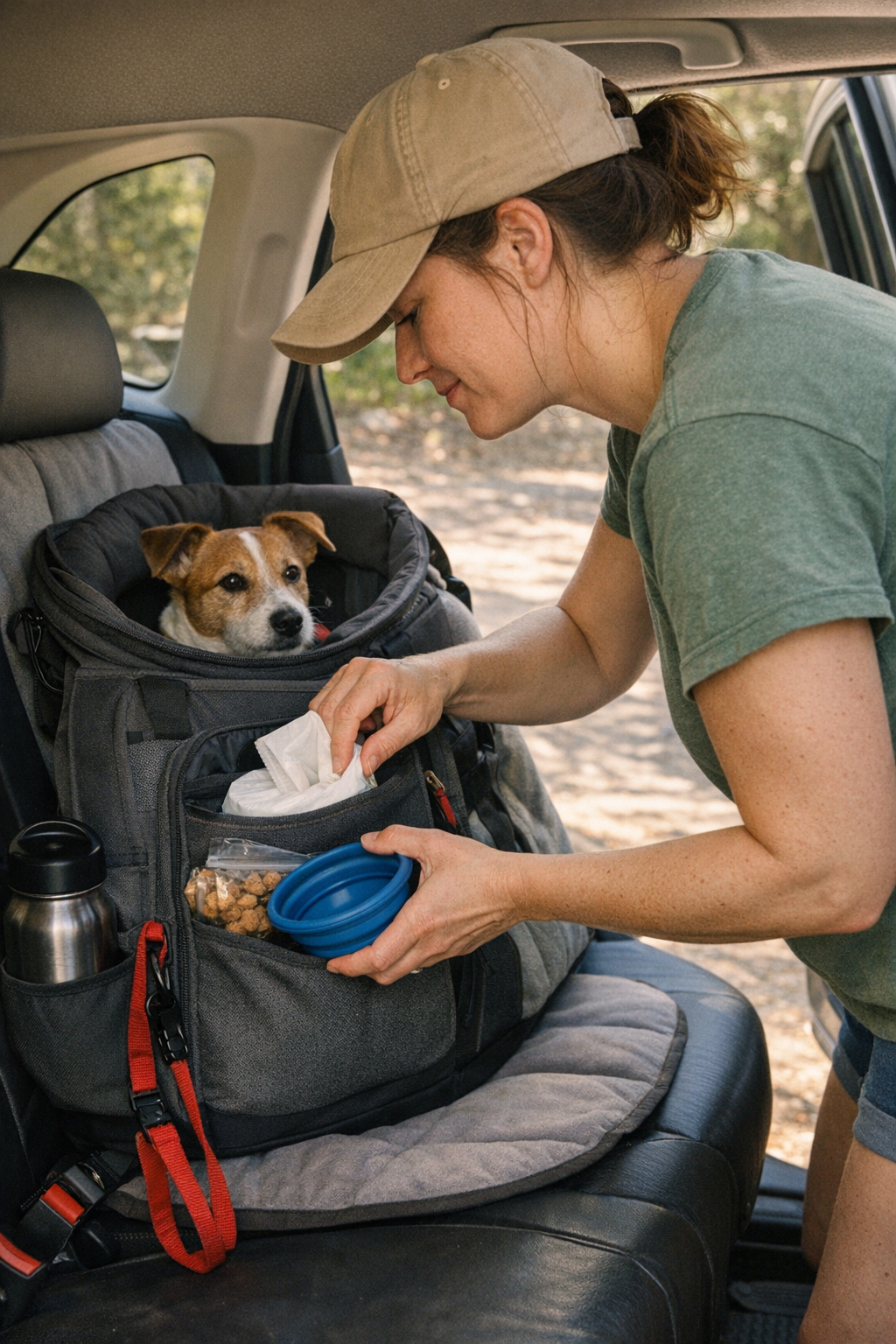
There’s a difference between a pet travel bag that looks sorted in your hallway and one that works when you actually need it. Most setups feel “ready”—pockets full, zippers closed, gear in its place. But the first real stop tests everything: you reach for wipes and instead find them pressed under bedding, the bowl is blocked behind the comfort pad, and the leash is buried just out of sight in the wrong section. Seconds drag into irritation. Suddenly, being “organized” doesn’t mean fast, smooth, or calm.
When “Organized” Turns into Ongoing Delay
Pet travel friction doesn’t show as a big mess. It reveals itself through small, repeated slowdowns: reaching through a pile of treats for a wipe, shifting a layered pad to find a bowl, unzipping the same pocket twice to get the item you forgot was at the bottom. Each “almost there” moment stacks on the last, especially during short stops and quick returns to the car. The more you have to re-search, the more every break bleeds time and rhythm away. An at-home layout that seemed efficient quickly shows its weak links once you’re actually moving.
What passes for neatness at home stalls in motion. Stacked or nested compartments force extra actions. Your most-used items become the hardest to grab—and every attempt to keep things “tidy” ends up making stops slower and more frustrating. Clean lines and closed flaps may hide the real pressure points: the items you need most are never the ones on top or in reach when the moment hits.
Real-World Slowdowns: How Good Setups Stall in Use
The Double-Layer Dilemma: One Pocket Blocks Another
Standard double-pocket setups seem clever—until you see how often that “secondary” layer buries something you need. Snacks and wipes get arranged by habit, not repeated sequence. Real use means you reach for wipes and end up emptying bedding and leftovers to get there. Even a minor misplacement turns each stop into an awkward reshuffle. The order that made sense at home breaks down after the first use.
Quick-Access Items Buried in “Safe” Spots
Bags that hide daily-use essentials in zipped, “secure” pockets create friction every time you stop. Bowls meant for quick drinks after a walk end up locked under layers. Cleanup wipes meant for fast handoffs get zipped away for neatness—turning minor spills or muddy paws into time-consuming interruptions. In the rush, you’re stuck digging where “safe” doesn’t mean “ready.”
Shared Spaces, Shared Snags
Mixing pet gear with your own—leashes bumping against sunglasses, hand sanitizer tangled with treats—always seems fine packed flat. But on the road, your items overlap and migrate. One careless turn or quick stop and an easy find turns into a scatter of mixed contents—each little spill or reshuffle forcing a full-bag hunt just to locate the basics. Streamlined space quickly becomes shared pileup.
The Real Cost of Repeated Interruptions
Few delays are huge; they’re just constant. One more search for a leash. Another pause to unbury the water bowl. A pad falling loose while you’re rushing a cleanup. On a multi-stop trip, every two-second snag builds into a restless routine—and your pet feels it. Instead of a smooth exit, you’re resetting for every stop, handling the same small irritations over and over. Pets pick up the cues: the hesitation, the fuss, the waiting while you untangle one more layered pouch. Even a perfectly arranged bag doesn’t help if using it interrupts rather than supports your route.
Spotting the Breakpoints: Where Pet Travel Setups Actually Fail
Dragged-Down by Layered Layouts
Impressive travel bags tend to show off order, but overlook repeated use. When you need a bowl hidden under blankets, you’re forced to repeat the cycle: reach, pause, pull everything out, repack, and lose your momentum. What felt secure and contained at home becomes a drag—literally slowing how you get your pet out, cleaned up, or fed en route. One hidden item breaks the entire “flow” at every restart.
Cleanup Delayed, Comfort Compromised
Cleanup supplies hidden for appearance become obstacles in real use. If wipes are under food pouches or wedged behind a comfort pad, a spill becomes an ordeal instead of a quick rescue. Pads and blankets meant for comfort sometimes form new barriers—preventing you from getting at a bowl or wipe without a messy, all-layer disruption. Every comfort item meant to soothe your pet adds handling steps if it isn’t positioned for real movement.
The Distraction of Looking Prepared
Visual neatness fails practical tests. That photo-perfect carrier—or color-coordinated organizer—looks satisfying until the third stop, when you’re reaching behind, digging from the wrong angle, or pausing to decide which zipper to open for the thing you need. Function fades, friction grows. Looking ready is not the same as moving easily with your pet, especially during repeat transitions.
Switching the Flow: One Setup Change That Really Helped
The most effective shift wasn’t about new gear—it was about how gear was placed. Putting highest-churn items—bowls, wipes, leashes—right at seat-side in a fast-grab pocket above or outside bedding flipped the script. Not everything looked as crisp, but in real stops, it barely mattered: wipes became a true grab-and-go, water bowls unclipped in a second, and the leash was where a hand naturally landed. Messiness didn’t vanish, but friction did. Stops sped up, pets settled quicker, and the need to pause and reshuffle slowly disappeared.
Keys to a Smoother Pet-Travel Routine—Tested in Repeated Use
Favor Open Access Over Over-Zipping
Items used at every stop—bowls, wipes, chews, leashes—should have open or seat-side pockets, not be buried in zipped zones. Each quick-access section cuts down on friction and stops the “secondary search” that slows down real movement.
Design for Movement, Not Just Initial Appearance
The best routine survives real restarts: spills, muddy paws, jumping in and out. Notice which items you always need to dig out again, and let the setup flex for that—don’t just aim for “untouched” appearance. It’s the after-the-trip layout, not the before-the-trip look, that signals what works.
Watching for Recurring Slow Spots
Take note of where you reach and get stuck: seat-edge awkwardness, buried wipes, mixed-up owner/pet items. Each of these is a signal—not a one-time annoyance, but a design flaw that can be fixed for the next run. A few tweaks keep movement smooth, even if your kit looks a bit scattered later on.
Function Over Form: Travel Calm Built to Last
Being prepared for real travel means your gear matches interruption, mess, and fast restarts—not just a clean look. The working setup is the one you can grab, reset, and move on from—at rest stops, friends’ houses, or curbside—without breaking the flow or your focus. Spills and mix-ups never disappear, but the right structure means they stop stealing your time and energy from every trip. “Ready” is what moves with you and your pet, not just what looks sorted before you leave.
Find setups made for real travel rhythm at PawGoTravel.