
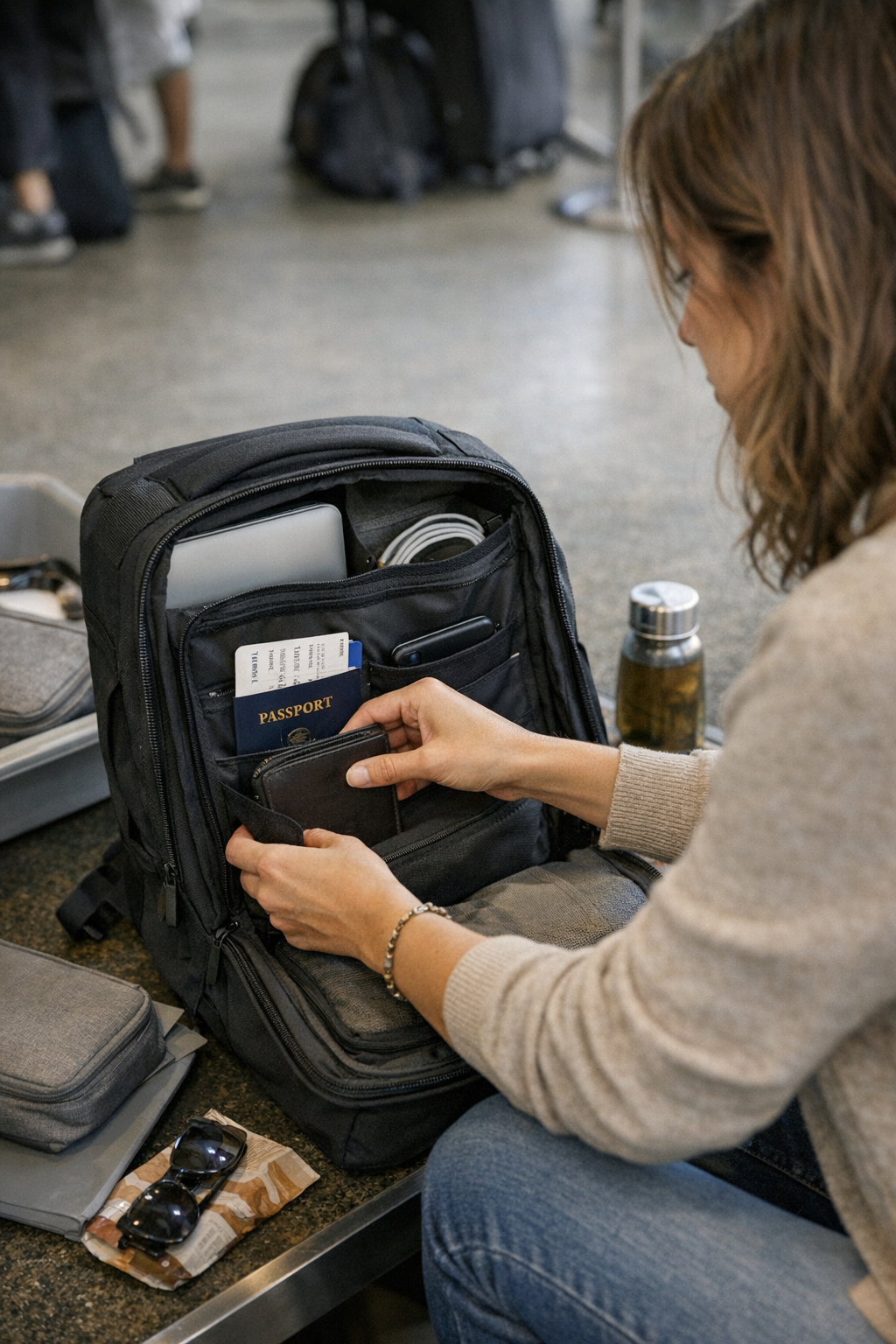
Most carry-ons fail right when you need them most: packed with precision at home, then unraveling at every airport checkpoint. The structure that looked smart in your living room—pouches zipped, cables wrapped, documents slotted—starts showing cracks the moment you hurry for your passport at security or fumble for a boarding pass while juggling trays. The problem isn’t organizing once; it’s surviving every rushed reach and awkward reset. What works for one tidy night rarely works for three cycles of pressure, especially when you’re pressed for time at gate entry or forced to repack with a line building behind you. This is where a bag that “looks organized” often drags you down, and where real carry-on design—spotted at CarryOnSupply—shows its difference.
When Neatness Collides with Movement
The bag you felt smug about at home can turn on you fast after two airport turns. Slide it into a security tray, and layers that seemed orderly become a slow-motion obstacle course. One pouch blocks your passport; an “organized” document gets lost behind a cable wrap. Unzipping for a laptop means fishing past snug pockets, unstacking organizers now stacked on top of each other. Each layer adds seconds—or hands—where you only wanted one quick pull. What once looked like organization now demands a full partial unpack, just to retrieve one item amid the crowd.
Even minimal layouts backfire if they require an exact reset every single time. That neat row of pouches turns into a cascade on the security belt. Hunting for a pen or a phone cord mid-boarding means juggling slots and stacking organizers in your lap. Unless a section survives the push and pull of real travel—with items used and returned under stress—being “organized” quickly becomes another friction point.
The Drag of Over-Controlled Packing
Perfect-at-home systems—layered organizers, double-stacked pouches, ultra-nested inner pockets—start to suffocate the minute you move. Packing every inch for “maximum control” builds booby traps in actual use: the zippered pocket you can’t reach without emptying a layer, the tech organizer that makes you detangle three cables to grab one, the “safe” compartment that hides your boarding pass during back-to-back checks. Packing control turns into micro-delays, each reset slowing movement instead of speeding it.
- Tray logjam: That tight document holder you tucked behind a pouch at home makes you dump half the bag for a passport scan.
- Organizer gridlock: A complex cable case that snags your only charger with three others, forcing a reverse Tetris game each time you recharge.
- Blocked access: A zipper pocket you thought was “secure” at home is now buried when it’s time for an ID at boarding—turning the quick check into an awkward scramble.
With every repeat, the control you designed in becomes a chore you have to unwind before moving forward again.
Resets That Restore Flow—Or Create New Snags
Most travelers have their “reset ritual”—everything refolded, compartments reassigned, every item in its lane the night before a flight. But under airport conditions, neat packing is only half the battle. Lived-in flow depends less on perfect stacks and more on keeping high-frequency items exactly where fast retrieval won’t jam up the rest of your setup.
- Where do you feel a snag—zippers catching, pouches wedging, pockets overlapping?
- What have you had to pull out entirely just to get one thing back in motion?
- Do you need to split your bag open just for a single boarding card or charger?
Real resets protect your fastest grabs: passport, phone, wallet, tickets. These don’t belong deep in a tactile maze. Design that endures airport stress means fewer doubled-up compartments, flat easy panels for high-use items, and one zip—never three—to reach what you actually use at each checkpoint. It isn’t the neatest section that works; it’s the one you don’t have to think twice about at boarding or security.
The Real Test: Returning After Repeated Rounds
It’s easy to be “organized” once—hard to stay that way after a day of transfers, tight gates, and three rounds of partial repacks. With every lap, slick setups often collapse where it counts:
- Gate pressure: Boarding group called—are you digging through half your bag for the phone, panicking as people wait?
- Bin access: Needing a charger mid-flight—can you grab it without spilling the contents, or do you wedge the bag between seats for awkward access?
- Security repeat: Every time you slide the laptop out, does it unravel the careful sequence you set up at home?
Bags that pass one test often fail the second or third. The repetition exposes where a bad pocket, unnecessary overlap, or rigid layout turns a five-second task into a clumsy minute-long wrangle. At a certain point, friction multiplies; your setup goes from “looks under control” to “slowing you down with every routine action.”
Overlapping Compartments: The Source of Repeat Friction
Nested, overlapping, or cross-stacked compartments—the minor mistakes that don’t show up in your bedroom mirror—compound every airport routine. That snack sleeve covering your wallet, or the tech pouch in front of key documents, adds a new step every time you reach. Each overlap that felt harmless at home magnifies when:
- ID buried two-deep: You need to fish out two pouches before you find the one with your boarding pass.
- Disappearing act: A pen or headphone slides behind a toiletry kit, not to be seen until touchdown.
- Forced repacks: After one rushed grab, the only way to reseat your items is to start from scratch while the line behind you grows impatient.
The pattern stays the same—every added step shaves speed off your travel routine, making the bag feel less like a tool and more like a chore to manage. A crowded or over-featured organizer punishes you with drag, even if it hides the mess for a moment.
What Actually Makes a Carry-On Setup Work?
After missed layovers, sprinted connections, and multiple rounds of “just one more check,” the difference always comes back to: Can you get to what you use most without breaking your own setup? For most travelers, the best switch isn’t adding organizers, but leaving certain sections open and uncongested. One fast-access panel for documents, tickets, and a pen beats a stack of zippered helpers nine times out of ten—especially during checkpoint sprints or repacks outside the arrival gate. The setups that last aren’t the ones that only look good after a reset, but those that move as smoothly on the third use as on the first.
After trying the “open zone” approach—one dedicated spot, always unburdened for essentials—the endless pouch shuffle faded fast. Resets stopped collapsing at the next squeeze through security, and the whole bag started feeling… lighter. You see the contrast: setups that survive real-world cycles, versus those that only hold together for a single photo.
Design Choices That Survive Real Airport Routines
- Protect core pockets for high-frequency items—don’t double them up or stack behind zippered layers.
- Limit overlapping compartments near main access points; avoid pouch nesting where it slows your hand during the busiest moments.
- Keep retrieval a one-move task, not a multi-draw process. Each delay during a checkpoint is a design flaw, not just a packing error.
- See how your setup holds after two airport cycles, not just a tidy kitchen table reset.
If you travel back-to-back, hustle between terminals, or often reset in cramped spots, these choices translate directly into smoother movement and less dead time. The right carry-on design takes weight off your transitions, not just your shoulder.
After the Reset: Does Your Bag Still Move With You?
When you arrive, don’t just check whether your bag “looks orderly”—test how it moves. Does grabbing your passport, re-seating a laptop, or pulling a charger still require digging through packed layers? If your “reset” only restores appearances, it hasn’t solved repeated drag. True improvement comes where overlap is minimal and items needed most are always a clean reach away. The margin between an “organized” carry-on and one that lets you move lighter is stubbornly specific: fewer barriers between need and access, especially as the travel cycle repeats.
Explore carry-on tools and travel organizers at CarryOnSupply.