
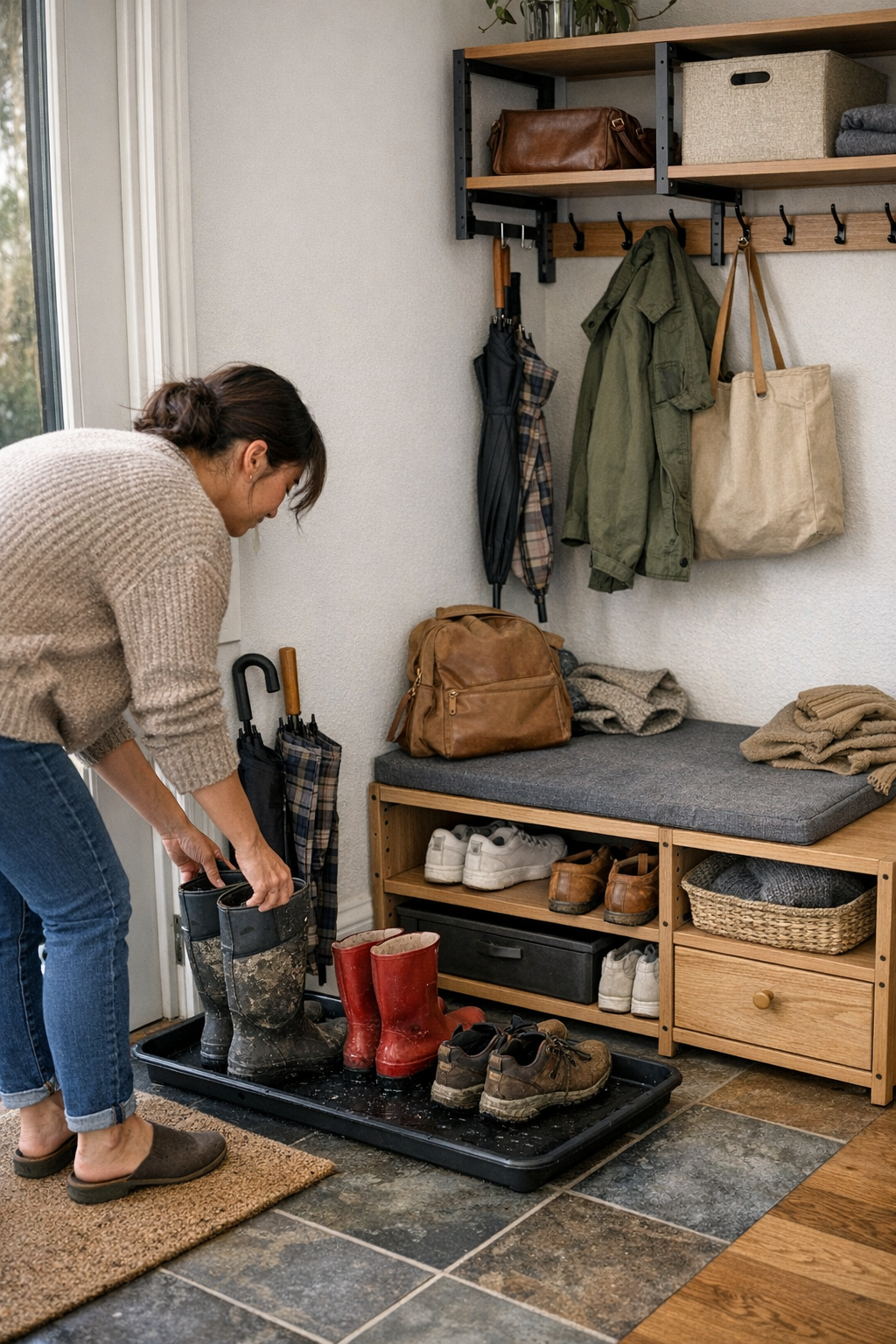
Entryway organization always seems simple—until wet weather exposes what actually works and what quietly fails. The most disruptive mess in a threshold space isn’t always visible clutter. It’s water, creeping past the “clean” line as boots, umbrellas, and gear keep crossing the same spot, day after day. One damp arrival feels minor—a mat catches the runoff, a bench looks untouched. But as the week wears on, the pattern becomes obvious: moisture spreads outward, soaking beneath benches, pooling in storage cubes, dulling the so-called dry zone until every return feels like a fresh reset you can’t quite finish.
When the Invisible Mess Spreads
Wet zones sound like organizing jargon, but in a real entryway, missing or weak wet containment is a trigger for daily inconvenience. Without a strong, defined stop for wet shoes and gear, moisture quietly escapes—soaked shoes inch off the mat, half-damp bags get dropped bag-side down, backpack fabric starts picking up a cold patch, and “dry” quickly becomes a hypothetical zone. The friction isn’t just tidiness slipping; it’s backpacks absorbing odors, floorboards starting to buckle, and reset work getting harder each day you ignore the issue.
Benches you once set up so carefully end up clammy at the edges. Storage cubes begin to smell faintly sour, runoff seeps through, and the sealed bins you trusted get emptied out, just to check if they’re starting to go soft inside. When moisture and clutter fuse, each entry—each cold, rainy arrival—adds a little more chaos to the transition zone.
Organization That Slips Under Real Pressure
Picture a normal after-work sequence: sudden downpour, three people, one narrow entryway. The mat’s already crowded by arrival two; boots land heel-to-toe, but overflow pushes across the threshold. Duffel bags drag across damp spots. An umbrella, never quite dry, leans against the utility cabinet—leaving a swelling puddle. The bench, meant as a quick shoe-removal perch, becomes overflow, leaving gear slightly soggy at the edge. What looked orderly at Sunday reset becomes—by midweek—cramped, slippery, and more annoying to cross each time.
Slim racks or closed benches seem functional on clean-out day but show their limits by Friday. Water wicks along bench frames. Shoe racks hung too high drip directly onto bags below. Wall-mounted units buy you visual space, but the line between “contained” and “creeping” mess gets blurrier after every return. Entryways without enough separation between wet and dry go from controlled to congested with surprising speed.
How Moisture Forces Bad Habits
Let a reset slip once or twice, and temporary mess turns permanent. Miss placing a bag back on a shelf and it starts living by the door, each trip picking up more moisture and eventually a musty hint. Shoes pile sideways, mats slide out of place, the clear walking route vanishes under gear moved “just for a second.” Wall-mounted hooks which seem like a fix just push the saturation line further up the wall—wet coats above, puddles below, and little real control gained.
Overflow starts as a momentary shortcut—set a bag or coat on the bench, planning to move it later—but multiply those micro-decisions, and the bench becomes a permanent damp zone, shoes crowd further inside, and every storage cube or basket near the door ends up fighting must and mildew you rarely notice until it settles in. The worst friction isn’t the daily mess—but the creeping permanence that follows weak containment.
The Sharp Difference a True Wet Zone Makes
Set up a clear wet zone right at the threshold—a heavy-duty mat, a floor tray placed nose-to-door, a vertical umbrella rack on the edge—and the whole rhythm changes. Wet items have one destination, not three. Shoes form a single, defined row that doesn’t edge wider by the hour. Anything damp stops at the door, so dry gear travels safely past and stays that way. Sudden returns become manageable, not a reset spiral.
The improvement isn’t just about looks. Reset chores become shorter, not because you’re working harder, but because the storage interior stays protected: benches stay dry, cubbies don’t develop that sticky feel, and the pathway remains clear even during busy times. Fewer last-minute shuffles. Cleanup shifts from a tedious, catch-up cycle to a short scan and occasional wipe-down.
When the Wet Zone Isn’t Big Enough
Catch the limits early: if shoes are drying half-on, half-off the tray; if “dry” sneakers still feel clammy the next morning; if you’re cracking open storage to air it out every other week—your wet zone is underpowered, misplaced, or simply too narrow for real traffic. Adjust by shifting trays closer to the door, using bigger mats, or splitting storage: lower compartments for wet, upper for dry. Small changes here force all the difference in how long these defenses really last.
Simple Habits for Lasting Control
Routines that last are ones you barely need to think about, because the space itself guides even hurried arrivals. Put an ironclad rule in the setup itself: wet gear never travels past the threshold spot. Place the mat or wet tray directly at the step-in point—even a slim catchment at the weather-facing edge is better than letting moisture sneak further inside.
Keep cabinet interiors, benches, wall hooks and storage cubes reserved for dry items only—never blend wet and dry. If you share storage, ventilate anything near the floor and retrain yourself to drop gear at the outer edge, not “just for now” on the first available surface. In lean entryways, that one disciplined divide—wet gears out, dry gears in—protects you from the slow invasion of invisible reset work.
Real Entryways Need Adaptive Routines
Threshold spaces are built to be crossed, not just admired. Daily conditions—unexpected guests, muddy gear, shifting blow of wind and rain—expose layouts that only look controlled in a vacuum. Sometimes the wet zone needs to expand overnight; sometimes it’s about moving key pieces so flow can reset, not stall out. Permanent solutions fail if nobody uses them; adaptive ones survive because they’re easier to enforce, even when everyone’s rushing or the weather refuses to cooperate.
Months of living with and adjusting a true wet zone make the payoff undeniable: less invisible damage, fewer blocked paths, less endless wiping-up, and an entry that welcomes in all seasons rather than acting as a friction gate. Ignore the need to separate wet and dry, and the transition mess always returns; design for it, and the entry actually works with you.
For entryway storage and adaptive wet/dry solutions built for transition spaces, visit Betweenry.