
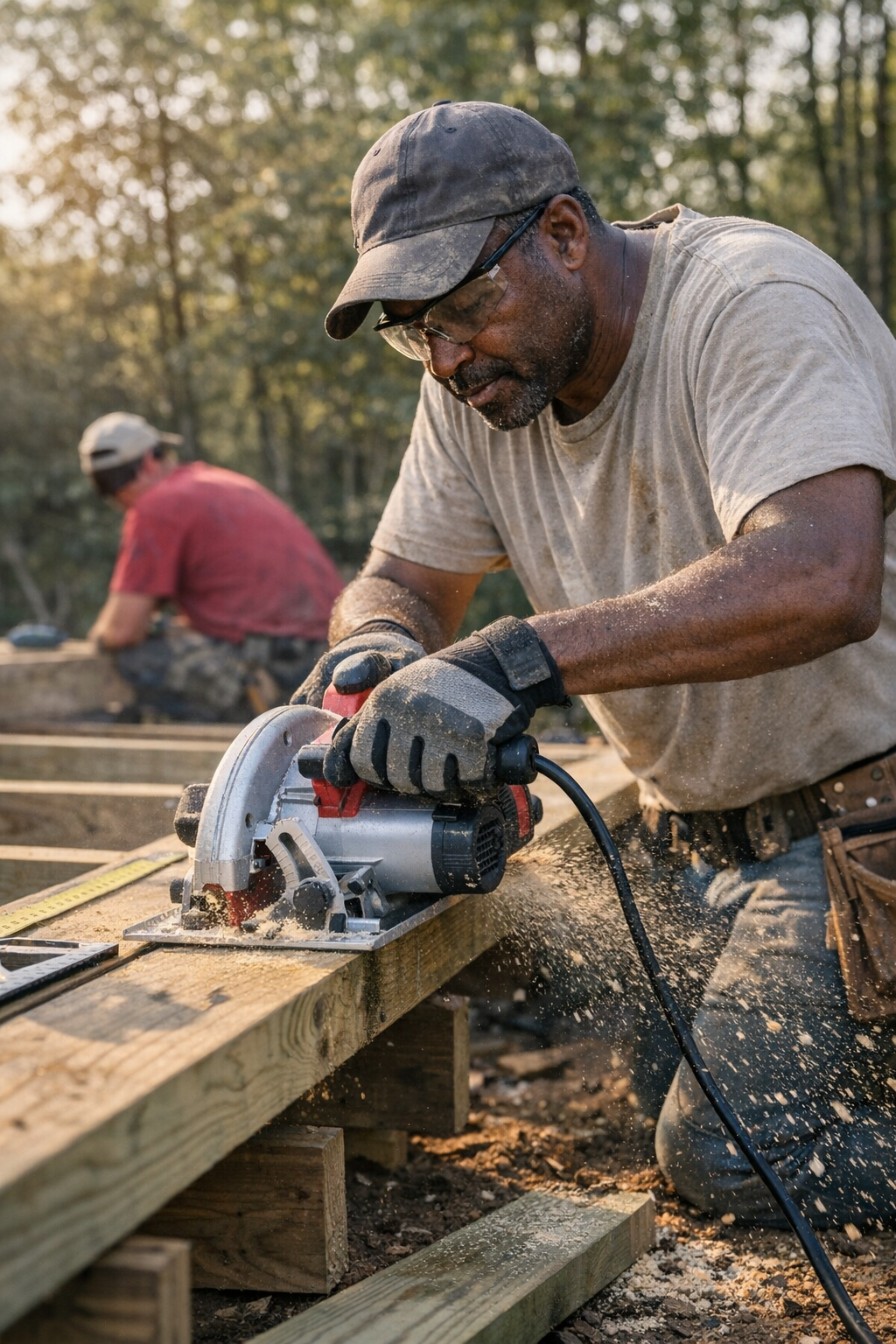
It’s not the first cut—it’s the fiftieth—that decides whether you’ve got the right circular saw in your hands. By the time the sun is overhead and you’re deep into a deck’s pressure-treated boards, every choice you made—blade, baseplate, grip, weight—hits back. The boards get heavier. The knots get meaner. And a tool that felt “good enough” starts to show every shortcoming, one stuttering cut at a time.
The First Few Cuts: A False Sense of Security
You know the routine: new saw, fresh blade, stacked lumber on sawhorses. The first pass is smooth enough to make you think specs might actually tell the whole story. RPMs, amps, price tag—all blend together as you knock out those opening boards. But every deck builder knows these early wins mean nothing. When the wood’s dry, the blade’s at its sharpest, and your arms are still fresh, even a bargain saw can fake it.
Wait a few dozen boards. Once the lumber starts to sweat, knots turn ragged, and you’ve pushed through the edge of your patience, the real test begins. Pressure-treated pine doesn’t just resist blades—it wears them down. Pitch, moisture, and crooked grain start gluing up the teeth, and suddenly that clean, crisp cut wobbles just a hair off line. Fine at first—but run your palm along the edge. You’ll feel the difference in every chip, splinter, and micro-shake.
The Real-World Grind: How Tools Expose Their Limits
The steady rhythm you found in the morning—pulling the trigger, riding the line, flipping boards—falls apart as you get deeper into the stack. Now, the saw’s subtle flaws start adding up. The blade sinks slower. Sawdust piles up between your shoes. Vibration creeps into your wrist until it’s not just the wood resisting, but your own grip getting tired.
Tool specs go silent when fatigue sets in. It’s easy to bench-race saws on no-load speed or cord length, but what matters is how the saw handles the hundredth cut. Does it hold its speed into a knot, or does the motor note dip and the cut angle wander? Do you need a break to shake away tingling in your fingers, or can you keep going without wincing? These pain points don’t show up on the box—they appear one rough cut at a time.
Head-to-Head on the Job: Where Specs Stop, Reality Starts
Picture the scene: two nearly identical saws, both with 7-1/4″ blades, both fresh out of the box. By the end of a long afternoon, you can tell them apart by the feel alone. With one, chips eject clean and you’re hardly dusting the edge between cuts. The other bogs down on every joint, leaving fuzz and tear-out that needs sanding. You start swapping batteries or blades just to keep up, but the real difference comes in how you have to babysit the “off” saw every step—the tool fights you, never the other way around.
The Fatigue Factor: When Small Issues Slow Down the Entire Day
By midday, what looked like a lightweight saw becomes a lead weight. Even a few ounces off in balance feel like a mistake after your twentieth board. Each knot needs an awkward pause and more force. Tiny shudders up the handle steal momentum from every push. Now the little problems you ignored in the morning—vibration, binding, awkward switches—start to cost you time, cut after cut.
This is the cumulative effect of short-sighted choices. The saw that felt okay at first now eats into your energy, and you find yourself reaching for sanding blocks or extra batteries as often as the tape. Over a full day, the result isn’t just slower progress—your patience and finish quality wear thin too.
Sudden Relief: What a Real Upgrade Feels Like
Every builder’s been there: You swap in a saw with a true low-friction baseplate. Instantly, that sticky plank that just fought you now glides, the blade tracking straight with half the effort. It’s not a revolution—but suddenly boards cut cleaner, hands cramp less, sanding is an afterthought, and you’re not double-checking for burn marks after every pass.
Even a minor design change—a slimmer grip, better line of sight, less motor strain—makes the workflow smoother and steadier. Cut after cut, your pace holds up. The pile of finished boards grows instead of the list of little fixes you’ll need to make later. The “just good enough” saw gets benched, and you remember what production looks like when the tool helps, not hinders.
Spot the Signs Your Saw’s Slowing You Down
Listen close: dropping RPMs or a strained whine on dense grain means the blade is working too hard. If you’re seeing more dust than chips thrown from the cut, you’re losing efficiency—more resistance, more sanding later. If vibration lingers in your hand after a pass, imagine sixty more of those. These micro-frustrations, minute by minute, drag a project from satisfying to slog.
Specs Mean Nothing in the Long Haul
No tool looks bad sitting fresh on a shelf. But by the last cut of a real job, the difference between “fine on paper” and “right in the hand” is obvious. The gulf between a passable saw and a genuinely good one doesn’t show up for the first five cuts—it compounds over hours of real use.
If edges are rough, the sound changes, or you’re tightening your grip just to stay straight, don’t wait for the tool to quit on you. Even small gear upgrades—a better glide, a more consistent motor output, a dust port that keeps the line clean—chip away at frustration and keep the day moving forward. That’s not marketing. That’s just what keeps the job finish sharp and your energy intact, no matter how long the project drags out.
For equipment that stands up to real work, visit Gumboll.