
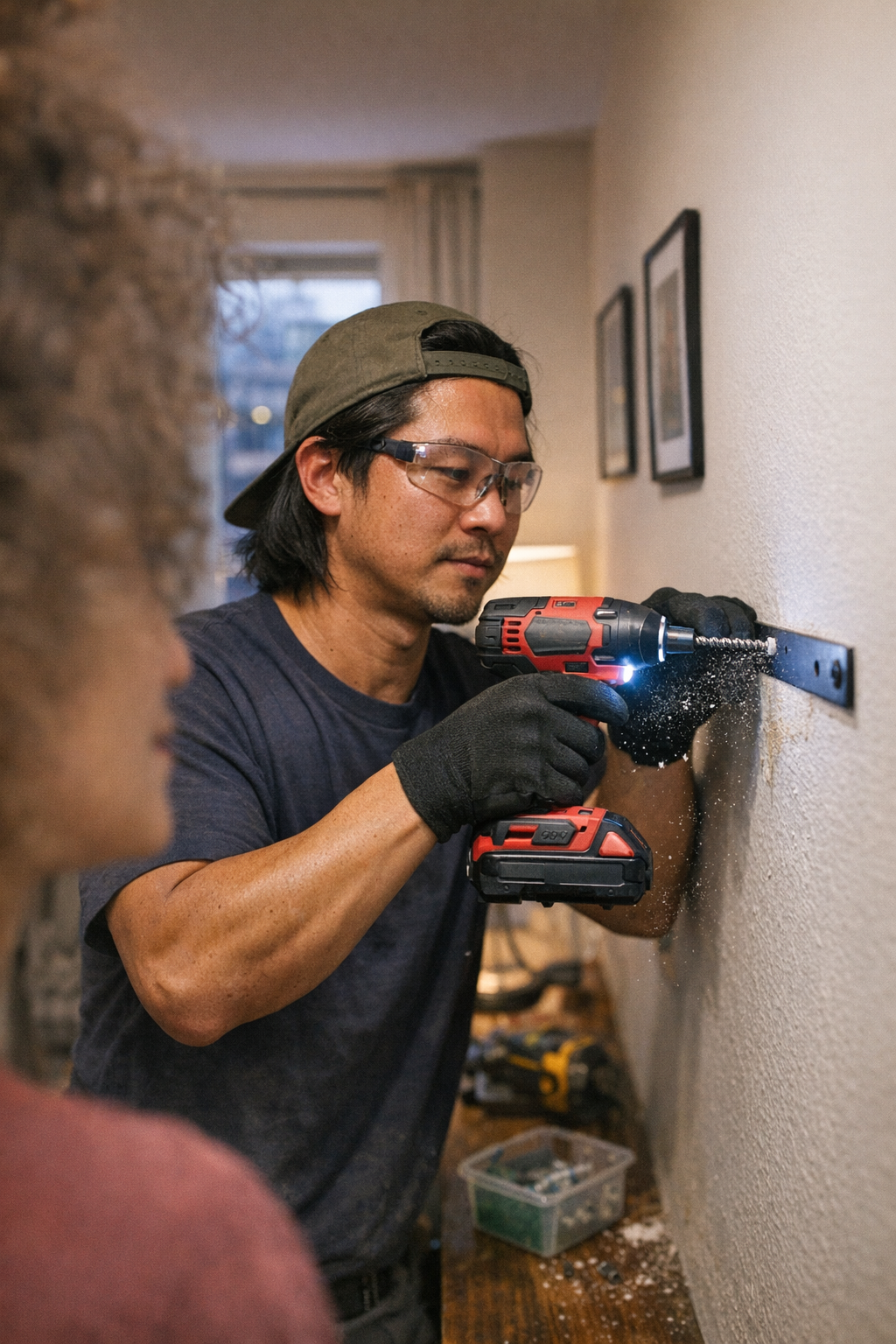
Every job looks clean and easy from the outside—until you’re sweating over drywall dust in a cramped apartment, one screw away from a dented wall or a noise complaint. Tool catalogs brag about horsepower and torque, but in real rooms with thin partitions and the clock ticking down to your lease renewal, what separates the “almost good enough” from “never again” is how the tool actually feels—and what it leaves behind.
Apartment Fastening: Friction Shows Up Fast
If you’ve ever assembled a shelf set or mounted curtain rods in an apartment, you know the routine. You walk in thinking, “I’ll be done in an hour.” The first anchor goes in, fine. By the third, the buzzing tool starts to bite. Jittery vibration creeps from your palm up your wrist. The noise spikes as the screw seats, echoing not just in your ears, but in the apartment below. Dust pools along the baseboard. And with every next anchor, holes widen, plaster flakes, and your confidence shifts to damage control.
It’s the accumulation of little problems that grinds you down—bit slips, bounced anchors, and the spreading mess. One bad driver and suddenly ten anchor points become five cleanup projects.
Spec Sheets Don’t Silence the Neighbor
Marketed specs—RPM, weight, torque—mean little when you’re partway through a wall of fastening. You switch to high gear expecting speed, but instead get more rattle. The wrong driver transmits vibration with every screw, turning your living room wall into a low-grade percussion instrument. In thin units, the reality isn’t just noise, but physical feedback: cracked seams, splintered drywall, anchors that won’t bite flush. What looked “powerful” in the ad just feels reckless in your hand.
Contrast that to a tool with decent vibration dampening. Each drive is controlled, anchors stop just where you want—no sudden kicks, no cloud of dust spreading three feet out. You power through awkward angles without bracing for the ache after every fastener.
When Poor Tools Make More Work
A cheap or mismatched driver means scrapes, stripped bits, torn paper, and that slow ballooning of patch jobs: spackling, sanding, and repainting over craters where an anchor blew out the back. And for every echoing bang, the risk rises—the neighbor’s fist, the building manager’s warning, the mounting stress.
What’s supposed to be an afternoon project piles up into days spent restoring your own mistakes. Fatigue isn’t just physical, it’s mental—repeating the same action, dreading the next flaw, constantly cleaning droppings you never planned for.
Scenes from the Real World, Not the Showroom
Imagine it: Friday night, bracket kit laid out, driver battery freshly swapped. You start mounting shelves; after a handful of fastenings, you’re feeling every impact both in your wrist and your patience.
- Noise snowballs: Each drive drumrolls through plaster. By anchor eight, you’re bracing for the next complaint as much as the next screw.
- Mess multiplies: Bits of paint and grit scatter across furniture and carpet—more time with the vacuum than the tool.
- Anchors fudge or fail: Lack of control means the anchor’s not square or buries deep, forcing the dreaded wall patch even before the shelf’s up.
Minutes saved with a bargain-bin driver evaporate into hours lost redoing, cleaning, and running apology circuits with neighbors or landlords. Cheap seems fast. It rarely is.
Switching Drivers, Shifting Experience
The first job with a properly engineered driver feels like switching to noise-canceling headphones for your hands. Vibration doesn’t jump back at you with every pull. Wrist pain subsides, even with repeated anchor runs. Most notably, the clatter drops instantly: the job sinks comfortably below the level that travels through walls. Dust and chipping slow, anchors stay tight, and drywall stays intact.
The difference is precision—anchor after anchor goes exactly where you wanted. Seams stay crisp. By the end, you’re not scrubbing corners, redoing holes, or apologizing for the disaster. The real win isn’t speed; it’s the way each small fix stays small.
Fatigue and Friction: Work Smarter, Not Harder
Fatigue sneaks in. Squeeze a vibration-heavy driver and your hand cramps; you start skipping the fine touches, just wanting the job finished. With the right dampening, control returns: you brace less, slip less, and each run feels measured instead of rushed. The job doesn’t just go faster, it feels lighter—mentally as much as physically. There’s no holding your breath to counter stray kicks, no crossing your fingers you haven’t missed a stud or widened the hole.
Why “Lightweight” Can Work Against You
That featherweight driver on sale? Sometimes it’s a shortcut to more vibration, not less. Lightweight bodies pass more of the fight to your hand—and through every thin partition you touch. Suddenly, your afternoon job turns into a lesson in drywall repair: splintered holes, spidered paint, and yet another lost afternoon beneath the patching kit.
If you feel the floor shake after three or four fastenings, or hear the walls echo next door, your tool’s isolation has failed the test. And in apartment living, that’s a shortcut to a growing repair list and annoyed neighbors.
Bit, Blade, and Battery: Control Matters Most
Sure, upgrading to a better bit helps—less cam-out, less stripped hardware—but it only fixes half the problem. The real leverage is in the driver’s “feel” itself: whether sanding, cutting, or sinking anchors, the more control you get, the less fallout you manage. It’s in how you swap bits without fighting stiff chucks, how a fresh battery slots mid-job, and how the driver’s balance prevents accidents on the very last run.
This is where experience shifts: tool behavior becomes prevention, not just correction. You spend less time patching and more time actually progressing, because mistakes stop multiplying.
Protect the Job, the Walls, Your Sanity
In apartment work, specs don’t tell the whole story. What matters is how the tool counters the friction points: persistent vibration, creeping fatigue, control slipping away at the worst moment. The right driver means tighter anchors, less dust roaring out over your floors, and a quiet enough workflow to finish a job without planning an apology script.
If you’ve patched one wall too many or found “quick” fixes spiraling out, you already know the truth: the impact driver isn’t just about what you put into the wall—it’s about what you don’t have to fix after.
Shop practical, work-proven drivers and fastening gear at Gumboll.