
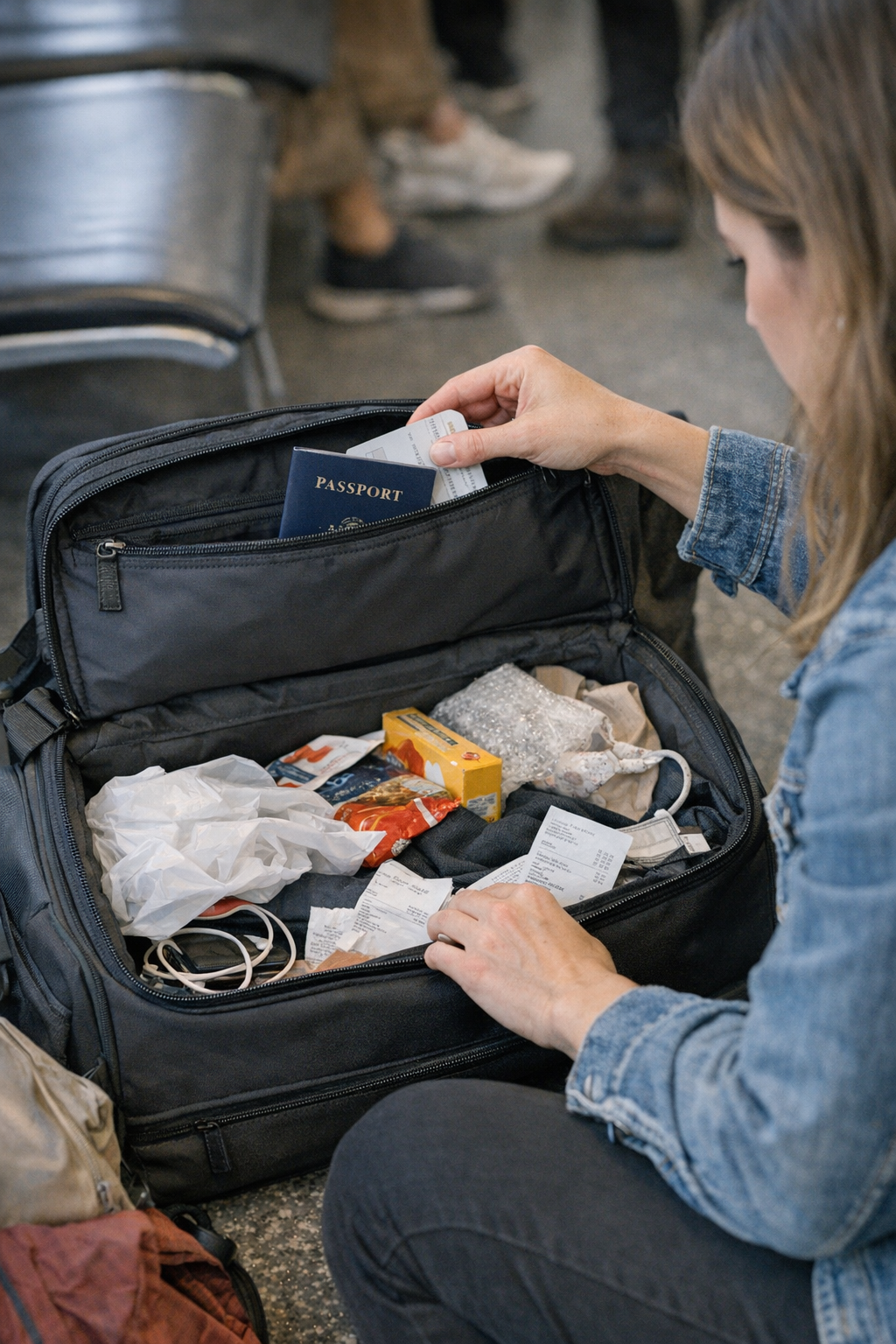
The carry-on that looks perfectly organized at home rarely survives a single airport shop before its setup starts breaking down. The moment you pick up an unexpected snack, collect a handful of new receipts, or accept a souvenir bag, your efficient packing structure starts slipping—sometimes even before you reach your gate. Headphones get pinned under snack wrappers, that easy-to-grab passport is suddenly camouflaged by store packaging, chargers vanish behind impulse purchases. Order collapses fast, not from overpacking, but from the way real travel introduces new, badly placed objects into every pocket and gap. No matter how tidy your bag looked at the hotel, friction hits hard after just one or two airport stops: reaching slows, movement stalls, and “organized” means less than you thought.
When Shopping Joins the Carry-On
The myth is that your careful packing will withstand the chaos of airport life. But within one layover—or even the first pass through duty-free—the pattern breaks: a last-minute gift, snacks for the plane, receipts you meant to tuck away but suddenly forget. With nowhere planned for these extras, they end up wedged in the first available space—jammed next to pouches, buried beneath what was once a flat layer, or piled on top of everything else. The cost is immediate: grab your passport at a checkpoint and instead you drag out a tangle of stubs; reach for headphones at the gate and crush a chocolate bar somebody handed you ten minutes ago. Each access point doubles as a friction point, slowing you down and sapping your travel flow.
It isn’t just about mess—it’s about movement, about the way every small addition interrupts the carry-on you’re trying to use on the fly. Every attempt to retrieve an essential forces you to shuffle aside new obstacles, or pause and rethink your reach-path. The line behind you moves. Your own progress, even moving from gate to gate, starts to drag.
Repeated Reach, Repeated Friction
The typical cycle looks the same every time: zip your bag closed, feeling in control. Then, after one checkpoint, your system unravels. Receipts slip out and scatter, snack wrappers block access to chargers, that compact souvenir is now blocking the tech pouch you actually needed. Every “quick” retrieval becomes a mini detour. You catch yourself pausing mid-queue, digging through pouches you didn’t mean to open, running your fingers through layers that felt simple an hour ago and now leave you stalling in public, visibly disrupting the flow you thought you’d preserved.
The wear shows most clearly with single-compartment bags. Even well-packed cubes can’t offset the entropy that creeps in once unplanned items spiral throughout the main cavity. Each repeated retrieval takes longer—sometimes just seconds, sometimes enough to irritate the person behind you at a checkpoint. By the second or third search, essentials might as well be invisible, lost under a shifting layer of new, unordered stuff.
When “Tidy” Stops Working
A bag that zips up looking calm isn’t actually organized if it can’t protect fast access from last-minute chaos. This becomes painfully clear at crunch moments: boarding pass buried under a gift bag you forgot you had, ID jammed next to snack wrappers, headphones tangled with receipts. The system you trusted on departure starts to feel actively hostile just hours in—because appearance doesn’t survive airport reality if your structure can’t bend without breaking.
Where Most Carry-On Setups Fail
The real risk isn’t overpacking—it’s failing to plan for the unplanned. Almost everyone stumbles here, usually for the same handful of reasons:
- The surprise overlap: Souvenir bags or receipt piles settle right on top of daily essentials, hiding what you need mid-trip.
- Awkward blends: Loose snacks drift into “tech gear” territory, forcing re-sorting at the worst possible moment.
- Compartment confusion: Single, open spaces absorb new objects deep inside, so even simple retrieval turns clumsy and multi-step.
- Visual order, physical mess: What looked neat in a hotel mirror collapses as soon as you’re at the tray transfer; small things vanish instantly or jam in zipper paths you thought were protected.
Each micro-delay on retrieval might seem ignorable, but the sum adds up—especially when it’s repeated for every routine check or boarding sequence.
The Compounded Cost of Tiny Interruptions
This isn’t about “just seconds lost.” The hit comes from repeatedly pausing, awkwardly, for items you should already have in hand—hauling a bag down from the overhead bin to find a cable lost behind a snack pack, or shuffling for documents while blocking the aisle. Each interruption feels trivial in the moment, but stacked together, they sap travel energy and turn simple movements into a running reset.
If your structure focuses on looking good, not on adapting, the cost is cumulative: after every checkpoint, you’re forced to reorganize. Essentials for quick access drift out of reach. The entire sequence—security, shops, boarding, even hotel check-in—becomes choppy, and your mental load goes up just keeping track of what’s moved where. Bags that seemed minimalistic can become stressful just by the third airport stop.
The “Waystation” Fix: Segregate New Shopping Instantly
The fix isn’t necessarily a new bag, but a repeatable setup: a flat, surface-access pouch set aside for anything you acquire in motion. Think receipts, last-minute snacks, stubby souvenirs, shopping bags. This pouch sits at the very top of your main compartment or slides into a dedicated outer pocket—never invisible, never buried. Every new object goes there first—nothing blends into your base packing. The pouch isn’t just extra organization; it’s a quarantine zone for chaos, one layer separating the predictable from the unpredictable.
Every quick add—snack picked up at the terminal, receipt handed across the counter—goes to the pouch, not your main layers. The real advantage: at security or boarding, you know exactly where floating items live, so every “quick grab” is actually quick. Your base system isn’t punctured with every unplanned stop; your essentials remain accessible, untouched by the day’s random acquisitions.
How It Changes Actual Travel Flow
The stress test is real-world security, not home trial runs. Unzip your carry-on at a tray checkpoint and only your shopping pouch moves—no paper explosion, no food packaging rolling over your tech setup. Pull out your passport without brushing aside snacks, retrieve headphones with zero interference. After the first airport stop, you’re not rebuilding your bag while hunched over a gate seat—just unzipping the waystation, moving on. Instead of a “good enough” visual reset, you get a real operational reset for each cycle of movement.
Choosing a Carry-On That Won’t Break Down Mid-Trip
Some bags make this routine painless. Segmented compartments or modular insert systems often work best; top-access or externally zipped outer pockets provide a built-in “incoming” zone for new items without disturbing everything else. Bags built around one large cavity, no matter how minimal they look during packing, tend to break down first in real use—just a few floating items later and every retrieval is a forage. Choosing a structure that routes new stuff to a controlled spot—immediately—means you spend less time fixing and more time moving.
What to Avoid With In-Transit Packing
The baseline mistake is letting new clutter mix deep into the core compartment. Once snacks, receipts, and shopping bags weave themselves directly into your packing cubes or gear pouches, every access becomes multi-step. This is how you end up re-stacking clothes at the gate, losing small items between layers, or repacking in a cramped aisle as the queue grows. Predictable separation—not picture-perfect order—is the real measure of carry-on effectiveness when actual movement counts.
Organization That Survives the Realities of Travel
The point isn’t a bag that looks organized, but a setup that endures disruption without crumbling at each checkpoint. Frequent travelers know: every trip guarantees new receipts, snacks, and extras, and bags that can’t keep those separated from your essentials fall apart under repeated use. Building a “waystation” pouch into your travel logic—always surface-accessible, always the first landing zone—turns ordinary travel breakdown into routine, stress-free motion. Carry-on order, instead of being temporary, becomes something you can actually trust during real movement, not just admire in a packing photo.
Find practical carry-on solutions built for real movement at CarryOnSupply.