
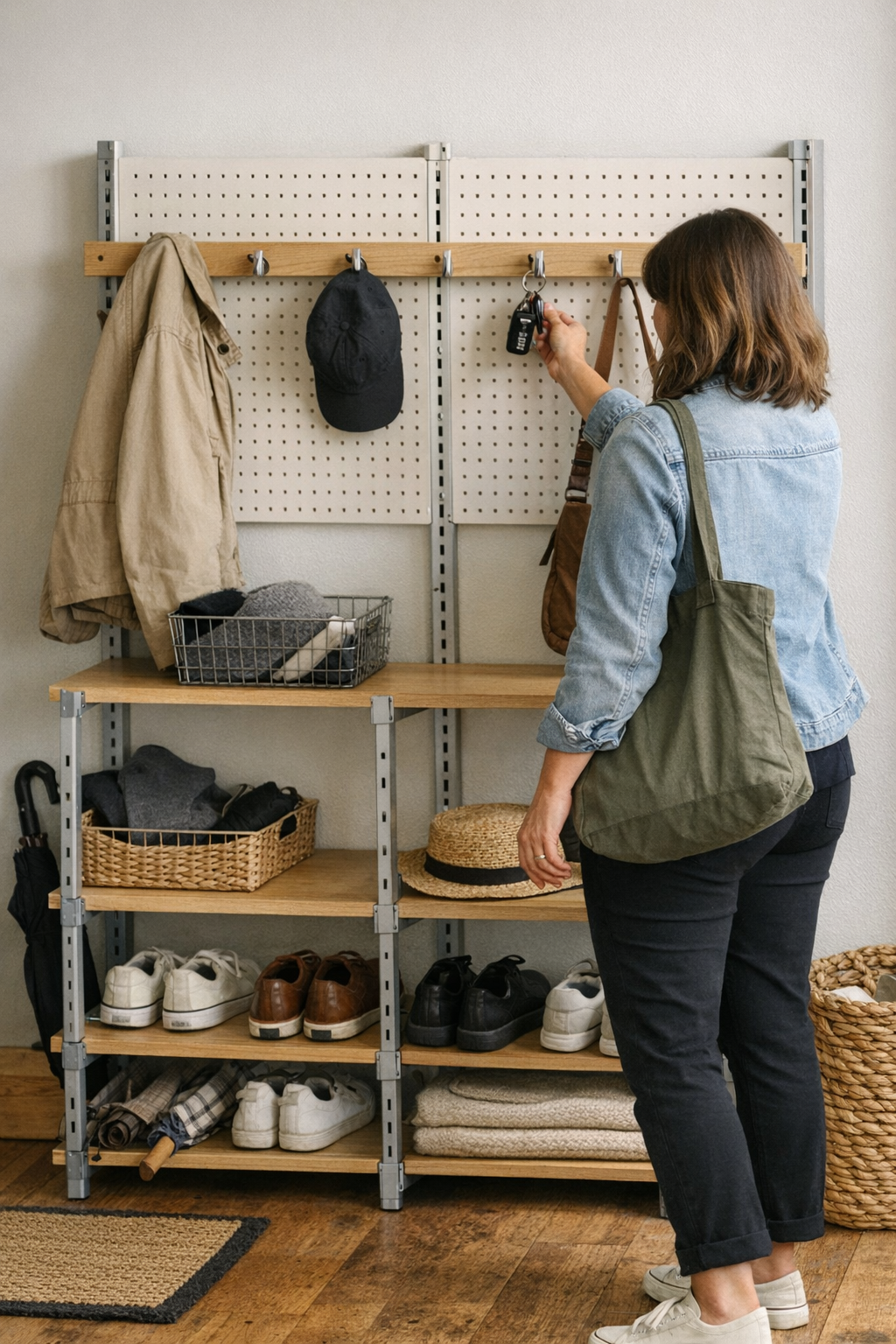
A spotless pegboard promises instant order in the entryway—until real life starts pushing back. Shoes squeeze onto crowded shelves, someone’s bag lands on a scarf, and keys are forced onto whatever hook is left open. If you’ve ever tried leaving or coming home at speed, you know: a pegboard system cracks when routines overlap, and the drop zone turns into a daily reset trap.
When Pegboards Meet Real-World Routines
Transition spaces aren’t just backdrops for organization—they catch every messy detail of daily movement. Wall-mounted pegboards look efficient at first, with everything raised off the floor. But the moment two categories compete for the same spot, friction builds fast. Your key hook gets borrowed. A tote covers the house umbrella. Shoes, three-wide, become five, and the clean path you set up narrows until it’s barely there. The chaos isn’t on the wall—it spreads in the rushed shuffle to get out the door or the slow, inconvenient heap building each day.
Morning Rush, Evening Return: How Friction Builds
The pegboard’s weakness shows up at peak times. The morning shuffle sees keys dropped where jackets were meant to hang. By evening, a soccer bag muscles in on the shelf and a line of shoes blurs into a jumble. Every step requires a workaround—slide a bag to sit, sidestep two pairs of sneakers, unhook one thing to reach another. After a couple of busy entries and exits, the “system” usually turns into a puzzle—with your routine blocked by your own setup. Even a couple of extra items or a rainy day is enough to throw off hours of tidy intentions.
Pegboards Reward Discipline, but Punish Overlap
A pegboard functions if—and only if—each hook and shelf serves exactly one job. The moment double-duty slips in, everything slows: shoes pile on shoes, keys vanish under a scarf, and the bench becomes another layer of storage instead of a seat. In strict mode, pegboards feel lightning-fast; hang, drop, go. But no system survives when a single overflow item forces you to rearrange. Discipline pays off instantly, but routine, imperfect life punishes it with extra steps and silent frustration.
The Hidden Cost of Mixed Storage
Appearances deceive. Hooks show order but hide tangles—scarves looped behind bags, shoes forced out at angles. The bench, supposedly a calm place to sit, always seems to gain an extra bag after school or an umbrella after rain. Return flow breaks down first: what should be a quick stow turns into tracing what belongs where, or, too often, dropping things in the nearest open slot just to clear your hands. Each layer multiplies the time needed to reset; every shortcut slowly erodes the whole setup.
Busy Entryways Expose the System
Real-life pressure reveals a pegboard’s limits quickly. Shared entryways or wet weather mean the drop zone becomes obstacle course: a coat dumped over a gym bag, boots half-blocking the walkway, hats spilling off the end. The setup that looked “organized” in quiet moments can’t keep pace as the flow thickens. You sidestep one blockage only to hit another. By the end of a heavy-use day, small essentials drift out of reach, overflow creeps along the wall, and the visual order collapses under repeated, hurried use.
Quick Fixes That Don’t Hold
Patching the system only buys time. Shift a jacket, send a shoe back in line, stuff a scarf onto a hook nobody uses—each is a quick salvage move, but none lasts past the next rush. Temporary placements turn semi-permanent. Bench edges become drop zones, shoes double up, bags migrate to wherever the floor clears. What looked like an organized buffer zone slips into a bottleneck—one that eats time every time you pass through.
Resetting the Zone: Fewer Hooks, Better Access
Chasing perfect order in an entryway invites failure. The real upgrade is reducing opportunities for overlap: fewer hooks, strict one-item-per-spot, and ruthless overflow limits. Instead of six hooks catching everything, four hooks with one defined purpose keeps use clear. Overflow shelf? Only for true exceptions—double-stacking is out. With fewer choices, every drop zone sees less competition. Shoes can finally be accessed, not excavated. The bench keeps its primary use—sitting, not storage. One misplaced bag won’t topple the system or block your route out the door.
Real-World Improvements in Daily Flow
The change isn’t just neater visuals—it’s speed. After a crowded afternoon, reset takes seconds. The pegboard doesn’t demand a full rethink; you scan once and correct in a single pass. Sticking to a “less but clearer” rule means friction doesn’t pile up unseen. Each hook or shelf gives up scrambling time and returns a smoother routine. You get through the threshold with less maneuvering, faster bounce-back, and fewer half-finished resets lingering into the next day.
Recognizing the Difference: Looking Tidy vs. Living Tidy
A photo-ready pegboard can still slow you down. The lived-in test: do you shift, juggle, or detour every time you leave or return? If everyday setups prevent clutter from spreading, and a quick reset is truly quick, your system works under real conditions—not just in theory. But if “just for now” items keep landing wherever the last gap was, or the threshold narrows under invisible overflow, the pegboard is part of the delay, not the solution. It’s time to simplify until movement feels possible again.
One Useful Habit: The “Reset on Return”
The smallest ritual keeps friction under control: every time you come home, move just one stray item back to its true spot before doing anything else. This habit costs seconds now, and saves minutes of accumulated obstruction and re-sorting later. It doesn’t erase every problem—but it starves the buildup that makes reset a chore rather than a moment.
For storage that endures real routines—not just looks organized between them—visit Betweenry.