
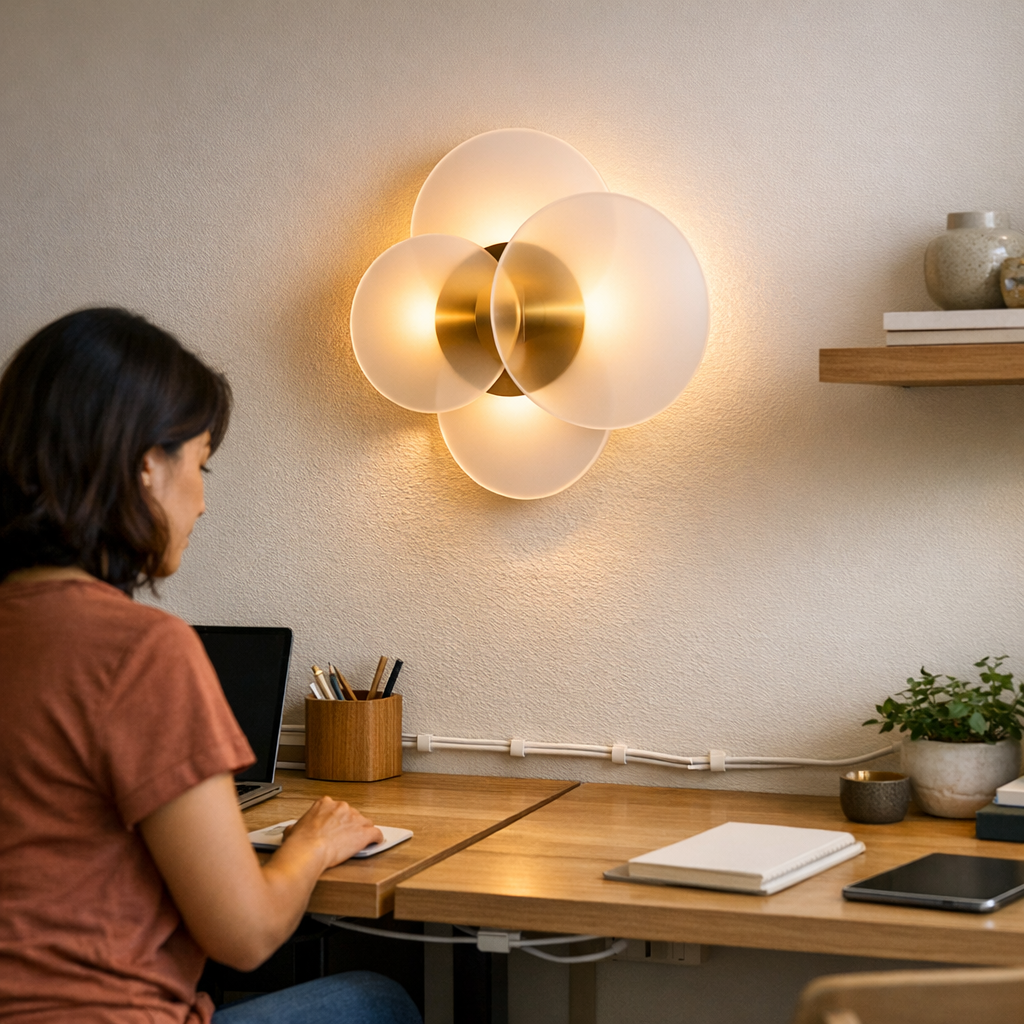
A “clean” lighting setup often unravels the moment daily life returns. A desk lamp placed with care, its cord tucked along the edge, looks resolved for a week—until a rolling chair brushes the cable loose or the next charger crowds the outlet. Suddenly, the tidy surface is broken: a curling cord now hooks ankles, blocks a drawer, or trails dust under the work light. You don’t have to look for the clutter; you feel it every time you adjust your chair, reach for something below, or catch your foot on a wire that’s supposed to stay out of sight. That tension—between looking finished and actually staying usable—defines whether your lighting and support setup helps or keeps dragging you back to the same fixes.
When a Tidy Lighting Setup Isn’t Enough
Even the best LED panel, task lamp, or under-shelf light looks flawless on day one. But setups change in ways that static photos can’t show: a small chair shift, an extra device, or one deep sweep under the desk brings every supposed “solution” into test. If you rely only on cables hidden by surface placement or adhesive clips, a single nudge or the warmth from a power supply weakens your arrangement. The result? A wire once beautifully concealed now droops or curls into walkways and work zones. Rooms that collect real use—shared offices, family study corners, multipurpose tables—expose every shortcut in cable management. What looks resolved on Monday is already slipping by week three, and everyday movement makes the disorder more obvious, not less.
Everyday Friction: What Unmanaged Cables Really Do
Loose cords from lamps or panels are more than visual noise—they actively reshape routines. If you’ve ever had to pause mid-edit to steer a chair around a snagged cord, or back up from a shelf because a wire pulls taut under your hand, you know the disruption isn’t theoretical. In shared rooms, these disruptions multiply: lamps unplugged by passing feet, chargers tugged from place by kids, cables trailing across dusting and cleaning paths that signal “not really set up.” An exposed drop under an open shelf means you hesitate each time you store or retrieve something, and a cord draping off a shared table means each user has a new interruption to solve. The more traffic and turnover in the room, the faster a lazy cable solution becomes the new source of daily hassle.
“Hidden” Only Until Something Moves
Slim fixtures and plug-in accessories promise a low-profile look, but “out of sight” rarely survives the real habits of a workspace. A cable pressed flat behind a shelf edge or run along a baseboard with a cheap adhesive will keep its promise for a handful of days—until vacuuming, kids, pets, or bag handles disconnect it. The calm illusion is snapped; a wandering cord returns to view, crossing the same clear table you thought you’d finally resolved. The more active the space, the more precarious any cable route that depends on being left alone.
Real Room Example: When Good Setups Break Down
Imagine two side-by-side workstations, both originally installed with slim LED lighting and tidy cable runs. In the first week, each looks sharp—no wires on show, surfaces stay open. But life starts to pull at the setup: headphone swaps, laptop moves, under-desk organizing. On one desk, a weak adhesive bracket lets go, dumping a cable where feet slide or bins shift. That desk now hosts small, persistent failures: a shifting light every time someone nudges under the desk, an unexpected unplug when a bag catches the wire, or a slow buildup of clutter in the open. The other desk uses screw-in clips and locked cable runs. Over time, even as chairs roll and routines bend, nothing shifts, catches, or interrupts. Only then do you realize which setup you can ignore—and which one keeps demanding corrections.
Why Anchoring Outperforms Hiding
An anchored cable stays predictable, even as everything else in the room changes. Relying on pure concealment—tucking wires behind or under with only tape or adhesive—sets a countdown until the next surprise tangle or slip. Clipped or bracketed cables, mounted along walls, under worktops, or behind solid support points, handle dozens of daily disruptions without needing to be re-fixed. Every shortcut you take for appearance over anchoring piles up, leaving future-you a maintenance loop instead of a solved setup.
Small Fix, Big Relief: A Mid-Desk Clip
One simple, targeted change often resolves the pattern of nuisance. After months of chasing a lamp cable under a shared work table—pushing it back after every chair adjustment or cleaning—the installation of a single screw-on clip between the wall and knee zone kept cords up and away for good. The difference isn’t just visual calm; suddenly you’re free to add another light, plug in extra devices, or clean quickly without new tangles appearing. Once the route is anchored, the work surface serves you, not the cable’s latest drift. This minor, precise fix erases repetitive friction without needing a full overhaul or invisible miracle solution.
Questions That Shape a More Usable Setup
How much cable management does a room actually need?
Just enough to keep every wire off moving surfaces, pathways, and visible room edges—no more, no less. Any cord that repeatedly crosses into a cleaning zone, desk edge, or walk path needs its own anchor. “Invisible” is a weak goal if it trades away the ability to move freely without snag or surprise.
What can I do if running cables behind furniture isn’t possible?
Work with what your room’s lines actually allow. Use slim surface-mounted channels, tough clips, or even bracketed runs to lead cables tight along desktop edges, shelf undersides, or baseboards—never across open zones. Consistency beats all else: a straight, anchored cable is quickly forgotten, while a wandering or slumped cord becomes the room’s persistent weak spot. Order matters more than invisibility here.
Do cable color or cover type actually change usability?
Matching cable color to wall or furniture can subdue visual clutter, but movement control trumps all aesthetics. The material matters only once you’ve anchored the cable mechanically, not just concealed it. What makes a setup functional is not how the cord looks, but how reliably it stays where you placed it, regardless of daily shifts.
Making Quiet Improvements: What Really Works?
Chasing total cable invisibility creates a fragile setup. Satisfying lighting and support systems are the ones that handle cleaning, new tech, chair rolls, and changing routines without shifting out of order. The real win? A few well-chosen clips or channels, a bracket on the right surface edge, and a cable route so regular you forget it exists. This isn’t about a showroom look—it’s about not being interrupted by the same fix each week, and feeling like the room is set up to work with, not against, you.
One Small Tip: Reroute for Calm, Not Just for Looks
If a cable keeps reappearing or blocking your movement, redirect it behind a non-movable anchor—along a desk leg, shelf bracket, or wall edge—and lock it in. Perfect invisibility is a myth in real rooms, but a cable that never strays restores calm immediately. Stability, not concealment, is what lets you stop thinking about cables at all.
A lighting setup that works lets you adjust, clean, or reroute devices without re-fighting the same cable every time. The best support structure disappears from your routine not because of how it looks, but because it stays silent—steady, anchored, and ready for whatever your space needs next.
Find practical indoor lighting and support solutions at LightSupport.