
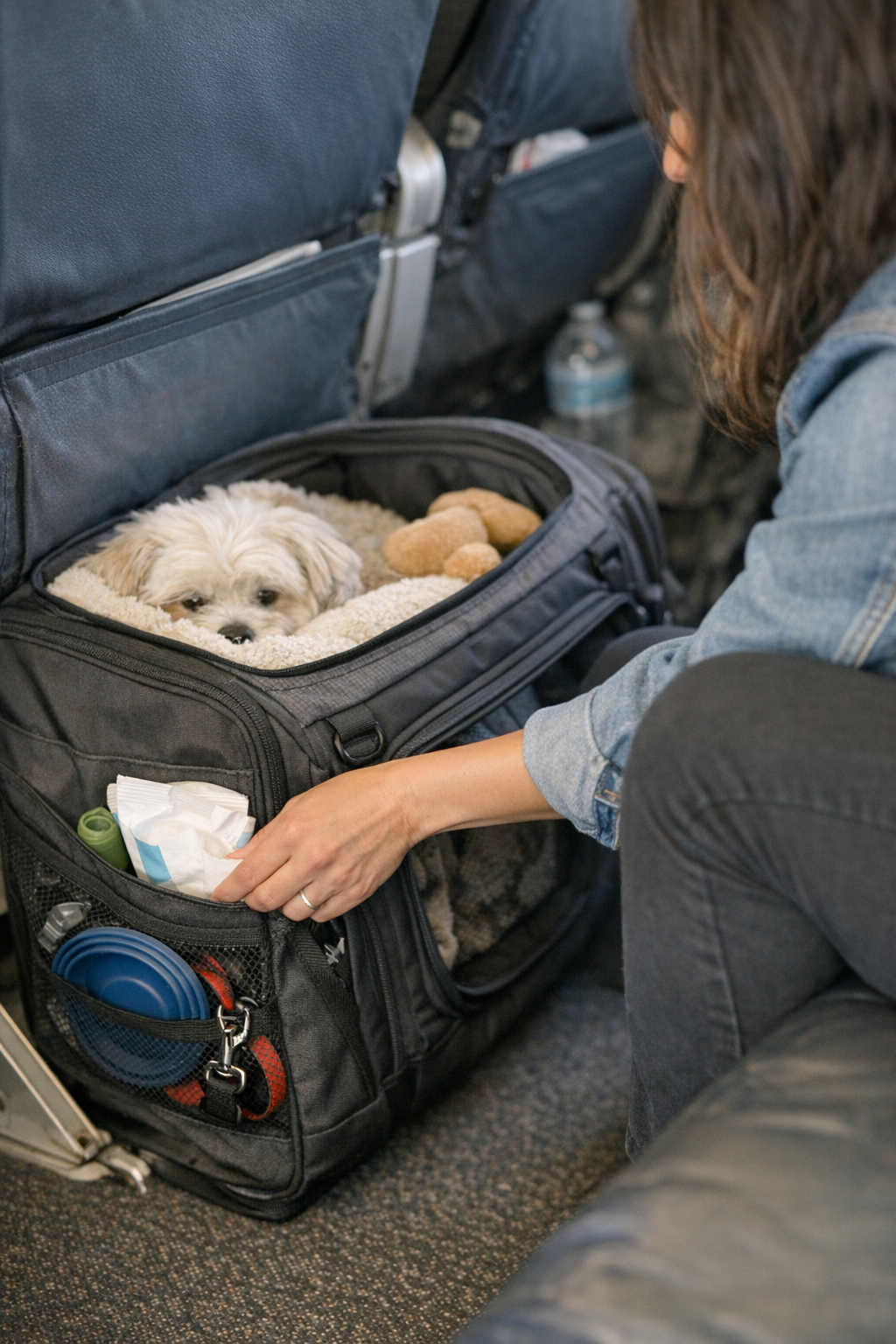
The pet travel bag that looks streamlined in your living room often buckles under real movement: try reaching for wipes at a crowded rest stop, or grabbing a water bowl one-handed while your dog shifts on the car seat. The first drive may feel smooth, but each pause, climb-back, and in-seat stretch shows where your “organized” under-seat setup slows you down—especially when comfort, cleanup, and your own essentials start scrambling for space. What looks prepared rarely survives a normal day on the road without friction reappearing: blocked access, gear slipping out of zones, and everything taking extra seconds just when you want to move quickly.
The Orderly Bag That Doesn’t Stay Orderly
No packing plan survives real travel. At home, your pet bag might look perfect—wipes on top, leash looped, bowls nested with all the right items in their place. But by the third stretch at a highway turnout, your “ready-to-go” setup unravels. A blanket meant for comfort ends up wedged over the bag’s front opening, blocking access. That bowl you filled? It disappears behind snacks jostled loose, while the wipes you thought were easy to grab require digging past toys and tangled leashes. The effect isn’t just a visual mess—even when nothing’s missing, you’re left negotiating with your own gear every time you reach in. Each stop means extra shifting, restacking, or simply wishing you hadn’t buried what you need under layers that slid out of order the last time you braked.
Repeated Use Exposes Hidden Weaknesses
Nearly every bag works the first stop. It’s at the fourth or fifth break that real travel habits collide with the bag’s structure. You reach for a quick wipe after water dribbles, but can’t get to it without first untangling the comfort blanket jammed at the opening. Cleanups and calm items mingle in ways you didn’t plan: what’s meant to soothe your pet now barricades the essentials you need fastest. And while the outside might look kept up, your inner routine starts to unravel with juggling, shuffling, and half-reaches that never quite land on what you want first.
That Familiar Scene: Too Many Pauses, Not Enough Access
Late-day travel, a restless pet in the back, your own patience running thinner—this is where you feel setup failure most: one hand calming your pet, the other buried elbow-deep trying to dig out a wipe yet again. This time, the compartment that should have held quick-clean items only yields a crusted chew toy and a folded mat. The next grab finds a water bowl upside-down under the treat pouch. Quick access turns sluggish, and you start dreading the pattern: each pause grows heavier, each movement slowed by a bag that looks organized but hides what you need behind something else. The organized look isn’t matching the lived reality.
Where Overlap and Overpacking Steal Time
Packing for neatness is the default: tight stacks, zipped pockets, everything nested. But in real use, more stacked means more buried. The more items packed in shared spaces—cleanups tossed with treats, bowls wedged under blankets—the more you repeat the same slow-motion search. Keys and phones wind up mixed with travel wipes. The clean divide between “pet” and “owner” blurs so that every stop becomes a multi-minute hunt, not just a quick reach. This overlap turns what should be a quick fix into a drawn-out shuffle that repeats with each new leg of the trip.
Repeated Restarts: The Real Drain
Every time you restart—seatbelt off, door open, pet checked—something has drifted, blocked, or buried itself. Maybe the wipes slipped under a toy, maybe a travel bowl is now stuck behind a rolled towel. Each five-second delay doesn’t seem much in isolation, but repeat it at every gas stop, snack break, and comfort pause and it becomes the background drag of travel. The subtle effect is a setup that feels heavier, not because of weight, but because of friction that resets every time you have to repack, reorganize, or hunt for the essentials all over again.
What Actually Improves the Routine: Separation and Access Zones
There’s a clear turning point in bag setup: function-first separation. Instead of a single cavern of mixed gear, create real access zones—side pockets for wipes and bags, a dedicated bowl slot, a top pouch for comfort items that never gets in your way. Assign a non-negotiable front or rear space for things you need instantly at stops. This adjustment isn’t about appearances; it’s entirely about easy reach in real time. The test is simple: can you grab what you need while your pet tugs or squirms, without having to move three unrelated things first?
A divided, zoned bag does more than look neater. It works lighter, resets faster, and holds up through repeated, unpredictable movement—making each routine feel less like a battle and more like a quick, controllable stop.
Small Gains, Big Impact
It may feel minor—saving a few seconds at each stop by having wipes or bowls reachable without shifting a stuffed blanket. But these slices of relief add up quickly: less interruption, smoother handoffs, attention back on your pet instead of the inside of your bag. Each smartly separated pocket reduces the low-level stress that grows when your gear keeps crossing paths every twenty minutes. Multiply that over a travel day, and you feel the difference in energy and focus, not just tidiness.
Owner Items vs Pet Essentials: Keep Them Apart
The overlap of pet and owner essentials is a classic source of micro-frustration. Your phone, keys, or wallet wind up tucked with wipes or treats—for the sake of quick stowing, but at the cost of guaranteed confusion later. Keeping your stuff in dedicated, external-access pockets separates the flow: pet needs stay on one rhythm, owner grabs on another. Every stop feels more intentional, with no double-sorting just to fish out your wallet while your pet waits and wiggles. One task at a time, less backtracking, fewer accidental crossovers—that’s functional separation in actual travel, not just organization by label.
Repeated Use, Once-Exposed Weak Points
After multiple routines—not just one trip—the weak points aren’t theoretical. The main pouch where cleanup gear gets lost, the “quick-grab” pocket buried by a comfort blanket, or the side section that always collects the wrong category: these patterns reveal themselves fast. They’re not accidents—they signal what needs reshaping. If you catch yourself fixing the same slow access, it means your setup is still tuned for how things look at home, not how they work under actual travel pressure. Spotting and fixing the consistent failure points is the only way to win back effortless movement and real confidence on repeat stops.
How Reset Friction Builds
At first, slow handling is just a minor inconvenience. But as the hours and stops build, each re-shuffle or blocked pocket eats into your patience—and your pet’s, too. Bags that divide comfort from quick-access essentials allow you to move on instinct, not by memory. The more you separate “needed now” from “nice later,” the less you struggle each restart. That difference is the real upgrade: less friction, more momentum, and a routine that gets easier with use, not harder.
If It Looks Ready, but Feels Slow, Rework Your Access Zones
The real test isn’t whether your bag looks sorted at the start—it’s whether stop-and-go motions stay smooth. Pausing to fuss, re-opening the same pocket, and sorting wipes from toys each time means you’re carrying a flawed setup. A pouch set aside for cleanups—never blocked, always on the outside—removes nearly all of the usual trip friction. Travel stops feel lighter, movements reset quickly, and organization starts to match actual use, not just visual neatness.
The true win is a travel setup that feels easier every time you move, not one that just looks tidy for a photo.
Find practical pet-travel setups that work for your real travel, repeated stops, and lived-in routines at PawGoTravel.