
Here’s the honest pattern of every small yard: You empty bins, stack gear, claim victory on a Saturday, and the place looks like it might finally stay organized. But by Wednesday, reality returns—there’s a line of boots in the walk path, seat cushions teetering on the wrong bin, and you’re weaving around a tangle of tools near the side gate. The frustration isn’t from laziness or too much stuff. It’s from a storage setup designed for looks, not for the fast, unpredictable rhythm of real outdoor use.
When “Organized” Is Only Temporary
The first hour after a cleanup feels like promise. Bins line the fence, a deck box hides under the eaves, and you finally rescued ground space from sprawl. But usable order doesn’t last. It takes two rushed mornings, and suddenly the hose nozzle goes missing, garden gloves land wherever there’s a gap, and by the weekend, the supposedly organized system is crowded with overflow. The weak link? Storage that leaves every return up to guesswork—a glove here, a boot there, whatever fits wherever it’s open.
The bottleneck is always the same: Open bins and plain shelves may look sorted, but without roles or boundaries, every item has to negotiate for a spot. Put away the trimmer and it ends up blocking the folding chairs. Someone else piles sports gear on top because it was handy. Now, a simple reset turns into shuffling bins, dodging stray shovels, and stepping over yet another “for now” heap taking over a corner.
The Subtle Ways Storage Designs Fail
Yard setups that just line up boxes along a fence are neutral at best, but neutrality doesn’t survive family use. As soon as there’s more than one person, systems built on “put it wherever” unravel fast. A rainy afternoon, a skip to dodge puddles, or a last-minute cleanup before guests—and things now have new, random homes. Before long, the main route clogs: first with a trimmer left across the path, then boots detoured by a stray bin, then an entire corner filling with overflow that nobody wants to touch.
Everyday Movement Breaks the Illusion
Think about the pinch points—side yards barely wider than a wheelbarrow; the patch next to the fence where everyone dumps shoes, balls, or gloves without thinking. Most setups don’t fail with a bang. They slip, quietly, as putting away something “just for now” becomes the new standard. One misplaced shovel blocks the whole return route for everything else. And that pile that was supposed to be temporary? It’s still there next month, blending into the landscape.
The best signal something’s wrong: If it takes moving three things to access a fourth, the setup is failing your routine. Rearranging bins just to reach the hose, or constantly pawing through another family’s toys to put your own away, means the system doesn’t match the way anyone actually uses the space—and every reset feels slower than the last.
Why Floor Storage Turns Into Obstacle Courses
Floor bins and deck boxes seem like a solution—stackable, labeled, squared up—until real life returns. As soon as kids cut through for their soccer ball while you’re watering plants, every system built on neat horizontal brawn collapses. Gear lands wherever there’s an empty inch. Leftover dinner outside? By morning, gloves are jammed under the table, watering cans block the footpath, and the “overflow” bin is the only one anyone uses—because it’s already half open and closest to the door.
Wall Storage: Looks Clean, Quickly Clutters
Hooks and racks on the wall have the same fate: perfect after a reset, but by midweek, hooks fill up with whatever’s longest or lightest, and the floor below—supposedly rescued space—collects everything heavy or awkward. By Thursday, even the wall becomes a guessing game. “Which hook does the trimmer go on?” “Why are there four pairs of boots wedged behind the ladder?” The system’s inflexibility sets the stage for chaos, not order.
Snags in Daily Yard Use—Where Setups Crack
Returning one, blocking another: Grab the rake, drop it near the storage bin—and now the way is blocked for putting away chairs. The “temporary” fix? Stack the chairs on the nearest flat bit, where they’ll stay until someone needs them—and then get dragged along to a different spot.
Overflow magnets: No matter how much you spread bins out, one will always become the dumping ground. Boots, then balls, then garden scraps until it’s jammed with a medley nobody wants to sort out. The rest of the system looks untouched, falling out of use.
Shuffle fatigue: If simple returns turn into a game of musical bins, with pots nudged, hoses shifted, and chairs restacked just to clear a landing area, you end up spending more time fixing the setup than using the yard. If ten minutes vanishes just putting away three things, the routine is broken by bad design, not busyness or clutter.
What Actually Survives Daily Use: Vertical, Modular Zones
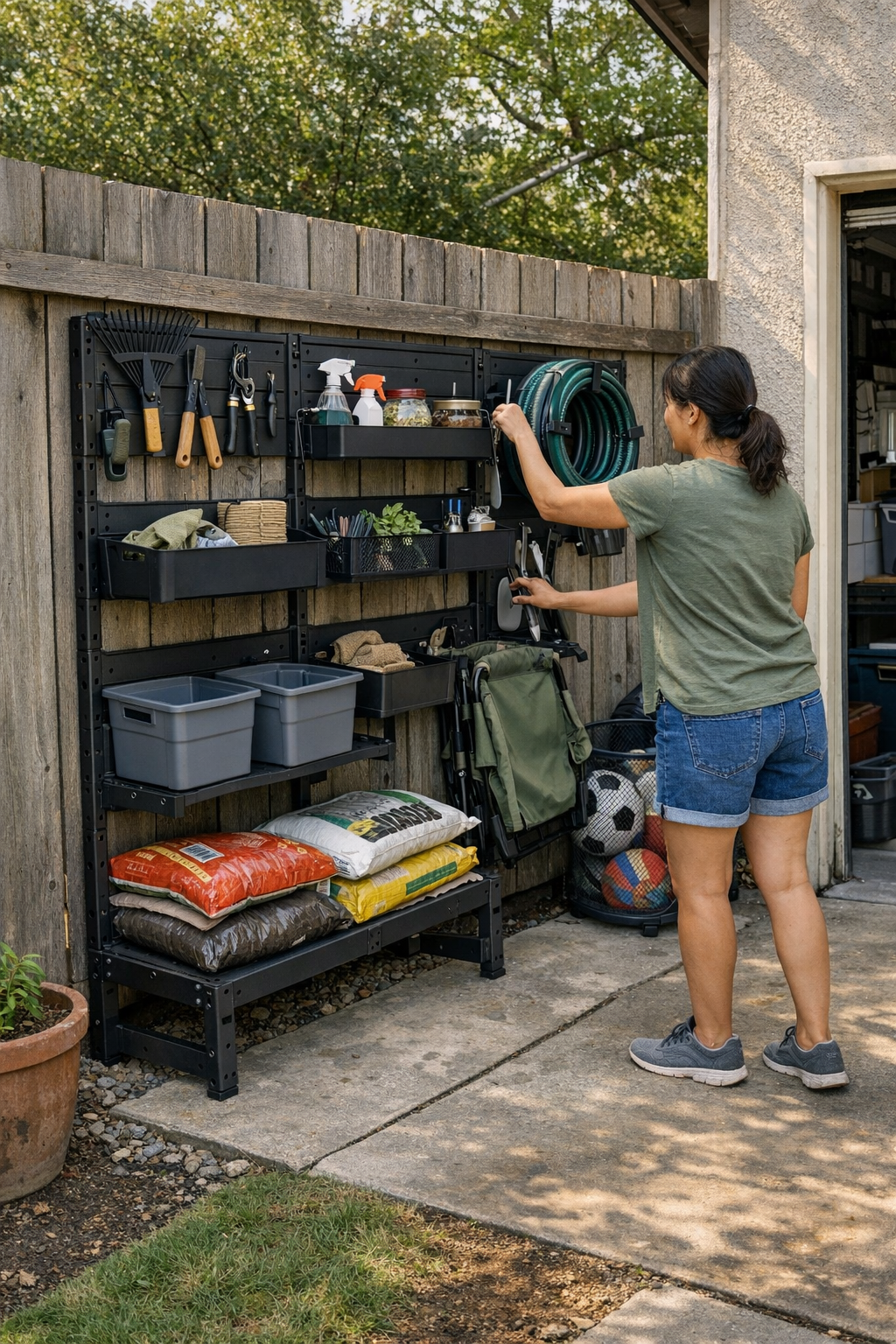
Eventually, the frustration hits a tipping point. What stands up to repeated use isn’t more containers on the ground, but fewer, tighter zones off the floor—visually divided, close at hand, and arranged for movement, not just for looks. Picture a four-foot wall rack split into three zones: balls, tools, fold-ups. If yard tools overflow or sports gear starts spreading, it immediately shows—the wall can’t hide pile-ups, and ground space stays clear. The next person instantly knows what needs fixing, not shuffling.
Suddenly, paths aren’t blocked, and routines are easier to stick to—even after a weekend of guests or a week of rain that threw everyone’s habits off. The main run to the gate is open; the dead corner where overflow used to collect is visible again. Resets stop being full rescues—they’re five-minute checks, not an hour of moving everything just to find one missing glove.
Everyday Adjustments That Stick
Keep it at eye level. Wall zones that are easy to see and reach—rather than tucked by your ankles or above head height—speed up returns and cut down on lost items. Lean into vertical stacking whenever possible, and don’t let storage sprawl sideways to choke your walking space. Mark sections with color, tape, or a label—small signals help everyone remember what goes where, and confusion drops fast as a result.
The True Test: The Five-Day Reset
The best yard storage isn’t measured after a spring weekend’s overhaul. The real test comes after five days of mixed, messy, real life—gardening, soccer, quick dinners, two or three people in and out at random times. If you can still walk through, spot which zones belong to which items, and put things away without negotiating with bins or cutting a new path through chaos, the setup is working. If not, the problem isn’t your effort—it’s the structure itself.
The setups that last are those that match actual movement and repeated use. Floor storage and wall hooks that aren’t truly zoned will always get overtaken by real routines. But modular, vertical storage—anchored in how your yard really works—protects footpaths, makes mistakes visible, and removes the friction that quietly rebuilds the mess week after week. It’s not about the prettiest box. It’s about boundaries built for lived-in, day-to-day outdoor life.
For outdoor storage systems that hold up to real use in busy, compact spaces, explore TidyYard.