
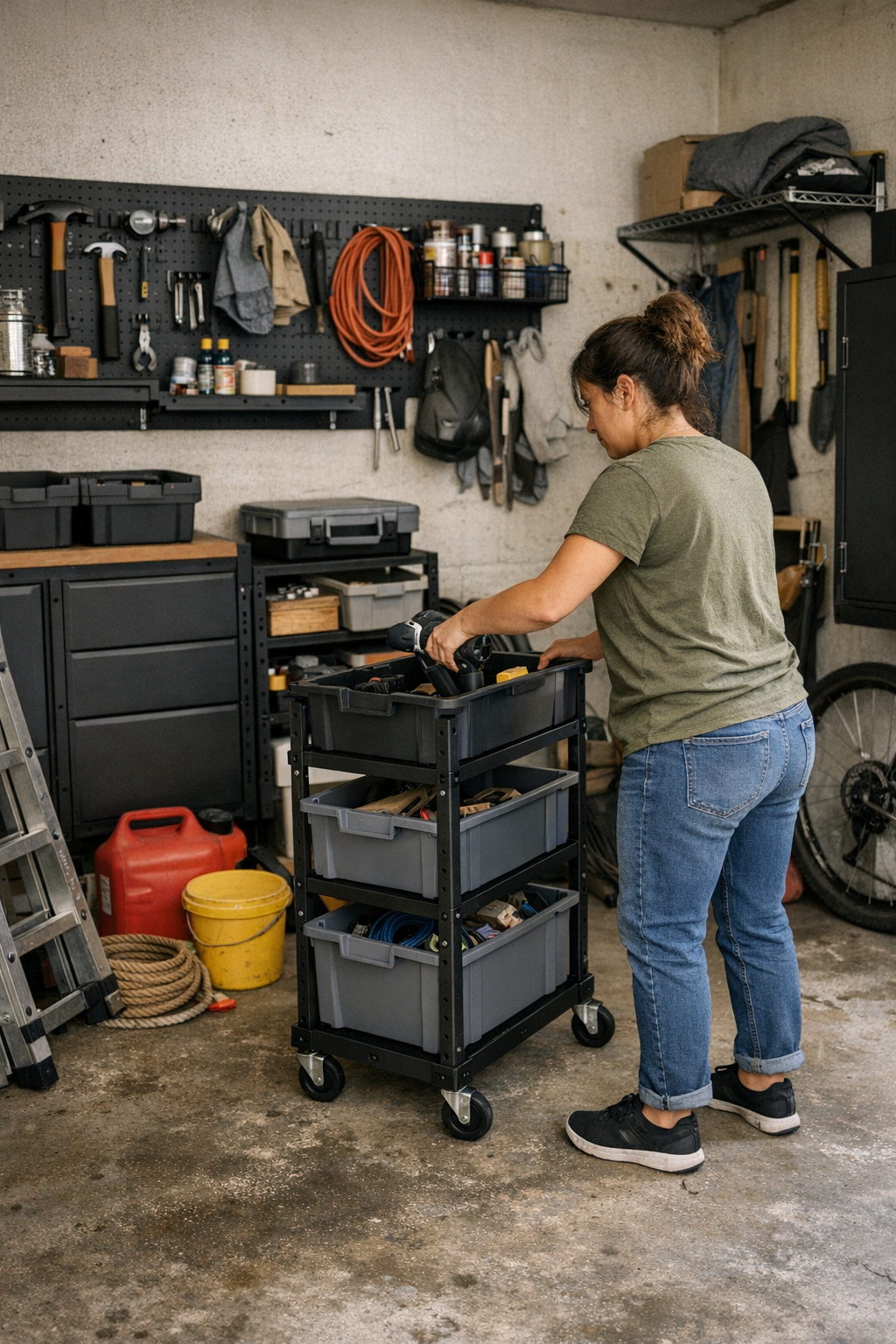
Tidy at a glance tells you nothing about performance in real life. Garages and workshops fill up with wall-mounted kits, rolling carts, and shelf grids that look sharp after setup. Everything appears under control: hooks aligned, bins stacked, paths clear. But walk in after an actual project, when tools have been dumped in a hurry, bins are halfway out, and you’re jogging between tasks—and that sleek first impression shatters. Order that works in theory can dissolve the moment you’re working against the clock. Does your setup help you bounce back to ready, or does getting organized become another mini-job every time you finish?
Where Neatness Fails: The Repeated-Use Backslide
The early satisfaction—rows lined up and tools “put away”—lasts only until you go through a few tough days of real use. Suddenly, you’re moving a bucket just to wedge the drill back where it “belongs.” Each handled tool seems to require a two-step process: one back, another jostled, a third about to topple. What looks like overflow is really evidence of broken flow. That bin left in the walkway? It started as a quick fix when you couldn’t find space mid-task and now lingers, an obstacle for every return trip.
Overflow happens in predictable hot spots. Park a ladder a few inches too close to a wall rack, and suddenly your sports gear zone is inaccessible. A bike temporarily leaning by the tool shelf morphs into a permanent barrier. The aisle you swore would stay open slowly narrows as “just for now” items migrate. Every tiny compromise—an extension cord dropped, a tote slid halfway, a toolbox at the edge—builds up to real blockages. The zones you planned lose their edges, and you find yourself constantly sidestepping, reaching awkwardly, or just leaving things out.
Everyday Friction: How Good Layouts Slip
Blocked In—When Footpaths Become Storage
Picture coming in with arms full: you want to slide the rolling cart back to its spot or stash a bag by the workbench. But the shelf zone is flush to the wall and just snug enough that any extra item forces you to shimmy things around. You nudge the cart, but it brushes a ladder, which bumps a bin—movement becomes a chain reaction. After a few return trips, the cart ends up abandoned wherever the path is clearest, never quite making it “home.” Freestanding chests and bins become semi-permanent headaches, nagging you every time you try to clear even simple access.
Serial Shuffle—Losing Minutes on Every Reset
After a long session, you’re ready to reclaim space and shut the garage. But the wall zone needs to be rearranged before handled tools will fit, and the bucket that holds rags must move just to put the drill away. Repetition sets in: shift, return, reshuffle, then repeat. Reset time balloons from “two minutes” to five, ten, sometimes longer if you’re tired or racing daylight. Soon enough, the temptation is strong to just pile things up somewhere and promise yourself you’ll fix it next time.
Blurring the Lines—Zones Lose Their Meaning
The lines you drew—garden on the left, project tools up front, sporting gear down back—fade each week. Repeated use pushes overflow into the nearest empty zone. What began as “organized” soon lets handled tools pile in the paint bucket, cords drape from hooks meant for rakes, and heavy hedge trimmers jut into the walking route. The original organization is still there, technically, but the space no longer works smoothly—everything’s present, nothing’s easy.
Reset by Design: Small Tweaks, Noticeable Results
Return flow beats shelf count every time. Improvement rarely boils down to just adding hooks or shoving in a bigger rack. Real change begins with making it easier to put things back—especially when you’re tired, distracted, or in a hurry. For most, that means lowering your most-used options to within arm’s reach (no need to tiptoe or crouch), and ensuring your clean-up path isn’t a tight squeeze between obstacles. If the tools you grab daily are positioned for a quick drop-off on the way out, friction fades; if not, small annoyances pile up fast.
Treat rarely-used gear like seasonal storage and get it up and out of your main workflow. Meanwhile, claim “prime” space near entry points and major work zones for handled items and daily-use gear. One of the simplest, most underrated fixes: keep a mobile cart or bin as a reset staging zone. During a project, it collects everything in motion—wrenches, cords, clamps—without forcing you to stop and return each piece as you work. At the end, a single trip with everything in hand keeps you from scattershot clutter and blocked footpaths. Less reshuffling. Fewer missed returns. More predictably clear zones.
Signal Flares: Know When Your System’s Giving Way
Watch for slow-creep mess. Do half a dozen handled tools gather in corners or on shelves “for now”? Do path edges fill with toted-in gear by the end of every busy week? These are not random accidents—they’re signs that your layout isn’t matching how you move and work. Pay close attention to spots that collect the most overflow or spark the most annoyance. The “just slide it over” problem reveals exactly where a shelf height, wall hook, or reset path needs an upgrade—or where a mobile staging solution could save daily steps.
More shelves don’t help if resets keep getting slower. Whenever added storage doesn’t ease the return flow—especially for fast-access items—clutter just redistributes itself. The mark of a better system is not a higher storage count, but fewer pauses, less backtracking, and open movement even when the space feels crowded. The faster you reset without shuffling, the longer your setup holds out against daily chaos.
Real Payoff: Resets That Don’t Wear You Down
When routines get busy, a well-designed setup makes itself invisible: no blocked wall access, no squeezed-in carts, no hesitation about where things go. Handled tools land in their spots almost by habit—no extra thought, no urge to pile them “out of the way.” When you rarely have to reshuffle, reach around a cabinet edge, or drag bins just to clear a path, you know the layout is pulling its weight. Ignore looks; the real measure is smooth, repeatable motion, and fast, low-effort resets every time.
Design around your real routine, not just storage targets. When your system flows with your habits—easy returns, open paths, visible zones—it survives seasons and stress. When it doesn’t, no amount of clean lines or matching bins can save you from blocked movement, pileups, and lost time. Build for use, not just for display, and your space will stay useful—and ready—week after week.
Find more practical storage ideas and tools for better resets at StackNest.