
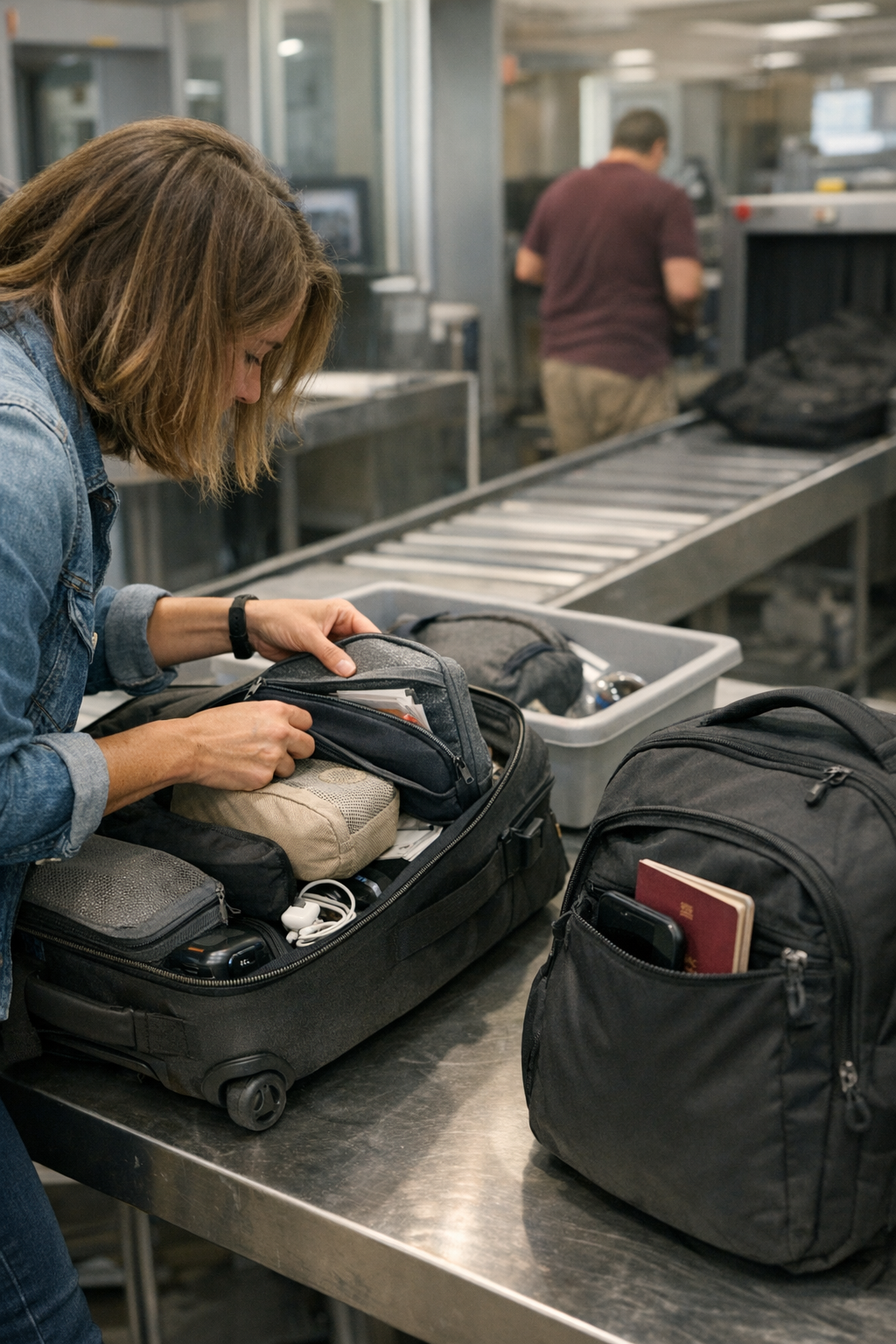
No matter how perfectly organized your carry-on looks at home, real airport movement exposes its weak points fast. The difference shows up immediately: you hit security, and that easy-access pouch now means contorted reach with someone waiting behind you. Boarding, your boarding pass hides an extra layer deep. Jostling through the gate, your “sorted” organizers stall you by a few seconds at every check. The frustration isn’t theoretical—it’s the drag you feel when a bag designed for order quietly blocks you in motion, forcing slow retrieval, awkward reach, and stop-and-start repacking at exactly the wrong moments. The picture-perfect setup suddenly becomes a series of micro-interruptions that only get louder as airport pressure builds. This is where so many carry-on routines break under repeat friction—just when you need the smooth flow you thought you’d packed for.
Why Order Breaks Down in Repeated Travel Routines
Pouches and slots give a sense of control in the calm of a bedroom or hotel, but the airport turns that order inside out. First pass: your passport is easy enough to extract. But after a flight or two, with the rhythm of unzipping, quick-stowing, and stacking organizers, you notice it slipping—literally—deeper into the pouch, or winding up behind something you just repacked. Grab the wrong slot, and you’re suddenly fumbling in line, one hand on the bag, the other searching for a document while agents nudge you forward.
This isn’t an isolated hassle. With each leg, friction builds: zippers catch at the wrong angle, pouches slide so neatly past each other you pull out two by mistake, a boarding pass is one layer down from where it should be. The inner order survives in appearance only. Your setup—which made sense in stillness—now undermines you in speed, each access step requiring just enough extra motion or thought to break your flow when you should be moving forward.
Static Structure vs. Moving Access
Most packing advice obsesses over keeping every item slotted and lined up for visual peace. But transit isn’t calm or controlled. Nested pouches, aggressively sorted compartments, or double-zipped organizers look sharp until you’re balancing in a queue, one arm on a tray, eyes tracking the next checkpoint. Suddenly each choice—Which pouch? Which zipper?—becomes costly: more seconds lost, more chance of dropping something, more internal voice saying, “this should be faster.” The static idea of order clashes with the real movement pattern of airport life, where a setup that’s tidy at rest creates friction in use.
The Hidden Cost of “Perfect” Organization
A carry-on bag that appears organized tricks you into thinking the problem is solved—until actual pressure moments reveal the cost:
- Security trays: You need your laptop, but a trio of tech pouches require a mini unpack, increasing your odds of missing a cable or rushing the repack with items out of sequence.
- Boarding lines: The “sorted” document pouch lives deep in the main compartment, so getting at your passport means a slow zip, dig, and reshuffle as the line inches. After the third check-in, this small lag begins to wear.
- Overhead bins and aisle entry: Anything marked “quick-grab” but living under more layers turns every retrieval into a multi-step pause—either you hold up the aisle or you’ll need to reopen the bin mid-flight.
- Repeated access mid-trip: Each time you return headphones or documents to “their place” under movement, the odds of a misplaced item grow. That order you rely on now creates confusion the next time you need something in a hurry.
Pressure escalates: what looked like a well-designed system in a quiet room turns into a series of tiny, repeated hurdles every time travel gets less predictable and hands get busier.
Real Moments Where Friction Shows Up
Airport conditions punish tidy but impractical layouts:
- Standing in security, you reach for your passport only to find the outer compartment stuffed with too many “quick access” pouches. Main compartment unzip: wrists collide, delays begin, and the line behind you grows.
- Post-security, gate info changes—your phone is buried under a toiletry kit, thanks to nesting everything to stay “organized.” What felt clever now feels like unpacking on the floor to answer a simple text.
- At boarding, your ticket takes longer to extract because it drifted under a loose pouch during the last hurried repack. Instead of a swift reveal, it’s a fumble at the plane door.
No one of these moments feels disastrous, but together they erode your confidence in your setup—especially as crowds increase the cost of every hesitation. The minutes add up, along with the tension of knowing your layout keeps slowing you down instead of smoothing things over.
The Difference Between Looking Packed and Moving Smoothly
There’s a gap between a bag that passes the “photo test” at home and one that handles actual airport chaos. You almost never have a clean surface, both hands available, and zero distractions in transit. Instead, the real world is trays in one arm, an impatient line, a narrow aisle, or a carry-on pressed between your hip and a trolley. “A place for everything” isn’t enough if every retrieval becomes a drawn-out motion, or if putting something back means disrupting two other compartments. What works for stillness fails in motion—real usefulness depends on setups that survive actual use, not ideal rest.
How Small Tweaks Shift the Entire Carry-On Experience
After too many cramped pouch dig-outs, I stopped sorting for neatness and started packing for speed. One trip in, I stripped it back: primary documents and phone in a single, uncluttered outer zip. No stacking, no sub-pouches, just what I touch at every checkpoint. Every time I needed to show ID at security or hand over a ticket, there was no second-guessing or layered retrieval—the motion was straight, quick, and uninterrupted.
The less space I gave to less-used items in that zone, the fewer interruptions at each access point: no more passport behind a power bank by accident, no scrambled zipper pulls, no repacking confusion. The seconds I saved returned as less stress, especially mid-transfer or when fighting for overhead space. The difference is visible not in how the bag looks, but in how little thought or repositioning it demands every time a gate agent checks my documents or I need to plug in headphones before takeoff.
Observation: Not All “Quick Access” Zones Are Equal
Packing guides talk up “outer pockets,” but it’s what lives there that counts. If you let that zip fill with chargers, receipts, sanitizer, and old mask wrappers, you’re back to multi-stage retrieval in disguise. The trick: protect your outer zip for the passport, boarding pass, and one or two other highest-frequency items—nothing else. Every extra object reintroduces friction. Fewer mixed uses mean smoother movement, and far less fumble to fix after every access.
Balancing Visual Order With True Movement Ease
It’s almost automatic to respond to travel friction with more organizers, more slots, or the promise of “perfect” order. But that logic breaks in motion: every extra segment adds a moment of retrieval drag, a small repacking stumble, or another pause at the wrong time. Instead, chase setups that sometimes look less composed but move with you—ones that trade a bit of visual neatness for true in-transit freedom. Travel exposes structure; only the setups that work while moving are worth copying, especially when seconds and hands are at a premium.
Find practical carry-on tools designed for real access at CarryOnSupply.